
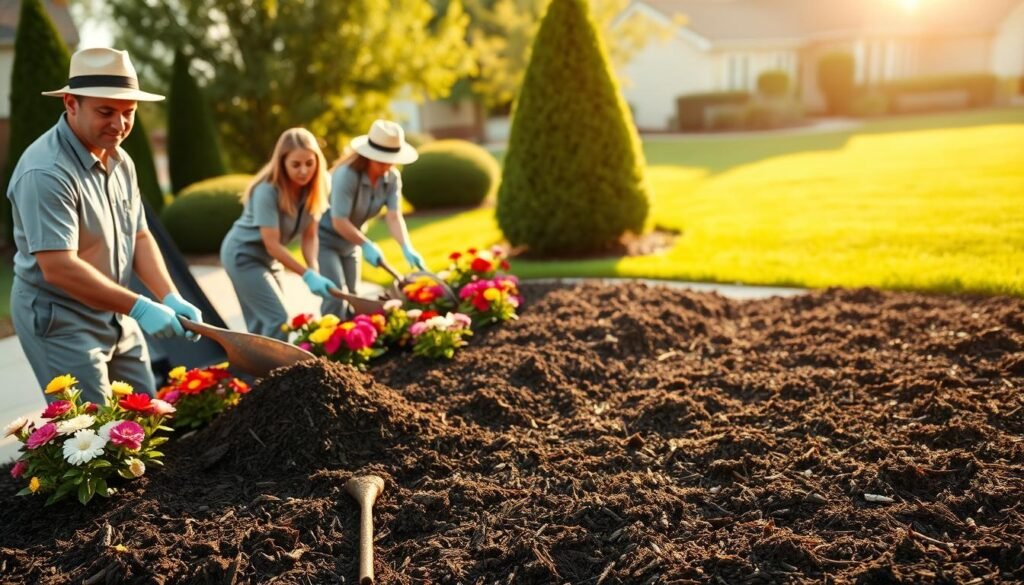
Your landscape is a big part of your property’s look. If you live in the 77058 area of Houston, TX, or manage a commercial space, picking the right ground cover matters. It affects how your property looks and how much you’ll spend on upkeep in the long run. We know you want to make smart choices about landscape services.
Getting professionals to install mulch can cost between $77 to $94 per cubic yard. This includes delivery and the work itself. The price of the mulch itself can vary a lot, from $20 to $400 per cubic yard. Knowing about mulch installation cost helps you plan your budget better and get more value for your money.
At Heaven On Earth Landscaping Inc., we’ve guided many in Houston on these choices. The mulch benefits go beyond just making your place look good. They help keep the soil moist, fight weeds, and control soil temperature. This guide will look at different mulch types, whether to do it yourself or hire a pro, and upkeep tips. We aim to help you choose the best option for your landscaping needs.
Understanding Mulch Installation
Before you get a mulching service, it’s key to know how mulch works. It’s a powerful way to improve your yard. Knowing about mulch materials and how to install them is important. This helps you pick the right service and get the most from your investment.
At Heaven On Earth Landscaping Inc., we think knowing is power. The right mulch can make a big difference in your yard. It’s about understanding what mulch does and how to use it right.
The Protective Layer That Transforms Landscapes
Mulch is a layer that protects your soil. It keeps your plants healthy and helps them grow. It’s more than just a pretty ground cover.
Mulch keeps soil temperature stable. It keeps roots cool in summer and warm in winter. This helps plants grow better all year.
Mulch also helps keep soil moist. It can save you money on water and keep plants hydrated. It stops soil from washing away during heavy rain.
Mulch stops weeds by blocking sunlight. It saves you time and effort. As it breaks down, it adds nutrients to your soil.
Comparing Materials for Your Landscape Needs
We offer many mulch types to fit your yard and style. The right choice depends on what you want, how much you can spend, and how much work you want to do. Knowing your options helps you make a smart choice.
Organic mulch like shredded bark is popular. It costs $20-$40 per cubic yard. It looks natural and helps keep soil moist.
Wood chips are another good choice. They cost the same as shredded bark but last longer. Compost mulch is great for gardens and costs $10-$30 per cubic yard.
Premium options like cedar and cypress cost more but last longer. Cedar repels pests and lasts a long time. Cypress is durable and looks good for a long time.
Inorganic mulch like rubber is durable. It lasts a long time and is good for busy areas. It costs $50-$80 per cubic yard.
Stone and gravel are permanent and low maintenance. They cost $50-$100 per cubic yard. But, they don’t add nutrients to the soil.
Choosing mulch is more than just looking at price. We consider how long it lasts, how it looks, and how easy it is to maintain. We also think about what your plants need.
Installation Techniques That Ensure Success
Getting mulch installed right is key to success. Even the best materials won’t work if they’re not applied correctly. We’ve seen many problems caused by bad installation.
The right amount of mulch is important. Most need 2-3 inches, but trees might need up to 4. Too little doesn’t work, and too much can harm plants.
Don’t make “mulch volcanoes” around plants. They trap moisture and attract pests. A good service knows how to avoid this.
Preparation is key before mulching. This includes removing weeds, amending soil, and defining edges. A professional does this right, making mulch work better.
How you spread mulch matters. We make sure it’s even and not compacted. This keeps air moving and looks good.
Our team’s experience is valuable. We make sure your mulch is installed right, giving you all its benefits.
Landscape Services Overview
Landscape services are more than just yard work. They are a complete way to improve your property. We know that great outdoor spaces need careful planning, expert work, and ongoing care. Professional landscaping ties together all parts of property care into one plan. This plan protects your investment and makes your surroundings beautiful.
Comprehensive landscape services cover many tasks all year round. These tasks include soil health, plant care, hardscape upkeep, and looks. Working with experts means you get better results than doing things yourself.
Professional Services and Installation Expertise
Professional landscape services add a lot of value to mulch projects. We look at each property’s unique needs before we start. We check the soil, drainage, plant health, and sun to decide the best mulching plan.
Getting ready for mulch installation is key. We remove old plants, level the ground for drainage, and put in edging. This makes sure the mulch stays in place and looks good.
Choosing the right mulch is important. We help you pick between organic and inorganic mulch based on your goals and budget. The right mulch makes your landscape look and work better.
Our installation methods are advanced and efficient. Mulch blowing costs $100 to $155 per cubic yard based on the site. Manual installation costs $50 to $100 per cubic yard in labor. Mechanical methods are more expensive but cover large areas fast.
We plan mulch installation with other landscape tasks. We do this to make sure everything works together. This creates the best growing conditions and looks all year.
Selecting Your Service Partner
Finding the right landscape contractor is important. Spending time to choose well means better results and avoids problems. Look for signs of professionalism, reliability, and quality.
Licensing and insurance verification are essential. Licensed contractors follow industry rules. They also have insurance to protect you if there’s an accident. Always check their insurance and coverage before you sign anything.
Knowing the local area is key in Houston 77058. We know the soil, humidity, and heat here. This helps us choose the best mulch and how to install it.
Clear pricing shows a contractor’s honesty. Get a detailed estimate that shows all costs. Avoid low bids that might mean poor quality or hidden fees.
Looking at references and portfolios helps you understand a contractor’s skills. Ask for recent clients with similar projects. Look at photos to see their attention to detail. At Heaven On Earth Landscaping Inc., we have many examples of our work in 77058.
Consider if the contractor offers maintenance contracts. These can save money and keep your property in good shape. We create plans that fit your needs and budget.
Commitment to sustainable practices shows a contractor’s forward thinking. Ask about their materials, waste disposal, and environmental efforts. We choose eco-friendly mulch and use methods that protect the environment.
Good communication is key to happiness with your project. Choose contractors who listen, answer questions, and keep you updated. We believe in clear talk to avoid mistakes and meet your expectations. Our team is always there to help and answer your questions.
Choosing unlicensed or uninsured contractors is risky. You could face legal problems, poor work, and disputes. Trusting a professional company means better results and peace of mind.
Benefits of Mulch Installation
Professional mulch installation turns ordinary landscapes into beautiful, easy-to-care-for outdoor spaces. Mulch does more than look good; it makes plants healthier and saves money on upkeep. When Heaven On Earth Landscaping Inc. does your mulching, we use the best methods and materials.
Knowing how mulch works shows its real value. It protects roots and cuts down on water bills, saving money for months.
Protecting Plants Through Moisture Retention
Mulch is great at saving water. It acts like a blanket, keeping moisture in the soil. This can cut down on watering by 25-50% in most gardens.
This means lower water bills all season. In hot weather, mulched areas stay moist, keeping plants healthy. We suggest 2-3 inches for the best water saving.
As mulch breaks down, it makes the soil better. It adds nutrients like nitrogen and potassium to the soil. This improves soil health and helps plants grow.
Mulch also keeps soil temperature stable. It keeps it cool in summer and warm in winter. This protects roots from extreme temperatures.
This creates perfect growing conditions. Healthy soil means stronger plants, starting a cycle of growth with each mulch layer.
Controlling Weeds Naturally
Weed control is a big reason for mulching. Mulch blocks sunlight, stopping weeds from growing. This keeps your garden weed-free.
Two inches of mulch controls weeds, but three inches does even better. For tough weeds, we use mulch and landscape fabric together.
This saves time and money on weed control. It’s also better for the environment and safer for families and pets.
Enhancing Visual Appeal and Property Worth
New mulch makes your garden look great. It adds color and texture, making your garden look professional. This boosts your property’s appeal.
We have many colors to match your garden and home:
- Natural mulch: Goes well with woodland and native plants
- Brown tones: Provides a classic look for colorful flowers
- Red shades: Adds bold contrast with green plants and modern homes
- Black mulch: Adds a sleek look for upscale homes
Mulch does more than look good. It can increase your property value by 5-10%. It’s a smart investment, not just upkeep.
Real estate experts say homes with nice mulched gardens sell faster and for more. Mulching is a small cost for big returns in property value. It shows buyers your home is well cared for.
At Heaven On Earth Landscaping Inc., we know how to get the most from mulch. Our experts ensure it’s applied right for the best results.
Cost Factors for Mulch Installation
Understanding the cost of mulch starts with knowing about material, labor, and project size. We think homeowners in the 77058 Houston area should know about mulch cost before starting any landscaping work. Breaking down costs helps you make choices that fit your budget and style.
Many things affect the final cost of mulch installation. The type of material is the biggest cost, but labor and project size also play a big role. We make sure you know all the costs upfront to avoid surprises.
Breaking Down Material Expenses
The cost of mulch starts with the material you choose. Organic mulches like pine straw are the cheapest, starting at $20-$55 per cubic yard. They’re great for big areas and small budgets.
Wood chips are a bit pricier, costing between $30-$110 per cubic yard. The price depends on how it’s made and the type of wood.
Bark mulch is a mid-range option, costing $30-$100 per cubic yard. Shredded hardwoods are more expensive but last longer.
Premium materials cost more but offer special benefits:
- Cedar mulch ($100/cu yd) – keeps bugs away and smells nice
- Cypress mulch ($110/cu yd) – keeps moisture out and lasts longer
- Rubber mulch ($80-$140/cu yd) – lasts 5-10+ years with little upkeep
- Decorative stone ($50-$180/cu yd) – a permanent choice with varying prices
Houston’s suppliers affect the cost of materials. We work with local suppliers to get good prices. Buying in bulk can save you money on big projects.
Professional Labor Investment
Labor costs for affordable mulch installation are $50-$100 per cubic yard. This depends on the job’s details like how easy it is to get to and how much prep work is needed.
Using mulch blowers can add $25-$40 per cubic yard. This method is fast and even, saving time and effort on big jobs. We’ve done big commercial jobs in hours, not days.
Getting your yard ready costs extra. This includes removing old mulch, getting rid of weeds, and edging. It’s worth it for better results and longer-lasting mulch.
Professional installers do a better job than DIY. They know how to spread mulch right and avoid mistakes. Spreading mulch is hard work, so hiring pros is often the best choice.
How Property Size Affects Pricing
The size of your project affects the cost per unit. Knowing how much mulch you need helps you plan. One cubic yard covers about 162 square feet at 2-inch depth or 108 square feet at 3-inch depth.
Small projects cost more per square foot. A 500-square-foot garden bed might cost $85 per cubic yard installed. But a 2,000-square-foot commercial space could cost $75 per cubic yard with bulk orders and efficient installation.
Delivery costs $70-$140, depending on how far it is and how much you order. Ordering more can save you money. We schedule deliveries to save you money and make sure everything is ready when we arrive.
Here’s a comparison for the 77058 area:
- Small residential (500 sq ft) – 3.1 cu yds, approximately $85/cu yd installed
- Medium residential (1,000 sq ft) – 6.2 cu yds, approximately $80/cu yd installed
- Large residential (1,500 sq ft) – 9.3 cu yds, approximately $77/cu yd installed
- Commercial property (2,000 sq ft) – 12.3 cu yds, approximately $75/cu yd installed
Doing a full landscape refresh is often cheaper than doing it bit by bit. We give you a detailed estimate so you know the cost before we start.
Budgeting for Mulch Installation
Starting a landscaping project needs a clear budget for materials and installation. We offer detailed pricing for mulch installation near me in Houston. This way, you can plan without worrying about hidden costs.
Planning your budget wisely helps you use your resources well. Working with experienced landscape services gives you accurate cost estimates. This helps avoid overspending and ensures quality work.
Local Pricing in the 77058 Area
Houston’s location in the Southeast U.S. makes mulch costs lower than in places like New York or San Diego. We’ve looked at current prices to give you a clear idea of what to expect. These prices reflect local labor, delivery, and seasonal changes.
For those in the 77058 area, here’s what you might pay per cubic yard installed:
- Standard bark or wood chip mulch: $70-$85 per cubic yard including materials, delivery, and labor
- Premium cedar or dyed mulch: $95-$120 per cubic yard with full installation
- Pine straw installation: $45-$65 per cubic yard for this regional favorite
- Rubber mulch installation: $120-$160 per cubic yard for long-lasting coverage
- Decorative stone installation: $85-$150 per cubic yard depending on stone type selected
These prices include everything from start to finish. Let’s look at some examples of what homeowners might face.
A 1,000 square foot bed needing 6.2 cubic yards costs $775-$1,150 total. This is about $465-$530 for materials and delivery, plus $310-$620 for installation. For a 2,500 square foot bed needing 15.4 cubic yards, expect to pay $1,950-$2,550 installed.
Buying in bulk saves money, but only if you need a lot. For 10 or more cubic yards, you can save 15-30% per yard. Delivery in Houston costs $70-$140, covering your whole order.
Smart Strategies for Budget Control
We suggest several ways to save money without sacrificing quality. These tips help you get great results while keeping costs down.
Timing your project strategically can save you money. Installing in fall or winter can be cheaper because demand is lower. Plus, you might find better service during these times.
Choosing the right materials is key. Pick mulch types that are common in your area to save on shipping. Going for bulk delivery instead of bags can save you about 35% per cubic yard.
Here are more ways to manage your budget:
- Do mulch installation with other landscaping tasks to split delivery costs
- Get annual mulch refreshment instead of full removal each year
- Use premium materials in visible areas and standard in less seen spots
- Look for deals on services for both spring and fall
- Get quotes from different providers to find the best price
The cheapest bid isn’t always the best. Look at the whole package, including material quality, installation, company reputation, and guarantees. Professional installation ensures your mulch looks great and lasts longer than DIY.
Refreshing your mulch annually instead of replacing it can save 40-60% while keeping it looking good. This works if your mulch has broken down naturally without weeds or displacement issues. Just adding new material on top keeps it looking fresh and protected.
Clear pricing builds trust between you and service providers. We think informed customers make better choices, leading to happy results for everyone. Knowing what affects costs helps you focus on what’s most important for your landscape.
Frequently Asked Questions
Thinking about getting professional mulch installation? It’s good to know the answers to common questions. We’ve helped hundreds of property owners in the 77058 area. They often ask the same things when planning.
Our team has years of experience in quality landscape installations across Houston. We believe that knowing what you’re getting into helps make the best outdoor spaces.
Calculating Your Mulch Requirements
To figure out how much mulch you need, use a simple formula. It’s: (Length × Width × Depth in inches) ÷ 324 = cubic yards needed. This works for square or rectangular beds.
Let’s say you have a 20×10 foot bed with 3 inches of mulch. The math is: (20 × 10 × 3) ÷ 324 = 1.85 cubic yards. We suggest getting 2 cubic yards to cover everything.
For round beds, you need to find the area first. Use πr² (3.14 × radius squared). For an 8-foot diameter bed, that’s 50.24 square feet. Then, add your mulch depth: (50.24 × 3) ÷ 324 = 0.47 cubic yards.
Knowing how much mulch you need helps plan better. One cubic yard covers different areas based on depth:
- 162 square feet at 2-inch depth
- 108 square feet at 3-inch depth
- 81 square feet at 4-inch depth
The depth you choose affects cost and how well it works. A 2-inch layer doesn’t block weeds or hold moisture well. We usually suggest 3 inches for homes, balancing cost and effectiveness. For areas around trees or where weeds grow a lot, 4 inches is best.
For complex areas, break them into simple shapes. Calculate each part, then add them together. We always tell you to get 10-15% more to cover settling and irregular shapes.
Our team can measure your space accurately. They consider the terrain and what’s already there. This way, you buy just the right amount without waste.
Understanding Replacement Schedules
How often to replace mulch depends on the type, climate, and what you like. Different mulches break down at different rates, affecting how often you need to replace them.
Organic mulch options break down naturally, improving your soil. Shredded hardwood and bark need a 1-inch layer every year, with full replacement every 2-3 years. Wood chips last longer, 2-3 years, before needing a full replacement.
Pine straw is special in Houston’s humid climate. It breaks down faster, needing to be replaced every 6-12 months. Despite needing more attention, it’s great for water absorption and looks natural.
Compost mulch decomposes quickly, in 8-12 months. It’s great for soil health but needs to be replaced often. Properties focused on soil health often choose this option.
Inorganic mulches last longer. Rubber mulch lasts over 10 years but may fade after 5-7 years in the sun. Stone and gravel last forever but might need some to be replaced if moved or washed away.
We help our 77058 area clients know when their mulch needs attention:
- Faded color from UV and weather
- Soil showing through the mulch
- Weeds growing through the mulch
- Mulch that’s too compacted
- Fungal growth on old mulch
Houston’s climate makes mulch break down faster. Our humidity and warmth speed up organic mulch breakdown. So, properties here often need more frequent attention than guidelines suggest.
Refreshing mulch is a cost-effective option instead of replacing it all. Adding 1-2 inches of new mulch over the old one keeps it looking good and working well. This is great for organic mulches in their second year.
Our service includes checking your mulch and suggesting whether to refresh or replace it. We consider your budget, what you want, and the needs of your landscape. This customized approach ensures you invest wisely without spending too much.
DIY vs. Professional Mulch Installation
Choosing between DIY and hiring a mulch company is a big decision. It depends on your project size, how much you can do, and how much time you have. Knowing the pros and cons helps you make the best choice for your needs.
This choice affects more than just your wallet. It also impacts the quality of your work, how much time you spend, and your landscape’s health. We suggest looking at both options carefully before deciding.
Advantages and Challenges of Self-Installation
DIY mulching saves money by cutting out labor costs. Professionals charge $50 to $100 per cubic yard. For small jobs, DIY can save money and let you choose the materials and timing.
DIY gives you the freedom to work at your own pace. You can spread the work over weekends if needed. Many people enjoy the hands-on work and feel proud of their results.
But, DIY has its challenges. Mulch can weigh 400 to 800 pounds per cubic yard. Spreading 10 cubic yards means moving up to 8,000 pounds, a big job that takes days.
You’ll need a wheelbarrow, rake, shovel, and maybe a truck for DIY projects. Bagged mulch costs 35% more than bulk delivery, which can eat into savings on big jobs.
Getting the mulch right is hard. Too much or too little can harm plants. You need experience to get a professional look, which most homeowners lack.
DIY can take a lot of time. What pros do in hours might take you all weekend. Stick to DIY for small areas where the savings are worth the effort.
Professional Service Advantages
Professional mulch installation brings expertise that protects your investment. They know the right depth, edging, and how to handle plants. This prevents mistakes that can harm your plants.
Professionals work fast and efficiently with special tools. Mulch blowing technology spreads material evenly across big areas or hard spots that DIY can’t reach.
Professionals get better prices on materials, which helps offset their labor costs. This is a big plus for big projects where you save money.
Professionals prepare the site better than DIY. They remove weeds, manage old mulch, and create clean edges. This makes sure your new mulch looks great.
Professional installation comes with a guarantee. If there are problems, they fix them for free. This gives you peace of mind that DIY can’t offer.
Not having to do the hard work yourself saves time and energy. You can enjoy your garden while pros do the heavy lifting. For big properties or tough terrain, this is often worth the extra cost.
Professionals also have insurance, which protects you from liability if they get hurt on your property. This is a big plus for DIY projects, where accidents can be costly.
Many people mix DIY and professional services. They hire pros for the main areas and do small jobs themselves. This way, they get the best of both worlds.
Eco-Friendly Mulch Options
More people want landscaping that’s good for the planet. Organic mulch is key in this effort. At Heaven On Earth Landscaping Inc., we offer mulching that’s good for your yard and the environment.
Choosing eco-friendly mulch helps your landscape and the planet. These materials break down and make the soil better. Your choice today will affect your yard for years.
Natural Material Selection
Organic mulch is better for the environment than synthetic stuff. It works with nature, not against it. We suggest great options for those in the 77058 Houston area.
Shredded bark and wood chips are great for recycling. They come from tree services and lumber mills. They cost $20-$40 per cubic yard and last 1-2 years before adding to the soil.
Compost mulch turns yard waste into rich soil. It’s a top choice for using resources wisely. It costs $10-$30 per cubic yard and makes the soil better.
Leaf mulch is free if you collect leaves. It’s perfect for fall cleanup. Using leaves in your yard is a closed-loop system.
Cedar mulch costs more, about $100 per cubic yard. But it keeps pests away naturally. Its smell keeps bugs away without chemicals.
Using local mulch cuts down on carbon emissions. We work with nearby suppliers to help the planet and support local businesses.
Environmental Benefits and Sustainable Installation
Good mulch installation is more than just picking the right material. It’s about how you apply it too. We do it in a way that’s good for the planet and looks great.
Proper mulching saves water. A 2-3 inch layer can cut down soil evaporation by 70%. This means you use less water, which is important in Texas.
Sustainable landscaping means using fewer chemicals. Mulch keeps weeds away, so you don’t need as many herbicides. As it breaks down, it adds nutrients to the soil.
The process of mulch breaking down is good for the soil:
- It feeds good bugs that help the soil
- It helps water soak into the ground better
- It slowly adds nutrients to the soil
- It helps keep carbon in the soil
- It’s a home for worms and other helpful insects
But, synthetic mulches like rubber and plastic are bad for the environment. They come from oil and can harm the soil. Stone mulch is also bad because it’s hard to get and doesn’t help the soil.
We try to refresh mulch instead of replacing it all the time. This lets the lower layers keep breaking down. When we do need to replace it, we recycle it instead of throwing it away.
When you put down mulch at the right time, it helps the environment. Putting it down in the fall keeps the soil from washing away. In the spring, it helps keep the soil moist when plants need it most.
At Heaven On Earth Landscaping Inc., we follow these sustainable landscaping rules. We make sure your yard looks great while helping the planet. We believe in working with nature, not against it.
Maintenance Tips for Mulched Areas
Keeping your mulched areas looking good and healthy is key. We know that taking care of your landscape is more than just the start. Your mulch will work best when you follow the right care steps all year.
Good mulch means less work for you. But knowing how to care for it keeps your landscape at its best. We offer tips to help you keep your mulch working well.
Proper Irrigation Practices
After putting in mulch, your plants need less water. Mulch stops soil moisture from evaporating. So, your plants need water less often than those without mulch.
Right after you put in the mulch, water it well. This helps the mulch settle and gets moisture to the roots. For the first two to three weeks, check the soil moisture. Lift the mulch a bit to see if it’s damp two to three inches down.
Once it’s settled, mulched areas need 30 to 50 percent less water. Mulched areas might only need watering every four to six days in Houston’s hot summers. Unmulched areas might need water every two to three days.
Water the soil, not the mulch. Use soaker hoses or drip irrigation under the mulch for the best results. Don’t water too little and too often. Water deeply but not too often to help roots grow strong.
Signs you might need to water more include:
- Plants that wilt in the morning
- Leaf edges that are crispy or brown
- Soil that’s dry three to four inches down
- Mulch that looks too dry or dusty
Check the mulch depth often because it breaks down. As it decomposes, it holds less moisture. This means you need to keep an eye on it.
Year-Round Care Strategies
Adjust your care for mulched areas with the seasons. We suggest a plan that changes with the weather and what your plants need all year.
In spring, from March to May, there are a few key tasks. Check if the mulch is too thin and add more if needed. Fluff up any compacted mulch to help with water and air. Pull weeds by hand to avoid disturbing the mulch.
Edge your landscape beds to keep the mulch in place. Refresh the mulch at the same time as you fertilize and prune. This gets your beds ready for the growing season.
In summer, watch for moisture and adjust watering as needed. Check around tree trunks for mulch that’s moved and fix it. Pull weeds quickly when they’re small.
Fall is the best time for a big mulch update. Remove old, broken-down mulch and put in a fresh layer. This keeps your landscape safe through winter and looks good all fall and winter.
Fall maintenance includes:
- Checking the mulch for breakdown and compaction
- Removing leaves before adding new mulch
- Applying new mulch in September through November
- Doing this with other fall landscape tasks
In winter, just check the mulch after heavy rain. Rake any matted areas to keep water flowing. Add more mulch to protect the soil from cold weather.
Watch for signs that your mulch needs attention. Look for faded color, soil showing through, compacted mulch, weeds, fungal growth, or bad smells. These mean your mulch needs a refresh.
Many people like to have a mulching service that checks and refreshes your mulch seasonally. Our maintenance programs keep your landscape looking great without taking up your time. We protect your investment all year.
Case Studies: Successful Mulch Installations
We’ve changed hundreds of landscapes in the Houston area. Each story shows our skill as a mulch installation company. We work on both homes and businesses in the 77058 area. Our projects show how planning, quality materials, and skill create lasting value.
Our professional landscaping services make a big difference. We work on everything from small yards to big commercial areas. Our method is always the same: we assess the site, pick the right materials, and install them carefully.
Transforming Private Properties
We focus on making homes look better with our Houston landscaping services. Homeowners count on us to improve their outdoor spaces. We also help with weed control and keeping the soil moist.
One example was a 1,200 square foot front yard makeover. It had big oak trees, plants, and shrubs that needed new mulch. The old mulch was almost gone, letting weeds grow.
We found a few big problems when we first looked at the yard. The mulch was spread out unevenly, making it look bad. Also, mulch was piled up around trees, which could hurt them.
Our team came up with a good plan. We took out the old mulch and put in new edging. Then, we spread out three-inch deep shredded hardwood mulch everywhere, except around the trees.
We used 7.4 cubic yards of mulch in one day. The total cost was $925. The yard looked much better right away, and the homeowner had to spend less time fighting weeds.
Another project was for backyard garden beds around a pool and entertainment area. The homeowner needed 2,100 square feet of mulch. We put down landscape fabric and cedar mulch to keep weeds away.
We used 13 cubic yards of mulch for this job. The cost was $1,740. The cedar mulch was good for keeping pests away and looked great with the brick pavers and plants.
Our third example was for an elderly homeowner. They wanted to change their yard from hard-to-care-for annuals to easy-to-maintain perennials. We put down eight cubic yards of hardwood mulch to help.
This mulch layer made the yard easier to take care of. It cut down the homeowner’s work by about 60% and looked good too. It was a win-win for the homeowner.
Elevating Business Properties
Commercial properties need to look good to attract customers and keep their value up. Our professional landscaping helps with this. We make sure they look great without causing trouble.
A big office complex needed new mulch in the spring. The property management wanted it to look good for the tenants without stopping work.
We used special mulch blowing technology to put down 53 cubic yards of mulch in one day. The cost was $6,890. It made the property look much better.
The new look helped keep tenants happy and attracted new ones. We offer annual mulch service to keep it looking good all year.
A shopping center with 15,000 square feet of landscape needed a big makeover. It had old, weedy mulch that was hurting its looks. Customers were complaining about it.
We fixed the problem by removing the old mulch and fixing the weeds. Then, we put down 93 cubic yards of new mulch. It made the center look much better.
The project cost $11,625. The owners thought it was a good investment. They were able to lease two empty spaces in six months.
The biggest project was for a homeowners association. They wanted to make their common areas look better. We worked on entryways, median islands, and other areas.
We did mulch in the spring and fall. We used 75 cubic yards in the spring and 30 in the fall. The cost was $13,650. It was a smart move to improve the community.
The effort paid off. The community looked better, and property values went up by 8% in two years. This shows how good mulch installation can be a smart investment.
There are a few things that make our projects successful. We carefully choose the right materials and install them well. We also work fast to not disturb anyone. And we make sure the maintenance is done right to keep things looking good for a long time.
Every project shows our dedication to making outdoor spaces better. We use our knowledge, quality materials, and proven methods to make properties valuable.
How to Contact Heaven On Earth Landscaping Inc.
We’re ready to make your property look great with professional mulch installation and landscape services. Our team serves the 77058 area and nearby Houston communities. We offer expert care and proven results.
Reaching Our Team
Call us at 281-286-7335 to talk about your mulch installation needs. We’re at 1350 E NASA Pkwy STE 214 K, Houston, TX 77058. Our team answers inquiries within one business day.
Visit our contact page to send project details and ask for estimates online. Check out client reviews and our completed projects on our Google Business Profile. See landscaping tips and project showcases on our blog.
Follow Heaven On Earth Landscaping on social media for updates and inspiration. Find us on Facebook, Twitter, Instagram, and YouTube for maintenance tutorials and behind-the-scenes content.
Looking for mulch installation near you or complete landscape services? We deliver quality results. Contact us today to schedule your property assessment. Discover how our expertise can improve your outdoor space.
Frequently Asked Questions
Q: How much mulch do I need for my landscape beds?
Q: How often should I replace or refresh my mulch?
Q: What’s the difference between organic and inorganic mulch?
Q: How deep should mulch be installed?
Q: What does professional mulch installation cost in the Houston 77058 area?
Frequently Asked Questions
Q: How much mulch do I need for my landscape beds?
A: To figure out how much mulch you need, use this formula: Volume (cubic yards) = (Length in feet × Width in feet × Depth in inches) ÷ 324. For example, a 20 feet × 10 feet bed with 3-inch depth needs 1.85 cubic yards, or 2 cubic yards to be safe. One cubic yard covers about 162 square feet at 2-inch depth, 108 square feet at 3-inch depth, or 81 square feet at 4-inch depth.
For complex shapes, break them into rectangles and circles, then add the totals together. We suggest ordering 10-15% extra material for settling and irregular shapes. At Heaven On Earth Landscaping Inc., we provide accurate measurements for your specific terrain and conditions.
Q: How often should I replace or refresh my mulch?
A: The frequency of replacing or refreshing your mulch depends on the type and Houston’s climate. Organic mulches like shredded hardwood and bark need 1-inch refreshment annually, with full replacement every 2-3 years. Wood chips last 2-3 years before needing full replacement.
Pine straw breaks down quickly in our humid climate, needing replenishment every 6-12 months. Cedar and cypress mulch last 2-4 years due to their natural oils. Inorganic options like rubber mulch last 10+ years, though color may fade after 5-7 years.
Visual signs that your mulch needs attention include faded color, visible soil, increased weed emergence, compacted texture, and fungal growth. We recommend annual mulch refreshment as a cost-effective alternative to complete replacement.
Q: What’s the difference between organic and inorganic mulch?
A: Organic mulches include shredded bark, wood chips, pine bark, hardwood mulch, compost, leaf mulch, and pine straw. These materials decompose over time, enriching your soil with nutrients and improving soil structure. They cost -0 per cubic yard and last 1-3 years.
Inorganic mulches include rubber mulch, stone, gravel, and landscape fabric. These materials don’t decompose and don’t contribute to soil health. They cost -0 per cubic yard but last 5-10+ years or permanently. We recommend organic mulches for most landscape beds because they support plant health through soil enrichment.
Q: How deep should mulch be installed?
A: The optimal mulch depth for most landscape applications is 2-3 inches. A 2-inch layer provides basic weed control and moisture retention, suitable for established beds with minimal weed pressure. A 3-inch depth offers superior weed suppression and moisture conservation.
Around trees, we recommend 3-4 inches extending to the drip line. Never create “mulch volcanoes” by piling material against tree trunks. Always maintain a 2-3 inch gap between mulch and tree trunks or plant stems. Depths exceeding 4 inches can create problems including restricted oxygen to plant roots, excessive moisture retention that promotes fungal diseases, and habitat for rodents.
Q: What does professional mulch installation cost in the Houston 77058 area?
A: Professional mulch installation costs in the Houston 77058 area vary based on material selection and project scope. Standard bark or wood chip mulch installed professionally typically runs – per cubic yard including materials, delivery, and labor. Premium cedar or dyed mulch installations range -0 per cubic yard.
Pine straw installation costs – per cubic yard. Rubber mulch installation ranges 0-0 per cubic yard. Decorative stone installation costs -0 per cubic yard depending on stone type. For typical residential projects, a 1,000 square foot landscape bed requiring 6.2 cubic yards at 2-inch depth would cost approximately 5-
Frequently Asked Questions
Q: How much mulch do I need for my landscape beds?
A: To figure out how much mulch you need, use this formula: Volume (cubic yards) = (Length in feet × Width in feet × Depth in inches) ÷ 324. For example, a 20 feet × 10 feet bed with 3-inch depth needs 1.85 cubic yards, or 2 cubic yards to be safe. One cubic yard covers about 162 square feet at 2-inch depth, 108 square feet at 3-inch depth, or 81 square feet at 4-inch depth.
For complex shapes, break them into rectangles and circles, then add the totals together. We suggest ordering 10-15% extra material for settling and irregular shapes. At Heaven On Earth Landscaping Inc., we provide accurate measurements for your specific terrain and conditions.
Q: How often should I replace or refresh my mulch?
A: The frequency of replacing or refreshing your mulch depends on the type and Houston’s climate. Organic mulches like shredded hardwood and bark need 1-inch refreshment annually, with full replacement every 2-3 years. Wood chips last 2-3 years before needing full replacement.
Pine straw breaks down quickly in our humid climate, needing replenishment every 6-12 months. Cedar and cypress mulch last 2-4 years due to their natural oils. Inorganic options like rubber mulch last 10+ years, though color may fade after 5-7 years.
Visual signs that your mulch needs attention include faded color, visible soil, increased weed emergence, compacted texture, and fungal growth. We recommend annual mulch refreshment as a cost-effective alternative to complete replacement.
Q: What’s the difference between organic and inorganic mulch?
A: Organic mulches include shredded bark, wood chips, pine bark, hardwood mulch, compost, leaf mulch, and pine straw. These materials decompose over time, enriching your soil with nutrients and improving soil structure. They cost $20-$110 per cubic yard and last 1-3 years.
Inorganic mulches include rubber mulch, stone, gravel, and landscape fabric. These materials don’t decompose and don’t contribute to soil health. They cost $50-$180 per cubic yard but last 5-10+ years or permanently. We recommend organic mulches for most landscape beds because they support plant health through soil enrichment.
Q: How deep should mulch be installed?
A: The optimal mulch depth for most landscape applications is 2-3 inches. A 2-inch layer provides basic weed control and moisture retention, suitable for established beds with minimal weed pressure. A 3-inch depth offers superior weed suppression and moisture conservation.
Around trees, we recommend 3-4 inches extending to the drip line. Never create “mulch volcanoes” by piling material against tree trunks. Always maintain a 2-3 inch gap between mulch and tree trunks or plant stems. Depths exceeding 4 inches can create problems including restricted oxygen to plant roots, excessive moisture retention that promotes fungal diseases, and habitat for rodents.
Q: What does professional mulch installation cost in the Houston 77058 area?
A: Professional mulch installation costs in the Houston 77058 area vary based on material selection and project scope. Standard bark or wood chip mulch installed professionally typically runs $70-$85 per cubic yard including materials, delivery, and labor. Premium cedar or dyed mulch installations range $95-$120 per cubic yard.
Pine straw installation costs $45-$65 per cubic yard. Rubber mulch installation ranges $120-$160 per cubic yard. Decorative stone installation costs $85-$150 per cubic yard depending on stone type. For typical residential projects, a 1,000 square foot landscape bed requiring 6.2 cubic yards at 2-inch depth would cost approximately $775-$1,150 installed, while a 2,500 square foot property requiring 15.4 cubic yards would total approximately $1,950-$2,550.
Q: Should I remove old mulch before installing new mulch?
A: Complete removal isn’t always necessary and depends on your existing mulch condition. If your current mulch is only 1-2 years old, relatively intact, and less than 2 inches deep, we typically recommend mulch refreshment—adding 1-2 inches of new material over the existing layer. This approach costs 40-60% less than complete replacement while achieving excellent results.
Complete removal and replacement is advisable when: existing mulch has decomposed to a compacted, matted layer that prevents water penetration; mulch depth exceeds 3-4 inches (adding more would create excessive depth); the material has developed unpleasant odors indicating anaerobic conditions; fungal growth or pest infestations are present; or you’re changing mulch types (for example, switching from wood chips to stone).
Q: Can mulch attract termites or other pests?
A: While this concern is common, properly installed mulch rarely causes termite problems. Research shows that mulch itself doesn’t attract termites—these insects are drawn to moisture and wood-to-soil contact, not the mulch material itself. The key is proper installation: maintain a 2-3 inch gap between mulch and your home’s foundation, siding, or wooden structures; avoid excessive mulch depth that creates overly moist conditions; don’t allow mulch to contact wooden fence posts, deck supports, or other wood structures; and ensure proper drainage so mulch doesn’t remain constantly saturated.
Cedar and cypress mulch offer natural pest resistance due to aromatic oils that repel insects. If you’re concerned about pest issues, we can recommend inorganic alternatives like rubber mulch or stone for areas immediately adjacent to structures, while using organic mulch in planting beds farther from buildings. Our professional installation practices include these preventive measures as standard procedure, protecting your property while delivering all the benefits of quality mulch coverage.
Q: What’s the best time of year to install mulch in Houston?
A: In the Houston area, we have two optimal mulch installation windows. Spring installation (March-May) is ideal because fresh mulch provides moisture conservation during the upcoming hot summer months, suppresses weeds before peak growing season, and looks pristine during spring when landscapes receive high visibility. Fall installation (September-November) offers advantages including lower demand that may result in better pricing, protection for landscape beds through winter, time for mulch to settle before peak spring growing season, and coordination with fall cleanup and landscape preparation activities.
Many of our clients implement a spring mulch installation or complete replacement in fall, followed by spring refreshment adding 1 inch of new material to restore appearance after winter. Summer installation (June-August) works but requires more frequent watering to help mulch settle, while winter installation (December-February) is perfectly acceptable though landscapes receive less visibility during this season. We recommend scheduling your preferred installation timing in advance, as spring represents our busiest season with highest demand for landscape services including mulch installation.
Q: Is professional mulch installation worth the cost compared to doing it myself?
A: The value of professional installation versus DIY depends on your project scope, physical capability, and time availability. For small projects under 3 cubic yards (covering approximately 500 square feet at 2-inch depth), DIY may be cost-effective if you have the necessary equipment and physical ability. Professional installation delivers compelling value for larger projects because we complete in hours what might take you entire weekends.
Our crews have expertise in proper depth, edging techniques, and avoiding common mistakes like mulch volcanoes. We access bulk pricing on materials that partially offset labor costs. We use professional equipment including mulch blowers that ensure even distribution and reach difficult areas. We handle all the physical labor—each cubic yard weighs 400-800 pounds, so a typical 10-cubic-yard project involves moving 4,000-8,000 pounds of material.
We’re fully insured, protecting you from liability if injuries occur. We guarantee our work, returning to address any issues. Most property owners find that for projects exceeding 1,000 square feet, the time savings, result quality, and physical effort avoidance make professional installation excellent value. Contact Heaven On Earth Landscaping Inc. at 281-286-7335 for a detailed estimate—you may find our professional service more affordable than expected when you factor in your time value and equipment needs.
Q: Does mulch really reduce water usage?
A: Absolutely—properly installed mulch dramatically reduces landscape irrigation requirements. A 2-3 inch mulch layer acts as an insulating barrier that reduces soil surface evaporation by up to 70%, maintaining consistent soil moisture that keeps plants healthier while reducing watering frequency. In Houston’s climate, mulched landscape beds typically require 25-50% less irrigation than unmulched areas.
For example, beds without mulch might need watering every 2-3 days during summer heat, while properly mulched beds often thrive with watering every 4-6 days. This water conservation translates to lower utility bills—a typical 2,000 square foot landscape can save 3,000-5,000 gallons per month during peak summer with adequate mulch coverage. Beyond cost savings, reduced water usage supports environmental sustainability, which is important as Texas faces increasing water resource challenges.
Q: Can I install mulch over landscape fabric or plastic sheeting?
A: You can install mulch over landscape fabric, and this combination often provides superior weed suppression compared to mulch alone. Quality landscape fabric allows water and air penetration while blocking weed growth, creating an effective barrier when combined with 2-3 inches of mulch on top. This approach works well for ornamental beds, around trees and shrubs, and in areas with aggressive weed pressure.
Commercial properties and high-visibility residential landscapes often implement spring and fall refreshment to maintain premium appearance year-round. We recommend annual mulch refreshment that adds 1-2 inches of fresh, richly-colored material over the weathered base layer. This approach costs less than complete replacement while restoring the attractive appearance that makes your landscape beds look professionally maintained.
Q: How do I prevent mulch from washing into my lawn?
A: Installing proper edging represents the most effective solution for containing mulch within landscape beds and preventing migration into lawn areas. We offer several edging options: steel or aluminum landscape edging provides permanent, nearly invisible borders that create clean separation between mulch beds and turf; plastic edging offers affordable containment, though it’s more visible and less durable than metal options; natural stone or brick borders create attractive, substantial barriers that complement many architectural styles while providing excellent mulch containment; and professional bed edging using a motorized edger creates a 2-3 inch vertical trench that serves as an effective temporary barrier, though it requires annual maintenance.
For properties requiring frequent planting changes like annual color rotations, we sometimes recommend reduced mulch depth (2 inches) that’s easier to work with, or limiting heavy mulch coverage to permanent planting areas while using lighter application in annual beds. If you’re planning significant landscape additions or renovations, coordinate your mulch installation timing appropriately—complete your planting first, then apply mulch around established plants. Our landscape design and installation services can coordinate these elements seamlessly, ensuring your new plantings and mulch coverage work together optimally for both establishment success and attractive appearance.
Q: Can I use free mulch from tree service companies?
A: Free mulch from tree services can be cost-effective but comes with important considerations and drawbacks. Advantages include obvious cost savings (free material versus $30-$110 per cubic yard for purchased mulch) and environmental benefit of recycling tree waste.
Significant disadvantages include: uncertain wood sources that may include diseased trees, introducing pathogens to your landscape; possible inclusion of invasive plant species seeds that spread into your beds; inconsistent material composition mixing various wood types, some of which decompose too quickly or too slowly; fresh wood chips that haven’t been aged or composted may temporarily deplete soil nitrogen as they begin decomposing; and mulch spread over plastic sheeting that prevents drainage, creating water-trapping conditions.
If you choose free tree service mulch, we recommend: requesting only hardwood material, avoiding softwoods and treated lumber; allowing the material to age in a pile for 6-12 months before application, which allows initial decomposition and kills weed seeds; applying supplemental nitrogen fertilizer to offset possible nitrogen depletion; and using it in low-visibility utility areas instead of prominent landscape beds. For front yards and high-visibility areas, the modest cost of quality, processed mulch from reputable suppliers delivers superior appearance and performance that justifies the investment.
Q: What’s mulch blowing and when should I consider it?
A: Mulch blowing is a professional installation method using specialized equipment that pneumatically distributes mulch through large hoses, similar to how insulation is blown into attics. This technology revolutionizes large-scale installations by dramatically reducing time and labor while ensuring even distribution. We recommend mulch blowing for: properties exceeding 2,000 square feet where the efficiency gains justify the additional $25-$40 per cubic yard cost; areas with difficult access like steep slopes, narrow side yards, or locations requiring long wheelbarrow trips; commercial properties where minimizing installation time reduces business disruption; and projects requiring coverage around numerous obstacles like irrigation heads, lighting fixtures, and plantings where hand spreading becomes tedious.
A typical mulch blowing crew can install 50-70 cubic yards per day compared to 10-20 cubic yards with manual methods, completing projects in hours instead of days. The blower truck parks curbside while operators maneuver flexible hoses throughout your property, placing material precisely where needed. The process is surprisingly low-impact—minimal lawn traffic, no heavy equipment crossing your property, and quiet operation compared to traditional landscape equipment. For large Houston-area properties, mulch blowing isn’t just more convenient—it’s often more cost-effective when considering the total project timeline and result quality. Heaven On Earth Landscaping Inc. maintains professional mulch blowing equipment and trained operators, delivering efficient installation that Texas property owners appreciate.
Q: Does mulch attract mosquitoes?
A: Mulch itself doesn’t attract mosquitoes—these pests require standing water for breeding and aren’t drawn to properly-maintained mulch beds. Excessively deep mulch (4+ inches) that remains constantly saturated in low-lying areas can harbor moisture that attracts mosquitoes; mulch installed in areas with poor drainage where water puddles on top of the material; and mulch spread over plastic sheeting that prevents drainage, creating water-trapping conditions.
To prevent any mosquito-related issues with your mulched areas: ensure proper drainage so water doesn’t pool in or on mulch; maintain appropriate 2-3 inch depth instead of excessive layers; avoid plastic sheeting beneath mulch, using breathable landscape fabric instead if weed barriers are desired; address any low spots or grade issues that cause water accumulation; and keep mulch from direct contact with downspouts or irrigation overspray that creates constant wetness. Cedar mulch offers additional mosquito-deterrent properties due to natural aromatic oils. If you’re concerned about mosquito issues in your landscape, our site assessment identifies problem areas and recommends preventive measures. The moisture-retention benefits of mulch actually help by reducing the need for frequent watering that can create temporary standing water—properly mulched beds require less irrigation, resulting in drier conditions between watering events that are less attractive to mosquitoes.
Q: Can I plant directly in mulch or do I need to move it aside?
A: You should always move mulch aside and plant directly in soil—never plant in the mulch layer itself. Mulch doesn’t provide the nutrients, structure, or growing medium that plants need to establish healthy root systems. When adding new plants to existing mulched beds, follow this process: pull back mulch in the planting area to expose bare soil; dig your planting hole in the soil to appropriate depth; install your plant at proper height with root flare at or slightly above soil level; backfill with soil and water thoroughly; and replace mulch around the new plant, maintaining a 2-3 inch gap between mulch and the plant stem or trunk.
This gap prevents moisture from remaining in constant contact with plant tissue, which can cause rot and disease. For properties requiring frequent planting changes like annual color rotations, we sometimes recommend reduced mulch depth (2 inches) that’s easier to work with, or limiting heavy mulch coverage to permanent planting areas while using lighter application in annual beds. If you’re planning significant landscape additions or renovations, coordinate your mulch installation timing appropriately—complete your planting first, then apply mulch around established plants. Our landscape design and installation services can coordinate these elements seamlessly, ensuring your new plantings and mulch coverage work together optimally for both establishment success and attractive appearance.
Q: What’s the difference between bagged mulch and bulk delivery?
A: The primary differences involve cost, convenience, and project scale. Bagged mulch sold at garden centers typically comes in 2 cubic foot bags, meaning you need 13.5 bags to equal one cubic yard. Bagged mulch costs approximately $3-$6 per bag ($40-$80 per cubic yard equivalent), representing 35-50% premium over bulk pricing. Bagged mulch advantages include: convenience for very small projects (under 1 cubic yard); no minimum order quantities; easy transport in personal vehicles; and simple storage of unused material.
For projects exceeding 2-3 cubic yards, bulk delivery becomes dramatically more cost-effective and practical. Bulk mulch delivered by professional landscape suppliers costs $20-$110 per cubic yard depending on material type, requires minimum orders typically of 3-5 cubic yards, arrives via dump truck or specialized delivery vehicle, and gets deposited in your driveway or designated location. The cost savings on a typical 10-cubic-yard residential project ranges $200-$400 compared to bagged equivalent, plus you avoid the tedious process of purchasing, transporting, and disposing of 135 plastic bags.
When you choose professional installation with Heaven On Earth Landscaping Inc., we handle all material sourcing through our supplier relationships, accessing bulk pricing while managing delivery logistics. For small projects under 3 cubic yards where you’re handling installation yourself, bagged mulch may offer adequate convenience, but for extensive landscape mulching, bulk delivery provides far superior value.
Q: How does mulch installation affect my property value?
A: Professional mulch installation contributes measurably to property value through both immediate curb appeal enhancement and long-term landscape health benefits. Real estate studies consistently show that well-maintained landscapes can increase property values by 5-10%, with fresh mulch installation being one of the most visible indicators of quality maintenance. The impact occurs through several mechanisms: curb appeal enhancement—fresh, uniform mulch creates immediate positive impression that influences buyer perceptions during critical first moments; landscape health—proper mulch coverage supports plant vigor and appearance, contributing to the overall landscape quality that adds value; maintenance signal—properties with professional mulch coverage signal to buyers that the property has been properly maintained, reducing concerns about deferred maintenance; and outdoor living enhancement—attractive mulched beds create appealing garden spaces that extend the property’s functional living area.
For properties being prepared for sale, mulch installation ranks among the highest-return improvements, typically costing $1,000-$2,500 for complete coverage while potentially adding $5,000-$15,000 to perceived value. Even for properties not immediately for sale, consistent mulch maintenance protects your landscape investment, preventing plant losses that are expensive to replace and maintaining the aesthetic appeal that preserves property values in your neighborhood.
,150 installed, while a 2,500 square foot property requiring 15.4 cubic yards would total approximately
Frequently Asked Questions
Q: How much mulch do I need for my landscape beds?
A: To figure out how much mulch you need, use this formula: Volume (cubic yards) = (Length in feet × Width in feet × Depth in inches) ÷ 324. For example, a 20 feet × 10 feet bed with 3-inch depth needs 1.85 cubic yards, or 2 cubic yards to be safe. One cubic yard covers about 162 square feet at 2-inch depth, 108 square feet at 3-inch depth, or 81 square feet at 4-inch depth.
For complex shapes, break them into rectangles and circles, then add the totals together. We suggest ordering 10-15% extra material for settling and irregular shapes. At Heaven On Earth Landscaping Inc., we provide accurate measurements for your specific terrain and conditions.
Q: How often should I replace or refresh my mulch?
A: The frequency of replacing or refreshing your mulch depends on the type and Houston’s climate. Organic mulches like shredded hardwood and bark need 1-inch refreshment annually, with full replacement every 2-3 years. Wood chips last 2-3 years before needing full replacement.
Pine straw breaks down quickly in our humid climate, needing replenishment every 6-12 months. Cedar and cypress mulch last 2-4 years due to their natural oils. Inorganic options like rubber mulch last 10+ years, though color may fade after 5-7 years.
Visual signs that your mulch needs attention include faded color, visible soil, increased weed emergence, compacted texture, and fungal growth. We recommend annual mulch refreshment as a cost-effective alternative to complete replacement.
Q: What’s the difference between organic and inorganic mulch?
A: Organic mulches include shredded bark, wood chips, pine bark, hardwood mulch, compost, leaf mulch, and pine straw. These materials decompose over time, enriching your soil with nutrients and improving soil structure. They cost $20-$110 per cubic yard and last 1-3 years.
Inorganic mulches include rubber mulch, stone, gravel, and landscape fabric. These materials don’t decompose and don’t contribute to soil health. They cost $50-$180 per cubic yard but last 5-10+ years or permanently. We recommend organic mulches for most landscape beds because they support plant health through soil enrichment.
Q: How deep should mulch be installed?
A: The optimal mulch depth for most landscape applications is 2-3 inches. A 2-inch layer provides basic weed control and moisture retention, suitable for established beds with minimal weed pressure. A 3-inch depth offers superior weed suppression and moisture conservation.
Around trees, we recommend 3-4 inches extending to the drip line. Never create “mulch volcanoes” by piling material against tree trunks. Always maintain a 2-3 inch gap between mulch and tree trunks or plant stems. Depths exceeding 4 inches can create problems including restricted oxygen to plant roots, excessive moisture retention that promotes fungal diseases, and habitat for rodents.
Q: What does professional mulch installation cost in the Houston 77058 area?
A: Professional mulch installation costs in the Houston 77058 area vary based on material selection and project scope. Standard bark or wood chip mulch installed professionally typically runs $70-$85 per cubic yard including materials, delivery, and labor. Premium cedar or dyed mulch installations range $95-$120 per cubic yard.
Pine straw installation costs $45-$65 per cubic yard. Rubber mulch installation ranges $120-$160 per cubic yard. Decorative stone installation costs $85-$150 per cubic yard depending on stone type. For typical residential projects, a 1,000 square foot landscape bed requiring 6.2 cubic yards at 2-inch depth would cost approximately $775-$1,150 installed, while a 2,500 square foot property requiring 15.4 cubic yards would total approximately $1,950-$2,550.
Q: Should I remove old mulch before installing new mulch?
A: Complete removal isn’t always necessary and depends on your existing mulch condition. If your current mulch is only 1-2 years old, relatively intact, and less than 2 inches deep, we typically recommend mulch refreshment—adding 1-2 inches of new material over the existing layer. This approach costs 40-60% less than complete replacement while achieving excellent results.
Complete removal and replacement is advisable when: existing mulch has decomposed to a compacted, matted layer that prevents water penetration; mulch depth exceeds 3-4 inches (adding more would create excessive depth); the material has developed unpleasant odors indicating anaerobic conditions; fungal growth or pest infestations are present; or you’re changing mulch types (for example, switching from wood chips to stone).
Q: Can mulch attract termites or other pests?
A: While this concern is common, properly installed mulch rarely causes termite problems. Research shows that mulch itself doesn’t attract termites—these insects are drawn to moisture and wood-to-soil contact, not the mulch material itself. The key is proper installation: maintain a 2-3 inch gap between mulch and your home’s foundation, siding, or wooden structures; avoid excessive mulch depth that creates overly moist conditions; don’t allow mulch to contact wooden fence posts, deck supports, or other wood structures; and ensure proper drainage so mulch doesn’t remain constantly saturated.
Cedar and cypress mulch offer natural pest resistance due to aromatic oils that repel insects. If you’re concerned about pest issues, we can recommend inorganic alternatives like rubber mulch or stone for areas immediately adjacent to structures, while using organic mulch in planting beds farther from buildings. Our professional installation practices include these preventive measures as standard procedure, protecting your property while delivering all the benefits of quality mulch coverage.
Q: What’s the best time of year to install mulch in Houston?
A: In the Houston area, we have two optimal mulch installation windows. Spring installation (March-May) is ideal because fresh mulch provides moisture conservation during the upcoming hot summer months, suppresses weeds before peak growing season, and looks pristine during spring when landscapes receive high visibility. Fall installation (September-November) offers advantages including lower demand that may result in better pricing, protection for landscape beds through winter, time for mulch to settle before peak spring growing season, and coordination with fall cleanup and landscape preparation activities.
Many of our clients implement a spring mulch installation or complete replacement in fall, followed by spring refreshment adding 1 inch of new material to restore appearance after winter. Summer installation (June-August) works but requires more frequent watering to help mulch settle, while winter installation (December-February) is perfectly acceptable though landscapes receive less visibility during this season. We recommend scheduling your preferred installation timing in advance, as spring represents our busiest season with highest demand for landscape services including mulch installation.
Q: Is professional mulch installation worth the cost compared to doing it myself?
A: The value of professional installation versus DIY depends on your project scope, physical capability, and time availability. For small projects under 3 cubic yards (covering approximately 500 square feet at 2-inch depth), DIY may be cost-effective if you have the necessary equipment and physical ability. Professional installation delivers compelling value for larger projects because we complete in hours what might take you entire weekends.
Our crews have expertise in proper depth, edging techniques, and avoiding common mistakes like mulch volcanoes. We access bulk pricing on materials that partially offset labor costs. We use professional equipment including mulch blowers that ensure even distribution and reach difficult areas. We handle all the physical labor—each cubic yard weighs 400-800 pounds, so a typical 10-cubic-yard project involves moving 4,000-8,000 pounds of material.
We’re fully insured, protecting you from liability if injuries occur. We guarantee our work, returning to address any issues. Most property owners find that for projects exceeding 1,000 square feet, the time savings, result quality, and physical effort avoidance make professional installation excellent value. Contact Heaven On Earth Landscaping Inc. at 281-286-7335 for a detailed estimate—you may find our professional service more affordable than expected when you factor in your time value and equipment needs.
Q: Does mulch really reduce water usage?
A: Absolutely—properly installed mulch dramatically reduces landscape irrigation requirements. A 2-3 inch mulch layer acts as an insulating barrier that reduces soil surface evaporation by up to 70%, maintaining consistent soil moisture that keeps plants healthier while reducing watering frequency. In Houston’s climate, mulched landscape beds typically require 25-50% less irrigation than unmulched areas.
For example, beds without mulch might need watering every 2-3 days during summer heat, while properly mulched beds often thrive with watering every 4-6 days. This water conservation translates to lower utility bills—a typical 2,000 square foot landscape can save 3,000-5,000 gallons per month during peak summer with adequate mulch coverage. Beyond cost savings, reduced water usage supports environmental sustainability, which is important as Texas faces increasing water resource challenges.
Q: Can I install mulch over landscape fabric or plastic sheeting?
A: You can install mulch over landscape fabric, and this combination often provides superior weed suppression compared to mulch alone. Quality landscape fabric allows water and air penetration while blocking weed growth, creating an effective barrier when combined with 2-3 inches of mulch on top. This approach works well for ornamental beds, around trees and shrubs, and in areas with aggressive weed pressure.
Commercial properties and high-visibility residential landscapes often implement spring and fall refreshment to maintain premium appearance year-round. We recommend annual mulch refreshment that adds 1-2 inches of fresh, richly-colored material over the weathered base layer. This approach costs less than complete replacement while restoring the attractive appearance that makes your landscape beds look professionally maintained.
Q: How do I prevent mulch from washing into my lawn?
A: Installing proper edging represents the most effective solution for containing mulch within landscape beds and preventing migration into lawn areas. We offer several edging options: steel or aluminum landscape edging provides permanent, nearly invisible borders that create clean separation between mulch beds and turf; plastic edging offers affordable containment, though it’s more visible and less durable than metal options; natural stone or brick borders create attractive, substantial barriers that complement many architectural styles while providing excellent mulch containment; and professional bed edging using a motorized edger creates a 2-3 inch vertical trench that serves as an effective temporary barrier, though it requires annual maintenance.
For properties requiring frequent planting changes like annual color rotations, we sometimes recommend reduced mulch depth (2 inches) that’s easier to work with, or limiting heavy mulch coverage to permanent planting areas while using lighter application in annual beds. If you’re planning significant landscape additions or renovations, coordinate your mulch installation timing appropriately—complete your planting first, then apply mulch around established plants. Our landscape design and installation services can coordinate these elements seamlessly, ensuring your new plantings and mulch coverage work together optimally for both establishment success and attractive appearance.
Q: Can I use free mulch from tree service companies?
A: Free mulch from tree services can be cost-effective but comes with important considerations and drawbacks. Advantages include obvious cost savings (free material versus $30-$110 per cubic yard for purchased mulch) and environmental benefit of recycling tree waste.
Significant disadvantages include: uncertain wood sources that may include diseased trees, introducing pathogens to your landscape; possible inclusion of invasive plant species seeds that spread into your beds; inconsistent material composition mixing various wood types, some of which decompose too quickly or too slowly; fresh wood chips that haven’t been aged or composted may temporarily deplete soil nitrogen as they begin decomposing; and mulch spread over plastic sheeting that prevents drainage, creating water-trapping conditions.
If you choose free tree service mulch, we recommend: requesting only hardwood material, avoiding softwoods and treated lumber; allowing the material to age in a pile for 6-12 months before application, which allows initial decomposition and kills weed seeds; applying supplemental nitrogen fertilizer to offset possible nitrogen depletion; and using it in low-visibility utility areas instead of prominent landscape beds. For front yards and high-visibility areas, the modest cost of quality, processed mulch from reputable suppliers delivers superior appearance and performance that justifies the investment.
Q: What’s mulch blowing and when should I consider it?
A: Mulch blowing is a professional installation method using specialized equipment that pneumatically distributes mulch through large hoses, similar to how insulation is blown into attics. This technology revolutionizes large-scale installations by dramatically reducing time and labor while ensuring even distribution. We recommend mulch blowing for: properties exceeding 2,000 square feet where the efficiency gains justify the additional $25-$40 per cubic yard cost; areas with difficult access like steep slopes, narrow side yards, or locations requiring long wheelbarrow trips; commercial properties where minimizing installation time reduces business disruption; and projects requiring coverage around numerous obstacles like irrigation heads, lighting fixtures, and plantings where hand spreading becomes tedious.
A typical mulch blowing crew can install 50-70 cubic yards per day compared to 10-20 cubic yards with manual methods, completing projects in hours instead of days. The blower truck parks curbside while operators maneuver flexible hoses throughout your property, placing material precisely where needed. The process is surprisingly low-impact—minimal lawn traffic, no heavy equipment crossing your property, and quiet operation compared to traditional landscape equipment. For large Houston-area properties, mulch blowing isn’t just more convenient—it’s often more cost-effective when considering the total project timeline and result quality. Heaven On Earth Landscaping Inc. maintains professional mulch blowing equipment and trained operators, delivering efficient installation that Texas property owners appreciate.
Q: Does mulch attract mosquitoes?
A: Mulch itself doesn’t attract mosquitoes—these pests require standing water for breeding and aren’t drawn to properly-maintained mulch beds. Excessively deep mulch (4+ inches) that remains constantly saturated in low-lying areas can harbor moisture that attracts mosquitoes; mulch installed in areas with poor drainage where water puddles on top of the material; and mulch spread over plastic sheeting that prevents drainage, creating water-trapping conditions.
To prevent any mosquito-related issues with your mulched areas: ensure proper drainage so water doesn’t pool in or on mulch; maintain appropriate 2-3 inch depth instead of excessive layers; avoid plastic sheeting beneath mulch, using breathable landscape fabric instead if weed barriers are desired; address any low spots or grade issues that cause water accumulation; and keep mulch from direct contact with downspouts or irrigation overspray that creates constant wetness. Cedar mulch offers additional mosquito-deterrent properties due to natural aromatic oils. If you’re concerned about mosquito issues in your landscape, our site assessment identifies problem areas and recommends preventive measures. The moisture-retention benefits of mulch actually help by reducing the need for frequent watering that can create temporary standing water—properly mulched beds require less irrigation, resulting in drier conditions between watering events that are less attractive to mosquitoes.
Q: Can I plant directly in mulch or do I need to move it aside?
A: You should always move mulch aside and plant directly in soil—never plant in the mulch layer itself. Mulch doesn’t provide the nutrients, structure, or growing medium that plants need to establish healthy root systems. When adding new plants to existing mulched beds, follow this process: pull back mulch in the planting area to expose bare soil; dig your planting hole in the soil to appropriate depth; install your plant at proper height with root flare at or slightly above soil level; backfill with soil and water thoroughly; and replace mulch around the new plant, maintaining a 2-3 inch gap between mulch and the plant stem or trunk.
This gap prevents moisture from remaining in constant contact with plant tissue, which can cause rot and disease. For properties requiring frequent planting changes like annual color rotations, we sometimes recommend reduced mulch depth (2 inches) that’s easier to work with, or limiting heavy mulch coverage to permanent planting areas while using lighter application in annual beds. If you’re planning significant landscape additions or renovations, coordinate your mulch installation timing appropriately—complete your planting first, then apply mulch around established plants. Our landscape design and installation services can coordinate these elements seamlessly, ensuring your new plantings and mulch coverage work together optimally for both establishment success and attractive appearance.
Q: What’s the difference between bagged mulch and bulk delivery?
A: The primary differences involve cost, convenience, and project scale. Bagged mulch sold at garden centers typically comes in 2 cubic foot bags, meaning you need 13.5 bags to equal one cubic yard. Bagged mulch costs approximately $3-$6 per bag ($40-$80 per cubic yard equivalent), representing 35-50% premium over bulk pricing. Bagged mulch advantages include: convenience for very small projects (under 1 cubic yard); no minimum order quantities; easy transport in personal vehicles; and simple storage of unused material.
For projects exceeding 2-3 cubic yards, bulk delivery becomes dramatically more cost-effective and practical. Bulk mulch delivered by professional landscape suppliers costs $20-$110 per cubic yard depending on material type, requires minimum orders typically of 3-5 cubic yards, arrives via dump truck or specialized delivery vehicle, and gets deposited in your driveway or designated location. The cost savings on a typical 10-cubic-yard residential project ranges $200-$400 compared to bagged equivalent, plus you avoid the tedious process of purchasing, transporting, and disposing of 135 plastic bags.
When you choose professional installation with Heaven On Earth Landscaping Inc., we handle all material sourcing through our supplier relationships, accessing bulk pricing while managing delivery logistics. For small projects under 3 cubic yards where you’re handling installation yourself, bagged mulch may offer adequate convenience, but for extensive landscape mulching, bulk delivery provides far superior value.
Q: How does mulch installation affect my property value?
A: Professional mulch installation contributes measurably to property value through both immediate curb appeal enhancement and long-term landscape health benefits. Real estate studies consistently show that well-maintained landscapes can increase property values by 5-10%, with fresh mulch installation being one of the most visible indicators of quality maintenance. The impact occurs through several mechanisms: curb appeal enhancement—fresh, uniform mulch creates immediate positive impression that influences buyer perceptions during critical first moments; landscape health—proper mulch coverage supports plant vigor and appearance, contributing to the overall landscape quality that adds value; maintenance signal—properties with professional mulch coverage signal to buyers that the property has been properly maintained, reducing concerns about deferred maintenance; and outdoor living enhancement—attractive mulched beds create appealing garden spaces that extend the property’s functional living area.
For properties being prepared for sale, mulch installation ranks among the highest-return improvements, typically costing $1,000-$2,500 for complete coverage while potentially adding $5,000-$15,000 to perceived value. Even for properties not immediately for sale, consistent mulch maintenance protects your landscape investment, preventing plant losses that are expensive to replace and maintaining the aesthetic appeal that preserves property values in your neighborhood.
,950-,550.
Q: Should I remove old mulch before installing new mulch?
A: Complete removal isn’t always necessary and depends on your existing mulch condition. If your current mulch is only 1-2 years old, relatively intact, and less than 2 inches deep, we typically recommend mulch refreshment—adding 1-2 inches of new material over the existing layer. This approach costs 40-60% less than complete replacement while achieving excellent results.
Complete removal and replacement is advisable when: existing mulch has decomposed to a compacted, matted layer that prevents water penetration; mulch depth exceeds 3-4 inches (adding more would create excessive depth); the material has developed unpleasant odors indicating anaerobic conditions; fungal growth or pest infestations are present; or you’re changing mulch types (for example, switching from wood chips to stone).
Q: Can mulch attract termites or other pests?
A: While this concern is common, properly installed mulch rarely causes termite problems. Research shows that mulch itself doesn’t attract termites—these insects are drawn to moisture and wood-to-soil contact, not the mulch material itself. The key is proper installation: maintain a 2-3 inch gap between mulch and your home’s foundation, siding, or wooden structures; avoid excessive mulch depth that creates overly moist conditions; don’t allow mulch to contact wooden fence posts, deck supports, or other wood structures; and ensure proper drainage so mulch doesn’t remain constantly saturated.
Cedar and cypress mulch offer natural pest resistance due to aromatic oils that repel insects. If you’re concerned about pest issues, we can recommend inorganic alternatives like rubber mulch or stone for areas immediately adjacent to structures, while using organic mulch in planting beds farther from buildings. Our professional installation practices include these preventive measures as standard procedure, protecting your property while delivering all the benefits of quality mulch coverage.
Q: What’s the best time of year to install mulch in Houston?
A: In the Houston area, we have two optimal mulch installation windows. Spring installation (March-May) is ideal because fresh mulch provides moisture conservation during the upcoming hot summer months, suppresses weeds before peak growing season, and looks pristine during spring when landscapes receive high visibility. Fall installation (September-November) offers advantages including lower demand that may result in better pricing, protection for landscape beds through winter, time for mulch to settle before peak spring growing season, and coordination with fall cleanup and landscape preparation activities.
Many of our clients implement a spring mulch installation or complete replacement in fall, followed by spring refreshment adding 1 inch of new material to restore appearance after winter. Summer installation (June-August) works but requires more frequent watering to help mulch settle, while winter installation (December-February) is perfectly acceptable though landscapes receive less visibility during this season. We recommend scheduling your preferred installation timing in advance, as spring represents our busiest season with highest demand for landscape services including mulch installation.
Q: Is professional mulch installation worth the cost compared to doing it myself?
A: The value of professional installation versus DIY depends on your project scope, physical capability, and time availability. For small projects under 3 cubic yards (covering approximately 500 square feet at 2-inch depth), DIY may be cost-effective if you have the necessary equipment and physical ability. Professional installation delivers compelling value for larger projects because we complete in hours what might take you entire weekends.
Our crews have expertise in proper depth, edging techniques, and avoiding common mistakes like mulch volcanoes. We access bulk pricing on materials that partially offset labor costs. We use professional equipment including mulch blowers that ensure even distribution and reach difficult areas. We handle all the physical labor—each cubic yard weighs 400-800 pounds, so a typical 10-cubic-yard project involves moving 4,000-8,000 pounds of material.
We’re fully insured, protecting you from liability if injuries occur. We guarantee our work, returning to address any issues. Most property owners find that for projects exceeding 1,000 square feet, the time savings, result quality, and physical effort avoidance make professional installation excellent value. Contact Heaven On Earth Landscaping Inc. at 281-286-7335 for a detailed estimate—you may find our professional service more affordable than expected when you factor in your time value and equipment needs.
Q: Does mulch really reduce water usage?
A: Absolutely—properly installed mulch dramatically reduces landscape irrigation requirements. A 2-3 inch mulch layer acts as an insulating barrier that reduces soil surface evaporation by up to 70%, maintaining consistent soil moisture that keeps plants healthier while reducing watering frequency. In Houston’s climate, mulched landscape beds typically require 25-50% less irrigation than unmulched areas.
For example, beds without mulch might need watering every 2-3 days during summer heat, while properly mulched beds often thrive with watering every 4-6 days. This water conservation translates to lower utility bills—a typical 2,000 square foot landscape can save 3,000-5,000 gallons per month during peak summer with adequate mulch coverage. Beyond cost savings, reduced water usage supports environmental sustainability, which is important as Texas faces increasing water resource challenges.
Q: Can I install mulch over landscape fabric or plastic sheeting?
A: You can install mulch over landscape fabric, and this combination often provides superior weed suppression compared to mulch alone. Quality landscape fabric allows water and air penetration while blocking weed growth, creating an effective barrier when combined with 2-3 inches of mulch on top. This approach works well for ornamental beds, around trees and shrubs, and in areas with aggressive weed pressure.
Commercial properties and high-visibility residential landscapes often implement spring and fall refreshment to maintain premium appearance year-round. We recommend annual mulch refreshment that adds 1-2 inches of fresh, richly-colored material over the weathered base layer. This approach costs less than complete replacement while restoring the attractive appearance that makes your landscape beds look professionally maintained.
Q: How do I prevent mulch from washing into my lawn?
A: Installing proper edging represents the most effective solution for containing mulch within landscape beds and preventing migration into lawn areas. We offer several edging options: steel or aluminum landscape edging provides permanent, nearly invisible borders that create clean separation between mulch beds and turf; plastic edging offers affordable containment, though it’s more visible and less durable than metal options; natural stone or brick borders create attractive, substantial barriers that complement many architectural styles while providing excellent mulch containment; and professional bed edging using a motorized edger creates a 2-3 inch vertical trench that serves as an effective temporary barrier, though it requires annual maintenance.
For properties requiring frequent planting changes like annual color rotations, we sometimes recommend reduced mulch depth (2 inches) that’s easier to work with, or limiting heavy mulch coverage to permanent planting areas while using lighter application in annual beds. If you’re planning significant landscape additions or renovations, coordinate your mulch installation timing appropriately—complete your planting first, then apply mulch around established plants. Our landscape design and installation services can coordinate these elements seamlessly, ensuring your new plantings and mulch coverage work together optimally for both establishment success and attractive appearance.
Q: Can I use free mulch from tree service companies?
A: Free mulch from tree services can be cost-effective but comes with important considerations and drawbacks. Advantages include obvious cost savings (free material versus -0 per cubic yard for purchased mulch) and environmental benefit of recycling tree waste.
Significant disadvantages include: uncertain wood sources that may include diseased trees, introducing pathogens to your landscape; possible inclusion of invasive plant species seeds that spread into your beds; inconsistent material composition mixing various wood types, some of which decompose too quickly or too slowly; fresh wood chips that haven’t been aged or composted may temporarily deplete soil nitrogen as they begin decomposing; and mulch spread over plastic sheeting that prevents drainage, creating water-trapping conditions.
If you choose free tree service mulch, we recommend: requesting only hardwood material, avoiding softwoods and treated lumber; allowing the material to age in a pile for 6-12 months before application, which allows initial decomposition and kills weed seeds; applying supplemental nitrogen fertilizer to offset possible nitrogen depletion; and using it in low-visibility utility areas instead of prominent landscape beds. For front yards and high-visibility areas, the modest cost of quality, processed mulch from reputable suppliers delivers superior appearance and performance that justifies the investment.
Q: What’s mulch blowing and when should I consider it?
A: Mulch blowing is a professional installation method using specialized equipment that pneumatically distributes mulch through large hoses, similar to how insulation is blown into attics. This technology revolutionizes large-scale installations by dramatically reducing time and labor while ensuring even distribution. We recommend mulch blowing for: properties exceeding 2,000 square feet where the efficiency gains justify the additional – per cubic yard cost; areas with difficult access like steep slopes, narrow side yards, or locations requiring long wheelbarrow trips; commercial properties where minimizing installation time reduces business disruption; and projects requiring coverage around numerous obstacles like irrigation heads, lighting fixtures, and plantings where hand spreading becomes tedious.
A typical mulch blowing crew can install 50-70 cubic yards per day compared to 10-20 cubic yards with manual methods, completing projects in hours instead of days. The blower truck parks curbside while operators maneuver flexible hoses throughout your property, placing material precisely where needed. The process is surprisingly low-impact—minimal lawn traffic, no heavy equipment crossing your property, and quiet operation compared to traditional landscape equipment. For large Houston-area properties, mulch blowing isn’t just more convenient—it’s often more cost-effective when considering the total project timeline and result quality. Heaven On Earth Landscaping Inc. maintains professional mulch blowing equipment and trained operators, delivering efficient installation that Texas property owners appreciate.
Q: Does mulch attract mosquitoes?
A: Mulch itself doesn’t attract mosquitoes—these pests require standing water for breeding and aren’t drawn to properly-maintained mulch beds. Excessively deep mulch (4+ inches) that remains constantly saturated in low-lying areas can harbor moisture that attracts mosquitoes; mulch installed in areas with poor drainage where water puddles on top of the material; and mulch spread over plastic sheeting that prevents drainage, creating water-trapping conditions.
To prevent any mosquito-related issues with your mulched areas: ensure proper drainage so water doesn’t pool in or on mulch; maintain appropriate 2-3 inch depth instead of excessive layers; avoid plastic sheeting beneath mulch, using breathable landscape fabric instead if weed barriers are desired; address any low spots or grade issues that cause water accumulation; and keep mulch from direct contact with downspouts or irrigation overspray that creates constant wetness. Cedar mulch offers additional mosquito-deterrent properties due to natural aromatic oils. If you’re concerned about mosquito issues in your landscape, our site assessment identifies problem areas and recommends preventive measures. The moisture-retention benefits of mulch actually help by reducing the need for frequent watering that can create temporary standing water—properly mulched beds require less irrigation, resulting in drier conditions between watering events that are less attractive to mosquitoes.
Q: Can I plant directly in mulch or do I need to move it aside?
A: You should always move mulch aside and plant directly in soil—never plant in the mulch layer itself. Mulch doesn’t provide the nutrients, structure, or growing medium that plants need to establish healthy root systems. When adding new plants to existing mulched beds, follow this process: pull back mulch in the planting area to expose bare soil; dig your planting hole in the soil to appropriate depth; install your plant at proper height with root flare at or slightly above soil level; backfill with soil and water thoroughly; and replace mulch around the new plant, maintaining a 2-3 inch gap between mulch and the plant stem or trunk.
This gap prevents moisture from remaining in constant contact with plant tissue, which can cause rot and disease. For properties requiring frequent planting changes like annual color rotations, we sometimes recommend reduced mulch depth (2 inches) that’s easier to work with, or limiting heavy mulch coverage to permanent planting areas while using lighter application in annual beds. If you’re planning significant landscape additions or renovations, coordinate your mulch installation timing appropriately—complete your planting first, then apply mulch around established plants. Our landscape design and installation services can coordinate these elements seamlessly, ensuring your new plantings and mulch coverage work together optimally for both establishment success and attractive appearance.
Q: What’s the difference between bagged mulch and bulk delivery?
A: The primary differences involve cost, convenience, and project scale. Bagged mulch sold at garden centers typically comes in 2 cubic foot bags, meaning you need 13.5 bags to equal one cubic yard. Bagged mulch costs approximately – per bag (- per cubic yard equivalent), representing 35-50% premium over bulk pricing. Bagged mulch advantages include: convenience for very small projects (under 1 cubic yard); no minimum order quantities; easy transport in personal vehicles; and simple storage of unused material.
For projects exceeding 2-3 cubic yards, bulk delivery becomes dramatically more cost-effective and practical. Bulk mulch delivered by professional landscape suppliers costs -0 per cubic yard depending on material type, requires minimum orders typically of 3-5 cubic yards, arrives via dump truck or specialized delivery vehicle, and gets deposited in your driveway or designated location. The cost savings on a typical 10-cubic-yard residential project ranges 0-0 compared to bagged equivalent, plus you avoid the tedious process of purchasing, transporting, and disposing of 135 plastic bags.
When you choose professional installation with Heaven On Earth Landscaping Inc., we handle all material sourcing through our supplier relationships, accessing bulk pricing while managing delivery logistics. For small projects under 3 cubic yards where you’re handling installation yourself, bagged mulch may offer adequate convenience, but for extensive landscape mulching, bulk delivery provides far superior value.
Q: How does mulch installation affect my property value?
A: Professional mulch installation contributes measurably to property value through both immediate curb appeal enhancement and long-term landscape health benefits. Real estate studies consistently show that well-maintained landscapes can increase property values by 5-10%, with fresh mulch installation being one of the most visible indicators of quality maintenance. The impact occurs through several mechanisms: curb appeal enhancement—fresh, uniform mulch creates immediate positive impression that influences buyer perceptions during critical first moments; landscape health—proper mulch coverage supports plant vigor and appearance, contributing to the overall landscape quality that adds value; maintenance signal—properties with professional mulch coverage signal to buyers that the property has been properly maintained, reducing concerns about deferred maintenance; and outdoor living enhancement—attractive mulched beds create appealing garden spaces that extend the property’s functional living area.
For properties being prepared for sale, mulch installation ranks among the highest-return improvements, typically costing
Frequently Asked Questions
Q: How much mulch do I need for my landscape beds?
A: To figure out how much mulch you need, use this formula: Volume (cubic yards) = (Length in feet × Width in feet × Depth in inches) ÷ 324. For example, a 20 feet × 10 feet bed with 3-inch depth needs 1.85 cubic yards, or 2 cubic yards to be safe. One cubic yard covers about 162 square feet at 2-inch depth, 108 square feet at 3-inch depth, or 81 square feet at 4-inch depth.
For complex shapes, break them into rectangles and circles, then add the totals together. We suggest ordering 10-15% extra material for settling and irregular shapes. At Heaven On Earth Landscaping Inc., we provide accurate measurements for your specific terrain and conditions.
Q: How often should I replace or refresh my mulch?
A: The frequency of replacing or refreshing your mulch depends on the type and Houston’s climate. Organic mulches like shredded hardwood and bark need 1-inch refreshment annually, with full replacement every 2-3 years. Wood chips last 2-3 years before needing full replacement.
Pine straw breaks down quickly in our humid climate, needing replenishment every 6-12 months. Cedar and cypress mulch last 2-4 years due to their natural oils. Inorganic options like rubber mulch last 10+ years, though color may fade after 5-7 years.
Visual signs that your mulch needs attention include faded color, visible soil, increased weed emergence, compacted texture, and fungal growth. We recommend annual mulch refreshment as a cost-effective alternative to complete replacement.
Q: What’s the difference between organic and inorganic mulch?
A: Organic mulches include shredded bark, wood chips, pine bark, hardwood mulch, compost, leaf mulch, and pine straw. These materials decompose over time, enriching your soil with nutrients and improving soil structure. They cost $20-$110 per cubic yard and last 1-3 years.
Inorganic mulches include rubber mulch, stone, gravel, and landscape fabric. These materials don’t decompose and don’t contribute to soil health. They cost $50-$180 per cubic yard but last 5-10+ years or permanently. We recommend organic mulches for most landscape beds because they support plant health through soil enrichment.
Q: How deep should mulch be installed?
A: The optimal mulch depth for most landscape applications is 2-3 inches. A 2-inch layer provides basic weed control and moisture retention, suitable for established beds with minimal weed pressure. A 3-inch depth offers superior weed suppression and moisture conservation.
Around trees, we recommend 3-4 inches extending to the drip line. Never create “mulch volcanoes” by piling material against tree trunks. Always maintain a 2-3 inch gap between mulch and tree trunks or plant stems. Depths exceeding 4 inches can create problems including restricted oxygen to plant roots, excessive moisture retention that promotes fungal diseases, and habitat for rodents.
Q: What does professional mulch installation cost in the Houston 77058 area?
A: Professional mulch installation costs in the Houston 77058 area vary based on material selection and project scope. Standard bark or wood chip mulch installed professionally typically runs $70-$85 per cubic yard including materials, delivery, and labor. Premium cedar or dyed mulch installations range $95-$120 per cubic yard.
Pine straw installation costs $45-$65 per cubic yard. Rubber mulch installation ranges $120-$160 per cubic yard. Decorative stone installation costs $85-$150 per cubic yard depending on stone type. For typical residential projects, a 1,000 square foot landscape bed requiring 6.2 cubic yards at 2-inch depth would cost approximately $775-$1,150 installed, while a 2,500 square foot property requiring 15.4 cubic yards would total approximately $1,950-$2,550.
Q: Should I remove old mulch before installing new mulch?
A: Complete removal isn’t always necessary and depends on your existing mulch condition. If your current mulch is only 1-2 years old, relatively intact, and less than 2 inches deep, we typically recommend mulch refreshment—adding 1-2 inches of new material over the existing layer. This approach costs 40-60% less than complete replacement while achieving excellent results.
Complete removal and replacement is advisable when: existing mulch has decomposed to a compacted, matted layer that prevents water penetration; mulch depth exceeds 3-4 inches (adding more would create excessive depth); the material has developed unpleasant odors indicating anaerobic conditions; fungal growth or pest infestations are present; or you’re changing mulch types (for example, switching from wood chips to stone).
Q: Can mulch attract termites or other pests?
A: While this concern is common, properly installed mulch rarely causes termite problems. Research shows that mulch itself doesn’t attract termites—these insects are drawn to moisture and wood-to-soil contact, not the mulch material itself. The key is proper installation: maintain a 2-3 inch gap between mulch and your home’s foundation, siding, or wooden structures; avoid excessive mulch depth that creates overly moist conditions; don’t allow mulch to contact wooden fence posts, deck supports, or other wood structures; and ensure proper drainage so mulch doesn’t remain constantly saturated.
Cedar and cypress mulch offer natural pest resistance due to aromatic oils that repel insects. If you’re concerned about pest issues, we can recommend inorganic alternatives like rubber mulch or stone for areas immediately adjacent to structures, while using organic mulch in planting beds farther from buildings. Our professional installation practices include these preventive measures as standard procedure, protecting your property while delivering all the benefits of quality mulch coverage.
Q: What’s the best time of year to install mulch in Houston?
A: In the Houston area, we have two optimal mulch installation windows. Spring installation (March-May) is ideal because fresh mulch provides moisture conservation during the upcoming hot summer months, suppresses weeds before peak growing season, and looks pristine during spring when landscapes receive high visibility. Fall installation (September-November) offers advantages including lower demand that may result in better pricing, protection for landscape beds through winter, time for mulch to settle before peak spring growing season, and coordination with fall cleanup and landscape preparation activities.
Many of our clients implement a spring mulch installation or complete replacement in fall, followed by spring refreshment adding 1 inch of new material to restore appearance after winter. Summer installation (June-August) works but requires more frequent watering to help mulch settle, while winter installation (December-February) is perfectly acceptable though landscapes receive less visibility during this season. We recommend scheduling your preferred installation timing in advance, as spring represents our busiest season with highest demand for landscape services including mulch installation.
Q: Is professional mulch installation worth the cost compared to doing it myself?
A: The value of professional installation versus DIY depends on your project scope, physical capability, and time availability. For small projects under 3 cubic yards (covering approximately 500 square feet at 2-inch depth), DIY may be cost-effective if you have the necessary equipment and physical ability. Professional installation delivers compelling value for larger projects because we complete in hours what might take you entire weekends.
Our crews have expertise in proper depth, edging techniques, and avoiding common mistakes like mulch volcanoes. We access bulk pricing on materials that partially offset labor costs. We use professional equipment including mulch blowers that ensure even distribution and reach difficult areas. We handle all the physical labor—each cubic yard weighs 400-800 pounds, so a typical 10-cubic-yard project involves moving 4,000-8,000 pounds of material.
We’re fully insured, protecting you from liability if injuries occur. We guarantee our work, returning to address any issues. Most property owners find that for projects exceeding 1,000 square feet, the time savings, result quality, and physical effort avoidance make professional installation excellent value. Contact Heaven On Earth Landscaping Inc. at 281-286-7335 for a detailed estimate—you may find our professional service more affordable than expected when you factor in your time value and equipment needs.
Q: Does mulch really reduce water usage?
A: Absolutely—properly installed mulch dramatically reduces landscape irrigation requirements. A 2-3 inch mulch layer acts as an insulating barrier that reduces soil surface evaporation by up to 70%, maintaining consistent soil moisture that keeps plants healthier while reducing watering frequency. In Houston’s climate, mulched landscape beds typically require 25-50% less irrigation than unmulched areas.
For example, beds without mulch might need watering every 2-3 days during summer heat, while properly mulched beds often thrive with watering every 4-6 days. This water conservation translates to lower utility bills—a typical 2,000 square foot landscape can save 3,000-5,000 gallons per month during peak summer with adequate mulch coverage. Beyond cost savings, reduced water usage supports environmental sustainability, which is important as Texas faces increasing water resource challenges.
Q: Can I install mulch over landscape fabric or plastic sheeting?
A: You can install mulch over landscape fabric, and this combination often provides superior weed suppression compared to mulch alone. Quality landscape fabric allows water and air penetration while blocking weed growth, creating an effective barrier when combined with 2-3 inches of mulch on top. This approach works well for ornamental beds, around trees and shrubs, and in areas with aggressive weed pressure.
Commercial properties and high-visibility residential landscapes often implement spring and fall refreshment to maintain premium appearance year-round. We recommend annual mulch refreshment that adds 1-2 inches of fresh, richly-colored material over the weathered base layer. This approach costs less than complete replacement while restoring the attractive appearance that makes your landscape beds look professionally maintained.
Q: How do I prevent mulch from washing into my lawn?
A: Installing proper edging represents the most effective solution for containing mulch within landscape beds and preventing migration into lawn areas. We offer several edging options: steel or aluminum landscape edging provides permanent, nearly invisible borders that create clean separation between mulch beds and turf; plastic edging offers affordable containment, though it’s more visible and less durable than metal options; natural stone or brick borders create attractive, substantial barriers that complement many architectural styles while providing excellent mulch containment; and professional bed edging using a motorized edger creates a 2-3 inch vertical trench that serves as an effective temporary barrier, though it requires annual maintenance.
For properties requiring frequent planting changes like annual color rotations, we sometimes recommend reduced mulch depth (2 inches) that’s easier to work with, or limiting heavy mulch coverage to permanent planting areas while using lighter application in annual beds. If you’re planning significant landscape additions or renovations, coordinate your mulch installation timing appropriately—complete your planting first, then apply mulch around established plants. Our landscape design and installation services can coordinate these elements seamlessly, ensuring your new plantings and mulch coverage work together optimally for both establishment success and attractive appearance.
Q: Can I use free mulch from tree service companies?
A: Free mulch from tree services can be cost-effective but comes with important considerations and drawbacks. Advantages include obvious cost savings (free material versus $30-$110 per cubic yard for purchased mulch) and environmental benefit of recycling tree waste.
Significant disadvantages include: uncertain wood sources that may include diseased trees, introducing pathogens to your landscape; possible inclusion of invasive plant species seeds that spread into your beds; inconsistent material composition mixing various wood types, some of which decompose too quickly or too slowly; fresh wood chips that haven’t been aged or composted may temporarily deplete soil nitrogen as they begin decomposing; and mulch spread over plastic sheeting that prevents drainage, creating water-trapping conditions.
If you choose free tree service mulch, we recommend: requesting only hardwood material, avoiding softwoods and treated lumber; allowing the material to age in a pile for 6-12 months before application, which allows initial decomposition and kills weed seeds; applying supplemental nitrogen fertilizer to offset possible nitrogen depletion; and using it in low-visibility utility areas instead of prominent landscape beds. For front yards and high-visibility areas, the modest cost of quality, processed mulch from reputable suppliers delivers superior appearance and performance that justifies the investment.
Q: What’s mulch blowing and when should I consider it?
A: Mulch blowing is a professional installation method using specialized equipment that pneumatically distributes mulch through large hoses, similar to how insulation is blown into attics. This technology revolutionizes large-scale installations by dramatically reducing time and labor while ensuring even distribution. We recommend mulch blowing for: properties exceeding 2,000 square feet where the efficiency gains justify the additional $25-$40 per cubic yard cost; areas with difficult access like steep slopes, narrow side yards, or locations requiring long wheelbarrow trips; commercial properties where minimizing installation time reduces business disruption; and projects requiring coverage around numerous obstacles like irrigation heads, lighting fixtures, and plantings where hand spreading becomes tedious.
A typical mulch blowing crew can install 50-70 cubic yards per day compared to 10-20 cubic yards with manual methods, completing projects in hours instead of days. The blower truck parks curbside while operators maneuver flexible hoses throughout your property, placing material precisely where needed. The process is surprisingly low-impact—minimal lawn traffic, no heavy equipment crossing your property, and quiet operation compared to traditional landscape equipment. For large Houston-area properties, mulch blowing isn’t just more convenient—it’s often more cost-effective when considering the total project timeline and result quality. Heaven On Earth Landscaping Inc. maintains professional mulch blowing equipment and trained operators, delivering efficient installation that Texas property owners appreciate.
Q: Does mulch attract mosquitoes?
A: Mulch itself doesn’t attract mosquitoes—these pests require standing water for breeding and aren’t drawn to properly-maintained mulch beds. Excessively deep mulch (4+ inches) that remains constantly saturated in low-lying areas can harbor moisture that attracts mosquitoes; mulch installed in areas with poor drainage where water puddles on top of the material; and mulch spread over plastic sheeting that prevents drainage, creating water-trapping conditions.
To prevent any mosquito-related issues with your mulched areas: ensure proper drainage so water doesn’t pool in or on mulch; maintain appropriate 2-3 inch depth instead of excessive layers; avoid plastic sheeting beneath mulch, using breathable landscape fabric instead if weed barriers are desired; address any low spots or grade issues that cause water accumulation; and keep mulch from direct contact with downspouts or irrigation overspray that creates constant wetness. Cedar mulch offers additional mosquito-deterrent properties due to natural aromatic oils. If you’re concerned about mosquito issues in your landscape, our site assessment identifies problem areas and recommends preventive measures. The moisture-retention benefits of mulch actually help by reducing the need for frequent watering that can create temporary standing water—properly mulched beds require less irrigation, resulting in drier conditions between watering events that are less attractive to mosquitoes.
Q: Can I plant directly in mulch or do I need to move it aside?
A: You should always move mulch aside and plant directly in soil—never plant in the mulch layer itself. Mulch doesn’t provide the nutrients, structure, or growing medium that plants need to establish healthy root systems. When adding new plants to existing mulched beds, follow this process: pull back mulch in the planting area to expose bare soil; dig your planting hole in the soil to appropriate depth; install your plant at proper height with root flare at or slightly above soil level; backfill with soil and water thoroughly; and replace mulch around the new plant, maintaining a 2-3 inch gap between mulch and the plant stem or trunk.
This gap prevents moisture from remaining in constant contact with plant tissue, which can cause rot and disease. For properties requiring frequent planting changes like annual color rotations, we sometimes recommend reduced mulch depth (2 inches) that’s easier to work with, or limiting heavy mulch coverage to permanent planting areas while using lighter application in annual beds. If you’re planning significant landscape additions or renovations, coordinate your mulch installation timing appropriately—complete your planting first, then apply mulch around established plants. Our landscape design and installation services can coordinate these elements seamlessly, ensuring your new plantings and mulch coverage work together optimally for both establishment success and attractive appearance.
Q: What’s the difference between bagged mulch and bulk delivery?
A: The primary differences involve cost, convenience, and project scale. Bagged mulch sold at garden centers typically comes in 2 cubic foot bags, meaning you need 13.5 bags to equal one cubic yard. Bagged mulch costs approximately $3-$6 per bag ($40-$80 per cubic yard equivalent), representing 35-50% premium over bulk pricing. Bagged mulch advantages include: convenience for very small projects (under 1 cubic yard); no minimum order quantities; easy transport in personal vehicles; and simple storage of unused material.
For projects exceeding 2-3 cubic yards, bulk delivery becomes dramatically more cost-effective and practical. Bulk mulch delivered by professional landscape suppliers costs $20-$110 per cubic yard depending on material type, requires minimum orders typically of 3-5 cubic yards, arrives via dump truck or specialized delivery vehicle, and gets deposited in your driveway or designated location. The cost savings on a typical 10-cubic-yard residential project ranges $200-$400 compared to bagged equivalent, plus you avoid the tedious process of purchasing, transporting, and disposing of 135 plastic bags.
When you choose professional installation with Heaven On Earth Landscaping Inc., we handle all material sourcing through our supplier relationships, accessing bulk pricing while managing delivery logistics. For small projects under 3 cubic yards where you’re handling installation yourself, bagged mulch may offer adequate convenience, but for extensive landscape mulching, bulk delivery provides far superior value.
Q: How does mulch installation affect my property value?
A: Professional mulch installation contributes measurably to property value through both immediate curb appeal enhancement and long-term landscape health benefits. Real estate studies consistently show that well-maintained landscapes can increase property values by 5-10%, with fresh mulch installation being one of the most visible indicators of quality maintenance. The impact occurs through several mechanisms: curb appeal enhancement—fresh, uniform mulch creates immediate positive impression that influences buyer perceptions during critical first moments; landscape health—proper mulch coverage supports plant vigor and appearance, contributing to the overall landscape quality that adds value; maintenance signal—properties with professional mulch coverage signal to buyers that the property has been properly maintained, reducing concerns about deferred maintenance; and outdoor living enhancement—attractive mulched beds create appealing garden spaces that extend the property’s functional living area.
For properties being prepared for sale, mulch installation ranks among the highest-return improvements, typically costing $1,000-$2,500 for complete coverage while potentially adding $5,000-$15,000 to perceived value. Even for properties not immediately for sale, consistent mulch maintenance protects your landscape investment, preventing plant losses that are expensive to replace and maintaining the aesthetic appeal that preserves property values in your neighborhood.
,000-,500 for complete coverage while potentially adding ,000-,000 to perceived value. Even for properties not immediately for sale, consistent mulch maintenance protects your landscape investment, preventing plant losses that are expensive to replace and maintaining the aesthetic appeal that preserves property values in your neighborhood.
Frequently Asked Questions
Q: How much mulch do I need for my landscape beds?
A: To figure out how much mulch you need, use this formula: Volume (cubic yards) = (Length in feet × Width in feet × Depth in inches) ÷ 324. For example, a 20 feet × 10 feet bed with 3-inch depth needs 1.85 cubic yards, or 2 cubic yards to be safe. One cubic yard covers about 162 square feet at 2-inch depth, 108 square feet at 3-inch depth, or 81 square feet at 4-inch depth.
For complex shapes, break them into rectangles and circles, then add the totals together. We suggest ordering 10-15% extra material for settling and irregular shapes. At Heaven On Earth Landscaping Inc., we provide accurate measurements for your specific terrain and conditions.
Q: How often should I replace or refresh my mulch?
A: The frequency of replacing or refreshing your mulch depends on the type and Houston’s climate. Organic mulches like shredded hardwood and bark need 1-inch refreshment annually, with full replacement every 2-3 years. Wood chips last 2-3 years before needing full replacement.
Pine straw breaks down quickly in our humid climate, needing replenishment every 6-12 months. Cedar and cypress mulch last 2-4 years due to their natural oils. Inorganic options like rubber mulch last 10+ years, though color may fade after 5-7 years.
Visual signs that your mulch needs attention include faded color, visible soil, increased weed emergence, compacted texture, and fungal growth. We recommend annual mulch refreshment as a cost-effective alternative to complete replacement.
Q: What’s the difference between organic and inorganic mulch?
A: Organic mulches include shredded bark, wood chips, pine bark, hardwood mulch, compost, leaf mulch, and pine straw. These materials decompose over time, enriching your soil with nutrients and improving soil structure. They cost -0 per cubic yard and last 1-3 years.
Inorganic mulches include rubber mulch, stone, gravel, and landscape fabric. These materials don’t decompose and don’t contribute to soil health. They cost -0 per cubic yard but last 5-10+ years or permanently. We recommend organic mulches for most landscape beds because they support plant health through soil enrichment.
Q: How deep should mulch be installed?
A: The optimal mulch depth for most landscape applications is 2-3 inches. A 2-inch layer provides basic weed control and moisture retention, suitable for established beds with minimal weed pressure. A 3-inch depth offers superior weed suppression and moisture conservation.
Around trees, we recommend 3-4 inches extending to the drip line. Never create “mulch volcanoes” by piling material against tree trunks. Always maintain a 2-3 inch gap between mulch and tree trunks or plant stems. Depths exceeding 4 inches can create problems including restricted oxygen to plant roots, excessive moisture retention that promotes fungal diseases, and habitat for rodents.
Q: What does professional mulch installation cost in the Houston 77058 area?
A: Professional mulch installation costs in the Houston 77058 area vary based on material selection and project scope. Standard bark or wood chip mulch installed professionally typically runs – per cubic yard including materials, delivery, and labor. Premium cedar or dyed mulch installations range -0 per cubic yard.
Pine straw installation costs – per cubic yard. Rubber mulch installation ranges 0-0 per cubic yard. Decorative stone installation costs -0 per cubic yard depending on stone type. For typical residential projects, a 1,000 square foot landscape bed requiring 6.2 cubic yards at 2-inch depth would cost approximately 5-
Frequently Asked Questions
Q: How much mulch do I need for my landscape beds?
A: To figure out how much mulch you need, use this formula: Volume (cubic yards) = (Length in feet × Width in feet × Depth in inches) ÷ 324. For example, a 20 feet × 10 feet bed with 3-inch depth needs 1.85 cubic yards, or 2 cubic yards to be safe. One cubic yard covers about 162 square feet at 2-inch depth, 108 square feet at 3-inch depth, or 81 square feet at 4-inch depth.
For complex shapes, break them into rectangles and circles, then add the totals together. We suggest ordering 10-15% extra material for settling and irregular shapes. At Heaven On Earth Landscaping Inc., we provide accurate measurements for your specific terrain and conditions.
Q: How often should I replace or refresh my mulch?
A: The frequency of replacing or refreshing your mulch depends on the type and Houston’s climate. Organic mulches like shredded hardwood and bark need 1-inch refreshment annually, with full replacement every 2-3 years. Wood chips last 2-3 years before needing full replacement.
Pine straw breaks down quickly in our humid climate, needing replenishment every 6-12 months. Cedar and cypress mulch last 2-4 years due to their natural oils. Inorganic options like rubber mulch last 10+ years, though color may fade after 5-7 years.
Visual signs that your mulch needs attention include faded color, visible soil, increased weed emergence, compacted texture, and fungal growth. We recommend annual mulch refreshment as a cost-effective alternative to complete replacement.
Q: What’s the difference between organic and inorganic mulch?
A: Organic mulches include shredded bark, wood chips, pine bark, hardwood mulch, compost, leaf mulch, and pine straw. These materials decompose over time, enriching your soil with nutrients and improving soil structure. They cost $20-$110 per cubic yard and last 1-3 years.
Inorganic mulches include rubber mulch, stone, gravel, and landscape fabric. These materials don’t decompose and don’t contribute to soil health. They cost $50-$180 per cubic yard but last 5-10+ years or permanently. We recommend organic mulches for most landscape beds because they support plant health through soil enrichment.
Q: How deep should mulch be installed?
A: The optimal mulch depth for most landscape applications is 2-3 inches. A 2-inch layer provides basic weed control and moisture retention, suitable for established beds with minimal weed pressure. A 3-inch depth offers superior weed suppression and moisture conservation.
Around trees, we recommend 3-4 inches extending to the drip line. Never create “mulch volcanoes” by piling material against tree trunks. Always maintain a 2-3 inch gap between mulch and tree trunks or plant stems. Depths exceeding 4 inches can create problems including restricted oxygen to plant roots, excessive moisture retention that promotes fungal diseases, and habitat for rodents.
Q: What does professional mulch installation cost in the Houston 77058 area?
A: Professional mulch installation costs in the Houston 77058 area vary based on material selection and project scope. Standard bark or wood chip mulch installed professionally typically runs $70-$85 per cubic yard including materials, delivery, and labor. Premium cedar or dyed mulch installations range $95-$120 per cubic yard.
Pine straw installation costs $45-$65 per cubic yard. Rubber mulch installation ranges $120-$160 per cubic yard. Decorative stone installation costs $85-$150 per cubic yard depending on stone type. For typical residential projects, a 1,000 square foot landscape bed requiring 6.2 cubic yards at 2-inch depth would cost approximately $775-$1,150 installed, while a 2,500 square foot property requiring 15.4 cubic yards would total approximately $1,950-$2,550.
Q: Should I remove old mulch before installing new mulch?
A: Complete removal isn’t always necessary and depends on your existing mulch condition. If your current mulch is only 1-2 years old, relatively intact, and less than 2 inches deep, we typically recommend mulch refreshment—adding 1-2 inches of new material over the existing layer. This approach costs 40-60% less than complete replacement while achieving excellent results.
Complete removal and replacement is advisable when: existing mulch has decomposed to a compacted, matted layer that prevents water penetration; mulch depth exceeds 3-4 inches (adding more would create excessive depth); the material has developed unpleasant odors indicating anaerobic conditions; fungal growth or pest infestations are present; or you’re changing mulch types (for example, switching from wood chips to stone).
Q: Can mulch attract termites or other pests?
A: While this concern is common, properly installed mulch rarely causes termite problems. Research shows that mulch itself doesn’t attract termites—these insects are drawn to moisture and wood-to-soil contact, not the mulch material itself. The key is proper installation: maintain a 2-3 inch gap between mulch and your home’s foundation, siding, or wooden structures; avoid excessive mulch depth that creates overly moist conditions; don’t allow mulch to contact wooden fence posts, deck supports, or other wood structures; and ensure proper drainage so mulch doesn’t remain constantly saturated.
Cedar and cypress mulch offer natural pest resistance due to aromatic oils that repel insects. If you’re concerned about pest issues, we can recommend inorganic alternatives like rubber mulch or stone for areas immediately adjacent to structures, while using organic mulch in planting beds farther from buildings. Our professional installation practices include these preventive measures as standard procedure, protecting your property while delivering all the benefits of quality mulch coverage.
Q: What’s the best time of year to install mulch in Houston?
A: In the Houston area, we have two optimal mulch installation windows. Spring installation (March-May) is ideal because fresh mulch provides moisture conservation during the upcoming hot summer months, suppresses weeds before peak growing season, and looks pristine during spring when landscapes receive high visibility. Fall installation (September-November) offers advantages including lower demand that may result in better pricing, protection for landscape beds through winter, time for mulch to settle before peak spring growing season, and coordination with fall cleanup and landscape preparation activities.
Many of our clients implement a spring mulch installation or complete replacement in fall, followed by spring refreshment adding 1 inch of new material to restore appearance after winter. Summer installation (June-August) works but requires more frequent watering to help mulch settle, while winter installation (December-February) is perfectly acceptable though landscapes receive less visibility during this season. We recommend scheduling your preferred installation timing in advance, as spring represents our busiest season with highest demand for landscape services including mulch installation.
Q: Is professional mulch installation worth the cost compared to doing it myself?
A: The value of professional installation versus DIY depends on your project scope, physical capability, and time availability. For small projects under 3 cubic yards (covering approximately 500 square feet at 2-inch depth), DIY may be cost-effective if you have the necessary equipment and physical ability. Professional installation delivers compelling value for larger projects because we complete in hours what might take you entire weekends.
Our crews have expertise in proper depth, edging techniques, and avoiding common mistakes like mulch volcanoes. We access bulk pricing on materials that partially offset labor costs. We use professional equipment including mulch blowers that ensure even distribution and reach difficult areas. We handle all the physical labor—each cubic yard weighs 400-800 pounds, so a typical 10-cubic-yard project involves moving 4,000-8,000 pounds of material.
We’re fully insured, protecting you from liability if injuries occur. We guarantee our work, returning to address any issues. Most property owners find that for projects exceeding 1,000 square feet, the time savings, result quality, and physical effort avoidance make professional installation excellent value. Contact Heaven On Earth Landscaping Inc. at 281-286-7335 for a detailed estimate—you may find our professional service more affordable than expected when you factor in your time value and equipment needs.
Q: Does mulch really reduce water usage?
A: Absolutely—properly installed mulch dramatically reduces landscape irrigation requirements. A 2-3 inch mulch layer acts as an insulating barrier that reduces soil surface evaporation by up to 70%, maintaining consistent soil moisture that keeps plants healthier while reducing watering frequency. In Houston’s climate, mulched landscape beds typically require 25-50% less irrigation than unmulched areas.
For example, beds without mulch might need watering every 2-3 days during summer heat, while properly mulched beds often thrive with watering every 4-6 days. This water conservation translates to lower utility bills—a typical 2,000 square foot landscape can save 3,000-5,000 gallons per month during peak summer with adequate mulch coverage. Beyond cost savings, reduced water usage supports environmental sustainability, which is important as Texas faces increasing water resource challenges.
Q: Can I install mulch over landscape fabric or plastic sheeting?
A: You can install mulch over landscape fabric, and this combination often provides superior weed suppression compared to mulch alone. Quality landscape fabric allows water and air penetration while blocking weed growth, creating an effective barrier when combined with 2-3 inches of mulch on top. This approach works well for ornamental beds, around trees and shrubs, and in areas with aggressive weed pressure.
Commercial properties and high-visibility residential landscapes often implement spring and fall refreshment to maintain premium appearance year-round. We recommend annual mulch refreshment that adds 1-2 inches of fresh, richly-colored material over the weathered base layer. This approach costs less than complete replacement while restoring the attractive appearance that makes your landscape beds look professionally maintained.
Q: How do I prevent mulch from washing into my lawn?
A: Installing proper edging represents the most effective solution for containing mulch within landscape beds and preventing migration into lawn areas. We offer several edging options: steel or aluminum landscape edging provides permanent, nearly invisible borders that create clean separation between mulch beds and turf; plastic edging offers affordable containment, though it’s more visible and less durable than metal options; natural stone or brick borders create attractive, substantial barriers that complement many architectural styles while providing excellent mulch containment; and professional bed edging using a motorized edger creates a 2-3 inch vertical trench that serves as an effective temporary barrier, though it requires annual maintenance.
For properties requiring frequent planting changes like annual color rotations, we sometimes recommend reduced mulch depth (2 inches) that’s easier to work with, or limiting heavy mulch coverage to permanent planting areas while using lighter application in annual beds. If you’re planning significant landscape additions or renovations, coordinate your mulch installation timing appropriately—complete your planting first, then apply mulch around established plants. Our landscape design and installation services can coordinate these elements seamlessly, ensuring your new plantings and mulch coverage work together optimally for both establishment success and attractive appearance.
Q: Can I use free mulch from tree service companies?
A: Free mulch from tree services can be cost-effective but comes with important considerations and drawbacks. Advantages include obvious cost savings (free material versus $30-$110 per cubic yard for purchased mulch) and environmental benefit of recycling tree waste.
Significant disadvantages include: uncertain wood sources that may include diseased trees, introducing pathogens to your landscape; possible inclusion of invasive plant species seeds that spread into your beds; inconsistent material composition mixing various wood types, some of which decompose too quickly or too slowly; fresh wood chips that haven’t been aged or composted may temporarily deplete soil nitrogen as they begin decomposing; and mulch spread over plastic sheeting that prevents drainage, creating water-trapping conditions.
If you choose free tree service mulch, we recommend: requesting only hardwood material, avoiding softwoods and treated lumber; allowing the material to age in a pile for 6-12 months before application, which allows initial decomposition and kills weed seeds; applying supplemental nitrogen fertilizer to offset possible nitrogen depletion; and using it in low-visibility utility areas instead of prominent landscape beds. For front yards and high-visibility areas, the modest cost of quality, processed mulch from reputable suppliers delivers superior appearance and performance that justifies the investment.
Q: What’s mulch blowing and when should I consider it?
A: Mulch blowing is a professional installation method using specialized equipment that pneumatically distributes mulch through large hoses, similar to how insulation is blown into attics. This technology revolutionizes large-scale installations by dramatically reducing time and labor while ensuring even distribution. We recommend mulch blowing for: properties exceeding 2,000 square feet where the efficiency gains justify the additional $25-$40 per cubic yard cost; areas with difficult access like steep slopes, narrow side yards, or locations requiring long wheelbarrow trips; commercial properties where minimizing installation time reduces business disruption; and projects requiring coverage around numerous obstacles like irrigation heads, lighting fixtures, and plantings where hand spreading becomes tedious.
A typical mulch blowing crew can install 50-70 cubic yards per day compared to 10-20 cubic yards with manual methods, completing projects in hours instead of days. The blower truck parks curbside while operators maneuver flexible hoses throughout your property, placing material precisely where needed. The process is surprisingly low-impact—minimal lawn traffic, no heavy equipment crossing your property, and quiet operation compared to traditional landscape equipment. For large Houston-area properties, mulch blowing isn’t just more convenient—it’s often more cost-effective when considering the total project timeline and result quality. Heaven On Earth Landscaping Inc. maintains professional mulch blowing equipment and trained operators, delivering efficient installation that Texas property owners appreciate.
Q: Does mulch attract mosquitoes?
A: Mulch itself doesn’t attract mosquitoes—these pests require standing water for breeding and aren’t drawn to properly-maintained mulch beds. Excessively deep mulch (4+ inches) that remains constantly saturated in low-lying areas can harbor moisture that attracts mosquitoes; mulch installed in areas with poor drainage where water puddles on top of the material; and mulch spread over plastic sheeting that prevents drainage, creating water-trapping conditions.
To prevent any mosquito-related issues with your mulched areas: ensure proper drainage so water doesn’t pool in or on mulch; maintain appropriate 2-3 inch depth instead of excessive layers; avoid plastic sheeting beneath mulch, using breathable landscape fabric instead if weed barriers are desired; address any low spots or grade issues that cause water accumulation; and keep mulch from direct contact with downspouts or irrigation overspray that creates constant wetness. Cedar mulch offers additional mosquito-deterrent properties due to natural aromatic oils. If you’re concerned about mosquito issues in your landscape, our site assessment identifies problem areas and recommends preventive measures. The moisture-retention benefits of mulch actually help by reducing the need for frequent watering that can create temporary standing water—properly mulched beds require less irrigation, resulting in drier conditions between watering events that are less attractive to mosquitoes.
Q: Can I plant directly in mulch or do I need to move it aside?
A: You should always move mulch aside and plant directly in soil—never plant in the mulch layer itself. Mulch doesn’t provide the nutrients, structure, or growing medium that plants need to establish healthy root systems. When adding new plants to existing mulched beds, follow this process: pull back mulch in the planting area to expose bare soil; dig your planting hole in the soil to appropriate depth; install your plant at proper height with root flare at or slightly above soil level; backfill with soil and water thoroughly; and replace mulch around the new plant, maintaining a 2-3 inch gap between mulch and the plant stem or trunk.
This gap prevents moisture from remaining in constant contact with plant tissue, which can cause rot and disease. For properties requiring frequent planting changes like annual color rotations, we sometimes recommend reduced mulch depth (2 inches) that’s easier to work with, or limiting heavy mulch coverage to permanent planting areas while using lighter application in annual beds. If you’re planning significant landscape additions or renovations, coordinate your mulch installation timing appropriately—complete your planting first, then apply mulch around established plants. Our landscape design and installation services can coordinate these elements seamlessly, ensuring your new plantings and mulch coverage work together optimally for both establishment success and attractive appearance.
Q: What’s the difference between bagged mulch and bulk delivery?
A: The primary differences involve cost, convenience, and project scale. Bagged mulch sold at garden centers typically comes in 2 cubic foot bags, meaning you need 13.5 bags to equal one cubic yard. Bagged mulch costs approximately $3-$6 per bag ($40-$80 per cubic yard equivalent), representing 35-50% premium over bulk pricing. Bagged mulch advantages include: convenience for very small projects (under 1 cubic yard); no minimum order quantities; easy transport in personal vehicles; and simple storage of unused material.
For projects exceeding 2-3 cubic yards, bulk delivery becomes dramatically more cost-effective and practical. Bulk mulch delivered by professional landscape suppliers costs $20-$110 per cubic yard depending on material type, requires minimum orders typically of 3-5 cubic yards, arrives via dump truck or specialized delivery vehicle, and gets deposited in your driveway or designated location. The cost savings on a typical 10-cubic-yard residential project ranges $200-$400 compared to bagged equivalent, plus you avoid the tedious process of purchasing, transporting, and disposing of 135 plastic bags.
When you choose professional installation with Heaven On Earth Landscaping Inc., we handle all material sourcing through our supplier relationships, accessing bulk pricing while managing delivery logistics. For small projects under 3 cubic yards where you’re handling installation yourself, bagged mulch may offer adequate convenience, but for extensive landscape mulching, bulk delivery provides far superior value.
Q: How does mulch installation affect my property value?
A: Professional mulch installation contributes measurably to property value through both immediate curb appeal enhancement and long-term landscape health benefits. Real estate studies consistently show that well-maintained landscapes can increase property values by 5-10%, with fresh mulch installation being one of the most visible indicators of quality maintenance. The impact occurs through several mechanisms: curb appeal enhancement—fresh, uniform mulch creates immediate positive impression that influences buyer perceptions during critical first moments; landscape health—proper mulch coverage supports plant vigor and appearance, contributing to the overall landscape quality that adds value; maintenance signal—properties with professional mulch coverage signal to buyers that the property has been properly maintained, reducing concerns about deferred maintenance; and outdoor living enhancement—attractive mulched beds create appealing garden spaces that extend the property’s functional living area.
For properties being prepared for sale, mulch installation ranks among the highest-return improvements, typically costing $1,000-$2,500 for complete coverage while potentially adding $5,000-$15,000 to perceived value. Even for properties not immediately for sale, consistent mulch maintenance protects your landscape investment, preventing plant losses that are expensive to replace and maintaining the aesthetic appeal that preserves property values in your neighborhood.
,150 installed, while a 2,500 square foot property requiring 15.4 cubic yards would total approximately
Frequently Asked Questions
Q: How much mulch do I need for my landscape beds?
A: To figure out how much mulch you need, use this formula: Volume (cubic yards) = (Length in feet × Width in feet × Depth in inches) ÷ 324. For example, a 20 feet × 10 feet bed with 3-inch depth needs 1.85 cubic yards, or 2 cubic yards to be safe. One cubic yard covers about 162 square feet at 2-inch depth, 108 square feet at 3-inch depth, or 81 square feet at 4-inch depth.
For complex shapes, break them into rectangles and circles, then add the totals together. We suggest ordering 10-15% extra material for settling and irregular shapes. At Heaven On Earth Landscaping Inc., we provide accurate measurements for your specific terrain and conditions.
Q: How often should I replace or refresh my mulch?
A: The frequency of replacing or refreshing your mulch depends on the type and Houston’s climate. Organic mulches like shredded hardwood and bark need 1-inch refreshment annually, with full replacement every 2-3 years. Wood chips last 2-3 years before needing full replacement.
Pine straw breaks down quickly in our humid climate, needing replenishment every 6-12 months. Cedar and cypress mulch last 2-4 years due to their natural oils. Inorganic options like rubber mulch last 10+ years, though color may fade after 5-7 years.
Visual signs that your mulch needs attention include faded color, visible soil, increased weed emergence, compacted texture, and fungal growth. We recommend annual mulch refreshment as a cost-effective alternative to complete replacement.
Q: What’s the difference between organic and inorganic mulch?
A: Organic mulches include shredded bark, wood chips, pine bark, hardwood mulch, compost, leaf mulch, and pine straw. These materials decompose over time, enriching your soil with nutrients and improving soil structure. They cost $20-$110 per cubic yard and last 1-3 years.
Inorganic mulches include rubber mulch, stone, gravel, and landscape fabric. These materials don’t decompose and don’t contribute to soil health. They cost $50-$180 per cubic yard but last 5-10+ years or permanently. We recommend organic mulches for most landscape beds because they support plant health through soil enrichment.
Q: How deep should mulch be installed?
A: The optimal mulch depth for most landscape applications is 2-3 inches. A 2-inch layer provides basic weed control and moisture retention, suitable for established beds with minimal weed pressure. A 3-inch depth offers superior weed suppression and moisture conservation.
Around trees, we recommend 3-4 inches extending to the drip line. Never create “mulch volcanoes” by piling material against tree trunks. Always maintain a 2-3 inch gap between mulch and tree trunks or plant stems. Depths exceeding 4 inches can create problems including restricted oxygen to plant roots, excessive moisture retention that promotes fungal diseases, and habitat for rodents.
Q: What does professional mulch installation cost in the Houston 77058 area?
A: Professional mulch installation costs in the Houston 77058 area vary based on material selection and project scope. Standard bark or wood chip mulch installed professionally typically runs $70-$85 per cubic yard including materials, delivery, and labor. Premium cedar or dyed mulch installations range $95-$120 per cubic yard.
Pine straw installation costs $45-$65 per cubic yard. Rubber mulch installation ranges $120-$160 per cubic yard. Decorative stone installation costs $85-$150 per cubic yard depending on stone type. For typical residential projects, a 1,000 square foot landscape bed requiring 6.2 cubic yards at 2-inch depth would cost approximately $775-$1,150 installed, while a 2,500 square foot property requiring 15.4 cubic yards would total approximately $1,950-$2,550.
Q: Should I remove old mulch before installing new mulch?
A: Complete removal isn’t always necessary and depends on your existing mulch condition. If your current mulch is only 1-2 years old, relatively intact, and less than 2 inches deep, we typically recommend mulch refreshment—adding 1-2 inches of new material over the existing layer. This approach costs 40-60% less than complete replacement while achieving excellent results.
Complete removal and replacement is advisable when: existing mulch has decomposed to a compacted, matted layer that prevents water penetration; mulch depth exceeds 3-4 inches (adding more would create excessive depth); the material has developed unpleasant odors indicating anaerobic conditions; fungal growth or pest infestations are present; or you’re changing mulch types (for example, switching from wood chips to stone).
Q: Can mulch attract termites or other pests?
A: While this concern is common, properly installed mulch rarely causes termite problems. Research shows that mulch itself doesn’t attract termites—these insects are drawn to moisture and wood-to-soil contact, not the mulch material itself. The key is proper installation: maintain a 2-3 inch gap between mulch and your home’s foundation, siding, or wooden structures; avoid excessive mulch depth that creates overly moist conditions; don’t allow mulch to contact wooden fence posts, deck supports, or other wood structures; and ensure proper drainage so mulch doesn’t remain constantly saturated.
Cedar and cypress mulch offer natural pest resistance due to aromatic oils that repel insects. If you’re concerned about pest issues, we can recommend inorganic alternatives like rubber mulch or stone for areas immediately adjacent to structures, while using organic mulch in planting beds farther from buildings. Our professional installation practices include these preventive measures as standard procedure, protecting your property while delivering all the benefits of quality mulch coverage.
Q: What’s the best time of year to install mulch in Houston?
A: In the Houston area, we have two optimal mulch installation windows. Spring installation (March-May) is ideal because fresh mulch provides moisture conservation during the upcoming hot summer months, suppresses weeds before peak growing season, and looks pristine during spring when landscapes receive high visibility. Fall installation (September-November) offers advantages including lower demand that may result in better pricing, protection for landscape beds through winter, time for mulch to settle before peak spring growing season, and coordination with fall cleanup and landscape preparation activities.
Many of our clients implement a spring mulch installation or complete replacement in fall, followed by spring refreshment adding 1 inch of new material to restore appearance after winter. Summer installation (June-August) works but requires more frequent watering to help mulch settle, while winter installation (December-February) is perfectly acceptable though landscapes receive less visibility during this season. We recommend scheduling your preferred installation timing in advance, as spring represents our busiest season with highest demand for landscape services including mulch installation.
Q: Is professional mulch installation worth the cost compared to doing it myself?
A: The value of professional installation versus DIY depends on your project scope, physical capability, and time availability. For small projects under 3 cubic yards (covering approximately 500 square feet at 2-inch depth), DIY may be cost-effective if you have the necessary equipment and physical ability. Professional installation delivers compelling value for larger projects because we complete in hours what might take you entire weekends.
Our crews have expertise in proper depth, edging techniques, and avoiding common mistakes like mulch volcanoes. We access bulk pricing on materials that partially offset labor costs. We use professional equipment including mulch blowers that ensure even distribution and reach difficult areas. We handle all the physical labor—each cubic yard weighs 400-800 pounds, so a typical 10-cubic-yard project involves moving 4,000-8,000 pounds of material.
We’re fully insured, protecting you from liability if injuries occur. We guarantee our work, returning to address any issues. Most property owners find that for projects exceeding 1,000 square feet, the time savings, result quality, and physical effort avoidance make professional installation excellent value. Contact Heaven On Earth Landscaping Inc. at 281-286-7335 for a detailed estimate—you may find our professional service more affordable than expected when you factor in your time value and equipment needs.
Q: Does mulch really reduce water usage?
A: Absolutely—properly installed mulch dramatically reduces landscape irrigation requirements. A 2-3 inch mulch layer acts as an insulating barrier that reduces soil surface evaporation by up to 70%, maintaining consistent soil moisture that keeps plants healthier while reducing watering frequency. In Houston’s climate, mulched landscape beds typically require 25-50% less irrigation than unmulched areas.
For example, beds without mulch might need watering every 2-3 days during summer heat, while properly mulched beds often thrive with watering every 4-6 days. This water conservation translates to lower utility bills—a typical 2,000 square foot landscape can save 3,000-5,000 gallons per month during peak summer with adequate mulch coverage. Beyond cost savings, reduced water usage supports environmental sustainability, which is important as Texas faces increasing water resource challenges.
Q: Can I install mulch over landscape fabric or plastic sheeting?
A: You can install mulch over landscape fabric, and this combination often provides superior weed suppression compared to mulch alone. Quality landscape fabric allows water and air penetration while blocking weed growth, creating an effective barrier when combined with 2-3 inches of mulch on top. This approach works well for ornamental beds, around trees and shrubs, and in areas with aggressive weed pressure.
Commercial properties and high-visibility residential landscapes often implement spring and fall refreshment to maintain premium appearance year-round. We recommend annual mulch refreshment that adds 1-2 inches of fresh, richly-colored material over the weathered base layer. This approach costs less than complete replacement while restoring the attractive appearance that makes your landscape beds look professionally maintained.
Q: How do I prevent mulch from washing into my lawn?
A: Installing proper edging represents the most effective solution for containing mulch within landscape beds and preventing migration into lawn areas. We offer several edging options: steel or aluminum landscape edging provides permanent, nearly invisible borders that create clean separation between mulch beds and turf; plastic edging offers affordable containment, though it’s more visible and less durable than metal options; natural stone or brick borders create attractive, substantial barriers that complement many architectural styles while providing excellent mulch containment; and professional bed edging using a motorized edger creates a 2-3 inch vertical trench that serves as an effective temporary barrier, though it requires annual maintenance.
For properties requiring frequent planting changes like annual color rotations, we sometimes recommend reduced mulch depth (2 inches) that’s easier to work with, or limiting heavy mulch coverage to permanent planting areas while using lighter application in annual beds. If you’re planning significant landscape additions or renovations, coordinate your mulch installation timing appropriately—complete your planting first, then apply mulch around established plants. Our landscape design and installation services can coordinate these elements seamlessly, ensuring your new plantings and mulch coverage work together optimally for both establishment success and attractive appearance.
Q: Can I use free mulch from tree service companies?
A: Free mulch from tree services can be cost-effective but comes with important considerations and drawbacks. Advantages include obvious cost savings (free material versus $30-$110 per cubic yard for purchased mulch) and environmental benefit of recycling tree waste.
Significant disadvantages include: uncertain wood sources that may include diseased trees, introducing pathogens to your landscape; possible inclusion of invasive plant species seeds that spread into your beds; inconsistent material composition mixing various wood types, some of which decompose too quickly or too slowly; fresh wood chips that haven’t been aged or composted may temporarily deplete soil nitrogen as they begin decomposing; and mulch spread over plastic sheeting that prevents drainage, creating water-trapping conditions.
If you choose free tree service mulch, we recommend: requesting only hardwood material, avoiding softwoods and treated lumber; allowing the material to age in a pile for 6-12 months before application, which allows initial decomposition and kills weed seeds; applying supplemental nitrogen fertilizer to offset possible nitrogen depletion; and using it in low-visibility utility areas instead of prominent landscape beds. For front yards and high-visibility areas, the modest cost of quality, processed mulch from reputable suppliers delivers superior appearance and performance that justifies the investment.
Q: What’s mulch blowing and when should I consider it?
A: Mulch blowing is a professional installation method using specialized equipment that pneumatically distributes mulch through large hoses, similar to how insulation is blown into attics. This technology revolutionizes large-scale installations by dramatically reducing time and labor while ensuring even distribution. We recommend mulch blowing for: properties exceeding 2,000 square feet where the efficiency gains justify the additional $25-$40 per cubic yard cost; areas with difficult access like steep slopes, narrow side yards, or locations requiring long wheelbarrow trips; commercial properties where minimizing installation time reduces business disruption; and projects requiring coverage around numerous obstacles like irrigation heads, lighting fixtures, and plantings where hand spreading becomes tedious.
A typical mulch blowing crew can install 50-70 cubic yards per day compared to 10-20 cubic yards with manual methods, completing projects in hours instead of days. The blower truck parks curbside while operators maneuver flexible hoses throughout your property, placing material precisely where needed. The process is surprisingly low-impact—minimal lawn traffic, no heavy equipment crossing your property, and quiet operation compared to traditional landscape equipment. For large Houston-area properties, mulch blowing isn’t just more convenient—it’s often more cost-effective when considering the total project timeline and result quality. Heaven On Earth Landscaping Inc. maintains professional mulch blowing equipment and trained operators, delivering efficient installation that Texas property owners appreciate.
Q: Does mulch attract mosquitoes?
A: Mulch itself doesn’t attract mosquitoes—these pests require standing water for breeding and aren’t drawn to properly-maintained mulch beds. Excessively deep mulch (4+ inches) that remains constantly saturated in low-lying areas can harbor moisture that attracts mosquitoes; mulch installed in areas with poor drainage where water puddles on top of the material; and mulch spread over plastic sheeting that prevents drainage, creating water-trapping conditions.
To prevent any mosquito-related issues with your mulched areas: ensure proper drainage so water doesn’t pool in or on mulch; maintain appropriate 2-3 inch depth instead of excessive layers; avoid plastic sheeting beneath mulch, using breathable landscape fabric instead if weed barriers are desired; address any low spots or grade issues that cause water accumulation; and keep mulch from direct contact with downspouts or irrigation overspray that creates constant wetness. Cedar mulch offers additional mosquito-deterrent properties due to natural aromatic oils. If you’re concerned about mosquito issues in your landscape, our site assessment identifies problem areas and recommends preventive measures. The moisture-retention benefits of mulch actually help by reducing the need for frequent watering that can create temporary standing water—properly mulched beds require less irrigation, resulting in drier conditions between watering events that are less attractive to mosquitoes.
Q: Can I plant directly in mulch or do I need to move it aside?
A: You should always move mulch aside and plant directly in soil—never plant in the mulch layer itself. Mulch doesn’t provide the nutrients, structure, or growing medium that plants need to establish healthy root systems. When adding new plants to existing mulched beds, follow this process: pull back mulch in the planting area to expose bare soil; dig your planting hole in the soil to appropriate depth; install your plant at proper height with root flare at or slightly above soil level; backfill with soil and water thoroughly; and replace mulch around the new plant, maintaining a 2-3 inch gap between mulch and the plant stem or trunk.
This gap prevents moisture from remaining in constant contact with plant tissue, which can cause rot and disease. For properties requiring frequent planting changes like annual color rotations, we sometimes recommend reduced mulch depth (2 inches) that’s easier to work with, or limiting heavy mulch coverage to permanent planting areas while using lighter application in annual beds. If you’re planning significant landscape additions or renovations, coordinate your mulch installation timing appropriately—complete your planting first, then apply mulch around established plants. Our landscape design and installation services can coordinate these elements seamlessly, ensuring your new plantings and mulch coverage work together optimally for both establishment success and attractive appearance.
Q: What’s the difference between bagged mulch and bulk delivery?
A: The primary differences involve cost, convenience, and project scale. Bagged mulch sold at garden centers typically comes in 2 cubic foot bags, meaning you need 13.5 bags to equal one cubic yard. Bagged mulch costs approximately $3-$6 per bag ($40-$80 per cubic yard equivalent), representing 35-50% premium over bulk pricing. Bagged mulch advantages include: convenience for very small projects (under 1 cubic yard); no minimum order quantities; easy transport in personal vehicles; and simple storage of unused material.
For projects exceeding 2-3 cubic yards, bulk delivery becomes dramatically more cost-effective and practical. Bulk mulch delivered by professional landscape suppliers costs $20-$110 per cubic yard depending on material type, requires minimum orders typically of 3-5 cubic yards, arrives via dump truck or specialized delivery vehicle, and gets deposited in your driveway or designated location. The cost savings on a typical 10-cubic-yard residential project ranges $200-$400 compared to bagged equivalent, plus you avoid the tedious process of purchasing, transporting, and disposing of 135 plastic bags.
When you choose professional installation with Heaven On Earth Landscaping Inc., we handle all material sourcing through our supplier relationships, accessing bulk pricing while managing delivery logistics. For small projects under 3 cubic yards where you’re handling installation yourself, bagged mulch may offer adequate convenience, but for extensive landscape mulching, bulk delivery provides far superior value.
Q: How does mulch installation affect my property value?
A: Professional mulch installation contributes measurably to property value through both immediate curb appeal enhancement and long-term landscape health benefits. Real estate studies consistently show that well-maintained landscapes can increase property values by 5-10%, with fresh mulch installation being one of the most visible indicators of quality maintenance. The impact occurs through several mechanisms: curb appeal enhancement—fresh, uniform mulch creates immediate positive impression that influences buyer perceptions during critical first moments; landscape health—proper mulch coverage supports plant vigor and appearance, contributing to the overall landscape quality that adds value; maintenance signal—properties with professional mulch coverage signal to buyers that the property has been properly maintained, reducing concerns about deferred maintenance; and outdoor living enhancement—attractive mulched beds create appealing garden spaces that extend the property’s functional living area.
For properties being prepared for sale, mulch installation ranks among the highest-return improvements, typically costing $1,000-$2,500 for complete coverage while potentially adding $5,000-$15,000 to perceived value. Even for properties not immediately for sale, consistent mulch maintenance protects your landscape investment, preventing plant losses that are expensive to replace and maintaining the aesthetic appeal that preserves property values in your neighborhood.
,950-,550.
Q: Should I remove old mulch before installing new mulch?
A: Complete removal isn’t always necessary and depends on your existing mulch condition. If your current mulch is only 1-2 years old, relatively intact, and less than 2 inches deep, we typically recommend mulch refreshment—adding 1-2 inches of new material over the existing layer. This approach costs 40-60% less than complete replacement while achieving excellent results.
Complete removal and replacement is advisable when: existing mulch has decomposed to a compacted, matted layer that prevents water penetration; mulch depth exceeds 3-4 inches (adding more would create excessive depth); the material has developed unpleasant odors indicating anaerobic conditions; fungal growth or pest infestations are present; or you’re changing mulch types (for example, switching from wood chips to stone).
Q: Can mulch attract termites or other pests?
A: While this concern is common, properly installed mulch rarely causes termite problems. Research shows that mulch itself doesn’t attract termites—these insects are drawn to moisture and wood-to-soil contact, not the mulch material itself. The key is proper installation: maintain a 2-3 inch gap between mulch and your home’s foundation, siding, or wooden structures; avoid excessive mulch depth that creates overly moist conditions; don’t allow mulch to contact wooden fence posts, deck supports, or other wood structures; and ensure proper drainage so mulch doesn’t remain constantly saturated.
Cedar and cypress mulch offer natural pest resistance due to aromatic oils that repel insects. If you’re concerned about pest issues, we can recommend inorganic alternatives like rubber mulch or stone for areas immediately adjacent to structures, while using organic mulch in planting beds farther from buildings. Our professional installation practices include these preventive measures as standard procedure, protecting your property while delivering all the benefits of quality mulch coverage.
Q: What’s the best time of year to install mulch in Houston?
A: In the Houston area, we have two optimal mulch installation windows. Spring installation (March-May) is ideal because fresh mulch provides moisture conservation during the upcoming hot summer months, suppresses weeds before peak growing season, and looks pristine during spring when landscapes receive high visibility. Fall installation (September-November) offers advantages including lower demand that may result in better pricing, protection for landscape beds through winter, time for mulch to settle before peak spring growing season, and coordination with fall cleanup and landscape preparation activities.
Many of our clients implement a spring mulch installation or complete replacement in fall, followed by spring refreshment adding 1 inch of new material to restore appearance after winter. Summer installation (June-August) works but requires more frequent watering to help mulch settle, while winter installation (December-February) is perfectly acceptable though landscapes receive less visibility during this season. We recommend scheduling your preferred installation timing in advance, as spring represents our busiest season with highest demand for landscape services including mulch installation.
Q: Is professional mulch installation worth the cost compared to doing it myself?
A: The value of professional installation versus DIY depends on your project scope, physical capability, and time availability. For small projects under 3 cubic yards (covering approximately 500 square feet at 2-inch depth), DIY may be cost-effective if you have the necessary equipment and physical ability. Professional installation delivers compelling value for larger projects because we complete in hours what might take you entire weekends.
Our crews have expertise in proper depth, edging techniques, and avoiding common mistakes like mulch volcanoes. We access bulk pricing on materials that partially offset labor costs. We use professional equipment including mulch blowers that ensure even distribution and reach difficult areas. We handle all the physical labor—each cubic yard weighs 400-800 pounds, so a typical 10-cubic-yard project involves moving 4,000-8,000 pounds of material.
We’re fully insured, protecting you from liability if injuries occur. We guarantee our work, returning to address any issues. Most property owners find that for projects exceeding 1,000 square feet, the time savings, result quality, and physical effort avoidance make professional installation excellent value. Contact Heaven On Earth Landscaping Inc. at 281-286-7335 for a detailed estimate—you may find our professional service more affordable than expected when you factor in your time value and equipment needs.
Q: Does mulch really reduce water usage?
A: Absolutely—properly installed mulch dramatically reduces landscape irrigation requirements. A 2-3 inch mulch layer acts as an insulating barrier that reduces soil surface evaporation by up to 70%, maintaining consistent soil moisture that keeps plants healthier while reducing watering frequency. In Houston’s climate, mulched landscape beds typically require 25-50% less irrigation than unmulched areas.
For example, beds without mulch might need watering every 2-3 days during summer heat, while properly mulched beds often thrive with watering every 4-6 days. This water conservation translates to lower utility bills—a typical 2,000 square foot landscape can save 3,000-5,000 gallons per month during peak summer with adequate mulch coverage. Beyond cost savings, reduced water usage supports environmental sustainability, which is important as Texas faces increasing water resource challenges.
Q: Can I install mulch over landscape fabric or plastic sheeting?
A: You can install mulch over landscape fabric, and this combination often provides superior weed suppression compared to mulch alone. Quality landscape fabric allows water and air penetration while blocking weed growth, creating an effective barrier when combined with 2-3 inches of mulch on top. This approach works well for ornamental beds, around trees and shrubs, and in areas with aggressive weed pressure.
Commercial properties and high-visibility residential landscapes often implement spring and fall refreshment to maintain premium appearance year-round. We recommend annual mulch refreshment that adds 1-2 inches of fresh, richly-colored material over the weathered base layer. This approach costs less than complete replacement while restoring the attractive appearance that makes your landscape beds look professionally maintained.
Q: How do I prevent mulch from washing into my lawn?
A: Installing proper edging represents the most effective solution for containing mulch within landscape beds and preventing migration into lawn areas. We offer several edging options: steel or aluminum landscape edging provides permanent, nearly invisible borders that create clean separation between mulch beds and turf; plastic edging offers affordable containment, though it’s more visible and less durable than metal options; natural stone or brick borders create attractive, substantial barriers that complement many architectural styles while providing excellent mulch containment; and professional bed edging using a motorized edger creates a 2-3 inch vertical trench that serves as an effective temporary barrier, though it requires annual maintenance.
For properties requiring frequent planting changes like annual color rotations, we sometimes recommend reduced mulch depth (2 inches) that’s easier to work with, or limiting heavy mulch coverage to permanent planting areas while using lighter application in annual beds. If you’re planning significant landscape additions or renovations, coordinate your mulch installation timing appropriately—complete your planting first, then apply mulch around established plants. Our landscape design and installation services can coordinate these elements seamlessly, ensuring your new plantings and mulch coverage work together optimally for both establishment success and attractive appearance.
Q: Can I use free mulch from tree service companies?
A: Free mulch from tree services can be cost-effective but comes with important considerations and drawbacks. Advantages include obvious cost savings (free material versus -0 per cubic yard for purchased mulch) and environmental benefit of recycling tree waste.
Significant disadvantages include: uncertain wood sources that may include diseased trees, introducing pathogens to your landscape; possible inclusion of invasive plant species seeds that spread into your beds; inconsistent material composition mixing various wood types, some of which decompose too quickly or too slowly; fresh wood chips that haven’t been aged or composted may temporarily deplete soil nitrogen as they begin decomposing; and mulch spread over plastic sheeting that prevents drainage, creating water-trapping conditions.
If you choose free tree service mulch, we recommend: requesting only hardwood material, avoiding softwoods and treated lumber; allowing the material to age in a pile for 6-12 months before application, which allows initial decomposition and kills weed seeds; applying supplemental nitrogen fertilizer to offset possible nitrogen depletion; and using it in low-visibility utility areas instead of prominent landscape beds. For front yards and high-visibility areas, the modest cost of quality, processed mulch from reputable suppliers delivers superior appearance and performance that justifies the investment.
Q: What’s mulch blowing and when should I consider it?
A: Mulch blowing is a professional installation method using specialized equipment that pneumatically distributes mulch through large hoses, similar to how insulation is blown into attics. This technology revolutionizes large-scale installations by dramatically reducing time and labor while ensuring even distribution. We recommend mulch blowing for: properties exceeding 2,000 square feet where the efficiency gains justify the additional – per cubic yard cost; areas with difficult access like steep slopes, narrow side yards, or locations requiring long wheelbarrow trips; commercial properties where minimizing installation time reduces business disruption; and projects requiring coverage around numerous obstacles like irrigation heads, lighting fixtures, and plantings where hand spreading becomes tedious.
A typical mulch blowing crew can install 50-70 cubic yards per day compared to 10-20 cubic yards with manual methods, completing projects in hours instead of days. The blower truck parks curbside while operators maneuver flexible hoses throughout your property, placing material precisely where needed. The process is surprisingly low-impact—minimal lawn traffic, no heavy equipment crossing your property, and quiet operation compared to traditional landscape equipment. For large Houston-area properties, mulch blowing isn’t just more convenient—it’s often more cost-effective when considering the total project timeline and result quality. Heaven On Earth Landscaping Inc. maintains professional mulch blowing equipment and trained operators, delivering efficient installation that Texas property owners appreciate.
Q: Does mulch attract mosquitoes?
A: Mulch itself doesn’t attract mosquitoes—these pests require standing water for breeding and aren’t drawn to properly-maintained mulch beds. Excessively deep mulch (4+ inches) that remains constantly saturated in low-lying areas can harbor moisture that attracts mosquitoes; mulch installed in areas with poor drainage where water puddles on top of the material; and mulch spread over plastic sheeting that prevents drainage, creating water-trapping conditions.
To prevent any mosquito-related issues with your mulched areas: ensure proper drainage so water doesn’t pool in or on mulch; maintain appropriate 2-3 inch depth instead of excessive layers; avoid plastic sheeting beneath mulch, using breathable landscape fabric instead if weed barriers are desired; address any low spots or grade issues that cause water accumulation; and keep mulch from direct contact with downspouts or irrigation overspray that creates constant wetness. Cedar mulch offers additional mosquito-deterrent properties due to natural aromatic oils. If you’re concerned about mosquito issues in your landscape, our site assessment identifies problem areas and recommends preventive measures. The moisture-retention benefits of mulch actually help by reducing the need for frequent watering that can create temporary standing water—properly mulched beds require less irrigation, resulting in drier conditions between watering events that are less attractive to mosquitoes.
Q: Can I plant directly in mulch or do I need to move it aside?
A: You should always move mulch aside and plant directly in soil—never plant in the mulch layer itself. Mulch doesn’t provide the nutrients, structure, or growing medium that plants need to establish healthy root systems. When adding new plants to existing mulched beds, follow this process: pull back mulch in the planting area to expose bare soil; dig your planting hole in the soil to appropriate depth; install your plant at proper height with root flare at or slightly above soil level; backfill with soil and water thoroughly; and replace mulch around the new plant, maintaining a 2-3 inch gap between mulch and the plant stem or trunk.
This gap prevents moisture from remaining in constant contact with plant tissue, which can cause rot and disease. For properties requiring frequent planting changes like annual color rotations, we sometimes recommend reduced mulch depth (2 inches) that’s easier to work with, or limiting heavy mulch coverage to permanent planting areas while using lighter application in annual beds. If you’re planning significant landscape additions or renovations, coordinate your mulch installation timing appropriately—complete your planting first, then apply mulch around established plants. Our landscape design and installation services can coordinate these elements seamlessly, ensuring your new plantings and mulch coverage work together optimally for both establishment success and attractive appearance.
Q: What’s the difference between bagged mulch and bulk delivery?
A: The primary differences involve cost, convenience, and project scale. Bagged mulch sold at garden centers typically comes in 2 cubic foot bags, meaning you need 13.5 bags to equal one cubic yard. Bagged mulch costs approximately – per bag (- per cubic yard equivalent), representing 35-50% premium over bulk pricing. Bagged mulch advantages include: convenience for very small projects (under 1 cubic yard); no minimum order quantities; easy transport in personal vehicles; and simple storage of unused material.
For projects exceeding 2-3 cubic yards, bulk delivery becomes dramatically more cost-effective and practical. Bulk mulch delivered by professional landscape suppliers costs -0 per cubic yard depending on material type, requires minimum orders typically of 3-5 cubic yards, arrives via dump truck or specialized delivery vehicle, and gets deposited in your driveway or designated location. The cost savings on a typical 10-cubic-yard residential project ranges 0-0 compared to bagged equivalent, plus you avoid the tedious process of purchasing, transporting, and disposing of 135 plastic bags.
When you choose professional installation with Heaven On Earth Landscaping Inc., we handle all material sourcing through our supplier relationships, accessing bulk pricing while managing delivery logistics. For small projects under 3 cubic yards where you’re handling installation yourself, bagged mulch may offer adequate convenience, but for extensive landscape mulching, bulk delivery provides far superior value.
Q: How does mulch installation affect my property value?
A: Professional mulch installation contributes measurably to property value through both immediate curb appeal enhancement and long-term landscape health benefits. Real estate studies consistently show that well-maintained landscapes can increase property values by 5-10%, with fresh mulch installation being one of the most visible indicators of quality maintenance. The impact occurs through several mechanisms: curb appeal enhancement—fresh, uniform mulch creates immediate positive impression that influences buyer perceptions during critical first moments; landscape health—proper mulch coverage supports plant vigor and appearance, contributing to the overall landscape quality that adds value; maintenance signal—properties with professional mulch coverage signal to buyers that the property has been properly maintained, reducing concerns about deferred maintenance; and outdoor living enhancement—attractive mulched beds create appealing garden spaces that extend the property’s functional living area.
For properties being prepared for sale, mulch installation ranks among the highest-return improvements, typically costing
Frequently Asked Questions
Q: How much mulch do I need for my landscape beds?
A: To figure out how much mulch you need, use this formula: Volume (cubic yards) = (Length in feet × Width in feet × Depth in inches) ÷ 324. For example, a 20 feet × 10 feet bed with 3-inch depth needs 1.85 cubic yards, or 2 cubic yards to be safe. One cubic yard covers about 162 square feet at 2-inch depth, 108 square feet at 3-inch depth, or 81 square feet at 4-inch depth.
For complex shapes, break them into rectangles and circles, then add the totals together. We suggest ordering 10-15% extra material for settling and irregular shapes. At Heaven On Earth Landscaping Inc., we provide accurate measurements for your specific terrain and conditions.
Q: How often should I replace or refresh my mulch?
A: The frequency of replacing or refreshing your mulch depends on the type and Houston’s climate. Organic mulches like shredded hardwood and bark need 1-inch refreshment annually, with full replacement every 2-3 years. Wood chips last 2-3 years before needing full replacement.
Pine straw breaks down quickly in our humid climate, needing replenishment every 6-12 months. Cedar and cypress mulch last 2-4 years due to their natural oils. Inorganic options like rubber mulch last 10+ years, though color may fade after 5-7 years.
Visual signs that your mulch needs attention include faded color, visible soil, increased weed emergence, compacted texture, and fungal growth. We recommend annual mulch refreshment as a cost-effective alternative to complete replacement.
Q: What’s the difference between organic and inorganic mulch?
A: Organic mulches include shredded bark, wood chips, pine bark, hardwood mulch, compost, leaf mulch, and pine straw. These materials decompose over time, enriching your soil with nutrients and improving soil structure. They cost $20-$110 per cubic yard and last 1-3 years.
Inorganic mulches include rubber mulch, stone, gravel, and landscape fabric. These materials don’t decompose and don’t contribute to soil health. They cost $50-$180 per cubic yard but last 5-10+ years or permanently. We recommend organic mulches for most landscape beds because they support plant health through soil enrichment.
Q: How deep should mulch be installed?
A: The optimal mulch depth for most landscape applications is 2-3 inches. A 2-inch layer provides basic weed control and moisture retention, suitable for established beds with minimal weed pressure. A 3-inch depth offers superior weed suppression and moisture conservation.
Around trees, we recommend 3-4 inches extending to the drip line. Never create “mulch volcanoes” by piling material against tree trunks. Always maintain a 2-3 inch gap between mulch and tree trunks or plant stems. Depths exceeding 4 inches can create problems including restricted oxygen to plant roots, excessive moisture retention that promotes fungal diseases, and habitat for rodents.
Q: What does professional mulch installation cost in the Houston 77058 area?
A: Professional mulch installation costs in the Houston 77058 area vary based on material selection and project scope. Standard bark or wood chip mulch installed professionally typically runs $70-$85 per cubic yard including materials, delivery, and labor. Premium cedar or dyed mulch installations range $95-$120 per cubic yard.
Pine straw installation costs $45-$65 per cubic yard. Rubber mulch installation ranges $120-$160 per cubic yard. Decorative stone installation costs $85-$150 per cubic yard depending on stone type. For typical residential projects, a 1,000 square foot landscape bed requiring 6.2 cubic yards at 2-inch depth would cost approximately $775-$1,150 installed, while a 2,500 square foot property requiring 15.4 cubic yards would total approximately $1,950-$2,550.
Q: Should I remove old mulch before installing new mulch?
A: Complete removal isn’t always necessary and depends on your existing mulch condition. If your current mulch is only 1-2 years old, relatively intact, and less than 2 inches deep, we typically recommend mulch refreshment—adding 1-2 inches of new material over the existing layer. This approach costs 40-60% less than complete replacement while achieving excellent results.
Complete removal and replacement is advisable when: existing mulch has decomposed to a compacted, matted layer that prevents water penetration; mulch depth exceeds 3-4 inches (adding more would create excessive depth); the material has developed unpleasant odors indicating anaerobic conditions; fungal growth or pest infestations are present; or you’re changing mulch types (for example, switching from wood chips to stone).
Q: Can mulch attract termites or other pests?
A: While this concern is common, properly installed mulch rarely causes termite problems. Research shows that mulch itself doesn’t attract termites—these insects are drawn to moisture and wood-to-soil contact, not the mulch material itself. The key is proper installation: maintain a 2-3 inch gap between mulch and your home’s foundation, siding, or wooden structures; avoid excessive mulch depth that creates overly moist conditions; don’t allow mulch to contact wooden fence posts, deck supports, or other wood structures; and ensure proper drainage so mulch doesn’t remain constantly saturated.
Cedar and cypress mulch offer natural pest resistance due to aromatic oils that repel insects. If you’re concerned about pest issues, we can recommend inorganic alternatives like rubber mulch or stone for areas immediately adjacent to structures, while using organic mulch in planting beds farther from buildings. Our professional installation practices include these preventive measures as standard procedure, protecting your property while delivering all the benefits of quality mulch coverage.
Q: What’s the best time of year to install mulch in Houston?
A: In the Houston area, we have two optimal mulch installation windows. Spring installation (March-May) is ideal because fresh mulch provides moisture conservation during the upcoming hot summer months, suppresses weeds before peak growing season, and looks pristine during spring when landscapes receive high visibility. Fall installation (September-November) offers advantages including lower demand that may result in better pricing, protection for landscape beds through winter, time for mulch to settle before peak spring growing season, and coordination with fall cleanup and landscape preparation activities.
Many of our clients implement a spring mulch installation or complete replacement in fall, followed by spring refreshment adding 1 inch of new material to restore appearance after winter. Summer installation (June-August) works but requires more frequent watering to help mulch settle, while winter installation (December-February) is perfectly acceptable though landscapes receive less visibility during this season. We recommend scheduling your preferred installation timing in advance, as spring represents our busiest season with highest demand for landscape services including mulch installation.
Q: Is professional mulch installation worth the cost compared to doing it myself?
A: The value of professional installation versus DIY depends on your project scope, physical capability, and time availability. For small projects under 3 cubic yards (covering approximately 500 square feet at 2-inch depth), DIY may be cost-effective if you have the necessary equipment and physical ability. Professional installation delivers compelling value for larger projects because we complete in hours what might take you entire weekends.
Our crews have expertise in proper depth, edging techniques, and avoiding common mistakes like mulch volcanoes. We access bulk pricing on materials that partially offset labor costs. We use professional equipment including mulch blowers that ensure even distribution and reach difficult areas. We handle all the physical labor—each cubic yard weighs 400-800 pounds, so a typical 10-cubic-yard project involves moving 4,000-8,000 pounds of material.
We’re fully insured, protecting you from liability if injuries occur. We guarantee our work, returning to address any issues. Most property owners find that for projects exceeding 1,000 square feet, the time savings, result quality, and physical effort avoidance make professional installation excellent value. Contact Heaven On Earth Landscaping Inc. at 281-286-7335 for a detailed estimate—you may find our professional service more affordable than expected when you factor in your time value and equipment needs.
Q: Does mulch really reduce water usage?
A: Absolutely—properly installed mulch dramatically reduces landscape irrigation requirements. A 2-3 inch mulch layer acts as an insulating barrier that reduces soil surface evaporation by up to 70%, maintaining consistent soil moisture that keeps plants healthier while reducing watering frequency. In Houston’s climate, mulched landscape beds typically require 25-50% less irrigation than unmulched areas.
For example, beds without mulch might need watering every 2-3 days during summer heat, while properly mulched beds often thrive with watering every 4-6 days. This water conservation translates to lower utility bills—a typical 2,000 square foot landscape can save 3,000-5,000 gallons per month during peak summer with adequate mulch coverage. Beyond cost savings, reduced water usage supports environmental sustainability, which is important as Texas faces increasing water resource challenges.
Q: Can I install mulch over landscape fabric or plastic sheeting?
A: You can install mulch over landscape fabric, and this combination often provides superior weed suppression compared to mulch alone. Quality landscape fabric allows water and air penetration while blocking weed growth, creating an effective barrier when combined with 2-3 inches of mulch on top. This approach works well for ornamental beds, around trees and shrubs, and in areas with aggressive weed pressure.
Commercial properties and high-visibility residential landscapes often implement spring and fall refreshment to maintain premium appearance year-round. We recommend annual mulch refreshment that adds 1-2 inches of fresh, richly-colored material over the weathered base layer. This approach costs less than complete replacement while restoring the attractive appearance that makes your landscape beds look professionally maintained.
Q: How do I prevent mulch from washing into my lawn?
A: Installing proper edging represents the most effective solution for containing mulch within landscape beds and preventing migration into lawn areas. We offer several edging options: steel or aluminum landscape edging provides permanent, nearly invisible borders that create clean separation between mulch beds and turf; plastic edging offers affordable containment, though it’s more visible and less durable than metal options; natural stone or brick borders create attractive, substantial barriers that complement many architectural styles while providing excellent mulch containment; and professional bed edging using a motorized edger creates a 2-3 inch vertical trench that serves as an effective temporary barrier, though it requires annual maintenance.
For properties requiring frequent planting changes like annual color rotations, we sometimes recommend reduced mulch depth (2 inches) that’s easier to work with, or limiting heavy mulch coverage to permanent planting areas while using lighter application in annual beds. If you’re planning significant landscape additions or renovations, coordinate your mulch installation timing appropriately—complete your planting first, then apply mulch around established plants. Our landscape design and installation services can coordinate these elements seamlessly, ensuring your new plantings and mulch coverage work together optimally for both establishment success and attractive appearance.
Q: Can I use free mulch from tree service companies?
A: Free mulch from tree services can be cost-effective but comes with important considerations and drawbacks. Advantages include obvious cost savings (free material versus $30-$110 per cubic yard for purchased mulch) and environmental benefit of recycling tree waste.
Significant disadvantages include: uncertain wood sources that may include diseased trees, introducing pathogens to your landscape; possible inclusion of invasive plant species seeds that spread into your beds; inconsistent material composition mixing various wood types, some of which decompose too quickly or too slowly; fresh wood chips that haven’t been aged or composted may temporarily deplete soil nitrogen as they begin decomposing; and mulch spread over plastic sheeting that prevents drainage, creating water-trapping conditions.
If you choose free tree service mulch, we recommend: requesting only hardwood material, avoiding softwoods and treated lumber; allowing the material to age in a pile for 6-12 months before application, which allows initial decomposition and kills weed seeds; applying supplemental nitrogen fertilizer to offset possible nitrogen depletion; and using it in low-visibility utility areas instead of prominent landscape beds. For front yards and high-visibility areas, the modest cost of quality, processed mulch from reputable suppliers delivers superior appearance and performance that justifies the investment.
Q: What’s mulch blowing and when should I consider it?
A: Mulch blowing is a professional installation method using specialized equipment that pneumatically distributes mulch through large hoses, similar to how insulation is blown into attics. This technology revolutionizes large-scale installations by dramatically reducing time and labor while ensuring even distribution. We recommend mulch blowing for: properties exceeding 2,000 square feet where the efficiency gains justify the additional $25-$40 per cubic yard cost; areas with difficult access like steep slopes, narrow side yards, or locations requiring long wheelbarrow trips; commercial properties where minimizing installation time reduces business disruption; and projects requiring coverage around numerous obstacles like irrigation heads, lighting fixtures, and plantings where hand spreading becomes tedious.
A typical mulch blowing crew can install 50-70 cubic yards per day compared to 10-20 cubic yards with manual methods, completing projects in hours instead of days. The blower truck parks curbside while operators maneuver flexible hoses throughout your property, placing material precisely where needed. The process is surprisingly low-impact—minimal lawn traffic, no heavy equipment crossing your property, and quiet operation compared to traditional landscape equipment. For large Houston-area properties, mulch blowing isn’t just more convenient—it’s often more cost-effective when considering the total project timeline and result quality. Heaven On Earth Landscaping Inc. maintains professional mulch blowing equipment and trained operators, delivering efficient installation that Texas property owners appreciate.
Q: Does mulch attract mosquitoes?
A: Mulch itself doesn’t attract mosquitoes—these pests require standing water for breeding and aren’t drawn to properly-maintained mulch beds. Excessively deep mulch (4+ inches) that remains constantly saturated in low-lying areas can harbor moisture that attracts mosquitoes; mulch installed in areas with poor drainage where water puddles on top of the material; and mulch spread over plastic sheeting that prevents drainage, creating water-trapping conditions.
To prevent any mosquito-related issues with your mulched areas: ensure proper drainage so water doesn’t pool in or on mulch; maintain appropriate 2-3 inch depth instead of excessive layers; avoid plastic sheeting beneath mulch, using breathable landscape fabric instead if weed barriers are desired; address any low spots or grade issues that cause water accumulation; and keep mulch from direct contact with downspouts or irrigation overspray that creates constant wetness. Cedar mulch offers additional mosquito-deterrent properties due to natural aromatic oils. If you’re concerned about mosquito issues in your landscape, our site assessment identifies problem areas and recommends preventive measures. The moisture-retention benefits of mulch actually help by reducing the need for frequent watering that can create temporary standing water—properly mulched beds require less irrigation, resulting in drier conditions between watering events that are less attractive to mosquitoes.
Q: Can I plant directly in mulch or do I need to move it aside?
A: You should always move mulch aside and plant directly in soil—never plant in the mulch layer itself. Mulch doesn’t provide the nutrients, structure, or growing medium that plants need to establish healthy root systems. When adding new plants to existing mulched beds, follow this process: pull back mulch in the planting area to expose bare soil; dig your planting hole in the soil to appropriate depth; install your plant at proper height with root flare at or slightly above soil level; backfill with soil and water thoroughly; and replace mulch around the new plant, maintaining a 2-3 inch gap between mulch and the plant stem or trunk.
This gap prevents moisture from remaining in constant contact with plant tissue, which can cause rot and disease. For properties requiring frequent planting changes like annual color rotations, we sometimes recommend reduced mulch depth (2 inches) that’s easier to work with, or limiting heavy mulch coverage to permanent planting areas while using lighter application in annual beds. If you’re planning significant landscape additions or renovations, coordinate your mulch installation timing appropriately—complete your planting first, then apply mulch around established plants. Our landscape design and installation services can coordinate these elements seamlessly, ensuring your new plantings and mulch coverage work together optimally for both establishment success and attractive appearance.
Q: What’s the difference between bagged mulch and bulk delivery?
A: The primary differences involve cost, convenience, and project scale. Bagged mulch sold at garden centers typically comes in 2 cubic foot bags, meaning you need 13.5 bags to equal one cubic yard. Bagged mulch costs approximately $3-$6 per bag ($40-$80 per cubic yard equivalent), representing 35-50% premium over bulk pricing. Bagged mulch advantages include: convenience for very small projects (under 1 cubic yard); no minimum order quantities; easy transport in personal vehicles; and simple storage of unused material.
For projects exceeding 2-3 cubic yards, bulk delivery becomes dramatically more cost-effective and practical. Bulk mulch delivered by professional landscape suppliers costs $20-$110 per cubic yard depending on material type, requires minimum orders typically of 3-5 cubic yards, arrives via dump truck or specialized delivery vehicle, and gets deposited in your driveway or designated location. The cost savings on a typical 10-cubic-yard residential project ranges $200-$400 compared to bagged equivalent, plus you avoid the tedious process of purchasing, transporting, and disposing of 135 plastic bags.
When you choose professional installation with Heaven On Earth Landscaping Inc., we handle all material sourcing through our supplier relationships, accessing bulk pricing while managing delivery logistics. For small projects under 3 cubic yards where you’re handling installation yourself, bagged mulch may offer adequate convenience, but for extensive landscape mulching, bulk delivery provides far superior value.
Q: How does mulch installation affect my property value?
A: Professional mulch installation contributes measurably to property value through both immediate curb appeal enhancement and long-term landscape health benefits. Real estate studies consistently show that well-maintained landscapes can increase property values by 5-10%, with fresh mulch installation being one of the most visible indicators of quality maintenance. The impact occurs through several mechanisms: curb appeal enhancement—fresh, uniform mulch creates immediate positive impression that influences buyer perceptions during critical first moments; landscape health—proper mulch coverage supports plant vigor and appearance, contributing to the overall landscape quality that adds value; maintenance signal—properties with professional mulch coverage signal to buyers that the property has been properly maintained, reducing concerns about deferred maintenance; and outdoor living enhancement—attractive mulched beds create appealing garden spaces that extend the property’s functional living area.
For properties being prepared for sale, mulch installation ranks among the highest-return improvements, typically costing $1,000-$2,500 for complete coverage while potentially adding $5,000-$15,000 to perceived value. Even for properties not immediately for sale, consistent mulch maintenance protects your landscape investment, preventing plant losses that are expensive to replace and maintaining the aesthetic appeal that preserves property values in your neighborhood.
,000-,500 for complete coverage while potentially adding ,000-,000 to perceived value. Even for properties not immediately for sale, consistent mulch maintenance protects your landscape investment, preventing plant losses that are expensive to replace and maintaining the aesthetic appeal that preserves property values in your neighborhood.
Frequently Asked Questions
Q: How much mulch do I need for my landscape beds?
A: To figure out how much mulch you need, use this formula: Volume (cubic yards) = (Length in feet × Width in feet × Depth in inches) ÷ 324. For example, a 20 feet × 10 feet bed with 3-inch depth needs 1.85 cubic yards, or 2 cubic yards to be safe. One cubic yard covers about 162 square feet at 2-inch depth, 108 square feet at 3-inch depth, or 81 square feet at 4-inch depth.
For complex shapes, break them into rectangles and circles, then add the totals together. We suggest ordering 10-15% extra material for settling and irregular shapes. At Heaven On Earth Landscaping Inc., we provide accurate measurements for your specific terrain and conditions.
Q: How often should I replace or refresh my mulch?
A: The frequency of replacing or refreshing your mulch depends on the type and Houston’s climate. Organic mulches like shredded hardwood and bark need 1-inch refreshment annually, with full replacement every 2-3 years. Wood chips last 2-3 years before needing full replacement.
Pine straw breaks down quickly in our humid climate, needing replenishment every 6-12 months. Cedar and cypress mulch last 2-4 years due to their natural oils. Inorganic options like rubber mulch last 10+ years, though color may fade after 5-7 years.
Visual signs that your mulch needs attention include faded color, visible soil, increased weed emergence, compacted texture, and fungal growth. We recommend annual mulch refreshment as a cost-effective alternative to complete replacement.
Q: What’s the difference between organic and inorganic mulch?
A: Organic mulches include shredded bark, wood chips, pine bark, hardwood mulch, compost, leaf mulch, and pine straw. These materials decompose over time, enriching your soil with nutrients and improving soil structure. They cost -0 per cubic yard and last 1-3 years.
Inorganic mulches include rubber mulch, stone, gravel, and landscape fabric. These materials don’t decompose and don’t contribute to soil health. They cost -0 per cubic yard but last 5-10+ years or permanently. We recommend organic mulches for most landscape beds because they support plant health through soil enrichment.
Q: How deep should mulch be installed?
A: The optimal mulch depth for most landscape applications is 2-3 inches. A 2-inch layer provides basic weed control and moisture retention, suitable for established beds with minimal weed pressure. A 3-inch depth offers superior weed suppression and moisture conservation.
Around trees, we recommend 3-4 inches extending to the drip line. Never create “mulch volcanoes” by piling material against tree trunks. Always maintain a 2-3 inch gap between mulch and tree trunks or plant stems. Depths exceeding 4 inches can create problems including restricted oxygen to plant roots, excessive moisture retention that promotes fungal diseases, and habitat for rodents.
Q: What does professional mulch installation cost in the Houston 77058 area?
A: Professional mulch installation costs in the Houston 77058 area vary based on material selection and project scope. Standard bark or wood chip mulch installed professionally typically runs – per cubic yard including materials, delivery, and labor. Premium cedar or dyed mulch installations range -0 per cubic yard.
Pine straw installation costs – per cubic yard. Rubber mulch installation ranges 0-0 per cubic yard. Decorative stone installation costs -0 per cubic yard depending on stone type. For typical residential projects, a 1,000 square foot landscape bed requiring 6.2 cubic yards at 2-inch depth would cost approximately 5-
Frequently Asked Questions
Q: How much mulch do I need for my landscape beds?
A: To figure out how much mulch you need, use this formula: Volume (cubic yards) = (Length in feet × Width in feet × Depth in inches) ÷ 324. For example, a 20 feet × 10 feet bed with 3-inch depth needs 1.85 cubic yards, or 2 cubic yards to be safe. One cubic yard covers about 162 square feet at 2-inch depth, 108 square feet at 3-inch depth, or 81 square feet at 4-inch depth.
For complex shapes, break them into rectangles and circles, then add the totals together. We suggest ordering 10-15% extra material for settling and irregular shapes. At Heaven On Earth Landscaping Inc., we provide accurate measurements for your specific terrain and conditions.
Q: How often should I replace or refresh my mulch?
A: The frequency of replacing or refreshing your mulch depends on the type and Houston’s climate. Organic mulches like shredded hardwood and bark need 1-inch refreshment annually, with full replacement every 2-3 years. Wood chips last 2-3 years before needing full replacement.
Pine straw breaks down quickly in our humid climate, needing replenishment every 6-12 months. Cedar and cypress mulch last 2-4 years due to their natural oils. Inorganic options like rubber mulch last 10+ years, though color may fade after 5-7 years.
Visual signs that your mulch needs attention include faded color, visible soil, increased weed emergence, compacted texture, and fungal growth. We recommend annual mulch refreshment as a cost-effective alternative to complete replacement.
Q: What’s the difference between organic and inorganic mulch?
A: Organic mulches include shredded bark, wood chips, pine bark, hardwood mulch, compost, leaf mulch, and pine straw. These materials decompose over time, enriching your soil with nutrients and improving soil structure. They cost $20-$110 per cubic yard and last 1-3 years.
Inorganic mulches include rubber mulch, stone, gravel, and landscape fabric. These materials don’t decompose and don’t contribute to soil health. They cost $50-$180 per cubic yard but last 5-10+ years or permanently. We recommend organic mulches for most landscape beds because they support plant health through soil enrichment.
Q: How deep should mulch be installed?
A: The optimal mulch depth for most landscape applications is 2-3 inches. A 2-inch layer provides basic weed control and moisture retention, suitable for established beds with minimal weed pressure. A 3-inch depth offers superior weed suppression and moisture conservation.
Around trees, we recommend 3-4 inches extending to the drip line. Never create “mulch volcanoes” by piling material against tree trunks. Always maintain a 2-3 inch gap between mulch and tree trunks or plant stems. Depths exceeding 4 inches can create problems including restricted oxygen to plant roots, excessive moisture retention that promotes fungal diseases, and habitat for rodents.
Q: What does professional mulch installation cost in the Houston 77058 area?
A: Professional mulch installation costs in the Houston 77058 area vary based on material selection and project scope. Standard bark or wood chip mulch installed professionally typically runs $70-$85 per cubic yard including materials, delivery, and labor. Premium cedar or dyed mulch installations range $95-$120 per cubic yard.
Pine straw installation costs $45-$65 per cubic yard. Rubber mulch installation ranges $120-$160 per cubic yard. Decorative stone installation costs $85-$150 per cubic yard depending on stone type. For typical residential projects, a 1,000 square foot landscape bed requiring 6.2 cubic yards at 2-inch depth would cost approximately $775-$1,150 installed, while a 2,500 square foot property requiring 15.4 cubic yards would total approximately $1,950-$2,550.
Q: Should I remove old mulch before installing new mulch?
A: Complete removal isn’t always necessary and depends on your existing mulch condition. If your current mulch is only 1-2 years old, relatively intact, and less than 2 inches deep, we typically recommend mulch refreshment—adding 1-2 inches of new material over the existing layer. This approach costs 40-60% less than complete replacement while achieving excellent results.
Complete removal and replacement is advisable when: existing mulch has decomposed to a compacted, matted layer that prevents water penetration; mulch depth exceeds 3-4 inches (adding more would create excessive depth); the material has developed unpleasant odors indicating anaerobic conditions; fungal growth or pest infestations are present; or you’re changing mulch types (for example, switching from wood chips to stone).
Q: Can mulch attract termites or other pests?
A: While this concern is common, properly installed mulch rarely causes termite problems. Research shows that mulch itself doesn’t attract termites—these insects are drawn to moisture and wood-to-soil contact, not the mulch material itself. The key is proper installation: maintain a 2-3 inch gap between mulch and your home’s foundation, siding, or wooden structures; avoid excessive mulch depth that creates overly moist conditions; don’t allow mulch to contact wooden fence posts, deck supports, or other wood structures; and ensure proper drainage so mulch doesn’t remain constantly saturated.
Cedar and cypress mulch offer natural pest resistance due to aromatic oils that repel insects. If you’re concerned about pest issues, we can recommend inorganic alternatives like rubber mulch or stone for areas immediately adjacent to structures, while using organic mulch in planting beds farther from buildings. Our professional installation practices include these preventive measures as standard procedure, protecting your property while delivering all the benefits of quality mulch coverage.
Q: What’s the best time of year to install mulch in Houston?
A: In the Houston area, we have two optimal mulch installation windows. Spring installation (March-May) is ideal because fresh mulch provides moisture conservation during the upcoming hot summer months, suppresses weeds before peak growing season, and looks pristine during spring when landscapes receive high visibility. Fall installation (September-November) offers advantages including lower demand that may result in better pricing, protection for landscape beds through winter, time for mulch to settle before peak spring growing season, and coordination with fall cleanup and landscape preparation activities.
Many of our clients implement a spring mulch installation or complete replacement in fall, followed by spring refreshment adding 1 inch of new material to restore appearance after winter. Summer installation (June-August) works but requires more frequent watering to help mulch settle, while winter installation (December-February) is perfectly acceptable though landscapes receive less visibility during this season. We recommend scheduling your preferred installation timing in advance, as spring represents our busiest season with highest demand for landscape services including mulch installation.
Q: Is professional mulch installation worth the cost compared to doing it myself?
A: The value of professional installation versus DIY depends on your project scope, physical capability, and time availability. For small projects under 3 cubic yards (covering approximately 500 square feet at 2-inch depth), DIY may be cost-effective if you have the necessary equipment and physical ability. Professional installation delivers compelling value for larger projects because we complete in hours what might take you entire weekends.
Our crews have expertise in proper depth, edging techniques, and avoiding common mistakes like mulch volcanoes. We access bulk pricing on materials that partially offset labor costs. We use professional equipment including mulch blowers that ensure even distribution and reach difficult areas. We handle all the physical labor—each cubic yard weighs 400-800 pounds, so a typical 10-cubic-yard project involves moving 4,000-8,000 pounds of material.
We’re fully insured, protecting you from liability if injuries occur. We guarantee our work, returning to address any issues. Most property owners find that for projects exceeding 1,000 square feet, the time savings, result quality, and physical effort avoidance make professional installation excellent value. Contact Heaven On Earth Landscaping Inc. at 281-286-7335 for a detailed estimate—you may find our professional service more affordable than expected when you factor in your time value and equipment needs.
Q: Does mulch really reduce water usage?
A: Absolutely—properly installed mulch dramatically reduces landscape irrigation requirements. A 2-3 inch mulch layer acts as an insulating barrier that reduces soil surface evaporation by up to 70%, maintaining consistent soil moisture that keeps plants healthier while reducing watering frequency. In Houston’s climate, mulched landscape beds typically require 25-50% less irrigation than unmulched areas.
For example, beds without mulch might need watering every 2-3 days during summer heat, while properly mulched beds often thrive with watering every 4-6 days. This water conservation translates to lower utility bills—a typical 2,000 square foot landscape can save 3,000-5,000 gallons per month during peak summer with adequate mulch coverage. Beyond cost savings, reduced water usage supports environmental sustainability, which is important as Texas faces increasing water resource challenges.
Q: Can I install mulch over landscape fabric or plastic sheeting?
A: You can install mulch over landscape fabric, and this combination often provides superior weed suppression compared to mulch alone. Quality landscape fabric allows water and air penetration while blocking weed growth, creating an effective barrier when combined with 2-3 inches of mulch on top. This approach works well for ornamental beds, around trees and shrubs, and in areas with aggressive weed pressure.
Commercial properties and high-visibility residential landscapes often implement spring and fall refreshment to maintain premium appearance year-round. We recommend annual mulch refreshment that adds 1-2 inches of fresh, richly-colored material over the weathered base layer. This approach costs less than complete replacement while restoring the attractive appearance that makes your landscape beds look professionally maintained.
Q: How do I prevent mulch from washing into my lawn?
A: Installing proper edging represents the most effective solution for containing mulch within landscape beds and preventing migration into lawn areas. We offer several edging options: steel or aluminum landscape edging provides permanent, nearly invisible borders that create clean separation between mulch beds and turf; plastic edging offers affordable containment, though it’s more visible and less durable than metal options; natural stone or brick borders create attractive, substantial barriers that complement many architectural styles while providing excellent mulch containment; and professional bed edging using a motorized edger creates a 2-3 inch vertical trench that serves as an effective temporary barrier, though it requires annual maintenance.
For properties requiring frequent planting changes like annual color rotations, we sometimes recommend reduced mulch depth (2 inches) that’s easier to work with, or limiting heavy mulch coverage to permanent planting areas while using lighter application in annual beds. If you’re planning significant landscape additions or renovations, coordinate your mulch installation timing appropriately—complete your planting first, then apply mulch around established plants. Our landscape design and installation services can coordinate these elements seamlessly, ensuring your new plantings and mulch coverage work together optimally for both establishment success and attractive appearance.
Q: Can I use free mulch from tree service companies?
A: Free mulch from tree services can be cost-effective but comes with important considerations and drawbacks. Advantages include obvious cost savings (free material versus $30-$110 per cubic yard for purchased mulch) and environmental benefit of recycling tree waste.
Significant disadvantages include: uncertain wood sources that may include diseased trees, introducing pathogens to your landscape; possible inclusion of invasive plant species seeds that spread into your beds; inconsistent material composition mixing various wood types, some of which decompose too quickly or too slowly; fresh wood chips that haven’t been aged or composted may temporarily deplete soil nitrogen as they begin decomposing; and mulch spread over plastic sheeting that prevents drainage, creating water-trapping conditions.
If you choose free tree service mulch, we recommend: requesting only hardwood material, avoiding softwoods and treated lumber; allowing the material to age in a pile for 6-12 months before application, which allows initial decomposition and kills weed seeds; applying supplemental nitrogen fertilizer to offset possible nitrogen depletion; and using it in low-visibility utility areas instead of prominent landscape beds. For front yards and high-visibility areas, the modest cost of quality, processed mulch from reputable suppliers delivers superior appearance and performance that justifies the investment.
Q: What’s mulch blowing and when should I consider it?
A: Mulch blowing is a professional installation method using specialized equipment that pneumatically distributes mulch through large hoses, similar to how insulation is blown into attics. This technology revolutionizes large-scale installations by dramatically reducing time and labor while ensuring even distribution. We recommend mulch blowing for: properties exceeding 2,000 square feet where the efficiency gains justify the additional $25-$40 per cubic yard cost; areas with difficult access like steep slopes, narrow side yards, or locations requiring long wheelbarrow trips; commercial properties where minimizing installation time reduces business disruption; and projects requiring coverage around numerous obstacles like irrigation heads, lighting fixtures, and plantings where hand spreading becomes tedious.
A typical mulch blowing crew can install 50-70 cubic yards per day compared to 10-20 cubic yards with manual methods, completing projects in hours instead of days. The blower truck parks curbside while operators maneuver flexible hoses throughout your property, placing material precisely where needed. The process is surprisingly low-impact—minimal lawn traffic, no heavy equipment crossing your property, and quiet operation compared to traditional landscape equipment. For large Houston-area properties, mulch blowing isn’t just more convenient—it’s often more cost-effective when considering the total project timeline and result quality. Heaven On Earth Landscaping Inc. maintains professional mulch blowing equipment and trained operators, delivering efficient installation that Texas property owners appreciate.
Q: Does mulch attract mosquitoes?
A: Mulch itself doesn’t attract mosquitoes—these pests require standing water for breeding and aren’t drawn to properly-maintained mulch beds. Excessively deep mulch (4+ inches) that remains constantly saturated in low-lying areas can harbor moisture that attracts mosquitoes; mulch installed in areas with poor drainage where water puddles on top of the material; and mulch spread over plastic sheeting that prevents drainage, creating water-trapping conditions.
To prevent any mosquito-related issues with your mulched areas: ensure proper drainage so water doesn’t pool in or on mulch; maintain appropriate 2-3 inch depth instead of excessive layers; avoid plastic sheeting beneath mulch, using breathable landscape fabric instead if weed barriers are desired; address any low spots or grade issues that cause water accumulation; and keep mulch from direct contact with downspouts or irrigation overspray that creates constant wetness. Cedar mulch offers additional mosquito-deterrent properties due to natural aromatic oils. If you’re concerned about mosquito issues in your landscape, our site assessment identifies problem areas and recommends preventive measures. The moisture-retention benefits of mulch actually help by reducing the need for frequent watering that can create temporary standing water—properly mulched beds require less irrigation, resulting in drier conditions between watering events that are less attractive to mosquitoes.
Q: Can I plant directly in mulch or do I need to move it aside?
A: You should always move mulch aside and plant directly in soil—never plant in the mulch layer itself. Mulch doesn’t provide the nutrients, structure, or growing medium that plants need to establish healthy root systems. When adding new plants to existing mulched beds, follow this process: pull back mulch in the planting area to expose bare soil; dig your planting hole in the soil to appropriate depth; install your plant at proper height with root flare at or slightly above soil level; backfill with soil and water thoroughly; and replace mulch around the new plant, maintaining a 2-3 inch gap between mulch and the plant stem or trunk.
This gap prevents moisture from remaining in constant contact with plant tissue, which can cause rot and disease. For properties requiring frequent planting changes like annual color rotations, we sometimes recommend reduced mulch depth (2 inches) that’s easier to work with, or limiting heavy mulch coverage to permanent planting areas while using lighter application in annual beds. If you’re planning significant landscape additions or renovations, coordinate your mulch installation timing appropriately—complete your planting first, then apply mulch around established plants. Our landscape design and installation services can coordinate these elements seamlessly, ensuring your new plantings and mulch coverage work together optimally for both establishment success and attractive appearance.
Q: What’s the difference between bagged mulch and bulk delivery?
A: The primary differences involve cost, convenience, and project scale. Bagged mulch sold at garden centers typically comes in 2 cubic foot bags, meaning you need 13.5 bags to equal one cubic yard. Bagged mulch costs approximately $3-$6 per bag ($40-$80 per cubic yard equivalent), representing 35-50% premium over bulk pricing. Bagged mulch advantages include: convenience for very small projects (under 1 cubic yard); no minimum order quantities; easy transport in personal vehicles; and simple storage of unused material.
For projects exceeding 2-3 cubic yards, bulk delivery becomes dramatically more cost-effective and practical. Bulk mulch delivered by professional landscape suppliers costs $20-$110 per cubic yard depending on material type, requires minimum orders typically of 3-5 cubic yards, arrives via dump truck or specialized delivery vehicle, and gets deposited in your driveway or designated location. The cost savings on a typical 10-cubic-yard residential project ranges $200-$400 compared to bagged equivalent, plus you avoid the tedious process of purchasing, transporting, and disposing of 135 plastic bags.
When you choose professional installation with Heaven On Earth Landscaping Inc., we handle all material sourcing through our supplier relationships, accessing bulk pricing while managing delivery logistics. For small projects under 3 cubic yards where you’re handling installation yourself, bagged mulch may offer adequate convenience, but for extensive landscape mulching, bulk delivery provides far superior value.
Q: How does mulch installation affect my property value?
A: Professional mulch installation contributes measurably to property value through both immediate curb appeal enhancement and long-term landscape health benefits. Real estate studies consistently show that well-maintained landscapes can increase property values by 5-10%, with fresh mulch installation being one of the most visible indicators of quality maintenance. The impact occurs through several mechanisms: curb appeal enhancement—fresh, uniform mulch creates immediate positive impression that influences buyer perceptions during critical first moments; landscape health—proper mulch coverage supports plant vigor and appearance, contributing to the overall landscape quality that adds value; maintenance signal—properties with professional mulch coverage signal to buyers that the property has been properly maintained, reducing concerns about deferred maintenance; and outdoor living enhancement—attractive mulched beds create appealing garden spaces that extend the property’s functional living area.
For properties being prepared for sale, mulch installation ranks among the highest-return improvements, typically costing $1,000-$2,500 for complete coverage while potentially adding $5,000-$15,000 to perceived value. Even for properties not immediately for sale, consistent mulch maintenance protects your landscape investment, preventing plant losses that are expensive to replace and maintaining the aesthetic appeal that preserves property values in your neighborhood.
,150 installed, while a 2,500 square foot property requiring 15.4 cubic yards would total approximately
Frequently Asked Questions
Q: How much mulch do I need for my landscape beds?
A: To figure out how much mulch you need, use this formula: Volume (cubic yards) = (Length in feet × Width in feet × Depth in inches) ÷ 324. For example, a 20 feet × 10 feet bed with 3-inch depth needs 1.85 cubic yards, or 2 cubic yards to be safe. One cubic yard covers about 162 square feet at 2-inch depth, 108 square feet at 3-inch depth, or 81 square feet at 4-inch depth.
For complex shapes, break them into rectangles and circles, then add the totals together. We suggest ordering 10-15% extra material for settling and irregular shapes. At Heaven On Earth Landscaping Inc., we provide accurate measurements for your specific terrain and conditions.
Q: How often should I replace or refresh my mulch?
A: The frequency of replacing or refreshing your mulch depends on the type and Houston’s climate. Organic mulches like shredded hardwood and bark need 1-inch refreshment annually, with full replacement every 2-3 years. Wood chips last 2-3 years before needing full replacement.
Pine straw breaks down quickly in our humid climate, needing replenishment every 6-12 months. Cedar and cypress mulch last 2-4 years due to their natural oils. Inorganic options like rubber mulch last 10+ years, though color may fade after 5-7 years.
Visual signs that your mulch needs attention include faded color, visible soil, increased weed emergence, compacted texture, and fungal growth. We recommend annual mulch refreshment as a cost-effective alternative to complete replacement.
Q: What’s the difference between organic and inorganic mulch?
A: Organic mulches include shredded bark, wood chips, pine bark, hardwood mulch, compost, leaf mulch, and pine straw. These materials decompose over time, enriching your soil with nutrients and improving soil structure. They cost $20-$110 per cubic yard and last 1-3 years.
Inorganic mulches include rubber mulch, stone, gravel, and landscape fabric. These materials don’t decompose and don’t contribute to soil health. They cost $50-$180 per cubic yard but last 5-10+ years or permanently. We recommend organic mulches for most landscape beds because they support plant health through soil enrichment.
Q: How deep should mulch be installed?
A: The optimal mulch depth for most landscape applications is 2-3 inches. A 2-inch layer provides basic weed control and moisture retention, suitable for established beds with minimal weed pressure. A 3-inch depth offers superior weed suppression and moisture conservation.
Around trees, we recommend 3-4 inches extending to the drip line. Never create “mulch volcanoes” by piling material against tree trunks. Always maintain a 2-3 inch gap between mulch and tree trunks or plant stems. Depths exceeding 4 inches can create problems including restricted oxygen to plant roots, excessive moisture retention that promotes fungal diseases, and habitat for rodents.
Q: What does professional mulch installation cost in the Houston 77058 area?
A: Professional mulch installation costs in the Houston 77058 area vary based on material selection and project scope. Standard bark or wood chip mulch installed professionally typically runs $70-$85 per cubic yard including materials, delivery, and labor. Premium cedar or dyed mulch installations range $95-$120 per cubic yard.
Pine straw installation costs $45-$65 per cubic yard. Rubber mulch installation ranges $120-$160 per cubic yard. Decorative stone installation costs $85-$150 per cubic yard depending on stone type. For typical residential projects, a 1,000 square foot landscape bed requiring 6.2 cubic yards at 2-inch depth would cost approximately $775-$1,150 installed, while a 2,500 square foot property requiring 15.4 cubic yards would total approximately $1,950-$2,550.
Q: Should I remove old mulch before installing new mulch?
A: Complete removal isn’t always necessary and depends on your existing mulch condition. If your current mulch is only 1-2 years old, relatively intact, and less than 2 inches deep, we typically recommend mulch refreshment—adding 1-2 inches of new material over the existing layer. This approach costs 40-60% less than complete replacement while achieving excellent results.
Complete removal and replacement is advisable when: existing mulch has decomposed to a compacted, matted layer that prevents water penetration; mulch depth exceeds 3-4 inches (adding more would create excessive depth); the material has developed unpleasant odors indicating anaerobic conditions; fungal growth or pest infestations are present; or you’re changing mulch types (for example, switching from wood chips to stone).
Q: Can mulch attract termites or other pests?
A: While this concern is common, properly installed mulch rarely causes termite problems. Research shows that mulch itself doesn’t attract termites—these insects are drawn to moisture and wood-to-soil contact, not the mulch material itself. The key is proper installation: maintain a 2-3 inch gap between mulch and your home’s foundation, siding, or wooden structures; avoid excessive mulch depth that creates overly moist conditions; don’t allow mulch to contact wooden fence posts, deck supports, or other wood structures; and ensure proper drainage so mulch doesn’t remain constantly saturated.
Cedar and cypress mulch offer natural pest resistance due to aromatic oils that repel insects. If you’re concerned about pest issues, we can recommend inorganic alternatives like rubber mulch or stone for areas immediately adjacent to structures, while using organic mulch in planting beds farther from buildings. Our professional installation practices include these preventive measures as standard procedure, protecting your property while delivering all the benefits of quality mulch coverage.
Q: What’s the best time of year to install mulch in Houston?
A: In the Houston area, we have two optimal mulch installation windows. Spring installation (March-May) is ideal because fresh mulch provides moisture conservation during the upcoming hot summer months, suppresses weeds before peak growing season, and looks pristine during spring when landscapes receive high visibility. Fall installation (September-November) offers advantages including lower demand that may result in better pricing, protection for landscape beds through winter, time for mulch to settle before peak spring growing season, and coordination with fall cleanup and landscape preparation activities.
Many of our clients implement a spring mulch installation or complete replacement in fall, followed by spring refreshment adding 1 inch of new material to restore appearance after winter. Summer installation (June-August) works but requires more frequent watering to help mulch settle, while winter installation (December-February) is perfectly acceptable though landscapes receive less visibility during this season. We recommend scheduling your preferred installation timing in advance, as spring represents our busiest season with highest demand for landscape services including mulch installation.
Q: Is professional mulch installation worth the cost compared to doing it myself?
A: The value of professional installation versus DIY depends on your project scope, physical capability, and time availability. For small projects under 3 cubic yards (covering approximately 500 square feet at 2-inch depth), DIY may be cost-effective if you have the necessary equipment and physical ability. Professional installation delivers compelling value for larger projects because we complete in hours what might take you entire weekends.
Our crews have expertise in proper depth, edging techniques, and avoiding common mistakes like mulch volcanoes. We access bulk pricing on materials that partially offset labor costs. We use professional equipment including mulch blowers that ensure even distribution and reach difficult areas. We handle all the physical labor—each cubic yard weighs 400-800 pounds, so a typical 10-cubic-yard project involves moving 4,000-8,000 pounds of material.
We’re fully insured, protecting you from liability if injuries occur. We guarantee our work, returning to address any issues. Most property owners find that for projects exceeding 1,000 square feet, the time savings, result quality, and physical effort avoidance make professional installation excellent value. Contact Heaven On Earth Landscaping Inc. at 281-286-7335 for a detailed estimate—you may find our professional service more affordable than expected when you factor in your time value and equipment needs.
Q: Does mulch really reduce water usage?
A: Absolutely—properly installed mulch dramatically reduces landscape irrigation requirements. A 2-3 inch mulch layer acts as an insulating barrier that reduces soil surface evaporation by up to 70%, maintaining consistent soil moisture that keeps plants healthier while reducing watering frequency. In Houston’s climate, mulched landscape beds typically require 25-50% less irrigation than unmulched areas.
For example, beds without mulch might need watering every 2-3 days during summer heat, while properly mulched beds often thrive with watering every 4-6 days. This water conservation translates to lower utility bills—a typical 2,000 square foot landscape can save 3,000-5,000 gallons per month during peak summer with adequate mulch coverage. Beyond cost savings, reduced water usage supports environmental sustainability, which is important as Texas faces increasing water resource challenges.
Q: Can I install mulch over landscape fabric or plastic sheeting?
A: You can install mulch over landscape fabric, and this combination often provides superior weed suppression compared to mulch alone. Quality landscape fabric allows water and air penetration while blocking weed growth, creating an effective barrier when combined with 2-3 inches of mulch on top. This approach works well for ornamental beds, around trees and shrubs, and in areas with aggressive weed pressure.
Commercial properties and high-visibility residential landscapes often implement spring and fall refreshment to maintain premium appearance year-round. We recommend annual mulch refreshment that adds 1-2 inches of fresh, richly-colored material over the weathered base layer. This approach costs less than complete replacement while restoring the attractive appearance that makes your landscape beds look professionally maintained.
Q: How do I prevent mulch from washing into my lawn?
A: Installing proper edging represents the most effective solution for containing mulch within landscape beds and preventing migration into lawn areas. We offer several edging options: steel or aluminum landscape edging provides permanent, nearly invisible borders that create clean separation between mulch beds and turf; plastic edging offers affordable containment, though it’s more visible and less durable than metal options; natural stone or brick borders create attractive, substantial barriers that complement many architectural styles while providing excellent mulch containment; and professional bed edging using a motorized edger creates a 2-3 inch vertical trench that serves as an effective temporary barrier, though it requires annual maintenance.
For properties requiring frequent planting changes like annual color rotations, we sometimes recommend reduced mulch depth (2 inches) that’s easier to work with, or limiting heavy mulch coverage to permanent planting areas while using lighter application in annual beds. If you’re planning significant landscape additions or renovations, coordinate your mulch installation timing appropriately—complete your planting first, then apply mulch around established plants. Our landscape design and installation services can coordinate these elements seamlessly, ensuring your new plantings and mulch coverage work together optimally for both establishment success and attractive appearance.
Q: Can I use free mulch from tree service companies?
A: Free mulch from tree services can be cost-effective but comes with important considerations and drawbacks. Advantages include obvious cost savings (free material versus $30-$110 per cubic yard for purchased mulch) and environmental benefit of recycling tree waste.
Significant disadvantages include: uncertain wood sources that may include diseased trees, introducing pathogens to your landscape; possible inclusion of invasive plant species seeds that spread into your beds; inconsistent material composition mixing various wood types, some of which decompose too quickly or too slowly; fresh wood chips that haven’t been aged or composted may temporarily deplete soil nitrogen as they begin decomposing; and mulch spread over plastic sheeting that prevents drainage, creating water-trapping conditions.
If you choose free tree service mulch, we recommend: requesting only hardwood material, avoiding softwoods and treated lumber; allowing the material to age in a pile for 6-12 months before application, which allows initial decomposition and kills weed seeds; applying supplemental nitrogen fertilizer to offset possible nitrogen depletion; and using it in low-visibility utility areas instead of prominent landscape beds. For front yards and high-visibility areas, the modest cost of quality, processed mulch from reputable suppliers delivers superior appearance and performance that justifies the investment.
Q: What’s mulch blowing and when should I consider it?
A: Mulch blowing is a professional installation method using specialized equipment that pneumatically distributes mulch through large hoses, similar to how insulation is blown into attics. This technology revolutionizes large-scale installations by dramatically reducing time and labor while ensuring even distribution. We recommend mulch blowing for: properties exceeding 2,000 square feet where the efficiency gains justify the additional $25-$40 per cubic yard cost; areas with difficult access like steep slopes, narrow side yards, or locations requiring long wheelbarrow trips; commercial properties where minimizing installation time reduces business disruption; and projects requiring coverage around numerous obstacles like irrigation heads, lighting fixtures, and plantings where hand spreading becomes tedious.
A typical mulch blowing crew can install 50-70 cubic yards per day compared to 10-20 cubic yards with manual methods, completing projects in hours instead of days. The blower truck parks curbside while operators maneuver flexible hoses throughout your property, placing material precisely where needed. The process is surprisingly low-impact—minimal lawn traffic, no heavy equipment crossing your property, and quiet operation compared to traditional landscape equipment. For large Houston-area properties, mulch blowing isn’t just more convenient—it’s often more cost-effective when considering the total project timeline and result quality. Heaven On Earth Landscaping Inc. maintains professional mulch blowing equipment and trained operators, delivering efficient installation that Texas property owners appreciate.
Q: Does mulch attract mosquitoes?
A: Mulch itself doesn’t attract mosquitoes—these pests require standing water for breeding and aren’t drawn to properly-maintained mulch beds. Excessively deep mulch (4+ inches) that remains constantly saturated in low-lying areas can harbor moisture that attracts mosquitoes; mulch installed in areas with poor drainage where water puddles on top of the material; and mulch spread over plastic sheeting that prevents drainage, creating water-trapping conditions.
To prevent any mosquito-related issues with your mulched areas: ensure proper drainage so water doesn’t pool in or on mulch; maintain appropriate 2-3 inch depth instead of excessive layers; avoid plastic sheeting beneath mulch, using breathable landscape fabric instead if weed barriers are desired; address any low spots or grade issues that cause water accumulation; and keep mulch from direct contact with downspouts or irrigation overspray that creates constant wetness. Cedar mulch offers additional mosquito-deterrent properties due to natural aromatic oils. If you’re concerned about mosquito issues in your landscape, our site assessment identifies problem areas and recommends preventive measures. The moisture-retention benefits of mulch actually help by reducing the need for frequent watering that can create temporary standing water—properly mulched beds require less irrigation, resulting in drier conditions between watering events that are less attractive to mosquitoes.
Q: Can I plant directly in mulch or do I need to move it aside?
A: You should always move mulch aside and plant directly in soil—never plant in the mulch layer itself. Mulch doesn’t provide the nutrients, structure, or growing medium that plants need to establish healthy root systems. When adding new plants to existing mulched beds, follow this process: pull back mulch in the planting area to expose bare soil; dig your planting hole in the soil to appropriate depth; install your plant at proper height with root flare at or slightly above soil level; backfill with soil and water thoroughly; and replace mulch around the new plant, maintaining a 2-3 inch gap between mulch and the plant stem or trunk.
This gap prevents moisture from remaining in constant contact with plant tissue, which can cause rot and disease. For properties requiring frequent planting changes like annual color rotations, we sometimes recommend reduced mulch depth (2 inches) that’s easier to work with, or limiting heavy mulch coverage to permanent planting areas while using lighter application in annual beds. If you’re planning significant landscape additions or renovations, coordinate your mulch installation timing appropriately—complete your planting first, then apply mulch around established plants. Our landscape design and installation services can coordinate these elements seamlessly, ensuring your new plantings and mulch coverage work together optimally for both establishment success and attractive appearance.
Q: What’s the difference between bagged mulch and bulk delivery?
A: The primary differences involve cost, convenience, and project scale. Bagged mulch sold at garden centers typically comes in 2 cubic foot bags, meaning you need 13.5 bags to equal one cubic yard. Bagged mulch costs approximately $3-$6 per bag ($40-$80 per cubic yard equivalent), representing 35-50% premium over bulk pricing. Bagged mulch advantages include: convenience for very small projects (under 1 cubic yard); no minimum order quantities; easy transport in personal vehicles; and simple storage of unused material.
For projects exceeding 2-3 cubic yards, bulk delivery becomes dramatically more cost-effective and practical. Bulk mulch delivered by professional landscape suppliers costs $20-$110 per cubic yard depending on material type, requires minimum orders typically of 3-5 cubic yards, arrives via dump truck or specialized delivery vehicle, and gets deposited in your driveway or designated location. The cost savings on a typical 10-cubic-yard residential project ranges $200-$400 compared to bagged equivalent, plus you avoid the tedious process of purchasing, transporting, and disposing of 135 plastic bags.
When you choose professional installation with Heaven On Earth Landscaping Inc., we handle all material sourcing through our supplier relationships, accessing bulk pricing while managing delivery logistics. For small projects under 3 cubic yards where you’re handling installation yourself, bagged mulch may offer adequate convenience, but for extensive landscape mulching, bulk delivery provides far superior value.
Q: How does mulch installation affect my property value?
A: Professional mulch installation contributes measurably to property value through both immediate curb appeal enhancement and long-term landscape health benefits. Real estate studies consistently show that well-maintained landscapes can increase property values by 5-10%, with fresh mulch installation being one of the most visible indicators of quality maintenance. The impact occurs through several mechanisms: curb appeal enhancement—fresh, uniform mulch creates immediate positive impression that influences buyer perceptions during critical first moments; landscape health—proper mulch coverage supports plant vigor and appearance, contributing to the overall landscape quality that adds value; maintenance signal—properties with professional mulch coverage signal to buyers that the property has been properly maintained, reducing concerns about deferred maintenance; and outdoor living enhancement—attractive mulched beds create appealing garden spaces that extend the property’s functional living area.
For properties being prepared for sale, mulch installation ranks among the highest-return improvements, typically costing $1,000-$2,500 for complete coverage while potentially adding $5,000-$15,000 to perceived value. Even for properties not immediately for sale, consistent mulch maintenance protects your landscape investment, preventing plant losses that are expensive to replace and maintaining the aesthetic appeal that preserves property values in your neighborhood.
,950-,550.
Q: Should I remove old mulch before installing new mulch?
A: Complete removal isn’t always necessary and depends on your existing mulch condition. If your current mulch is only 1-2 years old, relatively intact, and less than 2 inches deep, we typically recommend mulch refreshment—adding 1-2 inches of new material over the existing layer. This approach costs 40-60% less than complete replacement while achieving excellent results.
Complete removal and replacement is advisable when: existing mulch has decomposed to a compacted, matted layer that prevents water penetration; mulch depth exceeds 3-4 inches (adding more would create excessive depth); the material has developed unpleasant odors indicating anaerobic conditions; fungal growth or pest infestations are present; or you’re changing mulch types (for example, switching from wood chips to stone).
Q: Can mulch attract termites or other pests?
A: While this concern is common, properly installed mulch rarely causes termite problems. Research shows that mulch itself doesn’t attract termites—these insects are drawn to moisture and wood-to-soil contact, not the mulch material itself. The key is proper installation: maintain a 2-3 inch gap between mulch and your home’s foundation, siding, or wooden structures; avoid excessive mulch depth that creates overly moist conditions; don’t allow mulch to contact wooden fence posts, deck supports, or other wood structures; and ensure proper drainage so mulch doesn’t remain constantly saturated.
Cedar and cypress mulch offer natural pest resistance due to aromatic oils that repel insects. If you’re concerned about pest issues, we can recommend inorganic alternatives like rubber mulch or stone for areas immediately adjacent to structures, while using organic mulch in planting beds farther from buildings. Our professional installation practices include these preventive measures as standard procedure, protecting your property while delivering all the benefits of quality mulch coverage.
Q: What’s the best time of year to install mulch in Houston?
A: In the Houston area, we have two optimal mulch installation windows. Spring installation (March-May) is ideal because fresh mulch provides moisture conservation during the upcoming hot summer months, suppresses weeds before peak growing season, and looks pristine during spring when landscapes receive high visibility. Fall installation (September-November) offers advantages including lower demand that may result in better pricing, protection for landscape beds through winter, time for mulch to settle before peak spring growing season, and coordination with fall cleanup and landscape preparation activities.
Many of our clients implement a spring mulch installation or complete replacement in fall, followed by spring refreshment adding 1 inch of new material to restore appearance after winter. Summer installation (June-August) works but requires more frequent watering to help mulch settle, while winter installation (December-February) is perfectly acceptable though landscapes receive less visibility during this season. We recommend scheduling your preferred installation timing in advance, as spring represents our busiest season with highest demand for landscape services including mulch installation.
Q: Is professional mulch installation worth the cost compared to doing it myself?
A: The value of professional installation versus DIY depends on your project scope, physical capability, and time availability. For small projects under 3 cubic yards (covering approximately 500 square feet at 2-inch depth), DIY may be cost-effective if you have the necessary equipment and physical ability. Professional installation delivers compelling value for larger projects because we complete in hours what might take you entire weekends.
Our crews have expertise in proper depth, edging techniques, and avoiding common mistakes like mulch volcanoes. We access bulk pricing on materials that partially offset labor costs. We use professional equipment including mulch blowers that ensure even distribution and reach difficult areas. We handle all the physical labor—each cubic yard weighs 400-800 pounds, so a typical 10-cubic-yard project involves moving 4,000-8,000 pounds of material.
We’re fully insured, protecting you from liability if injuries occur. We guarantee our work, returning to address any issues. Most property owners find that for projects exceeding 1,000 square feet, the time savings, result quality, and physical effort avoidance make professional installation excellent value. Contact Heaven On Earth Landscaping Inc. at 281-286-7335 for a detailed estimate—you may find our professional service more affordable than expected when you factor in your time value and equipment needs.
Q: Does mulch really reduce water usage?
A: Absolutely—properly installed mulch dramatically reduces landscape irrigation requirements. A 2-3 inch mulch layer acts as an insulating barrier that reduces soil surface evaporation by up to 70%, maintaining consistent soil moisture that keeps plants healthier while reducing watering frequency. In Houston’s climate, mulched landscape beds typically require 25-50% less irrigation than unmulched areas.
For example, beds without mulch might need watering every 2-3 days during summer heat, while properly mulched beds often thrive with watering every 4-6 days. This water conservation translates to lower utility bills—a typical 2,000 square foot landscape can save 3,000-5,000 gallons per month during peak summer with adequate mulch coverage. Beyond cost savings, reduced water usage supports environmental sustainability, which is important as Texas faces increasing water resource challenges.
Q: Can I install mulch over landscape fabric or plastic sheeting?
A: You can install mulch over landscape fabric, and this combination often provides superior weed suppression compared to mulch alone. Quality landscape fabric allows water and air penetration while blocking weed growth, creating an effective barrier when combined with 2-3 inches of mulch on top. This approach works well for ornamental beds, around trees and shrubs, and in areas with aggressive weed pressure.
Commercial properties and high-visibility residential landscapes often implement spring and fall refreshment to maintain premium appearance year-round. We recommend annual mulch refreshment that adds 1-2 inches of fresh, richly-colored material over the weathered base layer. This approach costs less than complete replacement while restoring the attractive appearance that makes your landscape beds look professionally maintained.
Q: How do I prevent mulch from washing into my lawn?
A: Installing proper edging represents the most effective solution for containing mulch within landscape beds and preventing migration into lawn areas. We offer several edging options: steel or aluminum landscape edging provides permanent, nearly invisible borders that create clean separation between mulch beds and turf; plastic edging offers affordable containment, though it’s more visible and less durable than metal options; natural stone or brick borders create attractive, substantial barriers that complement many architectural styles while providing excellent mulch containment; and professional bed edging using a motorized edger creates a 2-3 inch vertical trench that serves as an effective temporary barrier, though it requires annual maintenance.
For properties requiring frequent planting changes like annual color rotations, we sometimes recommend reduced mulch depth (2 inches) that’s easier to work with, or limiting heavy mulch coverage to permanent planting areas while using lighter application in annual beds. If you’re planning significant landscape additions or renovations, coordinate your mulch installation timing appropriately—complete your planting first, then apply mulch around established plants. Our landscape design and installation services can coordinate these elements seamlessly, ensuring your new plantings and mulch coverage work together optimally for both establishment success and attractive appearance.
Q: Can I use free mulch from tree service companies?
A: Free mulch from tree services can be cost-effective but comes with important considerations and drawbacks. Advantages include obvious cost savings (free material versus -0 per cubic yard for purchased mulch) and environmental benefit of recycling tree waste.
Significant disadvantages include: uncertain wood sources that may include diseased trees, introducing pathogens to your landscape; possible inclusion of invasive plant species seeds that spread into your beds; inconsistent material composition mixing various wood types, some of which decompose too quickly or too slowly; fresh wood chips that haven’t been aged or composted may temporarily deplete soil nitrogen as they begin decomposing; and mulch spread over plastic sheeting that prevents drainage, creating water-trapping conditions.
If you choose free tree service mulch, we recommend: requesting only hardwood material, avoiding softwoods and treated lumber; allowing the material to age in a pile for 6-12 months before application, which allows initial decomposition and kills weed seeds; applying supplemental nitrogen fertilizer to offset possible nitrogen depletion; and using it in low-visibility utility areas instead of prominent landscape beds. For front yards and high-visibility areas, the modest cost of quality, processed mulch from reputable suppliers delivers superior appearance and performance that justifies the investment.
Q: What’s mulch blowing and when should I consider it?
A: Mulch blowing is a professional installation method using specialized equipment that pneumatically distributes mulch through large hoses, similar to how insulation is blown into attics. This technology revolutionizes large-scale installations by dramatically reducing time and labor while ensuring even distribution. We recommend mulch blowing for: properties exceeding 2,000 square feet where the efficiency gains justify the additional – per cubic yard cost; areas with difficult access like steep slopes, narrow side yards, or locations requiring long wheelbarrow trips; commercial properties where minimizing installation time reduces business disruption; and projects requiring coverage around numerous obstacles like irrigation heads, lighting fixtures, and plantings where hand spreading becomes tedious.
A typical mulch blowing crew can install 50-70 cubic yards per day compared to 10-20 cubic yards with manual methods, completing projects in hours instead of days. The blower truck parks curbside while operators maneuver flexible hoses throughout your property, placing material precisely where needed. The process is surprisingly low-impact—minimal lawn traffic, no heavy equipment crossing your property, and quiet operation compared to traditional landscape equipment. For large Houston-area properties, mulch blowing isn’t just more convenient—it’s often more cost-effective when considering the total project timeline and result quality. Heaven On Earth Landscaping Inc. maintains professional mulch blowing equipment and trained operators, delivering efficient installation that Texas property owners appreciate.
Q: Does mulch attract mosquitoes?
A: Mulch itself doesn’t attract mosquitoes—these pests require standing water for breeding and aren’t drawn to properly-maintained mulch beds. Excessively deep mulch (4+ inches) that remains constantly saturated in low-lying areas can harbor moisture that attracts mosquitoes; mulch installed in areas with poor drainage where water puddles on top of the material; and mulch spread over plastic sheeting that prevents drainage, creating water-trapping conditions.
To prevent any mosquito-related issues with your mulched areas: ensure proper drainage so water doesn’t pool in or on mulch; maintain appropriate 2-3 inch depth instead of excessive layers; avoid plastic sheeting beneath mulch, using breathable landscape fabric instead if weed barriers are desired; address any low spots or grade issues that cause water accumulation; and keep mulch from direct contact with downspouts or irrigation overspray that creates constant wetness. Cedar mulch offers additional mosquito-deterrent properties due to natural aromatic oils. If you’re concerned about mosquito issues in your landscape, our site assessment identifies problem areas and recommends preventive measures. The moisture-retention benefits of mulch actually help by reducing the need for frequent watering that can create temporary standing water—properly mulched beds require less irrigation, resulting in drier conditions between watering events that are less attractive to mosquitoes.
Q: Can I plant directly in mulch or do I need to move it aside?
A: You should always move mulch aside and plant directly in soil—never plant in the mulch layer itself. Mulch doesn’t provide the nutrients, structure, or growing medium that plants need to establish healthy root systems. When adding new plants to existing mulched beds, follow this process: pull back mulch in the planting area to expose bare soil; dig your planting hole in the soil to appropriate depth; install your plant at proper height with root flare at or slightly above soil level; backfill with soil and water thoroughly; and replace mulch around the new plant, maintaining a 2-3 inch gap between mulch and the plant stem or trunk.
This gap prevents moisture from remaining in constant contact with plant tissue, which can cause rot and disease. For properties requiring frequent planting changes like annual color rotations, we sometimes recommend reduced mulch depth (2 inches) that’s easier to work with, or limiting heavy mulch coverage to permanent planting areas while using lighter application in annual beds. If you’re planning significant landscape additions or renovations, coordinate your mulch installation timing appropriately—complete your planting first, then apply mulch around established plants. Our landscape design and installation services can coordinate these elements seamlessly, ensuring your new plantings and mulch coverage work together optimally for both establishment success and attractive appearance.
Q: What’s the difference between bagged mulch and bulk delivery?
A: The primary differences involve cost, convenience, and project scale. Bagged mulch sold at garden centers typically comes in 2 cubic foot bags, meaning you need 13.5 bags to equal one cubic yard. Bagged mulch costs approximately – per bag (- per cubic yard equivalent), representing 35-50% premium over bulk pricing. Bagged mulch advantages include: convenience for very small projects (under 1 cubic yard); no minimum order quantities; easy transport in personal vehicles; and simple storage of unused material.
For projects exceeding 2-3 cubic yards, bulk delivery becomes dramatically more cost-effective and practical. Bulk mulch delivered by professional landscape suppliers costs -0 per cubic yard depending on material type, requires minimum orders typically of 3-5 cubic yards, arrives via dump truck or specialized delivery vehicle, and gets deposited in your driveway or designated location. The cost savings on a typical 10-cubic-yard residential project ranges 0-0 compared to bagged equivalent, plus you avoid the tedious process of purchasing, transporting, and disposing of 135 plastic bags.
When you choose professional installation with Heaven On Earth Landscaping Inc., we handle all material sourcing through our supplier relationships, accessing bulk pricing while managing delivery logistics. For small projects under 3 cubic yards where you’re handling installation yourself, bagged mulch may offer adequate convenience, but for extensive landscape mulching, bulk delivery provides far superior value.
Q: How does mulch installation affect my property value?
A: Professional mulch installation contributes measurably to property value through both immediate curb appeal enhancement and long-term landscape health benefits. Real estate studies consistently show that well-maintained landscapes can increase property values by 5-10%, with fresh mulch installation being one of the most visible indicators of quality maintenance. The impact occurs through several mechanisms: curb appeal enhancement—fresh, uniform mulch creates immediate positive impression that influences buyer perceptions during critical first moments; landscape health—proper mulch coverage supports plant vigor and appearance, contributing to the overall landscape quality that adds value; maintenance signal—properties with professional mulch coverage signal to buyers that the property has been properly maintained, reducing concerns about deferred maintenance; and outdoor living enhancement—attractive mulched beds create appealing garden spaces that extend the property’s functional living area.
For properties being prepared for sale, mulch installation ranks among the highest-return improvements, typically costing
Frequently Asked Questions
Q: How much mulch do I need for my landscape beds?
A: To figure out how much mulch you need, use this formula: Volume (cubic yards) = (Length in feet × Width in feet × Depth in inches) ÷ 324. For example, a 20 feet × 10 feet bed with 3-inch depth needs 1.85 cubic yards, or 2 cubic yards to be safe. One cubic yard covers about 162 square feet at 2-inch depth, 108 square feet at 3-inch depth, or 81 square feet at 4-inch depth.
For complex shapes, break them into rectangles and circles, then add the totals together. We suggest ordering 10-15% extra material for settling and irregular shapes. At Heaven On Earth Landscaping Inc., we provide accurate measurements for your specific terrain and conditions.
Q: How often should I replace or refresh my mulch?
A: The frequency of replacing or refreshing your mulch depends on the type and Houston’s climate. Organic mulches like shredded hardwood and bark need 1-inch refreshment annually, with full replacement every 2-3 years. Wood chips last 2-3 years before needing full replacement.
Pine straw breaks down quickly in our humid climate, needing replenishment every 6-12 months. Cedar and cypress mulch last 2-4 years due to their natural oils. Inorganic options like rubber mulch last 10+ years, though color may fade after 5-7 years.
Visual signs that your mulch needs attention include faded color, visible soil, increased weed emergence, compacted texture, and fungal growth. We recommend annual mulch refreshment as a cost-effective alternative to complete replacement.
Q: What’s the difference between organic and inorganic mulch?
A: Organic mulches include shredded bark, wood chips, pine bark, hardwood mulch, compost, leaf mulch, and pine straw. These materials decompose over time, enriching your soil with nutrients and improving soil structure. They cost $20-$110 per cubic yard and last 1-3 years.
Inorganic mulches include rubber mulch, stone, gravel, and landscape fabric. These materials don’t decompose and don’t contribute to soil health. They cost $50-$180 per cubic yard but last 5-10+ years or permanently. We recommend organic mulches for most landscape beds because they support plant health through soil enrichment.
Q: How deep should mulch be installed?
A: The optimal mulch depth for most landscape applications is 2-3 inches. A 2-inch layer provides basic weed control and moisture retention, suitable for established beds with minimal weed pressure. A 3-inch depth offers superior weed suppression and moisture conservation.
Around trees, we recommend 3-4 inches extending to the drip line. Never create “mulch volcanoes” by piling material against tree trunks. Always maintain a 2-3 inch gap between mulch and tree trunks or plant stems. Depths exceeding 4 inches can create problems including restricted oxygen to plant roots, excessive moisture retention that promotes fungal diseases, and habitat for rodents.
Q: What does professional mulch installation cost in the Houston 77058 area?
A: Professional mulch installation costs in the Houston 77058 area vary based on material selection and project scope. Standard bark or wood chip mulch installed professionally typically runs $70-$85 per cubic yard including materials, delivery, and labor. Premium cedar or dyed mulch installations range $95-$120 per cubic yard.
Pine straw installation costs $45-$65 per cubic yard. Rubber mulch installation ranges $120-$160 per cubic yard. Decorative stone installation costs $85-$150 per cubic yard depending on stone type. For typical residential projects, a 1,000 square foot landscape bed requiring 6.2 cubic yards at 2-inch depth would cost approximately $775-$1,150 installed, while a 2,500 square foot property requiring 15.4 cubic yards would total approximately $1,950-$2,550.
Q: Should I remove old mulch before installing new mulch?
A: Complete removal isn’t always necessary and depends on your existing mulch condition. If your current mulch is only 1-2 years old, relatively intact, and less than 2 inches deep, we typically recommend mulch refreshment—adding 1-2 inches of new material over the existing layer. This approach costs 40-60% less than complete replacement while achieving excellent results.
Complete removal and replacement is advisable when: existing mulch has decomposed to a compacted, matted layer that prevents water penetration; mulch depth exceeds 3-4 inches (adding more would create excessive depth); the material has developed unpleasant odors indicating anaerobic conditions; fungal growth or pest infestations are present; or you’re changing mulch types (for example, switching from wood chips to stone).
Q: Can mulch attract termites or other pests?
A: While this concern is common, properly installed mulch rarely causes termite problems. Research shows that mulch itself doesn’t attract termites—these insects are drawn to moisture and wood-to-soil contact, not the mulch material itself. The key is proper installation: maintain a 2-3 inch gap between mulch and your home’s foundation, siding, or wooden structures; avoid excessive mulch depth that creates overly moist conditions; don’t allow mulch to contact wooden fence posts, deck supports, or other wood structures; and ensure proper drainage so mulch doesn’t remain constantly saturated.
Cedar and cypress mulch offer natural pest resistance due to aromatic oils that repel insects. If you’re concerned about pest issues, we can recommend inorganic alternatives like rubber mulch or stone for areas immediately adjacent to structures, while using organic mulch in planting beds farther from buildings. Our professional installation practices include these preventive measures as standard procedure, protecting your property while delivering all the benefits of quality mulch coverage.
Q: What’s the best time of year to install mulch in Houston?
A: In the Houston area, we have two optimal mulch installation windows. Spring installation (March-May) is ideal because fresh mulch provides moisture conservation during the upcoming hot summer months, suppresses weeds before peak growing season, and looks pristine during spring when landscapes receive high visibility. Fall installation (September-November) offers advantages including lower demand that may result in better pricing, protection for landscape beds through winter, time for mulch to settle before peak spring growing season, and coordination with fall cleanup and landscape preparation activities.
Many of our clients implement a spring mulch installation or complete replacement in fall, followed by spring refreshment adding 1 inch of new material to restore appearance after winter. Summer installation (June-August) works but requires more frequent watering to help mulch settle, while winter installation (December-February) is perfectly acceptable though landscapes receive less visibility during this season. We recommend scheduling your preferred installation timing in advance, as spring represents our busiest season with highest demand for landscape services including mulch installation.
Q: Is professional mulch installation worth the cost compared to doing it myself?
A: The value of professional installation versus DIY depends on your project scope, physical capability, and time availability. For small projects under 3 cubic yards (covering approximately 500 square feet at 2-inch depth), DIY may be cost-effective if you have the necessary equipment and physical ability. Professional installation delivers compelling value for larger projects because we complete in hours what might take you entire weekends.
Our crews have expertise in proper depth, edging techniques, and avoiding common mistakes like mulch volcanoes. We access bulk pricing on materials that partially offset labor costs. We use professional equipment including mulch blowers that ensure even distribution and reach difficult areas. We handle all the physical labor—each cubic yard weighs 400-800 pounds, so a typical 10-cubic-yard project involves moving 4,000-8,000 pounds of material.
We’re fully insured, protecting you from liability if injuries occur. We guarantee our work, returning to address any issues. Most property owners find that for projects exceeding 1,000 square feet, the time savings, result quality, and physical effort avoidance make professional installation excellent value. Contact Heaven On Earth Landscaping Inc. at 281-286-7335 for a detailed estimate—you may find our professional service more affordable than expected when you factor in your time value and equipment needs.
Q: Does mulch really reduce water usage?
A: Absolutely—properly installed mulch dramatically reduces landscape irrigation requirements. A 2-3 inch mulch layer acts as an insulating barrier that reduces soil surface evaporation by up to 70%, maintaining consistent soil moisture that keeps plants healthier while reducing watering frequency. In Houston’s climate, mulched landscape beds typically require 25-50% less irrigation than unmulched areas.
For example, beds without mulch might need watering every 2-3 days during summer heat, while properly mulched beds often thrive with watering every 4-6 days. This water conservation translates to lower utility bills—a typical 2,000 square foot landscape can save 3,000-5,000 gallons per month during peak summer with adequate mulch coverage. Beyond cost savings, reduced water usage supports environmental sustainability, which is important as Texas faces increasing water resource challenges.
Q: Can I install mulch over landscape fabric or plastic sheeting?
A: You can install mulch over landscape fabric, and this combination often provides superior weed suppression compared to mulch alone. Quality landscape fabric allows water and air penetration while blocking weed growth, creating an effective barrier when combined with 2-3 inches of mulch on top. This approach works well for ornamental beds, around trees and shrubs, and in areas with aggressive weed pressure.
Commercial properties and high-visibility residential landscapes often implement spring and fall refreshment to maintain premium appearance year-round. We recommend annual mulch refreshment that adds 1-2 inches of fresh, richly-colored material over the weathered base layer. This approach costs less than complete replacement while restoring the attractive appearance that makes your landscape beds look professionally maintained.
Q: How do I prevent mulch from washing into my lawn?
A: Installing proper edging represents the most effective solution for containing mulch within landscape beds and preventing migration into lawn areas. We offer several edging options: steel or aluminum landscape edging provides permanent, nearly invisible borders that create clean separation between mulch beds and turf; plastic edging offers affordable containment, though it’s more visible and less durable than metal options; natural stone or brick borders create attractive, substantial barriers that complement many architectural styles while providing excellent mulch containment; and professional bed edging using a motorized edger creates a 2-3 inch vertical trench that serves as an effective temporary barrier, though it requires annual maintenance.
For properties requiring frequent planting changes like annual color rotations, we sometimes recommend reduced mulch depth (2 inches) that’s easier to work with, or limiting heavy mulch coverage to permanent planting areas while using lighter application in annual beds. If you’re planning significant landscape additions or renovations, coordinate your mulch installation timing appropriately—complete your planting first, then apply mulch around established plants. Our landscape design and installation services can coordinate these elements seamlessly, ensuring your new plantings and mulch coverage work together optimally for both establishment success and attractive appearance.
Q: Can I use free mulch from tree service companies?
A: Free mulch from tree services can be cost-effective but comes with important considerations and drawbacks. Advantages include obvious cost savings (free material versus $30-$110 per cubic yard for purchased mulch) and environmental benefit of recycling tree waste.
Significant disadvantages include: uncertain wood sources that may include diseased trees, introducing pathogens to your landscape; possible inclusion of invasive plant species seeds that spread into your beds; inconsistent material composition mixing various wood types, some of which decompose too quickly or too slowly; fresh wood chips that haven’t been aged or composted may temporarily deplete soil nitrogen as they begin decomposing; and mulch spread over plastic sheeting that prevents drainage, creating water-trapping conditions.
If you choose free tree service mulch, we recommend: requesting only hardwood material, avoiding softwoods and treated lumber; allowing the material to age in a pile for 6-12 months before application, which allows initial decomposition and kills weed seeds; applying supplemental nitrogen fertilizer to offset possible nitrogen depletion; and using it in low-visibility utility areas instead of prominent landscape beds. For front yards and high-visibility areas, the modest cost of quality, processed mulch from reputable suppliers delivers superior appearance and performance that justifies the investment.
Q: What’s mulch blowing and when should I consider it?
A: Mulch blowing is a professional installation method using specialized equipment that pneumatically distributes mulch through large hoses, similar to how insulation is blown into attics. This technology revolutionizes large-scale installations by dramatically reducing time and labor while ensuring even distribution. We recommend mulch blowing for: properties exceeding 2,000 square feet where the efficiency gains justify the additional $25-$40 per cubic yard cost; areas with difficult access like steep slopes, narrow side yards, or locations requiring long wheelbarrow trips; commercial properties where minimizing installation time reduces business disruption; and projects requiring coverage around numerous obstacles like irrigation heads, lighting fixtures, and plantings where hand spreading becomes tedious.
A typical mulch blowing crew can install 50-70 cubic yards per day compared to 10-20 cubic yards with manual methods, completing projects in hours instead of days. The blower truck parks curbside while operators maneuver flexible hoses throughout your property, placing material precisely where needed. The process is surprisingly low-impact—minimal lawn traffic, no heavy equipment crossing your property, and quiet operation compared to traditional landscape equipment. For large Houston-area properties, mulch blowing isn’t just more convenient—it’s often more cost-effective when considering the total project timeline and result quality. Heaven On Earth Landscaping Inc. maintains professional mulch blowing equipment and trained operators, delivering efficient installation that Texas property owners appreciate.
Q: Does mulch attract mosquitoes?
A: Mulch itself doesn’t attract mosquitoes—these pests require standing water for breeding and aren’t drawn to properly-maintained mulch beds. Excessively deep mulch (4+ inches) that remains constantly saturated in low-lying areas can harbor moisture that attracts mosquitoes; mulch installed in areas with poor drainage where water puddles on top of the material; and mulch spread over plastic sheeting that prevents drainage, creating water-trapping conditions.
To prevent any mosquito-related issues with your mulched areas: ensure proper drainage so water doesn’t pool in or on mulch; maintain appropriate 2-3 inch depth instead of excessive layers; avoid plastic sheeting beneath mulch, using breathable landscape fabric instead if weed barriers are desired; address any low spots or grade issues that cause water accumulation; and keep mulch from direct contact with downspouts or irrigation overspray that creates constant wetness. Cedar mulch offers additional mosquito-deterrent properties due to natural aromatic oils. If you’re concerned about mosquito issues in your landscape, our site assessment identifies problem areas and recommends preventive measures. The moisture-retention benefits of mulch actually help by reducing the need for frequent watering that can create temporary standing water—properly mulched beds require less irrigation, resulting in drier conditions between watering events that are less attractive to mosquitoes.
Q: Can I plant directly in mulch or do I need to move it aside?
A: You should always move mulch aside and plant directly in soil—never plant in the mulch layer itself. Mulch doesn’t provide the nutrients, structure, or growing medium that plants need to establish healthy root systems. When adding new plants to existing mulched beds, follow this process: pull back mulch in the planting area to expose bare soil; dig your planting hole in the soil to appropriate depth; install your plant at proper height with root flare at or slightly above soil level; backfill with soil and water thoroughly; and replace mulch around the new plant, maintaining a 2-3 inch gap between mulch and the plant stem or trunk.
This gap prevents moisture from remaining in constant contact with plant tissue, which can cause rot and disease. For properties requiring frequent planting changes like annual color rotations, we sometimes recommend reduced mulch depth (2 inches) that’s easier to work with, or limiting heavy mulch coverage to permanent planting areas while using lighter application in annual beds. If you’re planning significant landscape additions or renovations, coordinate your mulch installation timing appropriately—complete your planting first, then apply mulch around established plants. Our landscape design and installation services can coordinate these elements seamlessly, ensuring your new plantings and mulch coverage work together optimally for both establishment success and attractive appearance.
Q: What’s the difference between bagged mulch and bulk delivery?
A: The primary differences involve cost, convenience, and project scale. Bagged mulch sold at garden centers typically comes in 2 cubic foot bags, meaning you need 13.5 bags to equal one cubic yard. Bagged mulch costs approximately $3-$6 per bag ($40-$80 per cubic yard equivalent), representing 35-50% premium over bulk pricing. Bagged mulch advantages include: convenience for very small projects (under 1 cubic yard); no minimum order quantities; easy transport in personal vehicles; and simple storage of unused material.
For projects exceeding 2-3 cubic yards, bulk delivery becomes dramatically more cost-effective and practical. Bulk mulch delivered by professional landscape suppliers costs $20-$110 per cubic yard depending on material type, requires minimum orders typically of 3-5 cubic yards, arrives via dump truck or specialized delivery vehicle, and gets deposited in your driveway or designated location. The cost savings on a typical 10-cubic-yard residential project ranges $200-$400 compared to bagged equivalent, plus you avoid the tedious process of purchasing, transporting, and disposing of 135 plastic bags.
When you choose professional installation with Heaven On Earth Landscaping Inc., we handle all material sourcing through our supplier relationships, accessing bulk pricing while managing delivery logistics. For small projects under 3 cubic yards where you’re handling installation yourself, bagged mulch may offer adequate convenience, but for extensive landscape mulching, bulk delivery provides far superior value.
Q: How does mulch installation affect my property value?
A: Professional mulch installation contributes measurably to property value through both immediate curb appeal enhancement and long-term landscape health benefits. Real estate studies consistently show that well-maintained landscapes can increase property values by 5-10%, with fresh mulch installation being one of the most visible indicators of quality maintenance. The impact occurs through several mechanisms: curb appeal enhancement—fresh, uniform mulch creates immediate positive impression that influences buyer perceptions during critical first moments; landscape health—proper mulch coverage supports plant vigor and appearance, contributing to the overall landscape quality that adds value; maintenance signal—properties with professional mulch coverage signal to buyers that the property has been properly maintained, reducing concerns about deferred maintenance; and outdoor living enhancement—attractive mulched beds create appealing garden spaces that extend the property’s functional living area.
For properties being prepared for sale, mulch installation ranks among the highest-return improvements, typically costing $1,000-$2,500 for complete coverage while potentially adding $5,000-$15,000 to perceived value. Even for properties not immediately for sale, consistent mulch maintenance protects your landscape investment, preventing plant losses that are expensive to replace and maintaining the aesthetic appeal that preserves property values in your neighborhood.
,000-,500 for complete coverage while potentially adding ,000-,000 to perceived value. Even for properties not immediately for sale, consistent mulch maintenance protects your landscape investment, preventing plant losses that are expensive to replace and maintaining the aesthetic appeal that preserves property values in your neighborhood.
Frequently Asked Questions
Q: How much mulch do I need for my landscape beds?
A: To figure out how much mulch you need, use this formula: Volume (cubic yards) = (Length in feet × Width in feet × Depth in inches) ÷ 324. For example, a 20 feet × 10 feet bed with 3-inch depth needs 1.85 cubic yards, or 2 cubic yards to be safe. One cubic yard covers about 162 square feet at 2-inch depth, 108 square feet at 3-inch depth, or 81 square feet at 4-inch depth.
For complex shapes, break them into rectangles and circles, then add the totals together. We suggest ordering 10-15% extra material for settling and irregular shapes. At Heaven On Earth Landscaping Inc., we provide accurate measurements for your specific terrain and conditions.
Q: How often should I replace or refresh my mulch?
A: The frequency of replacing or refreshing your mulch depends on the type and Houston’s climate. Organic mulches like shredded hardwood and bark need 1-inch refreshment annually, with full replacement every 2-3 years. Wood chips last 2-3 years before needing full replacement.
Pine straw breaks down quickly in our humid climate, needing replenishment every 6-12 months. Cedar and cypress mulch last 2-4 years due to their natural oils. Inorganic options like rubber mulch last 10+ years, though color may fade after 5-7 years.
Visual signs that your mulch needs attention include faded color, visible soil, increased weed emergence, compacted texture, and fungal growth. We recommend annual mulch refreshment as a cost-effective alternative to complete replacement.
Q: What’s the difference between organic and inorganic mulch?
A: Organic mulches include shredded bark, wood chips, pine bark, hardwood mulch, compost, leaf mulch, and pine straw. These materials decompose over time, enriching your soil with nutrients and improving soil structure. They cost -0 per cubic yard and last 1-3 years.
Inorganic mulches include rubber mulch, stone, gravel, and landscape fabric. These materials don’t decompose and don’t contribute to soil health. They cost -0 per cubic yard but last 5-10+ years or permanently. We recommend organic mulches for most landscape beds because they support plant health through soil enrichment.
Q: How deep should mulch be installed?
A: The optimal mulch depth for most landscape applications is 2-3 inches. A 2-inch layer provides basic weed control and moisture retention, suitable for established beds with minimal weed pressure. A 3-inch depth offers superior weed suppression and moisture conservation.
Around trees, we recommend 3-4 inches extending to the drip line. Never create “mulch volcanoes” by piling material against tree trunks. Always maintain a 2-3 inch gap between mulch and tree trunks or plant stems. Depths exceeding 4 inches can create problems including restricted oxygen to plant roots, excessive moisture retention that promotes fungal diseases, and habitat for rodents.
Q: What does professional mulch installation cost in the Houston 77058 area?
A: Professional mulch installation costs in the Houston 77058 area vary based on material selection and project scope. Standard bark or wood chip mulch installed professionally typically runs – per cubic yard including materials, delivery, and labor. Premium cedar or dyed mulch installations range -0 per cubic yard.
Pine straw installation costs – per cubic yard. Rubber mulch installation ranges 0-0 per cubic yard. Decorative stone installation costs -0 per cubic yard depending on stone type. For typical residential projects, a 1,000 square foot landscape bed requiring 6.2 cubic yards at 2-inch depth would cost approximately 5-
Frequently Asked Questions
Q: How much mulch do I need for my landscape beds?
A: To figure out how much mulch you need, use this formula: Volume (cubic yards) = (Length in feet × Width in feet × Depth in inches) ÷ 324. For example, a 20 feet × 10 feet bed with 3-inch depth needs 1.85 cubic yards, or 2 cubic yards to be safe. One cubic yard covers about 162 square feet at 2-inch depth, 108 square feet at 3-inch depth, or 81 square feet at 4-inch depth.
For complex shapes, break them into rectangles and circles, then add the totals together. We suggest ordering 10-15% extra material for settling and irregular shapes. At Heaven On Earth Landscaping Inc., we provide accurate measurements for your specific terrain and conditions.
Q: How often should I replace or refresh my mulch?
A: The frequency of replacing or refreshing your mulch depends on the type and Houston’s climate. Organic mulches like shredded hardwood and bark need 1-inch refreshment annually, with full replacement every 2-3 years. Wood chips last 2-3 years before needing full replacement.
Pine straw breaks down quickly in our humid climate, needing replenishment every 6-12 months. Cedar and cypress mulch last 2-4 years due to their natural oils. Inorganic options like rubber mulch last 10+ years, though color may fade after 5-7 years.
Visual signs that your mulch needs attention include faded color, visible soil, increased weed emergence, compacted texture, and fungal growth. We recommend annual mulch refreshment as a cost-effective alternative to complete replacement.
Q: What’s the difference between organic and inorganic mulch?
A: Organic mulches include shredded bark, wood chips, pine bark, hardwood mulch, compost, leaf mulch, and pine straw. These materials decompose over time, enriching your soil with nutrients and improving soil structure. They cost $20-$110 per cubic yard and last 1-3 years.
Inorganic mulches include rubber mulch, stone, gravel, and landscape fabric. These materials don’t decompose and don’t contribute to soil health. They cost $50-$180 per cubic yard but last 5-10+ years or permanently. We recommend organic mulches for most landscape beds because they support plant health through soil enrichment.
Q: How deep should mulch be installed?
A: The optimal mulch depth for most landscape applications is 2-3 inches. A 2-inch layer provides basic weed control and moisture retention, suitable for established beds with minimal weed pressure. A 3-inch depth offers superior weed suppression and moisture conservation.
Around trees, we recommend 3-4 inches extending to the drip line. Never create “mulch volcanoes” by piling material against tree trunks. Always maintain a 2-3 inch gap between mulch and tree trunks or plant stems. Depths exceeding 4 inches can create problems including restricted oxygen to plant roots, excessive moisture retention that promotes fungal diseases, and habitat for rodents.
Q: What does professional mulch installation cost in the Houston 77058 area?
A: Professional mulch installation costs in the Houston 77058 area vary based on material selection and project scope. Standard bark or wood chip mulch installed professionally typically runs $70-$85 per cubic yard including materials, delivery, and labor. Premium cedar or dyed mulch installations range $95-$120 per cubic yard.
Pine straw installation costs $45-$65 per cubic yard. Rubber mulch installation ranges $120-$160 per cubic yard. Decorative stone installation costs $85-$150 per cubic yard depending on stone type. For typical residential projects, a 1,000 square foot landscape bed requiring 6.2 cubic yards at 2-inch depth would cost approximately $775-$1,150 installed, while a 2,500 square foot property requiring 15.4 cubic yards would total approximately $1,950-$2,550.
Q: Should I remove old mulch before installing new mulch?
A: Complete removal isn’t always necessary and depends on your existing mulch condition. If your current mulch is only 1-2 years old, relatively intact, and less than 2 inches deep, we typically recommend mulch refreshment—adding 1-2 inches of new material over the existing layer. This approach costs 40-60% less than complete replacement while achieving excellent results.
Complete removal and replacement is advisable when: existing mulch has decomposed to a compacted, matted layer that prevents water penetration; mulch depth exceeds 3-4 inches (adding more would create excessive depth); the material has developed unpleasant odors indicating anaerobic conditions; fungal growth or pest infestations are present; or you’re changing mulch types (for example, switching from wood chips to stone).
Q: Can mulch attract termites or other pests?
A: While this concern is common, properly installed mulch rarely causes termite problems. Research shows that mulch itself doesn’t attract termites—these insects are drawn to moisture and wood-to-soil contact, not the mulch material itself. The key is proper installation: maintain a 2-3 inch gap between mulch and your home’s foundation, siding, or wooden structures; avoid excessive mulch depth that creates overly moist conditions; don’t allow mulch to contact wooden fence posts, deck supports, or other wood structures; and ensure proper drainage so mulch doesn’t remain constantly saturated.
Cedar and cypress mulch offer natural pest resistance due to aromatic oils that repel insects. If you’re concerned about pest issues, we can recommend inorganic alternatives like rubber mulch or stone for areas immediately adjacent to structures, while using organic mulch in planting beds farther from buildings. Our professional installation practices include these preventive measures as standard procedure, protecting your property while delivering all the benefits of quality mulch coverage.
Q: What’s the best time of year to install mulch in Houston?
A: In the Houston area, we have two optimal mulch installation windows. Spring installation (March-May) is ideal because fresh mulch provides moisture conservation during the upcoming hot summer months, suppresses weeds before peak growing season, and looks pristine during spring when landscapes receive high visibility. Fall installation (September-November) offers advantages including lower demand that may result in better pricing, protection for landscape beds through winter, time for mulch to settle before peak spring growing season, and coordination with fall cleanup and landscape preparation activities.
Many of our clients implement a spring mulch installation or complete replacement in fall, followed by spring refreshment adding 1 inch of new material to restore appearance after winter. Summer installation (June-August) works but requires more frequent watering to help mulch settle, while winter installation (December-February) is perfectly acceptable though landscapes receive less visibility during this season. We recommend scheduling your preferred installation timing in advance, as spring represents our busiest season with highest demand for landscape services including mulch installation.
Q: Is professional mulch installation worth the cost compared to doing it myself?
A: The value of professional installation versus DIY depends on your project scope, physical capability, and time availability. For small projects under 3 cubic yards (covering approximately 500 square feet at 2-inch depth), DIY may be cost-effective if you have the necessary equipment and physical ability. Professional installation delivers compelling value for larger projects because we complete in hours what might take you entire weekends.
Our crews have expertise in proper depth, edging techniques, and avoiding common mistakes like mulch volcanoes. We access bulk pricing on materials that partially offset labor costs. We use professional equipment including mulch blowers that ensure even distribution and reach difficult areas. We handle all the physical labor—each cubic yard weighs 400-800 pounds, so a typical 10-cubic-yard project involves moving 4,000-8,000 pounds of material.
We’re fully insured, protecting you from liability if injuries occur. We guarantee our work, returning to address any issues. Most property owners find that for projects exceeding 1,000 square feet, the time savings, result quality, and physical effort avoidance make professional installation excellent value. Contact Heaven On Earth Landscaping Inc. at 281-286-7335 for a detailed estimate—you may find our professional service more affordable than expected when you factor in your time value and equipment needs.
Q: Does mulch really reduce water usage?
A: Absolutely—properly installed mulch dramatically reduces landscape irrigation requirements. A 2-3 inch mulch layer acts as an insulating barrier that reduces soil surface evaporation by up to 70%, maintaining consistent soil moisture that keeps plants healthier while reducing watering frequency. In Houston’s climate, mulched landscape beds typically require 25-50% less irrigation than unmulched areas.
For example, beds without mulch might need watering every 2-3 days during summer heat, while properly mulched beds often thrive with watering every 4-6 days. This water conservation translates to lower utility bills—a typical 2,000 square foot landscape can save 3,000-5,000 gallons per month during peak summer with adequate mulch coverage. Beyond cost savings, reduced water usage supports environmental sustainability, which is important as Texas faces increasing water resource challenges.
Q: Can I install mulch over landscape fabric or plastic sheeting?
A: You can install mulch over landscape fabric, and this combination often provides superior weed suppression compared to mulch alone. Quality landscape fabric allows water and air penetration while blocking weed growth, creating an effective barrier when combined with 2-3 inches of mulch on top. This approach works well for ornamental beds, around trees and shrubs, and in areas with aggressive weed pressure.
Commercial properties and high-visibility residential landscapes often implement spring and fall refreshment to maintain premium appearance year-round. We recommend annual mulch refreshment that adds 1-2 inches of fresh, richly-colored material over the weathered base layer. This approach costs less than complete replacement while restoring the attractive appearance that makes your landscape beds look professionally maintained.
Q: How do I prevent mulch from washing into my lawn?
A: Installing proper edging represents the most effective solution for containing mulch within landscape beds and preventing migration into lawn areas. We offer several edging options: steel or aluminum landscape edging provides permanent, nearly invisible borders that create clean separation between mulch beds and turf; plastic edging offers affordable containment, though it’s more visible and less durable than metal options; natural stone or brick borders create attractive, substantial barriers that complement many architectural styles while providing excellent mulch containment; and professional bed edging using a motorized edger creates a 2-3 inch vertical trench that serves as an effective temporary barrier, though it requires annual maintenance.
For properties requiring frequent planting changes like annual color rotations, we sometimes recommend reduced mulch depth (2 inches) that’s easier to work with, or limiting heavy mulch coverage to permanent planting areas while using lighter application in annual beds. If you’re planning significant landscape additions or renovations, coordinate your mulch installation timing appropriately—complete your planting first, then apply mulch around established plants. Our landscape design and installation services can coordinate these elements seamlessly, ensuring your new plantings and mulch coverage work together optimally for both establishment success and attractive appearance.
Q: Can I use free mulch from tree service companies?
A: Free mulch from tree services can be cost-effective but comes with important considerations and drawbacks. Advantages include obvious cost savings (free material versus $30-$110 per cubic yard for purchased mulch) and environmental benefit of recycling tree waste.
Significant disadvantages include: uncertain wood sources that may include diseased trees, introducing pathogens to your landscape; possible inclusion of invasive plant species seeds that spread into your beds; inconsistent material composition mixing various wood types, some of which decompose too quickly or too slowly; fresh wood chips that haven’t been aged or composted may temporarily deplete soil nitrogen as they begin decomposing; and mulch spread over plastic sheeting that prevents drainage, creating water-trapping conditions.
If you choose free tree service mulch, we recommend: requesting only hardwood material, avoiding softwoods and treated lumber; allowing the material to age in a pile for 6-12 months before application, which allows initial decomposition and kills weed seeds; applying supplemental nitrogen fertilizer to offset possible nitrogen depletion; and using it in low-visibility utility areas instead of prominent landscape beds. For front yards and high-visibility areas, the modest cost of quality, processed mulch from reputable suppliers delivers superior appearance and performance that justifies the investment.
Q: What’s mulch blowing and when should I consider it?
A: Mulch blowing is a professional installation method using specialized equipment that pneumatically distributes mulch through large hoses, similar to how insulation is blown into attics. This technology revolutionizes large-scale installations by dramatically reducing time and labor while ensuring even distribution. We recommend mulch blowing for: properties exceeding 2,000 square feet where the efficiency gains justify the additional $25-$40 per cubic yard cost; areas with difficult access like steep slopes, narrow side yards, or locations requiring long wheelbarrow trips; commercial properties where minimizing installation time reduces business disruption; and projects requiring coverage around numerous obstacles like irrigation heads, lighting fixtures, and plantings where hand spreading becomes tedious.
A typical mulch blowing crew can install 50-70 cubic yards per day compared to 10-20 cubic yards with manual methods, completing projects in hours instead of days. The blower truck parks curbside while operators maneuver flexible hoses throughout your property, placing material precisely where needed. The process is surprisingly low-impact—minimal lawn traffic, no heavy equipment crossing your property, and quiet operation compared to traditional landscape equipment. For large Houston-area properties, mulch blowing isn’t just more convenient—it’s often more cost-effective when considering the total project timeline and result quality. Heaven On Earth Landscaping Inc. maintains professional mulch blowing equipment and trained operators, delivering efficient installation that Texas property owners appreciate.
Q: Does mulch attract mosquitoes?
A: Mulch itself doesn’t attract mosquitoes—these pests require standing water for breeding and aren’t drawn to properly-maintained mulch beds. Excessively deep mulch (4+ inches) that remains constantly saturated in low-lying areas can harbor moisture that attracts mosquitoes; mulch installed in areas with poor drainage where water puddles on top of the material; and mulch spread over plastic sheeting that prevents drainage, creating water-trapping conditions.
To prevent any mosquito-related issues with your mulched areas: ensure proper drainage so water doesn’t pool in or on mulch; maintain appropriate 2-3 inch depth instead of excessive layers; avoid plastic sheeting beneath mulch, using breathable landscape fabric instead if weed barriers are desired; address any low spots or grade issues that cause water accumulation; and keep mulch from direct contact with downspouts or irrigation overspray that creates constant wetness. Cedar mulch offers additional mosquito-deterrent properties due to natural aromatic oils. If you’re concerned about mosquito issues in your landscape, our site assessment identifies problem areas and recommends preventive measures. The moisture-retention benefits of mulch actually help by reducing the need for frequent watering that can create temporary standing water—properly mulched beds require less irrigation, resulting in drier conditions between watering events that are less attractive to mosquitoes.
Q: Can I plant directly in mulch or do I need to move it aside?
A: You should always move mulch aside and plant directly in soil—never plant in the mulch layer itself. Mulch doesn’t provide the nutrients, structure, or growing medium that plants need to establish healthy root systems. When adding new plants to existing mulched beds, follow this process: pull back mulch in the planting area to expose bare soil; dig your planting hole in the soil to appropriate depth; install your plant at proper height with root flare at or slightly above soil level; backfill with soil and water thoroughly; and replace mulch around the new plant, maintaining a 2-3 inch gap between mulch and the plant stem or trunk.
This gap prevents moisture from remaining in constant contact with plant tissue, which can cause rot and disease. For properties requiring frequent planting changes like annual color rotations, we sometimes recommend reduced mulch depth (2 inches) that’s easier to work with, or limiting heavy mulch coverage to permanent planting areas while using lighter application in annual beds. If you’re planning significant landscape additions or renovations, coordinate your mulch installation timing appropriately—complete your planting first, then apply mulch around established plants. Our landscape design and installation services can coordinate these elements seamlessly, ensuring your new plantings and mulch coverage work together optimally for both establishment success and attractive appearance.
Q: What’s the difference between bagged mulch and bulk delivery?
A: The primary differences involve cost, convenience, and project scale. Bagged mulch sold at garden centers typically comes in 2 cubic foot bags, meaning you need 13.5 bags to equal one cubic yard. Bagged mulch costs approximately $3-$6 per bag ($40-$80 per cubic yard equivalent), representing 35-50% premium over bulk pricing. Bagged mulch advantages include: convenience for very small projects (under 1 cubic yard); no minimum order quantities; easy transport in personal vehicles; and simple storage of unused material.
For projects exceeding 2-3 cubic yards, bulk delivery becomes dramatically more cost-effective and practical. Bulk mulch delivered by professional landscape suppliers costs $20-$110 per cubic yard depending on material type, requires minimum orders typically of 3-5 cubic yards, arrives via dump truck or specialized delivery vehicle, and gets deposited in your driveway or designated location. The cost savings on a typical 10-cubic-yard residential project ranges $200-$400 compared to bagged equivalent, plus you avoid the tedious process of purchasing, transporting, and disposing of 135 plastic bags.
When you choose professional installation with Heaven On Earth Landscaping Inc., we handle all material sourcing through our supplier relationships, accessing bulk pricing while managing delivery logistics. For small projects under 3 cubic yards where you’re handling installation yourself, bagged mulch may offer adequate convenience, but for extensive landscape mulching, bulk delivery provides far superior value.
Q: How does mulch installation affect my property value?
A: Professional mulch installation contributes measurably to property value through both immediate curb appeal enhancement and long-term landscape health benefits. Real estate studies consistently show that well-maintained landscapes can increase property values by 5-10%, with fresh mulch installation being one of the most visible indicators of quality maintenance. The impact occurs through several mechanisms: curb appeal enhancement—fresh, uniform mulch creates immediate positive impression that influences buyer perceptions during critical first moments; landscape health—proper mulch coverage supports plant vigor and appearance, contributing to the overall landscape quality that adds value; maintenance signal—properties with professional mulch coverage signal to buyers that the property has been properly maintained, reducing concerns about deferred maintenance; and outdoor living enhancement—attractive mulched beds create appealing garden spaces that extend the property’s functional living area.
For properties being prepared for sale, mulch installation ranks among the highest-return improvements, typically costing $1,000-$2,500 for complete coverage while potentially adding $5,000-$15,000 to perceived value. Even for properties not immediately for sale, consistent mulch maintenance protects your landscape investment, preventing plant losses that are expensive to replace and maintaining the aesthetic appeal that preserves property values in your neighborhood.
,150 installed, while a 2,500 square foot property requiring 15.4 cubic yards would total approximately
Frequently Asked Questions
Q: How much mulch do I need for my landscape beds?
A: To figure out how much mulch you need, use this formula: Volume (cubic yards) = (Length in feet × Width in feet × Depth in inches) ÷ 324. For example, a 20 feet × 10 feet bed with 3-inch depth needs 1.85 cubic yards, or 2 cubic yards to be safe. One cubic yard covers about 162 square feet at 2-inch depth, 108 square feet at 3-inch depth, or 81 square feet at 4-inch depth.
For complex shapes, break them into rectangles and circles, then add the totals together. We suggest ordering 10-15% extra material for settling and irregular shapes. At Heaven On Earth Landscaping Inc., we provide accurate measurements for your specific terrain and conditions.
Q: How often should I replace or refresh my mulch?
A: The frequency of replacing or refreshing your mulch depends on the type and Houston’s climate. Organic mulches like shredded hardwood and bark need 1-inch refreshment annually, with full replacement every 2-3 years. Wood chips last 2-3 years before needing full replacement.
Pine straw breaks down quickly in our humid climate, needing replenishment every 6-12 months. Cedar and cypress mulch last 2-4 years due to their natural oils. Inorganic options like rubber mulch last 10+ years, though color may fade after 5-7 years.
Visual signs that your mulch needs attention include faded color, visible soil, increased weed emergence, compacted texture, and fungal growth. We recommend annual mulch refreshment as a cost-effective alternative to complete replacement.
Q: What’s the difference between organic and inorganic mulch?
A: Organic mulches include shredded bark, wood chips, pine bark, hardwood mulch, compost, leaf mulch, and pine straw. These materials decompose over time, enriching your soil with nutrients and improving soil structure. They cost $20-$110 per cubic yard and last 1-3 years.
Inorganic mulches include rubber mulch, stone, gravel, and landscape fabric. These materials don’t decompose and don’t contribute to soil health. They cost $50-$180 per cubic yard but last 5-10+ years or permanently. We recommend organic mulches for most landscape beds because they support plant health through soil enrichment.
Q: How deep should mulch be installed?
A: The optimal mulch depth for most landscape applications is 2-3 inches. A 2-inch layer provides basic weed control and moisture retention, suitable for established beds with minimal weed pressure. A 3-inch depth offers superior weed suppression and moisture conservation.
Around trees, we recommend 3-4 inches extending to the drip line. Never create “mulch volcanoes” by piling material against tree trunks. Always maintain a 2-3 inch gap between mulch and tree trunks or plant stems. Depths exceeding 4 inches can create problems including restricted oxygen to plant roots, excessive moisture retention that promotes fungal diseases, and habitat for rodents.
Q: What does professional mulch installation cost in the Houston 77058 area?
A: Professional mulch installation costs in the Houston 77058 area vary based on material selection and project scope. Standard bark or wood chip mulch installed professionally typically runs $70-$85 per cubic yard including materials, delivery, and labor. Premium cedar or dyed mulch installations range $95-$120 per cubic yard.
Pine straw installation costs $45-$65 per cubic yard. Rubber mulch installation ranges $120-$160 per cubic yard. Decorative stone installation costs $85-$150 per cubic yard depending on stone type. For typical residential projects, a 1,000 square foot landscape bed requiring 6.2 cubic yards at 2-inch depth would cost approximately $775-$1,150 installed, while a 2,500 square foot property requiring 15.4 cubic yards would total approximately $1,950-$2,550.
Q: Should I remove old mulch before installing new mulch?
A: Complete removal isn’t always necessary and depends on your existing mulch condition. If your current mulch is only 1-2 years old, relatively intact, and less than 2 inches deep, we typically recommend mulch refreshment—adding 1-2 inches of new material over the existing layer. This approach costs 40-60% less than complete replacement while achieving excellent results.
Complete removal and replacement is advisable when: existing mulch has decomposed to a compacted, matted layer that prevents water penetration; mulch depth exceeds 3-4 inches (adding more would create excessive depth); the material has developed unpleasant odors indicating anaerobic conditions; fungal growth or pest infestations are present; or you’re changing mulch types (for example, switching from wood chips to stone).
Q: Can mulch attract termites or other pests?
A: While this concern is common, properly installed mulch rarely causes termite problems. Research shows that mulch itself doesn’t attract termites—these insects are drawn to moisture and wood-to-soil contact, not the mulch material itself. The key is proper installation: maintain a 2-3 inch gap between mulch and your home’s foundation, siding, or wooden structures; avoid excessive mulch depth that creates overly moist conditions; don’t allow mulch to contact wooden fence posts, deck supports, or other wood structures; and ensure proper drainage so mulch doesn’t remain constantly saturated.
Cedar and cypress mulch offer natural pest resistance due to aromatic oils that repel insects. If you’re concerned about pest issues, we can recommend inorganic alternatives like rubber mulch or stone for areas immediately adjacent to structures, while using organic mulch in planting beds farther from buildings. Our professional installation practices include these preventive measures as standard procedure, protecting your property while delivering all the benefits of quality mulch coverage.
Q: What’s the best time of year to install mulch in Houston?
A: In the Houston area, we have two optimal mulch installation windows. Spring installation (March-May) is ideal because fresh mulch provides moisture conservation during the upcoming hot summer months, suppresses weeds before peak growing season, and looks pristine during spring when landscapes receive high visibility. Fall installation (September-November) offers advantages including lower demand that may result in better pricing, protection for landscape beds through winter, time for mulch to settle before peak spring growing season, and coordination with fall cleanup and landscape preparation activities.
Many of our clients implement a spring mulch installation or complete replacement in fall, followed by spring refreshment adding 1 inch of new material to restore appearance after winter. Summer installation (June-August) works but requires more frequent watering to help mulch settle, while winter installation (December-February) is perfectly acceptable though landscapes receive less visibility during this season. We recommend scheduling your preferred installation timing in advance, as spring represents our busiest season with highest demand for landscape services including mulch installation.
Q: Is professional mulch installation worth the cost compared to doing it myself?
A: The value of professional installation versus DIY depends on your project scope, physical capability, and time availability. For small projects under 3 cubic yards (covering approximately 500 square feet at 2-inch depth), DIY may be cost-effective if you have the necessary equipment and physical ability. Professional installation delivers compelling value for larger projects because we complete in hours what might take you entire weekends.
Our crews have expertise in proper depth, edging techniques, and avoiding common mistakes like mulch volcanoes. We access bulk pricing on materials that partially offset labor costs. We use professional equipment including mulch blowers that ensure even distribution and reach difficult areas. We handle all the physical labor—each cubic yard weighs 400-800 pounds, so a typical 10-cubic-yard project involves moving 4,000-8,000 pounds of material.
We’re fully insured, protecting you from liability if injuries occur. We guarantee our work, returning to address any issues. Most property owners find that for projects exceeding 1,000 square feet, the time savings, result quality, and physical effort avoidance make professional installation excellent value. Contact Heaven On Earth Landscaping Inc. at 281-286-7335 for a detailed estimate—you may find our professional service more affordable than expected when you factor in your time value and equipment needs.
Q: Does mulch really reduce water usage?
A: Absolutely—properly installed mulch dramatically reduces landscape irrigation requirements. A 2-3 inch mulch layer acts as an insulating barrier that reduces soil surface evaporation by up to 70%, maintaining consistent soil moisture that keeps plants healthier while reducing watering frequency. In Houston’s climate, mulched landscape beds typically require 25-50% less irrigation than unmulched areas.
For example, beds without mulch might need watering every 2-3 days during summer heat, while properly mulched beds often thrive with watering every 4-6 days. This water conservation translates to lower utility bills—a typical 2,000 square foot landscape can save 3,000-5,000 gallons per month during peak summer with adequate mulch coverage. Beyond cost savings, reduced water usage supports environmental sustainability, which is important as Texas faces increasing water resource challenges.
Q: Can I install mulch over landscape fabric or plastic sheeting?
A: You can install mulch over landscape fabric, and this combination often provides superior weed suppression compared to mulch alone. Quality landscape fabric allows water and air penetration while blocking weed growth, creating an effective barrier when combined with 2-3 inches of mulch on top. This approach works well for ornamental beds, around trees and shrubs, and in areas with aggressive weed pressure.
Commercial properties and high-visibility residential landscapes often implement spring and fall refreshment to maintain premium appearance year-round. We recommend annual mulch refreshment that adds 1-2 inches of fresh, richly-colored material over the weathered base layer. This approach costs less than complete replacement while restoring the attractive appearance that makes your landscape beds look professionally maintained.
Q: How do I prevent mulch from washing into my lawn?
A: Installing proper edging represents the most effective solution for containing mulch within landscape beds and preventing migration into lawn areas. We offer several edging options: steel or aluminum landscape edging provides permanent, nearly invisible borders that create clean separation between mulch beds and turf; plastic edging offers affordable containment, though it’s more visible and less durable than metal options; natural stone or brick borders create attractive, substantial barriers that complement many architectural styles while providing excellent mulch containment; and professional bed edging using a motorized edger creates a 2-3 inch vertical trench that serves as an effective temporary barrier, though it requires annual maintenance.
For properties requiring frequent planting changes like annual color rotations, we sometimes recommend reduced mulch depth (2 inches) that’s easier to work with, or limiting heavy mulch coverage to permanent planting areas while using lighter application in annual beds. If you’re planning significant landscape additions or renovations, coordinate your mulch installation timing appropriately—complete your planting first, then apply mulch around established plants. Our landscape design and installation services can coordinate these elements seamlessly, ensuring your new plantings and mulch coverage work together optimally for both establishment success and attractive appearance.
Q: Can I use free mulch from tree service companies?
A: Free mulch from tree services can be cost-effective but comes with important considerations and drawbacks. Advantages include obvious cost savings (free material versus $30-$110 per cubic yard for purchased mulch) and environmental benefit of recycling tree waste.
Significant disadvantages include: uncertain wood sources that may include diseased trees, introducing pathogens to your landscape; possible inclusion of invasive plant species seeds that spread into your beds; inconsistent material composition mixing various wood types, some of which decompose too quickly or too slowly; fresh wood chips that haven’t been aged or composted may temporarily deplete soil nitrogen as they begin decomposing; and mulch spread over plastic sheeting that prevents drainage, creating water-trapping conditions.
If you choose free tree service mulch, we recommend: requesting only hardwood material, avoiding softwoods and treated lumber; allowing the material to age in a pile for 6-12 months before application, which allows initial decomposition and kills weed seeds; applying supplemental nitrogen fertilizer to offset possible nitrogen depletion; and using it in low-visibility utility areas instead of prominent landscape beds. For front yards and high-visibility areas, the modest cost of quality, processed mulch from reputable suppliers delivers superior appearance and performance that justifies the investment.
Q: What’s mulch blowing and when should I consider it?
A: Mulch blowing is a professional installation method using specialized equipment that pneumatically distributes mulch through large hoses, similar to how insulation is blown into attics. This technology revolutionizes large-scale installations by dramatically reducing time and labor while ensuring even distribution. We recommend mulch blowing for: properties exceeding 2,000 square feet where the efficiency gains justify the additional $25-$40 per cubic yard cost; areas with difficult access like steep slopes, narrow side yards, or locations requiring long wheelbarrow trips; commercial properties where minimizing installation time reduces business disruption; and projects requiring coverage around numerous obstacles like irrigation heads, lighting fixtures, and plantings where hand spreading becomes tedious.
A typical mulch blowing crew can install 50-70 cubic yards per day compared to 10-20 cubic yards with manual methods, completing projects in hours instead of days. The blower truck parks curbside while operators maneuver flexible hoses throughout your property, placing material precisely where needed. The process is surprisingly low-impact—minimal lawn traffic, no heavy equipment crossing your property, and quiet operation compared to traditional landscape equipment. For large Houston-area properties, mulch blowing isn’t just more convenient—it’s often more cost-effective when considering the total project timeline and result quality. Heaven On Earth Landscaping Inc. maintains professional mulch blowing equipment and trained operators, delivering efficient installation that Texas property owners appreciate.
Q: Does mulch attract mosquitoes?
A: Mulch itself doesn’t attract mosquitoes—these pests require standing water for breeding and aren’t drawn to properly-maintained mulch beds. Excessively deep mulch (4+ inches) that remains constantly saturated in low-lying areas can harbor moisture that attracts mosquitoes; mulch installed in areas with poor drainage where water puddles on top of the material; and mulch spread over plastic sheeting that prevents drainage, creating water-trapping conditions.
To prevent any mosquito-related issues with your mulched areas: ensure proper drainage so water doesn’t pool in or on mulch; maintain appropriate 2-3 inch depth instead of excessive layers; avoid plastic sheeting beneath mulch, using breathable landscape fabric instead if weed barriers are desired; address any low spots or grade issues that cause water accumulation; and keep mulch from direct contact with downspouts or irrigation overspray that creates constant wetness. Cedar mulch offers additional mosquito-deterrent properties due to natural aromatic oils. If you’re concerned about mosquito issues in your landscape, our site assessment identifies problem areas and recommends preventive measures. The moisture-retention benefits of mulch actually help by reducing the need for frequent watering that can create temporary standing water—properly mulched beds require less irrigation, resulting in drier conditions between watering events that are less attractive to mosquitoes.
Q: Can I plant directly in mulch or do I need to move it aside?
A: You should always move mulch aside and plant directly in soil—never plant in the mulch layer itself. Mulch doesn’t provide the nutrients, structure, or growing medium that plants need to establish healthy root systems. When adding new plants to existing mulched beds, follow this process: pull back mulch in the planting area to expose bare soil; dig your planting hole in the soil to appropriate depth; install your plant at proper height with root flare at or slightly above soil level; backfill with soil and water thoroughly; and replace mulch around the new plant, maintaining a 2-3 inch gap between mulch and the plant stem or trunk.
This gap prevents moisture from remaining in constant contact with plant tissue, which can cause rot and disease. For properties requiring frequent planting changes like annual color rotations, we sometimes recommend reduced mulch depth (2 inches) that’s easier to work with, or limiting heavy mulch coverage to permanent planting areas while using lighter application in annual beds. If you’re planning significant landscape additions or renovations, coordinate your mulch installation timing appropriately—complete your planting first, then apply mulch around established plants. Our landscape design and installation services can coordinate these elements seamlessly, ensuring your new plantings and mulch coverage work together optimally for both establishment success and attractive appearance.
Q: What’s the difference between bagged mulch and bulk delivery?
A: The primary differences involve cost, convenience, and project scale. Bagged mulch sold at garden centers typically comes in 2 cubic foot bags, meaning you need 13.5 bags to equal one cubic yard. Bagged mulch costs approximately $3-$6 per bag ($40-$80 per cubic yard equivalent), representing 35-50% premium over bulk pricing. Bagged mulch advantages include: convenience for very small projects (under 1 cubic yard); no minimum order quantities; easy transport in personal vehicles; and simple storage of unused material.
For projects exceeding 2-3 cubic yards, bulk delivery becomes dramatically more cost-effective and practical. Bulk mulch delivered by professional landscape suppliers costs $20-$110 per cubic yard depending on material type, requires minimum orders typically of 3-5 cubic yards, arrives via dump truck or specialized delivery vehicle, and gets deposited in your driveway or designated location. The cost savings on a typical 10-cubic-yard residential project ranges $200-$400 compared to bagged equivalent, plus you avoid the tedious process of purchasing, transporting, and disposing of 135 plastic bags.
When you choose professional installation with Heaven On Earth Landscaping Inc., we handle all material sourcing through our supplier relationships, accessing bulk pricing while managing delivery logistics. For small projects under 3 cubic yards where you’re handling installation yourself, bagged mulch may offer adequate convenience, but for extensive landscape mulching, bulk delivery provides far superior value.
Q: How does mulch installation affect my property value?
A: Professional mulch installation contributes measurably to property value through both immediate curb appeal enhancement and long-term landscape health benefits. Real estate studies consistently show that well-maintained landscapes can increase property values by 5-10%, with fresh mulch installation being one of the most visible indicators of quality maintenance. The impact occurs through several mechanisms: curb appeal enhancement—fresh, uniform mulch creates immediate positive impression that influences buyer perceptions during critical first moments; landscape health—proper mulch coverage supports plant vigor and appearance, contributing to the overall landscape quality that adds value; maintenance signal—properties with professional mulch coverage signal to buyers that the property has been properly maintained, reducing concerns about deferred maintenance; and outdoor living enhancement—attractive mulched beds create appealing garden spaces that extend the property’s functional living area.
For properties being prepared for sale, mulch installation ranks among the highest-return improvements, typically costing $1,000-$2,500 for complete coverage while potentially adding $5,000-$15,000 to perceived value. Even for properties not immediately for sale, consistent mulch maintenance protects your landscape investment, preventing plant losses that are expensive to replace and maintaining the aesthetic appeal that preserves property values in your neighborhood.
,950-,550.
Q: Should I remove old mulch before installing new mulch?
A: Complete removal isn’t always necessary and depends on your existing mulch condition. If your current mulch is only 1-2 years old, relatively intact, and less than 2 inches deep, we typically recommend mulch refreshment—adding 1-2 inches of new material over the existing layer. This approach costs 40-60% less than complete replacement while achieving excellent results.
Complete removal and replacement is advisable when: existing mulch has decomposed to a compacted, matted layer that prevents water penetration; mulch depth exceeds 3-4 inches (adding more would create excessive depth); the material has developed unpleasant odors indicating anaerobic conditions; fungal growth or pest infestations are present; or you’re changing mulch types (for example, switching from wood chips to stone).
Q: Can mulch attract termites or other pests?
A: While this concern is common, properly installed mulch rarely causes termite problems. Research shows that mulch itself doesn’t attract termites—these insects are drawn to moisture and wood-to-soil contact, not the mulch material itself. The key is proper installation: maintain a 2-3 inch gap between mulch and your home’s foundation, siding, or wooden structures; avoid excessive mulch depth that creates overly moist conditions; don’t allow mulch to contact wooden fence posts, deck supports, or other wood structures; and ensure proper drainage so mulch doesn’t remain constantly saturated.
Cedar and cypress mulch offer natural pest resistance due to aromatic oils that repel insects. If you’re concerned about pest issues, we can recommend inorganic alternatives like rubber mulch or stone for areas immediately adjacent to structures, while using organic mulch in planting beds farther from buildings. Our professional installation practices include these preventive measures as standard procedure, protecting your property while delivering all the benefits of quality mulch coverage.
Q: What’s the best time of year to install mulch in Houston?
A: In the Houston area, we have two optimal mulch installation windows. Spring installation (March-May) is ideal because fresh mulch provides moisture conservation during the upcoming hot summer months, suppresses weeds before peak growing season, and looks pristine during spring when landscapes receive high visibility. Fall installation (September-November) offers advantages including lower demand that may result in better pricing, protection for landscape beds through winter, time for mulch to settle before peak spring growing season, and coordination with fall cleanup and landscape preparation activities.
Many of our clients implement a spring mulch installation or complete replacement in fall, followed by spring refreshment adding 1 inch of new material to restore appearance after winter. Summer installation (June-August) works but requires more frequent watering to help mulch settle, while winter installation (December-February) is perfectly acceptable though landscapes receive less visibility during this season. We recommend scheduling your preferred installation timing in advance, as spring represents our busiest season with highest demand for landscape services including mulch installation.
Q: Is professional mulch installation worth the cost compared to doing it myself?
A: The value of professional installation versus DIY depends on your project scope, physical capability, and time availability. For small projects under 3 cubic yards (covering approximately 500 square feet at 2-inch depth), DIY may be cost-effective if you have the necessary equipment and physical ability. Professional installation delivers compelling value for larger projects because we complete in hours what might take you entire weekends.
Our crews have expertise in proper depth, edging techniques, and avoiding common mistakes like mulch volcanoes. We access bulk pricing on materials that partially offset labor costs. We use professional equipment including mulch blowers that ensure even distribution and reach difficult areas. We handle all the physical labor—each cubic yard weighs 400-800 pounds, so a typical 10-cubic-yard project involves moving 4,000-8,000 pounds of material.
We’re fully insured, protecting you from liability if injuries occur. We guarantee our work, returning to address any issues. Most property owners find that for projects exceeding 1,000 square feet, the time savings, result quality, and physical effort avoidance make professional installation excellent value. Contact Heaven On Earth Landscaping Inc. at 281-286-7335 for a detailed estimate—you may find our professional service more affordable than expected when you factor in your time value and equipment needs.
Q: Does mulch really reduce water usage?
A: Absolutely—properly installed mulch dramatically reduces landscape irrigation requirements. A 2-3 inch mulch layer acts as an insulating barrier that reduces soil surface evaporation by up to 70%, maintaining consistent soil moisture that keeps plants healthier while reducing watering frequency. In Houston’s climate, mulched landscape beds typically require 25-50% less irrigation than unmulched areas.
For example, beds without mulch might need watering every 2-3 days during summer heat, while properly mulched beds often thrive with watering every 4-6 days. This water conservation translates to lower utility bills—a typical 2,000 square foot landscape can save 3,000-5,000 gallons per month during peak summer with adequate mulch coverage. Beyond cost savings, reduced water usage supports environmental sustainability, which is important as Texas faces increasing water resource challenges.
Q: Can I install mulch over landscape fabric or plastic sheeting?
A: You can install mulch over landscape fabric, and this combination often provides superior weed suppression compared to mulch alone. Quality landscape fabric allows water and air penetration while blocking weed growth, creating an effective barrier when combined with 2-3 inches of mulch on top. This approach works well for ornamental beds, around trees and shrubs, and in areas with aggressive weed pressure.
Commercial properties and high-visibility residential landscapes often implement spring and fall refreshment to maintain premium appearance year-round. We recommend annual mulch refreshment that adds 1-2 inches of fresh, richly-colored material over the weathered base layer. This approach costs less than complete replacement while restoring the attractive appearance that makes your landscape beds look professionally maintained.
Q: How do I prevent mulch from washing into my lawn?
A: Installing proper edging represents the most effective solution for containing mulch within landscape beds and preventing migration into lawn areas. We offer several edging options: steel or aluminum landscape edging provides permanent, nearly invisible borders that create clean separation between mulch beds and turf; plastic edging offers affordable containment, though it’s more visible and less durable than metal options; natural stone or brick borders create attractive, substantial barriers that complement many architectural styles while providing excellent mulch containment; and professional bed edging using a motorized edger creates a 2-3 inch vertical trench that serves as an effective temporary barrier, though it requires annual maintenance.
For properties requiring frequent planting changes like annual color rotations, we sometimes recommend reduced mulch depth (2 inches) that’s easier to work with, or limiting heavy mulch coverage to permanent planting areas while using lighter application in annual beds. If you’re planning significant landscape additions or renovations, coordinate your mulch installation timing appropriately—complete your planting first, then apply mulch around established plants. Our landscape design and installation services can coordinate these elements seamlessly, ensuring your new plantings and mulch coverage work together optimally for both establishment success and attractive appearance.
Q: Can I use free mulch from tree service companies?
A: Free mulch from tree services can be cost-effective but comes with important considerations and drawbacks. Advantages include obvious cost savings (free material versus -0 per cubic yard for purchased mulch) and environmental benefit of recycling tree waste.
Significant disadvantages include: uncertain wood sources that may include diseased trees, introducing pathogens to your landscape; possible inclusion of invasive plant species seeds that spread into your beds; inconsistent material composition mixing various wood types, some of which decompose too quickly or too slowly; fresh wood chips that haven’t been aged or composted may temporarily deplete soil nitrogen as they begin decomposing; and mulch spread over plastic sheeting that prevents drainage, creating water-trapping conditions.
If you choose free tree service mulch, we recommend: requesting only hardwood material, avoiding softwoods and treated lumber; allowing the material to age in a pile for 6-12 months before application, which allows initial decomposition and kills weed seeds; applying supplemental nitrogen fertilizer to offset possible nitrogen depletion; and using it in low-visibility utility areas instead of prominent landscape beds. For front yards and high-visibility areas, the modest cost of quality, processed mulch from reputable suppliers delivers superior appearance and performance that justifies the investment.
Q: What’s mulch blowing and when should I consider it?
A: Mulch blowing is a professional installation method using specialized equipment that pneumatically distributes mulch through large hoses, similar to how insulation is blown into attics. This technology revolutionizes large-scale installations by dramatically reducing time and labor while ensuring even distribution. We recommend mulch blowing for: properties exceeding 2,000 square feet where the efficiency gains justify the additional – per cubic yard cost; areas with difficult access like steep slopes, narrow side yards, or locations requiring long wheelbarrow trips; commercial properties where minimizing installation time reduces business disruption; and projects requiring coverage around numerous obstacles like irrigation heads, lighting fixtures, and plantings where hand spreading becomes tedious.
A typical mulch blowing crew can install 50-70 cubic yards per day compared to 10-20 cubic yards with manual methods, completing projects in hours instead of days. The blower truck parks curbside while operators maneuver flexible hoses throughout your property, placing material precisely where needed. The process is surprisingly low-impact—minimal lawn traffic, no heavy equipment crossing your property, and quiet operation compared to traditional landscape equipment. For large Houston-area properties, mulch blowing isn’t just more convenient—it’s often more cost-effective when considering the total project timeline and result quality. Heaven On Earth Landscaping Inc. maintains professional mulch blowing equipment and trained operators, delivering efficient installation that Texas property owners appreciate.
Q: Does mulch attract mosquitoes?
A: Mulch itself doesn’t attract mosquitoes—these pests require standing water for breeding and aren’t drawn to properly-maintained mulch beds. Excessively deep mulch (4+ inches) that remains constantly saturated in low-lying areas can harbor moisture that attracts mosquitoes; mulch installed in areas with poor drainage where water puddles on top of the material; and mulch spread over plastic sheeting that prevents drainage, creating water-trapping conditions.
To prevent any mosquito-related issues with your mulched areas: ensure proper drainage so water doesn’t pool in or on mulch; maintain appropriate 2-3 inch depth instead of excessive layers; avoid plastic sheeting beneath mulch, using breathable landscape fabric instead if weed barriers are desired; address any low spots or grade issues that cause water accumulation; and keep mulch from direct contact with downspouts or irrigation overspray that creates constant wetness. Cedar mulch offers additional mosquito-deterrent properties due to natural aromatic oils. If you’re concerned about mosquito issues in your landscape, our site assessment identifies problem areas and recommends preventive measures. The moisture-retention benefits of mulch actually help by reducing the need for frequent watering that can create temporary standing water—properly mulched beds require less irrigation, resulting in drier conditions between watering events that are less attractive to mosquitoes.
Q: Can I plant directly in mulch or do I need to move it aside?
A: You should always move mulch aside and plant directly in soil—never plant in the mulch layer itself. Mulch doesn’t provide the nutrients, structure, or growing medium that plants need to establish healthy root systems. When adding new plants to existing mulched beds, follow this process: pull back mulch in the planting area to expose bare soil; dig your planting hole in the soil to appropriate depth; install your plant at proper height with root flare at or slightly above soil level; backfill with soil and water thoroughly; and replace mulch around the new plant, maintaining a 2-3 inch gap between mulch and the plant stem or trunk.
This gap prevents moisture from remaining in constant contact with plant tissue, which can cause rot and disease. For properties requiring frequent planting changes like annual color rotations, we sometimes recommend reduced mulch depth (2 inches) that’s easier to work with, or limiting heavy mulch coverage to permanent planting areas while using lighter application in annual beds. If you’re planning significant landscape additions or renovations, coordinate your mulch installation timing appropriately—complete your planting first, then apply mulch around established plants. Our landscape design and installation services can coordinate these elements seamlessly, ensuring your new plantings and mulch coverage work together optimally for both establishment success and attractive appearance.
Q: What’s the difference between bagged mulch and bulk delivery?
A: The primary differences involve cost, convenience, and project scale. Bagged mulch sold at garden centers typically comes in 2 cubic foot bags, meaning you need 13.5 bags to equal one cubic yard. Bagged mulch costs approximately – per bag (- per cubic yard equivalent), representing 35-50% premium over bulk pricing. Bagged mulch advantages include: convenience for very small projects (under 1 cubic yard); no minimum order quantities; easy transport in personal vehicles; and simple storage of unused material.
For projects exceeding 2-3 cubic yards, bulk delivery becomes dramatically more cost-effective and practical. Bulk mulch delivered by professional landscape suppliers costs -0 per cubic yard depending on material type, requires minimum orders typically of 3-5 cubic yards, arrives via dump truck or specialized delivery vehicle, and gets deposited in your driveway or designated location. The cost savings on a typical 10-cubic-yard residential project ranges 0-0 compared to bagged equivalent, plus you avoid the tedious process of purchasing, transporting, and disposing of 135 plastic bags.
When you choose professional installation with Heaven On Earth Landscaping Inc., we handle all material sourcing through our supplier relationships, accessing bulk pricing while managing delivery logistics. For small projects under 3 cubic yards where you’re handling installation yourself, bagged mulch may offer adequate convenience, but for extensive landscape mulching, bulk delivery provides far superior value.
Q: How does mulch installation affect my property value?
A: Professional mulch installation contributes measurably to property value through both immediate curb appeal enhancement and long-term landscape health benefits. Real estate studies consistently show that well-maintained landscapes can increase property values by 5-10%, with fresh mulch installation being one of the most visible indicators of quality maintenance. The impact occurs through several mechanisms: curb appeal enhancement—fresh, uniform mulch creates immediate positive impression that influences buyer perceptions during critical first moments; landscape health—proper mulch coverage supports plant vigor and appearance, contributing to the overall landscape quality that adds value; maintenance signal—properties with professional mulch coverage signal to buyers that the property has been properly maintained, reducing concerns about deferred maintenance; and outdoor living enhancement—attractive mulched beds create appealing garden spaces that extend the property’s functional living area.
For properties being prepared for sale, mulch installation ranks among the highest-return improvements, typically costing
Frequently Asked Questions
Q: How much mulch do I need for my landscape beds?
A: To figure out how much mulch you need, use this formula: Volume (cubic yards) = (Length in feet × Width in feet × Depth in inches) ÷ 324. For example, a 20 feet × 10 feet bed with 3-inch depth needs 1.85 cubic yards, or 2 cubic yards to be safe. One cubic yard covers about 162 square feet at 2-inch depth, 108 square feet at 3-inch depth, or 81 square feet at 4-inch depth.
For complex shapes, break them into rectangles and circles, then add the totals together. We suggest ordering 10-15% extra material for settling and irregular shapes. At Heaven On Earth Landscaping Inc., we provide accurate measurements for your specific terrain and conditions.
Q: How often should I replace or refresh my mulch?
A: The frequency of replacing or refreshing your mulch depends on the type and Houston’s climate. Organic mulches like shredded hardwood and bark need 1-inch refreshment annually, with full replacement every 2-3 years. Wood chips last 2-3 years before needing full replacement.
Pine straw breaks down quickly in our humid climate, needing replenishment every 6-12 months. Cedar and cypress mulch last 2-4 years due to their natural oils. Inorganic options like rubber mulch last 10+ years, though color may fade after 5-7 years.
Visual signs that your mulch needs attention include faded color, visible soil, increased weed emergence, compacted texture, and fungal growth. We recommend annual mulch refreshment as a cost-effective alternative to complete replacement.
Q: What’s the difference between organic and inorganic mulch?
A: Organic mulches include shredded bark, wood chips, pine bark, hardwood mulch, compost, leaf mulch, and pine straw. These materials decompose over time, enriching your soil with nutrients and improving soil structure. They cost $20-$110 per cubic yard and last 1-3 years.
Inorganic mulches include rubber mulch, stone, gravel, and landscape fabric. These materials don’t decompose and don’t contribute to soil health. They cost $50-$180 per cubic yard but last 5-10+ years or permanently. We recommend organic mulches for most landscape beds because they support plant health through soil enrichment.
Q: How deep should mulch be installed?
A: The optimal mulch depth for most landscape applications is 2-3 inches. A 2-inch layer provides basic weed control and moisture retention, suitable for established beds with minimal weed pressure. A 3-inch depth offers superior weed suppression and moisture conservation.
Around trees, we recommend 3-4 inches extending to the drip line. Never create “mulch volcanoes” by piling material against tree trunks. Always maintain a 2-3 inch gap between mulch and tree trunks or plant stems. Depths exceeding 4 inches can create problems including restricted oxygen to plant roots, excessive moisture retention that promotes fungal diseases, and habitat for rodents.
Q: What does professional mulch installation cost in the Houston 77058 area?
A: Professional mulch installation costs in the Houston 77058 area vary based on material selection and project scope. Standard bark or wood chip mulch installed professionally typically runs $70-$85 per cubic yard including materials, delivery, and labor. Premium cedar or dyed mulch installations range $95-$120 per cubic yard.
Pine straw installation costs $45-$65 per cubic yard. Rubber mulch installation ranges $120-$160 per cubic yard. Decorative stone installation costs $85-$150 per cubic yard depending on stone type. For typical residential projects, a 1,000 square foot landscape bed requiring 6.2 cubic yards at 2-inch depth would cost approximately $775-$1,150 installed, while a 2,500 square foot property requiring 15.4 cubic yards would total approximately $1,950-$2,550.
Q: Should I remove old mulch before installing new mulch?
A: Complete removal isn’t always necessary and depends on your existing mulch condition. If your current mulch is only 1-2 years old, relatively intact, and less than 2 inches deep, we typically recommend mulch refreshment—adding 1-2 inches of new material over the existing layer. This approach costs 40-60% less than complete replacement while achieving excellent results.
Complete removal and replacement is advisable when: existing mulch has decomposed to a compacted, matted layer that prevents water penetration; mulch depth exceeds 3-4 inches (adding more would create excessive depth); the material has developed unpleasant odors indicating anaerobic conditions; fungal growth or pest infestations are present; or you’re changing mulch types (for example, switching from wood chips to stone).
Q: Can mulch attract termites or other pests?
A: While this concern is common, properly installed mulch rarely causes termite problems. Research shows that mulch itself doesn’t attract termites—these insects are drawn to moisture and wood-to-soil contact, not the mulch material itself. The key is proper installation: maintain a 2-3 inch gap between mulch and your home’s foundation, siding, or wooden structures; avoid excessive mulch depth that creates overly moist conditions; don’t allow mulch to contact wooden fence posts, deck supports, or other wood structures; and ensure proper drainage so mulch doesn’t remain constantly saturated.
Cedar and cypress mulch offer natural pest resistance due to aromatic oils that repel insects. If you’re concerned about pest issues, we can recommend inorganic alternatives like rubber mulch or stone for areas immediately adjacent to structures, while using organic mulch in planting beds farther from buildings. Our professional installation practices include these preventive measures as standard procedure, protecting your property while delivering all the benefits of quality mulch coverage.
Q: What’s the best time of year to install mulch in Houston?
A: In the Houston area, we have two optimal mulch installation windows. Spring installation (March-May) is ideal because fresh mulch provides moisture conservation during the upcoming hot summer months, suppresses weeds before peak growing season, and looks pristine during spring when landscapes receive high visibility. Fall installation (September-November) offers advantages including lower demand that may result in better pricing, protection for landscape beds through winter, time for mulch to settle before peak spring growing season, and coordination with fall cleanup and landscape preparation activities.
Many of our clients implement a spring mulch installation or complete replacement in fall, followed by spring refreshment adding 1 inch of new material to restore appearance after winter. Summer installation (June-August) works but requires more frequent watering to help mulch settle, while winter installation (December-February) is perfectly acceptable though landscapes receive less visibility during this season. We recommend scheduling your preferred installation timing in advance, as spring represents our busiest season with highest demand for landscape services including mulch installation.
Q: Is professional mulch installation worth the cost compared to doing it myself?
A: The value of professional installation versus DIY depends on your project scope, physical capability, and time availability. For small projects under 3 cubic yards (covering approximately 500 square feet at 2-inch depth), DIY may be cost-effective if you have the necessary equipment and physical ability. Professional installation delivers compelling value for larger projects because we complete in hours what might take you entire weekends.
Our crews have expertise in proper depth, edging techniques, and avoiding common mistakes like mulch volcanoes. We access bulk pricing on materials that partially offset labor costs. We use professional equipment including mulch blowers that ensure even distribution and reach difficult areas. We handle all the physical labor—each cubic yard weighs 400-800 pounds, so a typical 10-cubic-yard project involves moving 4,000-8,000 pounds of material.
We’re fully insured, protecting you from liability if injuries occur. We guarantee our work, returning to address any issues. Most property owners find that for projects exceeding 1,000 square feet, the time savings, result quality, and physical effort avoidance make professional installation excellent value. Contact Heaven On Earth Landscaping Inc. at 281-286-7335 for a detailed estimate—you may find our professional service more affordable than expected when you factor in your time value and equipment needs.
Q: Does mulch really reduce water usage?
A: Absolutely—properly installed mulch dramatically reduces landscape irrigation requirements. A 2-3 inch mulch layer acts as an insulating barrier that reduces soil surface evaporation by up to 70%, maintaining consistent soil moisture that keeps plants healthier while reducing watering frequency. In Houston’s climate, mulched landscape beds typically require 25-50% less irrigation than unmulched areas.
For example, beds without mulch might need watering every 2-3 days during summer heat, while properly mulched beds often thrive with watering every 4-6 days. This water conservation translates to lower utility bills—a typical 2,000 square foot landscape can save 3,000-5,000 gallons per month during peak summer with adequate mulch coverage. Beyond cost savings, reduced water usage supports environmental sustainability, which is important as Texas faces increasing water resource challenges.
Q: Can I install mulch over landscape fabric or plastic sheeting?
A: You can install mulch over landscape fabric, and this combination often provides superior weed suppression compared to mulch alone. Quality landscape fabric allows water and air penetration while blocking weed growth, creating an effective barrier when combined with 2-3 inches of mulch on top. This approach works well for ornamental beds, around trees and shrubs, and in areas with aggressive weed pressure.
Commercial properties and high-visibility residential landscapes often implement spring and fall refreshment to maintain premium appearance year-round. We recommend annual mulch refreshment that adds 1-2 inches of fresh, richly-colored material over the weathered base layer. This approach costs less than complete replacement while restoring the attractive appearance that makes your landscape beds look professionally maintained.
Q: How do I prevent mulch from washing into my lawn?
A: Installing proper edging represents the most effective solution for containing mulch within landscape beds and preventing migration into lawn areas. We offer several edging options: steel or aluminum landscape edging provides permanent, nearly invisible borders that create clean separation between mulch beds and turf; plastic edging offers affordable containment, though it’s more visible and less durable than metal options; natural stone or brick borders create attractive, substantial barriers that complement many architectural styles while providing excellent mulch containment; and professional bed edging using a motorized edger creates a 2-3 inch vertical trench that serves as an effective temporary barrier, though it requires annual maintenance.
For properties requiring frequent planting changes like annual color rotations, we sometimes recommend reduced mulch depth (2 inches) that’s easier to work with, or limiting heavy mulch coverage to permanent planting areas while using lighter application in annual beds. If you’re planning significant landscape additions or renovations, coordinate your mulch installation timing appropriately—complete your planting first, then apply mulch around established plants. Our landscape design and installation services can coordinate these elements seamlessly, ensuring your new plantings and mulch coverage work together optimally for both establishment success and attractive appearance.
Q: Can I use free mulch from tree service companies?
A: Free mulch from tree services can be cost-effective but comes with important considerations and drawbacks. Advantages include obvious cost savings (free material versus $30-$110 per cubic yard for purchased mulch) and environmental benefit of recycling tree waste.
Significant disadvantages include: uncertain wood sources that may include diseased trees, introducing pathogens to your landscape; possible inclusion of invasive plant species seeds that spread into your beds; inconsistent material composition mixing various wood types, some of which decompose too quickly or too slowly; fresh wood chips that haven’t been aged or composted may temporarily deplete soil nitrogen as they begin decomposing; and mulch spread over plastic sheeting that prevents drainage, creating water-trapping conditions.
If you choose free tree service mulch, we recommend: requesting only hardwood material, avoiding softwoods and treated lumber; allowing the material to age in a pile for 6-12 months before application, which allows initial decomposition and kills weed seeds; applying supplemental nitrogen fertilizer to offset possible nitrogen depletion; and using it in low-visibility utility areas instead of prominent landscape beds. For front yards and high-visibility areas, the modest cost of quality, processed mulch from reputable suppliers delivers superior appearance and performance that justifies the investment.
Q: What’s mulch blowing and when should I consider it?
A: Mulch blowing is a professional installation method using specialized equipment that pneumatically distributes mulch through large hoses, similar to how insulation is blown into attics. This technology revolutionizes large-scale installations by dramatically reducing time and labor while ensuring even distribution. We recommend mulch blowing for: properties exceeding 2,000 square feet where the efficiency gains justify the additional $25-$40 per cubic yard cost; areas with difficult access like steep slopes, narrow side yards, or locations requiring long wheelbarrow trips; commercial properties where minimizing installation time reduces business disruption; and projects requiring coverage around numerous obstacles like irrigation heads, lighting fixtures, and plantings where hand spreading becomes tedious.
A typical mulch blowing crew can install 50-70 cubic yards per day compared to 10-20 cubic yards with manual methods, completing projects in hours instead of days. The blower truck parks curbside while operators maneuver flexible hoses throughout your property, placing material precisely where needed. The process is surprisingly low-impact—minimal lawn traffic, no heavy equipment crossing your property, and quiet operation compared to traditional landscape equipment. For large Houston-area properties, mulch blowing isn’t just more convenient—it’s often more cost-effective when considering the total project timeline and result quality. Heaven On Earth Landscaping Inc. maintains professional mulch blowing equipment and trained operators, delivering efficient installation that Texas property owners appreciate.
Q: Does mulch attract mosquitoes?
A: Mulch itself doesn’t attract mosquitoes—these pests require standing water for breeding and aren’t drawn to properly-maintained mulch beds. Excessively deep mulch (4+ inches) that remains constantly saturated in low-lying areas can harbor moisture that attracts mosquitoes; mulch installed in areas with poor drainage where water puddles on top of the material; and mulch spread over plastic sheeting that prevents drainage, creating water-trapping conditions.
To prevent any mosquito-related issues with your mulched areas: ensure proper drainage so water doesn’t pool in or on mulch; maintain appropriate 2-3 inch depth instead of excessive layers; avoid plastic sheeting beneath mulch, using breathable landscape fabric instead if weed barriers are desired; address any low spots or grade issues that cause water accumulation; and keep mulch from direct contact with downspouts or irrigation overspray that creates constant wetness. Cedar mulch offers additional mosquito-deterrent properties due to natural aromatic oils. If you’re concerned about mosquito issues in your landscape, our site assessment identifies problem areas and recommends preventive measures. The moisture-retention benefits of mulch actually help by reducing the need for frequent watering that can create temporary standing water—properly mulched beds require less irrigation, resulting in drier conditions between watering events that are less attractive to mosquitoes.
Q: Can I plant directly in mulch or do I need to move it aside?
A: You should always move mulch aside and plant directly in soil—never plant in the mulch layer itself. Mulch doesn’t provide the nutrients, structure, or growing medium that plants need to establish healthy root systems. When adding new plants to existing mulched beds, follow this process: pull back mulch in the planting area to expose bare soil; dig your planting hole in the soil to appropriate depth; install your plant at proper height with root flare at or slightly above soil level; backfill with soil and water thoroughly; and replace mulch around the new plant, maintaining a 2-3 inch gap between mulch and the plant stem or trunk.
This gap prevents moisture from remaining in constant contact with plant tissue, which can cause rot and disease. For properties requiring frequent planting changes like annual color rotations, we sometimes recommend reduced mulch depth (2 inches) that’s easier to work with, or limiting heavy mulch coverage to permanent planting areas while using lighter application in annual beds. If you’re planning significant landscape additions or renovations, coordinate your mulch installation timing appropriately—complete your planting first, then apply mulch around established plants. Our landscape design and installation services can coordinate these elements seamlessly, ensuring your new plantings and mulch coverage work together optimally for both establishment success and attractive appearance.
Q: What’s the difference between bagged mulch and bulk delivery?
A: The primary differences involve cost, convenience, and project scale. Bagged mulch sold at garden centers typically comes in 2 cubic foot bags, meaning you need 13.5 bags to equal one cubic yard. Bagged mulch costs approximately $3-$6 per bag ($40-$80 per cubic yard equivalent), representing 35-50% premium over bulk pricing. Bagged mulch advantages include: convenience for very small projects (under 1 cubic yard); no minimum order quantities; easy transport in personal vehicles; and simple storage of unused material.
For projects exceeding 2-3 cubic yards, bulk delivery becomes dramatically more cost-effective and practical. Bulk mulch delivered by professional landscape suppliers costs $20-$110 per cubic yard depending on material type, requires minimum orders typically of 3-5 cubic yards, arrives via dump truck or specialized delivery vehicle, and gets deposited in your driveway or designated location. The cost savings on a typical 10-cubic-yard residential project ranges $200-$400 compared to bagged equivalent, plus you avoid the tedious process of purchasing, transporting, and disposing of 135 plastic bags.
When you choose professional installation with Heaven On Earth Landscaping Inc., we handle all material sourcing through our supplier relationships, accessing bulk pricing while managing delivery logistics. For small projects under 3 cubic yards where you’re handling installation yourself, bagged mulch may offer adequate convenience, but for extensive landscape mulching, bulk delivery provides far superior value.
Q: How does mulch installation affect my property value?
A: Professional mulch installation contributes measurably to property value through both immediate curb appeal enhancement and long-term landscape health benefits. Real estate studies consistently show that well-maintained landscapes can increase property values by 5-10%, with fresh mulch installation being one of the most visible indicators of quality maintenance. The impact occurs through several mechanisms: curb appeal enhancement—fresh, uniform mulch creates immediate positive impression that influences buyer perceptions during critical first moments; landscape health—proper mulch coverage supports plant vigor and appearance, contributing to the overall landscape quality that adds value; maintenance signal—properties with professional mulch coverage signal to buyers that the property has been properly maintained, reducing concerns about deferred maintenance; and outdoor living enhancement—attractive mulched beds create appealing garden spaces that extend the property’s functional living area.
For properties being prepared for sale, mulch installation ranks among the highest-return improvements, typically costing $1,000-$2,500 for complete coverage while potentially adding $5,000-$15,000 to perceived value. Even for properties not immediately for sale, consistent mulch maintenance protects your landscape investment, preventing plant losses that are expensive to replace and maintaining the aesthetic appeal that preserves property values in your neighborhood.
,000-,500 for complete coverage while potentially adding ,000-,000 to perceived value. Even for properties not immediately for sale, consistent mulch maintenance protects your landscape investment, preventing plant losses that are expensive to replace and maintaining the aesthetic appeal that preserves property values in your neighborhood.
Frequently Asked Questions
Q: How much mulch do I need for my landscape beds?
A: To figure out how much mulch you need, use this formula: Volume (cubic yards) = (Length in feet × Width in feet × Depth in inches) ÷ 324. For example, a 20 feet × 10 feet bed with 3-inch depth needs 1.85 cubic yards, or 2 cubic yards to be safe. One cubic yard covers about 162 square feet at 2-inch depth, 108 square feet at 3-inch depth, or 81 square feet at 4-inch depth.
For complex shapes, break them into rectangles and circles, then add the totals together. We suggest ordering 10-15% extra material for settling and irregular shapes. At Heaven On Earth Landscaping Inc., we provide accurate measurements for your specific terrain and conditions.
Q: How often should I replace or refresh my mulch?
A: The frequency of replacing or refreshing your mulch depends on the type and Houston’s climate. Organic mulches like shredded hardwood and bark need 1-inch refreshment annually, with full replacement every 2-3 years. Wood chips last 2-3 years before needing full replacement.
Pine straw breaks down quickly in our humid climate, needing replenishment every 6-12 months. Cedar and cypress mulch last 2-4 years due to their natural oils. Inorganic options like rubber mulch last 10+ years, though color may fade after 5-7 years.
Visual signs that your mulch needs attention include faded color, visible soil, increased weed emergence, compacted texture, and fungal growth. We recommend annual mulch refreshment as a cost-effective alternative to complete replacement.
Q: What’s the difference between organic and inorganic mulch?
A: Organic mulches include shredded bark, wood chips, pine bark, hardwood mulch, compost, leaf mulch, and pine straw. These materials decompose over time, enriching your soil with nutrients and improving soil structure. They cost -0 per cubic yard and last 1-3 years.
Inorganic mulches include rubber mulch, stone, gravel, and landscape fabric. These materials don’t decompose and don’t contribute to soil health. They cost -0 per cubic yard but last 5-10+ years or permanently. We recommend organic mulches for most landscape beds because they support plant health through soil enrichment.
Q: How deep should mulch be installed?
A: The optimal mulch depth for most landscape applications is 2-3 inches. A 2-inch layer provides basic weed control and moisture retention, suitable for established beds with minimal weed pressure. A 3-inch depth offers superior weed suppression and moisture conservation.
Around trees, we recommend 3-4 inches extending to the drip line. Never create “mulch volcanoes” by piling material against tree trunks. Always maintain a 2-3 inch gap between mulch and tree trunks or plant stems. Depths exceeding 4 inches can create problems including restricted oxygen to plant roots, excessive moisture retention that promotes fungal diseases, and habitat for rodents.
Q: What does professional mulch installation cost in the Houston 77058 area?
A: Professional mulch installation costs in the Houston 77058 area vary based on material selection and project scope. Standard bark or wood chip mulch installed professionally typically runs – per cubic yard including materials, delivery, and labor. Premium cedar or dyed mulch installations range -0 per cubic yard.
Pine straw installation costs – per cubic yard. Rubber mulch installation ranges 0-0 per cubic yard. Decorative stone installation costs -0 per cubic yard depending on stone type. For typical residential projects, a 1,000 square foot landscape bed requiring 6.2 cubic yards at 2-inch depth would cost approximately 5-
Frequently Asked Questions
Q: How much mulch do I need for my landscape beds?
A: To figure out how much mulch you need, use this formula: Volume (cubic yards) = (Length in feet × Width in feet × Depth in inches) ÷ 324. For example, a 20 feet × 10 feet bed with 3-inch depth needs 1.85 cubic yards, or 2 cubic yards to be safe. One cubic yard covers about 162 square feet at 2-inch depth, 108 square feet at 3-inch depth, or 81 square feet at 4-inch depth.
For complex shapes, break them into rectangles and circles, then add the totals together. We suggest ordering 10-15% extra material for settling and irregular shapes. At Heaven On Earth Landscaping Inc., we provide accurate measurements for your specific terrain and conditions.
Q: How often should I replace or refresh my mulch?
A: The frequency of replacing or refreshing your mulch depends on the type and Houston’s climate. Organic mulches like shredded hardwood and bark need 1-inch refreshment annually, with full replacement every 2-3 years. Wood chips last 2-3 years before needing full replacement.
Pine straw breaks down quickly in our humid climate, needing replenishment every 6-12 months. Cedar and cypress mulch last 2-4 years due to their natural oils. Inorganic options like rubber mulch last 10+ years, though color may fade after 5-7 years.
Visual signs that your mulch needs attention include faded color, visible soil, increased weed emergence, compacted texture, and fungal growth. We recommend annual mulch refreshment as a cost-effective alternative to complete replacement.
Q: What’s the difference between organic and inorganic mulch?
A: Organic mulches include shredded bark, wood chips, pine bark, hardwood mulch, compost, leaf mulch, and pine straw. These materials decompose over time, enriching your soil with nutrients and improving soil structure. They cost $20-$110 per cubic yard and last 1-3 years.
Inorganic mulches include rubber mulch, stone, gravel, and landscape fabric. These materials don’t decompose and don’t contribute to soil health. They cost $50-$180 per cubic yard but last 5-10+ years or permanently. We recommend organic mulches for most landscape beds because they support plant health through soil enrichment.
Q: How deep should mulch be installed?
A: The optimal mulch depth for most landscape applications is 2-3 inches. A 2-inch layer provides basic weed control and moisture retention, suitable for established beds with minimal weed pressure. A 3-inch depth offers superior weed suppression and moisture conservation.
Around trees, we recommend 3-4 inches extending to the drip line. Never create “mulch volcanoes” by piling material against tree trunks. Always maintain a 2-3 inch gap between mulch and tree trunks or plant stems. Depths exceeding 4 inches can create problems including restricted oxygen to plant roots, excessive moisture retention that promotes fungal diseases, and habitat for rodents.
Q: What does professional mulch installation cost in the Houston 77058 area?
A: Professional mulch installation costs in the Houston 77058 area vary based on material selection and project scope. Standard bark or wood chip mulch installed professionally typically runs $70-$85 per cubic yard including materials, delivery, and labor. Premium cedar or dyed mulch installations range $95-$120 per cubic yard.
Pine straw installation costs $45-$65 per cubic yard. Rubber mulch installation ranges $120-$160 per cubic yard. Decorative stone installation costs $85-$150 per cubic yard depending on stone type. For typical residential projects, a 1,000 square foot landscape bed requiring 6.2 cubic yards at 2-inch depth would cost approximately $775-$1,150 installed, while a 2,500 square foot property requiring 15.4 cubic yards would total approximately $1,950-$2,550.
Q: Should I remove old mulch before installing new mulch?
A: Complete removal isn’t always necessary and depends on your existing mulch condition. If your current mulch is only 1-2 years old, relatively intact, and less than 2 inches deep, we typically recommend mulch refreshment—adding 1-2 inches of new material over the existing layer. This approach costs 40-60% less than complete replacement while achieving excellent results.
Complete removal and replacement is advisable when: existing mulch has decomposed to a compacted, matted layer that prevents water penetration; mulch depth exceeds 3-4 inches (adding more would create excessive depth); the material has developed unpleasant odors indicating anaerobic conditions; fungal growth or pest infestations are present; or you’re changing mulch types (for example, switching from wood chips to stone).
Q: Can mulch attract termites or other pests?
A: While this concern is common, properly installed mulch rarely causes termite problems. Research shows that mulch itself doesn’t attract termites—these insects are drawn to moisture and wood-to-soil contact, not the mulch material itself. The key is proper installation: maintain a 2-3 inch gap between mulch and your home’s foundation, siding, or wooden structures; avoid excessive mulch depth that creates overly moist conditions; don’t allow mulch to contact wooden fence posts, deck supports, or other wood structures; and ensure proper drainage so mulch doesn’t remain constantly saturated.
Cedar and cypress mulch offer natural pest resistance due to aromatic oils that repel insects. If you’re concerned about pest issues, we can recommend inorganic alternatives like rubber mulch or stone for areas immediately adjacent to structures, while using organic mulch in planting beds farther from buildings. Our professional installation practices include these preventive measures as standard procedure, protecting your property while delivering all the benefits of quality mulch coverage.
Q: What’s the best time of year to install mulch in Houston?
A: In the Houston area, we have two optimal mulch installation windows. Spring installation (March-May) is ideal because fresh mulch provides moisture conservation during the upcoming hot summer months, suppresses weeds before peak growing season, and looks pristine during spring when landscapes receive high visibility. Fall installation (September-November) offers advantages including lower demand that may result in better pricing, protection for landscape beds through winter, time for mulch to settle before peak spring growing season, and coordination with fall cleanup and landscape preparation activities.
Many of our clients implement a spring mulch installation or complete replacement in fall, followed by spring refreshment adding 1 inch of new material to restore appearance after winter. Summer installation (June-August) works but requires more frequent watering to help mulch settle, while winter installation (December-February) is perfectly acceptable though landscapes receive less visibility during this season. We recommend scheduling your preferred installation timing in advance, as spring represents our busiest season with highest demand for landscape services including mulch installation.
Q: Is professional mulch installation worth the cost compared to doing it myself?
A: The value of professional installation versus DIY depends on your project scope, physical capability, and time availability. For small projects under 3 cubic yards (covering approximately 500 square feet at 2-inch depth), DIY may be cost-effective if you have the necessary equipment and physical ability. Professional installation delivers compelling value for larger projects because we complete in hours what might take you entire weekends.
Our crews have expertise in proper depth, edging techniques, and avoiding common mistakes like mulch volcanoes. We access bulk pricing on materials that partially offset labor costs. We use professional equipment including mulch blowers that ensure even distribution and reach difficult areas. We handle all the physical labor—each cubic yard weighs 400-800 pounds, so a typical 10-cubic-yard project involves moving 4,000-8,000 pounds of material.
We’re fully insured, protecting you from liability if injuries occur. We guarantee our work, returning to address any issues. Most property owners find that for projects exceeding 1,000 square feet, the time savings, result quality, and physical effort avoidance make professional installation excellent value. Contact Heaven On Earth Landscaping Inc. at 281-286-7335 for a detailed estimate—you may find our professional service more affordable than expected when you factor in your time value and equipment needs.
Q: Does mulch really reduce water usage?
A: Absolutely—properly installed mulch dramatically reduces landscape irrigation requirements. A 2-3 inch mulch layer acts as an insulating barrier that reduces soil surface evaporation by up to 70%, maintaining consistent soil moisture that keeps plants healthier while reducing watering frequency. In Houston’s climate, mulched landscape beds typically require 25-50% less irrigation than unmulched areas.
For example, beds without mulch might need watering every 2-3 days during summer heat, while properly mulched beds often thrive with watering every 4-6 days. This water conservation translates to lower utility bills—a typical 2,000 square foot landscape can save 3,000-5,000 gallons per month during peak summer with adequate mulch coverage. Beyond cost savings, reduced water usage supports environmental sustainability, which is important as Texas faces increasing water resource challenges.
Q: Can I install mulch over landscape fabric or plastic sheeting?
A: You can install mulch over landscape fabric, and this combination often provides superior weed suppression compared to mulch alone. Quality landscape fabric allows water and air penetration while blocking weed growth, creating an effective barrier when combined with 2-3 inches of mulch on top. This approach works well for ornamental beds, around trees and shrubs, and in areas with aggressive weed pressure.
Commercial properties and high-visibility residential landscapes often implement spring and fall refreshment to maintain premium appearance year-round. We recommend annual mulch refreshment that adds 1-2 inches of fresh, richly-colored material over the weathered base layer. This approach costs less than complete replacement while restoring the attractive appearance that makes your landscape beds look professionally maintained.
Q: How do I prevent mulch from washing into my lawn?
A: Installing proper edging represents the most effective solution for containing mulch within landscape beds and preventing migration into lawn areas. We offer several edging options: steel or aluminum landscape edging provides permanent, nearly invisible borders that create clean separation between mulch beds and turf; plastic edging offers affordable containment, though it’s more visible and less durable than metal options; natural stone or brick borders create attractive, substantial barriers that complement many architectural styles while providing excellent mulch containment; and professional bed edging using a motorized edger creates a 2-3 inch vertical trench that serves as an effective temporary barrier, though it requires annual maintenance.
For properties requiring frequent planting changes like annual color rotations, we sometimes recommend reduced mulch depth (2 inches) that’s easier to work with, or limiting heavy mulch coverage to permanent planting areas while using lighter application in annual beds. If you’re planning significant landscape additions or renovations, coordinate your mulch installation timing appropriately—complete your planting first, then apply mulch around established plants. Our landscape design and installation services can coordinate these elements seamlessly, ensuring your new plantings and mulch coverage work together optimally for both establishment success and attractive appearance.
Q: Can I use free mulch from tree service companies?
A: Free mulch from tree services can be cost-effective but comes with important considerations and drawbacks. Advantages include obvious cost savings (free material versus $30-$110 per cubic yard for purchased mulch) and environmental benefit of recycling tree waste.
Significant disadvantages include: uncertain wood sources that may include diseased trees, introducing pathogens to your landscape; possible inclusion of invasive plant species seeds that spread into your beds; inconsistent material composition mixing various wood types, some of which decompose too quickly or too slowly; fresh wood chips that haven’t been aged or composted may temporarily deplete soil nitrogen as they begin decomposing; and mulch spread over plastic sheeting that prevents drainage, creating water-trapping conditions.
If you choose free tree service mulch, we recommend: requesting only hardwood material, avoiding softwoods and treated lumber; allowing the material to age in a pile for 6-12 months before application, which allows initial decomposition and kills weed seeds; applying supplemental nitrogen fertilizer to offset possible nitrogen depletion; and using it in low-visibility utility areas instead of prominent landscape beds. For front yards and high-visibility areas, the modest cost of quality, processed mulch from reputable suppliers delivers superior appearance and performance that justifies the investment.
Q: What’s mulch blowing and when should I consider it?
A: Mulch blowing is a professional installation method using specialized equipment that pneumatically distributes mulch through large hoses, similar to how insulation is blown into attics. This technology revolutionizes large-scale installations by dramatically reducing time and labor while ensuring even distribution. We recommend mulch blowing for: properties exceeding 2,000 square feet where the efficiency gains justify the additional $25-$40 per cubic yard cost; areas with difficult access like steep slopes, narrow side yards, or locations requiring long wheelbarrow trips; commercial properties where minimizing installation time reduces business disruption; and projects requiring coverage around numerous obstacles like irrigation heads, lighting fixtures, and plantings where hand spreading becomes tedious.
A typical mulch blowing crew can install 50-70 cubic yards per day compared to 10-20 cubic yards with manual methods, completing projects in hours instead of days. The blower truck parks curbside while operators maneuver flexible hoses throughout your property, placing material precisely where needed. The process is surprisingly low-impact—minimal lawn traffic, no heavy equipment crossing your property, and quiet operation compared to traditional landscape equipment. For large Houston-area properties, mulch blowing isn’t just more convenient—it’s often more cost-effective when considering the total project timeline and result quality. Heaven On Earth Landscaping Inc. maintains professional mulch blowing equipment and trained operators, delivering efficient installation that Texas property owners appreciate.
Q: Does mulch attract mosquitoes?
A: Mulch itself doesn’t attract mosquitoes—these pests require standing water for breeding and aren’t drawn to properly-maintained mulch beds. Excessively deep mulch (4+ inches) that remains constantly saturated in low-lying areas can harbor moisture that attracts mosquitoes; mulch installed in areas with poor drainage where water puddles on top of the material; and mulch spread over plastic sheeting that prevents drainage, creating water-trapping conditions.
To prevent any mosquito-related issues with your mulched areas: ensure proper drainage so water doesn’t pool in or on mulch; maintain appropriate 2-3 inch depth instead of excessive layers; avoid plastic sheeting beneath mulch, using breathable landscape fabric instead if weed barriers are desired; address any low spots or grade issues that cause water accumulation; and keep mulch from direct contact with downspouts or irrigation overspray that creates constant wetness. Cedar mulch offers additional mosquito-deterrent properties due to natural aromatic oils. If you’re concerned about mosquito issues in your landscape, our site assessment identifies problem areas and recommends preventive measures. The moisture-retention benefits of mulch actually help by reducing the need for frequent watering that can create temporary standing water—properly mulched beds require less irrigation, resulting in drier conditions between watering events that are less attractive to mosquitoes.
Q: Can I plant directly in mulch or do I need to move it aside?
A: You should always move mulch aside and plant directly in soil—never plant in the mulch layer itself. Mulch doesn’t provide the nutrients, structure, or growing medium that plants need to establish healthy root systems. When adding new plants to existing mulched beds, follow this process: pull back mulch in the planting area to expose bare soil; dig your planting hole in the soil to appropriate depth; install your plant at proper height with root flare at or slightly above soil level; backfill with soil and water thoroughly; and replace mulch around the new plant, maintaining a 2-3 inch gap between mulch and the plant stem or trunk.
This gap prevents moisture from remaining in constant contact with plant tissue, which can cause rot and disease. For properties requiring frequent planting changes like annual color rotations, we sometimes recommend reduced mulch depth (2 inches) that’s easier to work with, or limiting heavy mulch coverage to permanent planting areas while using lighter application in annual beds. If you’re planning significant landscape additions or renovations, coordinate your mulch installation timing appropriately—complete your planting first, then apply mulch around established plants. Our landscape design and installation services can coordinate these elements seamlessly, ensuring your new plantings and mulch coverage work together optimally for both establishment success and attractive appearance.
Q: What’s the difference between bagged mulch and bulk delivery?
A: The primary differences involve cost, convenience, and project scale. Bagged mulch sold at garden centers typically comes in 2 cubic foot bags, meaning you need 13.5 bags to equal one cubic yard. Bagged mulch costs approximately $3-$6 per bag ($40-$80 per cubic yard equivalent), representing 35-50% premium over bulk pricing. Bagged mulch advantages include: convenience for very small projects (under 1 cubic yard); no minimum order quantities; easy transport in personal vehicles; and simple storage of unused material.
For projects exceeding 2-3 cubic yards, bulk delivery becomes dramatically more cost-effective and practical. Bulk mulch delivered by professional landscape suppliers costs $20-$110 per cubic yard depending on material type, requires minimum orders typically of 3-5 cubic yards, arrives via dump truck or specialized delivery vehicle, and gets deposited in your driveway or designated location. The cost savings on a typical 10-cubic-yard residential project ranges $200-$400 compared to bagged equivalent, plus you avoid the tedious process of purchasing, transporting, and disposing of 135 plastic bags.
When you choose professional installation with Heaven On Earth Landscaping Inc., we handle all material sourcing through our supplier relationships, accessing bulk pricing while managing delivery logistics. For small projects under 3 cubic yards where you’re handling installation yourself, bagged mulch may offer adequate convenience, but for extensive landscape mulching, bulk delivery provides far superior value.
Q: How does mulch installation affect my property value?
A: Professional mulch installation contributes measurably to property value through both immediate curb appeal enhancement and long-term landscape health benefits. Real estate studies consistently show that well-maintained landscapes can increase property values by 5-10%, with fresh mulch installation being one of the most visible indicators of quality maintenance. The impact occurs through several mechanisms: curb appeal enhancement—fresh, uniform mulch creates immediate positive impression that influences buyer perceptions during critical first moments; landscape health—proper mulch coverage supports plant vigor and appearance, contributing to the overall landscape quality that adds value; maintenance signal—properties with professional mulch coverage signal to buyers that the property has been properly maintained, reducing concerns about deferred maintenance; and outdoor living enhancement—attractive mulched beds create appealing garden spaces that extend the property’s functional living area.
For properties being prepared for sale, mulch installation ranks among the highest-return improvements, typically costing $1,000-$2,500 for complete coverage while potentially adding $5,000-$15,000 to perceived value. Even for properties not immediately for sale, consistent mulch maintenance protects your landscape investment, preventing plant losses that are expensive to replace and maintaining the aesthetic appeal that preserves property values in your neighborhood.
,150 installed, while a 2,500 square foot property requiring 15.4 cubic yards would total approximately
Frequently Asked Questions
Q: How much mulch do I need for my landscape beds?
A: To figure out how much mulch you need, use this formula: Volume (cubic yards) = (Length in feet × Width in feet × Depth in inches) ÷ 324. For example, a 20 feet × 10 feet bed with 3-inch depth needs 1.85 cubic yards, or 2 cubic yards to be safe. One cubic yard covers about 162 square feet at 2-inch depth, 108 square feet at 3-inch depth, or 81 square feet at 4-inch depth.
For complex shapes, break them into rectangles and circles, then add the totals together. We suggest ordering 10-15% extra material for settling and irregular shapes. At Heaven On Earth Landscaping Inc., we provide accurate measurements for your specific terrain and conditions.
Q: How often should I replace or refresh my mulch?
A: The frequency of replacing or refreshing your mulch depends on the type and Houston’s climate. Organic mulches like shredded hardwood and bark need 1-inch refreshment annually, with full replacement every 2-3 years. Wood chips last 2-3 years before needing full replacement.
Pine straw breaks down quickly in our humid climate, needing replenishment every 6-12 months. Cedar and cypress mulch last 2-4 years due to their natural oils. Inorganic options like rubber mulch last 10+ years, though color may fade after 5-7 years.
Visual signs that your mulch needs attention include faded color, visible soil, increased weed emergence, compacted texture, and fungal growth. We recommend annual mulch refreshment as a cost-effective alternative to complete replacement.
Q: What’s the difference between organic and inorganic mulch?
A: Organic mulches include shredded bark, wood chips, pine bark, hardwood mulch, compost, leaf mulch, and pine straw. These materials decompose over time, enriching your soil with nutrients and improving soil structure. They cost $20-$110 per cubic yard and last 1-3 years.
Inorganic mulches include rubber mulch, stone, gravel, and landscape fabric. These materials don’t decompose and don’t contribute to soil health. They cost $50-$180 per cubic yard but last 5-10+ years or permanently. We recommend organic mulches for most landscape beds because they support plant health through soil enrichment.
Q: How deep should mulch be installed?
A: The optimal mulch depth for most landscape applications is 2-3 inches. A 2-inch layer provides basic weed control and moisture retention, suitable for established beds with minimal weed pressure. A 3-inch depth offers superior weed suppression and moisture conservation.
Around trees, we recommend 3-4 inches extending to the drip line. Never create “mulch volcanoes” by piling material against tree trunks. Always maintain a 2-3 inch gap between mulch and tree trunks or plant stems. Depths exceeding 4 inches can create problems including restricted oxygen to plant roots, excessive moisture retention that promotes fungal diseases, and habitat for rodents.
Q: What does professional mulch installation cost in the Houston 77058 area?
A: Professional mulch installation costs in the Houston 77058 area vary based on material selection and project scope. Standard bark or wood chip mulch installed professionally typically runs $70-$85 per cubic yard including materials, delivery, and labor. Premium cedar or dyed mulch installations range $95-$120 per cubic yard.
Pine straw installation costs $45-$65 per cubic yard. Rubber mulch installation ranges $120-$160 per cubic yard. Decorative stone installation costs $85-$150 per cubic yard depending on stone type. For typical residential projects, a 1,000 square foot landscape bed requiring 6.2 cubic yards at 2-inch depth would cost approximately $775-$1,150 installed, while a 2,500 square foot property requiring 15.4 cubic yards would total approximately $1,950-$2,550.
Q: Should I remove old mulch before installing new mulch?
A: Complete removal isn’t always necessary and depends on your existing mulch condition. If your current mulch is only 1-2 years old, relatively intact, and less than 2 inches deep, we typically recommend mulch refreshment—adding 1-2 inches of new material over the existing layer. This approach costs 40-60% less than complete replacement while achieving excellent results.
Complete removal and replacement is advisable when: existing mulch has decomposed to a compacted, matted layer that prevents water penetration; mulch depth exceeds 3-4 inches (adding more would create excessive depth); the material has developed unpleasant odors indicating anaerobic conditions; fungal growth or pest infestations are present; or you’re changing mulch types (for example, switching from wood chips to stone).
Q: Can mulch attract termites or other pests?
A: While this concern is common, properly installed mulch rarely causes termite problems. Research shows that mulch itself doesn’t attract termites—these insects are drawn to moisture and wood-to-soil contact, not the mulch material itself. The key is proper installation: maintain a 2-3 inch gap between mulch and your home’s foundation, siding, or wooden structures; avoid excessive mulch depth that creates overly moist conditions; don’t allow mulch to contact wooden fence posts, deck supports, or other wood structures; and ensure proper drainage so mulch doesn’t remain constantly saturated.
Cedar and cypress mulch offer natural pest resistance due to aromatic oils that repel insects. If you’re concerned about pest issues, we can recommend inorganic alternatives like rubber mulch or stone for areas immediately adjacent to structures, while using organic mulch in planting beds farther from buildings. Our professional installation practices include these preventive measures as standard procedure, protecting your property while delivering all the benefits of quality mulch coverage.
Q: What’s the best time of year to install mulch in Houston?
A: In the Houston area, we have two optimal mulch installation windows. Spring installation (March-May) is ideal because fresh mulch provides moisture conservation during the upcoming hot summer months, suppresses weeds before peak growing season, and looks pristine during spring when landscapes receive high visibility. Fall installation (September-November) offers advantages including lower demand that may result in better pricing, protection for landscape beds through winter, time for mulch to settle before peak spring growing season, and coordination with fall cleanup and landscape preparation activities.
Many of our clients implement a spring mulch installation or complete replacement in fall, followed by spring refreshment adding 1 inch of new material to restore appearance after winter. Summer installation (June-August) works but requires more frequent watering to help mulch settle, while winter installation (December-February) is perfectly acceptable though landscapes receive less visibility during this season. We recommend scheduling your preferred installation timing in advance, as spring represents our busiest season with highest demand for landscape services including mulch installation.
Q: Is professional mulch installation worth the cost compared to doing it myself?
A: The value of professional installation versus DIY depends on your project scope, physical capability, and time availability. For small projects under 3 cubic yards (covering approximately 500 square feet at 2-inch depth), DIY may be cost-effective if you have the necessary equipment and physical ability. Professional installation delivers compelling value for larger projects because we complete in hours what might take you entire weekends.
Our crews have expertise in proper depth, edging techniques, and avoiding common mistakes like mulch volcanoes. We access bulk pricing on materials that partially offset labor costs. We use professional equipment including mulch blowers that ensure even distribution and reach difficult areas. We handle all the physical labor—each cubic yard weighs 400-800 pounds, so a typical 10-cubic-yard project involves moving 4,000-8,000 pounds of material.
We’re fully insured, protecting you from liability if injuries occur. We guarantee our work, returning to address any issues. Most property owners find that for projects exceeding 1,000 square feet, the time savings, result quality, and physical effort avoidance make professional installation excellent value. Contact Heaven On Earth Landscaping Inc. at 281-286-7335 for a detailed estimate—you may find our professional service more affordable than expected when you factor in your time value and equipment needs.
Q: Does mulch really reduce water usage?
A: Absolutely—properly installed mulch dramatically reduces landscape irrigation requirements. A 2-3 inch mulch layer acts as an insulating barrier that reduces soil surface evaporation by up to 70%, maintaining consistent soil moisture that keeps plants healthier while reducing watering frequency. In Houston’s climate, mulched landscape beds typically require 25-50% less irrigation than unmulched areas.
For example, beds without mulch might need watering every 2-3 days during summer heat, while properly mulched beds often thrive with watering every 4-6 days. This water conservation translates to lower utility bills—a typical 2,000 square foot landscape can save 3,000-5,000 gallons per month during peak summer with adequate mulch coverage. Beyond cost savings, reduced water usage supports environmental sustainability, which is important as Texas faces increasing water resource challenges.
Q: Can I install mulch over landscape fabric or plastic sheeting?
A: You can install mulch over landscape fabric, and this combination often provides superior weed suppression compared to mulch alone. Quality landscape fabric allows water and air penetration while blocking weed growth, creating an effective barrier when combined with 2-3 inches of mulch on top. This approach works well for ornamental beds, around trees and shrubs, and in areas with aggressive weed pressure.
Commercial properties and high-visibility residential landscapes often implement spring and fall refreshment to maintain premium appearance year-round. We recommend annual mulch refreshment that adds 1-2 inches of fresh, richly-colored material over the weathered base layer. This approach costs less than complete replacement while restoring the attractive appearance that makes your landscape beds look professionally maintained.
Q: How do I prevent mulch from washing into my lawn?
A: Installing proper edging represents the most effective solution for containing mulch within landscape beds and preventing migration into lawn areas. We offer several edging options: steel or aluminum landscape edging provides permanent, nearly invisible borders that create clean separation between mulch beds and turf; plastic edging offers affordable containment, though it’s more visible and less durable than metal options; natural stone or brick borders create attractive, substantial barriers that complement many architectural styles while providing excellent mulch containment; and professional bed edging using a motorized edger creates a 2-3 inch vertical trench that serves as an effective temporary barrier, though it requires annual maintenance.
For properties requiring frequent planting changes like annual color rotations, we sometimes recommend reduced mulch depth (2 inches) that’s easier to work with, or limiting heavy mulch coverage to permanent planting areas while using lighter application in annual beds. If you’re planning significant landscape additions or renovations, coordinate your mulch installation timing appropriately—complete your planting first, then apply mulch around established plants. Our landscape design and installation services can coordinate these elements seamlessly, ensuring your new plantings and mulch coverage work together optimally for both establishment success and attractive appearance.
Q: Can I use free mulch from tree service companies?
A: Free mulch from tree services can be cost-effective but comes with important considerations and drawbacks. Advantages include obvious cost savings (free material versus $30-$110 per cubic yard for purchased mulch) and environmental benefit of recycling tree waste.
Significant disadvantages include: uncertain wood sources that may include diseased trees, introducing pathogens to your landscape; possible inclusion of invasive plant species seeds that spread into your beds; inconsistent material composition mixing various wood types, some of which decompose too quickly or too slowly; fresh wood chips that haven’t been aged or composted may temporarily deplete soil nitrogen as they begin decomposing; and mulch spread over plastic sheeting that prevents drainage, creating water-trapping conditions.
If you choose free tree service mulch, we recommend: requesting only hardwood material, avoiding softwoods and treated lumber; allowing the material to age in a pile for 6-12 months before application, which allows initial decomposition and kills weed seeds; applying supplemental nitrogen fertilizer to offset possible nitrogen depletion; and using it in low-visibility utility areas instead of prominent landscape beds. For front yards and high-visibility areas, the modest cost of quality, processed mulch from reputable suppliers delivers superior appearance and performance that justifies the investment.
Q: What’s mulch blowing and when should I consider it?
A: Mulch blowing is a professional installation method using specialized equipment that pneumatically distributes mulch through large hoses, similar to how insulation is blown into attics. This technology revolutionizes large-scale installations by dramatically reducing time and labor while ensuring even distribution. We recommend mulch blowing for: properties exceeding 2,000 square feet where the efficiency gains justify the additional $25-$40 per cubic yard cost; areas with difficult access like steep slopes, narrow side yards, or locations requiring long wheelbarrow trips; commercial properties where minimizing installation time reduces business disruption; and projects requiring coverage around numerous obstacles like irrigation heads, lighting fixtures, and plantings where hand spreading becomes tedious.
A typical mulch blowing crew can install 50-70 cubic yards per day compared to 10-20 cubic yards with manual methods, completing projects in hours instead of days. The blower truck parks curbside while operators maneuver flexible hoses throughout your property, placing material precisely where needed. The process is surprisingly low-impact—minimal lawn traffic, no heavy equipment crossing your property, and quiet operation compared to traditional landscape equipment. For large Houston-area properties, mulch blowing isn’t just more convenient—it’s often more cost-effective when considering the total project timeline and result quality. Heaven On Earth Landscaping Inc. maintains professional mulch blowing equipment and trained operators, delivering efficient installation that Texas property owners appreciate.
Q: Does mulch attract mosquitoes?
A: Mulch itself doesn’t attract mosquitoes—these pests require standing water for breeding and aren’t drawn to properly-maintained mulch beds. Excessively deep mulch (4+ inches) that remains constantly saturated in low-lying areas can harbor moisture that attracts mosquitoes; mulch installed in areas with poor drainage where water puddles on top of the material; and mulch spread over plastic sheeting that prevents drainage, creating water-trapping conditions.
To prevent any mosquito-related issues with your mulched areas: ensure proper drainage so water doesn’t pool in or on mulch; maintain appropriate 2-3 inch depth instead of excessive layers; avoid plastic sheeting beneath mulch, using breathable landscape fabric instead if weed barriers are desired; address any low spots or grade issues that cause water accumulation; and keep mulch from direct contact with downspouts or irrigation overspray that creates constant wetness. Cedar mulch offers additional mosquito-deterrent properties due to natural aromatic oils. If you’re concerned about mosquito issues in your landscape, our site assessment identifies problem areas and recommends preventive measures. The moisture-retention benefits of mulch actually help by reducing the need for frequent watering that can create temporary standing water—properly mulched beds require less irrigation, resulting in drier conditions between watering events that are less attractive to mosquitoes.
Q: Can I plant directly in mulch or do I need to move it aside?
A: You should always move mulch aside and plant directly in soil—never plant in the mulch layer itself. Mulch doesn’t provide the nutrients, structure, or growing medium that plants need to establish healthy root systems. When adding new plants to existing mulched beds, follow this process: pull back mulch in the planting area to expose bare soil; dig your planting hole in the soil to appropriate depth; install your plant at proper height with root flare at or slightly above soil level; backfill with soil and water thoroughly; and replace mulch around the new plant, maintaining a 2-3 inch gap between mulch and the plant stem or trunk.
This gap prevents moisture from remaining in constant contact with plant tissue, which can cause rot and disease. For properties requiring frequent planting changes like annual color rotations, we sometimes recommend reduced mulch depth (2 inches) that’s easier to work with, or limiting heavy mulch coverage to permanent planting areas while using lighter application in annual beds. If you’re planning significant landscape additions or renovations, coordinate your mulch installation timing appropriately—complete your planting first, then apply mulch around established plants. Our landscape design and installation services can coordinate these elements seamlessly, ensuring your new plantings and mulch coverage work together optimally for both establishment success and attractive appearance.
Q: What’s the difference between bagged mulch and bulk delivery?
A: The primary differences involve cost, convenience, and project scale. Bagged mulch sold at garden centers typically comes in 2 cubic foot bags, meaning you need 13.5 bags to equal one cubic yard. Bagged mulch costs approximately $3-$6 per bag ($40-$80 per cubic yard equivalent), representing 35-50% premium over bulk pricing. Bagged mulch advantages include: convenience for very small projects (under 1 cubic yard); no minimum order quantities; easy transport in personal vehicles; and simple storage of unused material.
For projects exceeding 2-3 cubic yards, bulk delivery becomes dramatically more cost-effective and practical. Bulk mulch delivered by professional landscape suppliers costs $20-$110 per cubic yard depending on material type, requires minimum orders typically of 3-5 cubic yards, arrives via dump truck or specialized delivery vehicle, and gets deposited in your driveway or designated location. The cost savings on a typical 10-cubic-yard residential project ranges $200-$400 compared to bagged equivalent, plus you avoid the tedious process of purchasing, transporting, and disposing of 135 plastic bags.
When you choose professional installation with Heaven On Earth Landscaping Inc., we handle all material sourcing through our supplier relationships, accessing bulk pricing while managing delivery logistics. For small projects under 3 cubic yards where you’re handling installation yourself, bagged mulch may offer adequate convenience, but for extensive landscape mulching, bulk delivery provides far superior value.
Q: How does mulch installation affect my property value?
A: Professional mulch installation contributes measurably to property value through both immediate curb appeal enhancement and long-term landscape health benefits. Real estate studies consistently show that well-maintained landscapes can increase property values by 5-10%, with fresh mulch installation being one of the most visible indicators of quality maintenance. The impact occurs through several mechanisms: curb appeal enhancement—fresh, uniform mulch creates immediate positive impression that influences buyer perceptions during critical first moments; landscape health—proper mulch coverage supports plant vigor and appearance, contributing to the overall landscape quality that adds value; maintenance signal—properties with professional mulch coverage signal to buyers that the property has been properly maintained, reducing concerns about deferred maintenance; and outdoor living enhancement—attractive mulched beds create appealing garden spaces that extend the property’s functional living area.
For properties being prepared for sale, mulch installation ranks among the highest-return improvements, typically costing $1,000-$2,500 for complete coverage while potentially adding $5,000-$15,000 to perceived value. Even for properties not immediately for sale, consistent mulch maintenance protects your landscape investment, preventing plant losses that are expensive to replace and maintaining the aesthetic appeal that preserves property values in your neighborhood.
,950-,550.
Q: Should I remove old mulch before installing new mulch?
A: Complete removal isn’t always necessary and depends on your existing mulch condition. If your current mulch is only 1-2 years old, relatively intact, and less than 2 inches deep, we typically recommend mulch refreshment—adding 1-2 inches of new material over the existing layer. This approach costs 40-60% less than complete replacement while achieving excellent results.
Complete removal and replacement is advisable when: existing mulch has decomposed to a compacted, matted layer that prevents water penetration; mulch depth exceeds 3-4 inches (adding more would create excessive depth); the material has developed unpleasant odors indicating anaerobic conditions; fungal growth or pest infestations are present; or you’re changing mulch types (for example, switching from wood chips to stone).
Q: Can mulch attract termites or other pests?
A: While this concern is common, properly installed mulch rarely causes termite problems. Research shows that mulch itself doesn’t attract termites—these insects are drawn to moisture and wood-to-soil contact, not the mulch material itself. The key is proper installation: maintain a 2-3 inch gap between mulch and your home’s foundation, siding, or wooden structures; avoid excessive mulch depth that creates overly moist conditions; don’t allow mulch to contact wooden fence posts, deck supports, or other wood structures; and ensure proper drainage so mulch doesn’t remain constantly saturated.
Cedar and cypress mulch offer natural pest resistance due to aromatic oils that repel insects. If you’re concerned about pest issues, we can recommend inorganic alternatives like rubber mulch or stone for areas immediately adjacent to structures, while using organic mulch in planting beds farther from buildings. Our professional installation practices include these preventive measures as standard procedure, protecting your property while delivering all the benefits of quality mulch coverage.
Q: What’s the best time of year to install mulch in Houston?
A: In the Houston area, we have two optimal mulch installation windows. Spring installation (March-May) is ideal because fresh mulch provides moisture conservation during the upcoming hot summer months, suppresses weeds before peak growing season, and looks pristine during spring when landscapes receive high visibility. Fall installation (September-November) offers advantages including lower demand that may result in better pricing, protection for landscape beds through winter, time for mulch to settle before peak spring growing season, and coordination with fall cleanup and landscape preparation activities.
Many of our clients implement a spring mulch installation or complete replacement in fall, followed by spring refreshment adding 1 inch of new material to restore appearance after winter. Summer installation (June-August) works but requires more frequent watering to help mulch settle, while winter installation (December-February) is perfectly acceptable though landscapes receive less visibility during this season. We recommend scheduling your preferred installation timing in advance, as spring represents our busiest season with highest demand for landscape services including mulch installation.
Q: Is professional mulch installation worth the cost compared to doing it myself?
A: The value of professional installation versus DIY depends on your project scope, physical capability, and time availability. For small projects under 3 cubic yards (covering approximately 500 square feet at 2-inch depth), DIY may be cost-effective if you have the necessary equipment and physical ability. Professional installation delivers compelling value for larger projects because we complete in hours what might take you entire weekends.
Our crews have expertise in proper depth, edging techniques, and avoiding common mistakes like mulch volcanoes. We access bulk pricing on materials that partially offset labor costs. We use professional equipment including mulch blowers that ensure even distribution and reach difficult areas. We handle all the physical labor—each cubic yard weighs 400-800 pounds, so a typical 10-cubic-yard project involves moving 4,000-8,000 pounds of material.
We’re fully insured, protecting you from liability if injuries occur. We guarantee our work, returning to address any issues. Most property owners find that for projects exceeding 1,000 square feet, the time savings, result quality, and physical effort avoidance make professional installation excellent value. Contact Heaven On Earth Landscaping Inc. at 281-286-7335 for a detailed estimate—you may find our professional service more affordable than expected when you factor in your time value and equipment needs.
Q: Does mulch really reduce water usage?
A: Absolutely—properly installed mulch dramatically reduces landscape irrigation requirements. A 2-3 inch mulch layer acts as an insulating barrier that reduces soil surface evaporation by up to 70%, maintaining consistent soil moisture that keeps plants healthier while reducing watering frequency. In Houston’s climate, mulched landscape beds typically require 25-50% less irrigation than unmulched areas.
For example, beds without mulch might need watering every 2-3 days during summer heat, while properly mulched beds often thrive with watering every 4-6 days. This water conservation translates to lower utility bills—a typical 2,000 square foot landscape can save 3,000-5,000 gallons per month during peak summer with adequate mulch coverage. Beyond cost savings, reduced water usage supports environmental sustainability, which is important as Texas faces increasing water resource challenges.
Q: Can I install mulch over landscape fabric or plastic sheeting?
A: You can install mulch over landscape fabric, and this combination often provides superior weed suppression compared to mulch alone. Quality landscape fabric allows water and air penetration while blocking weed growth, creating an effective barrier when combined with 2-3 inches of mulch on top. This approach works well for ornamental beds, around trees and shrubs, and in areas with aggressive weed pressure.
Commercial properties and high-visibility residential landscapes often implement spring and fall refreshment to maintain premium appearance year-round. We recommend annual mulch refreshment that adds 1-2 inches of fresh, richly-colored material over the weathered base layer. This approach costs less than complete replacement while restoring the attractive appearance that makes your landscape beds look professionally maintained.
Q: How do I prevent mulch from washing into my lawn?
A: Installing proper edging represents the most effective solution for containing mulch within landscape beds and preventing migration into lawn areas. We offer several edging options: steel or aluminum landscape edging provides permanent, nearly invisible borders that create clean separation between mulch beds and turf; plastic edging offers affordable containment, though it’s more visible and less durable than metal options; natural stone or brick borders create attractive, substantial barriers that complement many architectural styles while providing excellent mulch containment; and professional bed edging using a motorized edger creates a 2-3 inch vertical trench that serves as an effective temporary barrier, though it requires annual maintenance.
For properties requiring frequent planting changes like annual color rotations, we sometimes recommend reduced mulch depth (2 inches) that’s easier to work with, or limiting heavy mulch coverage to permanent planting areas while using lighter application in annual beds. If you’re planning significant landscape additions or renovations, coordinate your mulch installation timing appropriately—complete your planting first, then apply mulch around established plants. Our landscape design and installation services can coordinate these elements seamlessly, ensuring your new plantings and mulch coverage work together optimally for both establishment success and attractive appearance.
Q: Can I use free mulch from tree service companies?
A: Free mulch from tree services can be cost-effective but comes with important considerations and drawbacks. Advantages include obvious cost savings (free material versus -0 per cubic yard for purchased mulch) and environmental benefit of recycling tree waste.
Significant disadvantages include: uncertain wood sources that may include diseased trees, introducing pathogens to your landscape; possible inclusion of invasive plant species seeds that spread into your beds; inconsistent material composition mixing various wood types, some of which decompose too quickly or too slowly; fresh wood chips that haven’t been aged or composted may temporarily deplete soil nitrogen as they begin decomposing; and mulch spread over plastic sheeting that prevents drainage, creating water-trapping conditions.
If you choose free tree service mulch, we recommend: requesting only hardwood material, avoiding softwoods and treated lumber; allowing the material to age in a pile for 6-12 months before application, which allows initial decomposition and kills weed seeds; applying supplemental nitrogen fertilizer to offset possible nitrogen depletion; and using it in low-visibility utility areas instead of prominent landscape beds. For front yards and high-visibility areas, the modest cost of quality, processed mulch from reputable suppliers delivers superior appearance and performance that justifies the investment.
Q: What’s mulch blowing and when should I consider it?
A: Mulch blowing is a professional installation method using specialized equipment that pneumatically distributes mulch through large hoses, similar to how insulation is blown into attics. This technology revolutionizes large-scale installations by dramatically reducing time and labor while ensuring even distribution. We recommend mulch blowing for: properties exceeding 2,000 square feet where the efficiency gains justify the additional – per cubic yard cost; areas with difficult access like steep slopes, narrow side yards, or locations requiring long wheelbarrow trips; commercial properties where minimizing installation time reduces business disruption; and projects requiring coverage around numerous obstacles like irrigation heads, lighting fixtures, and plantings where hand spreading becomes tedious.
A typical mulch blowing crew can install 50-70 cubic yards per day compared to 10-20 cubic yards with manual methods, completing projects in hours instead of days. The blower truck parks curbside while operators maneuver flexible hoses throughout your property, placing material precisely where needed. The process is surprisingly low-impact—minimal lawn traffic, no heavy equipment crossing your property, and quiet operation compared to traditional landscape equipment. For large Houston-area properties, mulch blowing isn’t just more convenient—it’s often more cost-effective when considering the total project timeline and result quality. Heaven On Earth Landscaping Inc. maintains professional mulch blowing equipment and trained operators, delivering efficient installation that Texas property owners appreciate.
Q: Does mulch attract mosquitoes?
A: Mulch itself doesn’t attract mosquitoes—these pests require standing water for breeding and aren’t drawn to properly-maintained mulch beds. Excessively deep mulch (4+ inches) that remains constantly saturated in low-lying areas can harbor moisture that attracts mosquitoes; mulch installed in areas with poor drainage where water puddles on top of the material; and mulch spread over plastic sheeting that prevents drainage, creating water-trapping conditions.
To prevent any mosquito-related issues with your mulched areas: ensure proper drainage so water doesn’t pool in or on mulch; maintain appropriate 2-3 inch depth instead of excessive layers; avoid plastic sheeting beneath mulch, using breathable landscape fabric instead if weed barriers are desired; address any low spots or grade issues that cause water accumulation; and keep mulch from direct contact with downspouts or irrigation overspray that creates constant wetness. Cedar mulch offers additional mosquito-deterrent properties due to natural aromatic oils. If you’re concerned about mosquito issues in your landscape, our site assessment identifies problem areas and recommends preventive measures. The moisture-retention benefits of mulch actually help by reducing the need for frequent watering that can create temporary standing water—properly mulched beds require less irrigation, resulting in drier conditions between watering events that are less attractive to mosquitoes.
Q: Can I plant directly in mulch or do I need to move it aside?
A: You should always move mulch aside and plant directly in soil—never plant in the mulch layer itself. Mulch doesn’t provide the nutrients, structure, or growing medium that plants need to establish healthy root systems. When adding new plants to existing mulched beds, follow this process: pull back mulch in the planting area to expose bare soil; dig your planting hole in the soil to appropriate depth; install your plant at proper height with root flare at or slightly above soil level; backfill with soil and water thoroughly; and replace mulch around the new plant, maintaining a 2-3 inch gap between mulch and the plant stem or trunk.
This gap prevents moisture from remaining in constant contact with plant tissue, which can cause rot and disease. For properties requiring frequent planting changes like annual color rotations, we sometimes recommend reduced mulch depth (2 inches) that’s easier to work with, or limiting heavy mulch coverage to permanent planting areas while using lighter application in annual beds. If you’re planning significant landscape additions or renovations, coordinate your mulch installation timing appropriately—complete your planting first, then apply mulch around established plants. Our landscape design and installation services can coordinate these elements seamlessly, ensuring your new plantings and mulch coverage work together optimally for both establishment success and attractive appearance.
Q: What’s the difference between bagged mulch and bulk delivery?
A: The primary differences involve cost, convenience, and project scale. Bagged mulch sold at garden centers typically comes in 2 cubic foot bags, meaning you need 13.5 bags to equal one cubic yard. Bagged mulch costs approximately – per bag (- per cubic yard equivalent), representing 35-50% premium over bulk pricing. Bagged mulch advantages include: convenience for very small projects (under 1 cubic yard); no minimum order quantities; easy transport in personal vehicles; and simple storage of unused material.
For projects exceeding 2-3 cubic yards, bulk delivery becomes dramatically more cost-effective and practical. Bulk mulch delivered by professional landscape suppliers costs -0 per cubic yard depending on material type, requires minimum orders typically of 3-5 cubic yards, arrives via dump truck or specialized delivery vehicle, and gets deposited in your driveway or designated location. The cost savings on a typical 10-cubic-yard residential project ranges 0-0 compared to bagged equivalent, plus you avoid the tedious process of purchasing, transporting, and disposing of 135 plastic bags.
When you choose professional installation with Heaven On Earth Landscaping Inc., we handle all material sourcing through our supplier relationships, accessing bulk pricing while managing delivery logistics. For small projects under 3 cubic yards where you’re handling installation yourself, bagged mulch may offer adequate convenience, but for extensive landscape mulching, bulk delivery provides far superior value.
Q: How does mulch installation affect my property value?
A: Professional mulch installation contributes measurably to property value through both immediate curb appeal enhancement and long-term landscape health benefits. Real estate studies consistently show that well-maintained landscapes can increase property values by 5-10%, with fresh mulch installation being one of the most visible indicators of quality maintenance. The impact occurs through several mechanisms: curb appeal enhancement—fresh, uniform mulch creates immediate positive impression that influences buyer perceptions during critical first moments; landscape health—proper mulch coverage supports plant vigor and appearance, contributing to the overall landscape quality that adds value; maintenance signal—properties with professional mulch coverage signal to buyers that the property has been properly maintained, reducing concerns about deferred maintenance; and outdoor living enhancement—attractive mulched beds create appealing garden spaces that extend the property’s functional living area.
For properties being prepared for sale, mulch installation ranks among the highest-return improvements, typically costing
Frequently Asked Questions
Q: How much mulch do I need for my landscape beds?
A: To figure out how much mulch you need, use this formula: Volume (cubic yards) = (Length in feet × Width in feet × Depth in inches) ÷ 324. For example, a 20 feet × 10 feet bed with 3-inch depth needs 1.85 cubic yards, or 2 cubic yards to be safe. One cubic yard covers about 162 square feet at 2-inch depth, 108 square feet at 3-inch depth, or 81 square feet at 4-inch depth.
For complex shapes, break them into rectangles and circles, then add the totals together. We suggest ordering 10-15% extra material for settling and irregular shapes. At Heaven On Earth Landscaping Inc., we provide accurate measurements for your specific terrain and conditions.
Q: How often should I replace or refresh my mulch?
A: The frequency of replacing or refreshing your mulch depends on the type and Houston’s climate. Organic mulches like shredded hardwood and bark need 1-inch refreshment annually, with full replacement every 2-3 years. Wood chips last 2-3 years before needing full replacement.
Pine straw breaks down quickly in our humid climate, needing replenishment every 6-12 months. Cedar and cypress mulch last 2-4 years due to their natural oils. Inorganic options like rubber mulch last 10+ years, though color may fade after 5-7 years.
Visual signs that your mulch needs attention include faded color, visible soil, increased weed emergence, compacted texture, and fungal growth. We recommend annual mulch refreshment as a cost-effective alternative to complete replacement.
Q: What’s the difference between organic and inorganic mulch?
A: Organic mulches include shredded bark, wood chips, pine bark, hardwood mulch, compost, leaf mulch, and pine straw. These materials decompose over time, enriching your soil with nutrients and improving soil structure. They cost $20-$110 per cubic yard and last 1-3 years.
Inorganic mulches include rubber mulch, stone, gravel, and landscape fabric. These materials don’t decompose and don’t contribute to soil health. They cost $50-$180 per cubic yard but last 5-10+ years or permanently. We recommend organic mulches for most landscape beds because they support plant health through soil enrichment.
Q: How deep should mulch be installed?
A: The optimal mulch depth for most landscape applications is 2-3 inches. A 2-inch layer provides basic weed control and moisture retention, suitable for established beds with minimal weed pressure. A 3-inch depth offers superior weed suppression and moisture conservation.
Around trees, we recommend 3-4 inches extending to the drip line. Never create “mulch volcanoes” by piling material against tree trunks. Always maintain a 2-3 inch gap between mulch and tree trunks or plant stems. Depths exceeding 4 inches can create problems including restricted oxygen to plant roots, excessive moisture retention that promotes fungal diseases, and habitat for rodents.
Q: What does professional mulch installation cost in the Houston 77058 area?
A: Professional mulch installation costs in the Houston 77058 area vary based on material selection and project scope. Standard bark or wood chip mulch installed professionally typically runs $70-$85 per cubic yard including materials, delivery, and labor. Premium cedar or dyed mulch installations range $95-$120 per cubic yard.
Pine straw installation costs $45-$65 per cubic yard. Rubber mulch installation ranges $120-$160 per cubic yard. Decorative stone installation costs $85-$150 per cubic yard depending on stone type. For typical residential projects, a 1,000 square foot landscape bed requiring 6.2 cubic yards at 2-inch depth would cost approximately $775-$1,150 installed, while a 2,500 square foot property requiring 15.4 cubic yards would total approximately $1,950-$2,550.
Q: Should I remove old mulch before installing new mulch?
A: Complete removal isn’t always necessary and depends on your existing mulch condition. If your current mulch is only 1-2 years old, relatively intact, and less than 2 inches deep, we typically recommend mulch refreshment—adding 1-2 inches of new material over the existing layer. This approach costs 40-60% less than complete replacement while achieving excellent results.
Complete removal and replacement is advisable when: existing mulch has decomposed to a compacted, matted layer that prevents water penetration; mulch depth exceeds 3-4 inches (adding more would create excessive depth); the material has developed unpleasant odors indicating anaerobic conditions; fungal growth or pest infestations are present; or you’re changing mulch types (for example, switching from wood chips to stone).
Q: Can mulch attract termites or other pests?
A: While this concern is common, properly installed mulch rarely causes termite problems. Research shows that mulch itself doesn’t attract termites—these insects are drawn to moisture and wood-to-soil contact, not the mulch material itself. The key is proper installation: maintain a 2-3 inch gap between mulch and your home’s foundation, siding, or wooden structures; avoid excessive mulch depth that creates overly moist conditions; don’t allow mulch to contact wooden fence posts, deck supports, or other wood structures; and ensure proper drainage so mulch doesn’t remain constantly saturated.
Cedar and cypress mulch offer natural pest resistance due to aromatic oils that repel insects. If you’re concerned about pest issues, we can recommend inorganic alternatives like rubber mulch or stone for areas immediately adjacent to structures, while using organic mulch in planting beds farther from buildings. Our professional installation practices include these preventive measures as standard procedure, protecting your property while delivering all the benefits of quality mulch coverage.
Q: What’s the best time of year to install mulch in Houston?
A: In the Houston area, we have two optimal mulch installation windows. Spring installation (March-May) is ideal because fresh mulch provides moisture conservation during the upcoming hot summer months, suppresses weeds before peak growing season, and looks pristine during spring when landscapes receive high visibility. Fall installation (September-November) offers advantages including lower demand that may result in better pricing, protection for landscape beds through winter, time for mulch to settle before peak spring growing season, and coordination with fall cleanup and landscape preparation activities.
Many of our clients implement a spring mulch installation or complete replacement in fall, followed by spring refreshment adding 1 inch of new material to restore appearance after winter. Summer installation (June-August) works but requires more frequent watering to help mulch settle, while winter installation (December-February) is perfectly acceptable though landscapes receive less visibility during this season. We recommend scheduling your preferred installation timing in advance, as spring represents our busiest season with highest demand for landscape services including mulch installation.
Q: Is professional mulch installation worth the cost compared to doing it myself?
A: The value of professional installation versus DIY depends on your project scope, physical capability, and time availability. For small projects under 3 cubic yards (covering approximately 500 square feet at 2-inch depth), DIY may be cost-effective if you have the necessary equipment and physical ability. Professional installation delivers compelling value for larger projects because we complete in hours what might take you entire weekends.
Our crews have expertise in proper depth, edging techniques, and avoiding common mistakes like mulch volcanoes. We access bulk pricing on materials that partially offset labor costs. We use professional equipment including mulch blowers that ensure even distribution and reach difficult areas. We handle all the physical labor—each cubic yard weighs 400-800 pounds, so a typical 10-cubic-yard project involves moving 4,000-8,000 pounds of material.
We’re fully insured, protecting you from liability if injuries occur. We guarantee our work, returning to address any issues. Most property owners find that for projects exceeding 1,000 square feet, the time savings, result quality, and physical effort avoidance make professional installation excellent value. Contact Heaven On Earth Landscaping Inc. at 281-286-7335 for a detailed estimate—you may find our professional service more affordable than expected when you factor in your time value and equipment needs.
Q: Does mulch really reduce water usage?
A: Absolutely—properly installed mulch dramatically reduces landscape irrigation requirements. A 2-3 inch mulch layer acts as an insulating barrier that reduces soil surface evaporation by up to 70%, maintaining consistent soil moisture that keeps plants healthier while reducing watering frequency. In Houston’s climate, mulched landscape beds typically require 25-50% less irrigation than unmulched areas.
For example, beds without mulch might need watering every 2-3 days during summer heat, while properly mulched beds often thrive with watering every 4-6 days. This water conservation translates to lower utility bills—a typical 2,000 square foot landscape can save 3,000-5,000 gallons per month during peak summer with adequate mulch coverage. Beyond cost savings, reduced water usage supports environmental sustainability, which is important as Texas faces increasing water resource challenges.
Q: Can I install mulch over landscape fabric or plastic sheeting?
A: You can install mulch over landscape fabric, and this combination often provides superior weed suppression compared to mulch alone. Quality landscape fabric allows water and air penetration while blocking weed growth, creating an effective barrier when combined with 2-3 inches of mulch on top. This approach works well for ornamental beds, around trees and shrubs, and in areas with aggressive weed pressure.
Commercial properties and high-visibility residential landscapes often implement spring and fall refreshment to maintain premium appearance year-round. We recommend annual mulch refreshment that adds 1-2 inches of fresh, richly-colored material over the weathered base layer. This approach costs less than complete replacement while restoring the attractive appearance that makes your landscape beds look professionally maintained.
Q: How do I prevent mulch from washing into my lawn?
A: Installing proper edging represents the most effective solution for containing mulch within landscape beds and preventing migration into lawn areas. We offer several edging options: steel or aluminum landscape edging provides permanent, nearly invisible borders that create clean separation between mulch beds and turf; plastic edging offers affordable containment, though it’s more visible and less durable than metal options; natural stone or brick borders create attractive, substantial barriers that complement many architectural styles while providing excellent mulch containment; and professional bed edging using a motorized edger creates a 2-3 inch vertical trench that serves as an effective temporary barrier, though it requires annual maintenance.
For properties requiring frequent planting changes like annual color rotations, we sometimes recommend reduced mulch depth (2 inches) that’s easier to work with, or limiting heavy mulch coverage to permanent planting areas while using lighter application in annual beds. If you’re planning significant landscape additions or renovations, coordinate your mulch installation timing appropriately—complete your planting first, then apply mulch around established plants. Our landscape design and installation services can coordinate these elements seamlessly, ensuring your new plantings and mulch coverage work together optimally for both establishment success and attractive appearance.
Q: Can I use free mulch from tree service companies?
A: Free mulch from tree services can be cost-effective but comes with important considerations and drawbacks. Advantages include obvious cost savings (free material versus $30-$110 per cubic yard for purchased mulch) and environmental benefit of recycling tree waste.
Significant disadvantages include: uncertain wood sources that may include diseased trees, introducing pathogens to your landscape; possible inclusion of invasive plant species seeds that spread into your beds; inconsistent material composition mixing various wood types, some of which decompose too quickly or too slowly; fresh wood chips that haven’t been aged or composted may temporarily deplete soil nitrogen as they begin decomposing; and mulch spread over plastic sheeting that prevents drainage, creating water-trapping conditions.
If you choose free tree service mulch, we recommend: requesting only hardwood material, avoiding softwoods and treated lumber; allowing the material to age in a pile for 6-12 months before application, which allows initial decomposition and kills weed seeds; applying supplemental nitrogen fertilizer to offset possible nitrogen depletion; and using it in low-visibility utility areas instead of prominent landscape beds. For front yards and high-visibility areas, the modest cost of quality, processed mulch from reputable suppliers delivers superior appearance and performance that justifies the investment.
Q: What’s mulch blowing and when should I consider it?
A: Mulch blowing is a professional installation method using specialized equipment that pneumatically distributes mulch through large hoses, similar to how insulation is blown into attics. This technology revolutionizes large-scale installations by dramatically reducing time and labor while ensuring even distribution. We recommend mulch blowing for: properties exceeding 2,000 square feet where the efficiency gains justify the additional $25-$40 per cubic yard cost; areas with difficult access like steep slopes, narrow side yards, or locations requiring long wheelbarrow trips; commercial properties where minimizing installation time reduces business disruption; and projects requiring coverage around numerous obstacles like irrigation heads, lighting fixtures, and plantings where hand spreading becomes tedious.
A typical mulch blowing crew can install 50-70 cubic yards per day compared to 10-20 cubic yards with manual methods, completing projects in hours instead of days. The blower truck parks curbside while operators maneuver flexible hoses throughout your property, placing material precisely where needed. The process is surprisingly low-impact—minimal lawn traffic, no heavy equipment crossing your property, and quiet operation compared to traditional landscape equipment. For large Houston-area properties, mulch blowing isn’t just more convenient—it’s often more cost-effective when considering the total project timeline and result quality. Heaven On Earth Landscaping Inc. maintains professional mulch blowing equipment and trained operators, delivering efficient installation that Texas property owners appreciate.
Q: Does mulch attract mosquitoes?
A: Mulch itself doesn’t attract mosquitoes—these pests require standing water for breeding and aren’t drawn to properly-maintained mulch beds. Excessively deep mulch (4+ inches) that remains constantly saturated in low-lying areas can harbor moisture that attracts mosquitoes; mulch installed in areas with poor drainage where water puddles on top of the material; and mulch spread over plastic sheeting that prevents drainage, creating water-trapping conditions.
To prevent any mosquito-related issues with your mulched areas: ensure proper drainage so water doesn’t pool in or on mulch; maintain appropriate 2-3 inch depth instead of excessive layers; avoid plastic sheeting beneath mulch, using breathable landscape fabric instead if weed barriers are desired; address any low spots or grade issues that cause water accumulation; and keep mulch from direct contact with downspouts or irrigation overspray that creates constant wetness. Cedar mulch offers additional mosquito-deterrent properties due to natural aromatic oils. If you’re concerned about mosquito issues in your landscape, our site assessment identifies problem areas and recommends preventive measures. The moisture-retention benefits of mulch actually help by reducing the need for frequent watering that can create temporary standing water—properly mulched beds require less irrigation, resulting in drier conditions between watering events that are less attractive to mosquitoes.
Q: Can I plant directly in mulch or do I need to move it aside?
A: You should always move mulch aside and plant directly in soil—never plant in the mulch layer itself. Mulch doesn’t provide the nutrients, structure, or growing medium that plants need to establish healthy root systems. When adding new plants to existing mulched beds, follow this process: pull back mulch in the planting area to expose bare soil; dig your planting hole in the soil to appropriate depth; install your plant at proper height with root flare at or slightly above soil level; backfill with soil and water thoroughly; and replace mulch around the new plant, maintaining a 2-3 inch gap between mulch and the plant stem or trunk.
This gap prevents moisture from remaining in constant contact with plant tissue, which can cause rot and disease. For properties requiring frequent planting changes like annual color rotations, we sometimes recommend reduced mulch depth (2 inches) that’s easier to work with, or limiting heavy mulch coverage to permanent planting areas while using lighter application in annual beds. If you’re planning significant landscape additions or renovations, coordinate your mulch installation timing appropriately—complete your planting first, then apply mulch around established plants. Our landscape design and installation services can coordinate these elements seamlessly, ensuring your new plantings and mulch coverage work together optimally for both establishment success and attractive appearance.
Q: What’s the difference between bagged mulch and bulk delivery?
A: The primary differences involve cost, convenience, and project scale. Bagged mulch sold at garden centers typically comes in 2 cubic foot bags, meaning you need 13.5 bags to equal one cubic yard. Bagged mulch costs approximately $3-$6 per bag ($40-$80 per cubic yard equivalent), representing 35-50% premium over bulk pricing. Bagged mulch advantages include: convenience for very small projects (under 1 cubic yard); no minimum order quantities; easy transport in personal vehicles; and simple storage of unused material.
For projects exceeding 2-3 cubic yards, bulk delivery becomes dramatically more cost-effective and practical. Bulk mulch delivered by professional landscape suppliers costs $20-$110 per cubic yard depending on material type, requires minimum orders typically of 3-5 cubic yards, arrives via dump truck or specialized delivery vehicle, and gets deposited in your driveway or designated location. The cost savings on a typical 10-cubic-yard residential project ranges $200-$400 compared to bagged equivalent, plus you avoid the tedious process of purchasing, transporting, and disposing of 135 plastic bags.
When you choose professional installation with Heaven On Earth Landscaping Inc., we handle all material sourcing through our supplier relationships, accessing bulk pricing while managing delivery logistics. For small projects under 3 cubic yards where you’re handling installation yourself, bagged mulch may offer adequate convenience, but for extensive landscape mulching, bulk delivery provides far superior value.
Q: How does mulch installation affect my property value?
A: Professional mulch installation contributes measurably to property value through both immediate curb appeal enhancement and long-term landscape health benefits. Real estate studies consistently show that well-maintained landscapes can increase property values by 5-10%, with fresh mulch installation being one of the most visible indicators of quality maintenance. The impact occurs through several mechanisms: curb appeal enhancement—fresh, uniform mulch creates immediate positive impression that influences buyer perceptions during critical first moments; landscape health—proper mulch coverage supports plant vigor and appearance, contributing to the overall landscape quality that adds value; maintenance signal—properties with professional mulch coverage signal to buyers that the property has been properly maintained, reducing concerns about deferred maintenance; and outdoor living enhancement—attractive mulched beds create appealing garden spaces that extend the property’s functional living area.
For properties being prepared for sale, mulch installation ranks among the highest-return improvements, typically costing $1,000-$2,500 for complete coverage while potentially adding $5,000-$15,000 to perceived value. Even for properties not immediately for sale, consistent mulch maintenance protects your landscape investment, preventing plant losses that are expensive to replace and maintaining the aesthetic appeal that preserves property values in your neighborhood.
,000-,500 for complete coverage while potentially adding ,000-,000 to perceived value. Even for properties not immediately for sale, consistent mulch maintenance protects your landscape investment, preventing plant losses that are expensive to replace and maintaining the aesthetic appeal that preserves property values in your neighborhood.
Frequently Asked Questions
Q: How much mulch do I need for my landscape beds?
A: To figure out how much mulch you need, use this formula: Volume (cubic yards) = (Length in feet × Width in feet × Depth in inches) ÷ 324. For example, a 20 feet × 10 feet bed with 3-inch depth needs 1.85 cubic yards, or 2 cubic yards to be safe. One cubic yard covers about 162 square feet at 2-inch depth, 108 square feet at 3-inch depth, or 81 square feet at 4-inch depth.
For complex shapes, break them into rectangles and circles, then add the totals together. We suggest ordering 10-15% extra material for settling and irregular shapes. At Heaven On Earth Landscaping Inc., we provide accurate measurements for your specific terrain and conditions.
Q: How often should I replace or refresh my mulch?
A: The frequency of replacing or refreshing your mulch depends on the type and Houston’s climate. Organic mulches like shredded hardwood and bark need 1-inch refreshment annually, with full replacement every 2-3 years. Wood chips last 2-3 years before needing full replacement.
Pine straw breaks down quickly in our humid climate, needing replenishment every 6-12 months. Cedar and cypress mulch last 2-4 years due to their natural oils. Inorganic options like rubber mulch last 10+ years, though color may fade after 5-7 years.
Visual signs that your mulch needs attention include faded color, visible soil, increased weed emergence, compacted texture, and fungal growth. We recommend annual mulch refreshment as a cost-effective alternative to complete replacement.
Q: What’s the difference between organic and inorganic mulch?
A: Organic mulches include shredded bark, wood chips, pine bark, hardwood mulch, compost, leaf mulch, and pine straw. These materials decompose over time, enriching your soil with nutrients and improving soil structure. They cost -0 per cubic yard and last 1-3 years.
Inorganic mulches include rubber mulch, stone, gravel, and landscape fabric. These materials don’t decompose and don’t contribute to soil health. They cost -0 per cubic yard but last 5-10+ years or permanently. We recommend organic mulches for most landscape beds because they support plant health through soil enrichment.
Q: How deep should mulch be installed?
A: The optimal mulch depth for most landscape applications is 2-3 inches. A 2-inch layer provides basic weed control and moisture retention, suitable for established beds with minimal weed pressure. A 3-inch depth offers superior weed suppression and moisture conservation.
Around trees, we recommend 3-4 inches extending to the drip line. Never create “mulch volcanoes” by piling material against tree trunks. Always maintain a 2-3 inch gap between mulch and tree trunks or plant stems. Depths exceeding 4 inches can create problems including restricted oxygen to plant roots, excessive moisture retention that promotes fungal diseases, and habitat for rodents.
Q: What does professional mulch installation cost in the Houston 77058 area?
A: Professional mulch installation costs in the Houston 77058 area vary based on material selection and project scope. Standard bark or wood chip mulch installed professionally typically runs – per cubic yard including materials, delivery, and labor. Premium cedar or dyed mulch installations range -0 per cubic yard.
Pine straw installation costs – per cubic yard. Rubber mulch installation ranges 0-0 per cubic yard. Decorative stone installation costs -0 per cubic yard depending on stone type. For typical residential projects, a 1,000 square foot landscape bed requiring 6.2 cubic yards at 2-inch depth would cost approximately 5-
Frequently Asked Questions
Q: How much mulch do I need for my landscape beds?
A: To figure out how much mulch you need, use this formula: Volume (cubic yards) = (Length in feet × Width in feet × Depth in inches) ÷ 324. For example, a 20 feet × 10 feet bed with 3-inch depth needs 1.85 cubic yards, or 2 cubic yards to be safe. One cubic yard covers about 162 square feet at 2-inch depth, 108 square feet at 3-inch depth, or 81 square feet at 4-inch depth.
For complex shapes, break them into rectangles and circles, then add the totals together. We suggest ordering 10-15% extra material for settling and irregular shapes. At Heaven On Earth Landscaping Inc., we provide accurate measurements for your specific terrain and conditions.
Q: How often should I replace or refresh my mulch?
A: The frequency of replacing or refreshing your mulch depends on the type and Houston’s climate. Organic mulches like shredded hardwood and bark need 1-inch refreshment annually, with full replacement every 2-3 years. Wood chips last 2-3 years before needing full replacement.
Pine straw breaks down quickly in our humid climate, needing replenishment every 6-12 months. Cedar and cypress mulch last 2-4 years due to their natural oils. Inorganic options like rubber mulch last 10+ years, though color may fade after 5-7 years.
Visual signs that your mulch needs attention include faded color, visible soil, increased weed emergence, compacted texture, and fungal growth. We recommend annual mulch refreshment as a cost-effective alternative to complete replacement.
Q: What’s the difference between organic and inorganic mulch?
A: Organic mulches include shredded bark, wood chips, pine bark, hardwood mulch, compost, leaf mulch, and pine straw. These materials decompose over time, enriching your soil with nutrients and improving soil structure. They cost $20-$110 per cubic yard and last 1-3 years.
Inorganic mulches include rubber mulch, stone, gravel, and landscape fabric. These materials don’t decompose and don’t contribute to soil health. They cost $50-$180 per cubic yard but last 5-10+ years or permanently. We recommend organic mulches for most landscape beds because they support plant health through soil enrichment.
Q: How deep should mulch be installed?
A: The optimal mulch depth for most landscape applications is 2-3 inches. A 2-inch layer provides basic weed control and moisture retention, suitable for established beds with minimal weed pressure. A 3-inch depth offers superior weed suppression and moisture conservation.
Around trees, we recommend 3-4 inches extending to the drip line. Never create “mulch volcanoes” by piling material against tree trunks. Always maintain a 2-3 inch gap between mulch and tree trunks or plant stems. Depths exceeding 4 inches can create problems including restricted oxygen to plant roots, excessive moisture retention that promotes fungal diseases, and habitat for rodents.
Q: What does professional mulch installation cost in the Houston 77058 area?
A: Professional mulch installation costs in the Houston 77058 area vary based on material selection and project scope. Standard bark or wood chip mulch installed professionally typically runs $70-$85 per cubic yard including materials, delivery, and labor. Premium cedar or dyed mulch installations range $95-$120 per cubic yard.
Pine straw installation costs $45-$65 per cubic yard. Rubber mulch installation ranges $120-$160 per cubic yard. Decorative stone installation costs $85-$150 per cubic yard depending on stone type. For typical residential projects, a 1,000 square foot landscape bed requiring 6.2 cubic yards at 2-inch depth would cost approximately $775-$1,150 installed, while a 2,500 square foot property requiring 15.4 cubic yards would total approximately $1,950-$2,550.
Q: Should I remove old mulch before installing new mulch?
A: Complete removal isn’t always necessary and depends on your existing mulch condition. If your current mulch is only 1-2 years old, relatively intact, and less than 2 inches deep, we typically recommend mulch refreshment—adding 1-2 inches of new material over the existing layer. This approach costs 40-60% less than complete replacement while achieving excellent results.
Complete removal and replacement is advisable when: existing mulch has decomposed to a compacted, matted layer that prevents water penetration; mulch depth exceeds 3-4 inches (adding more would create excessive depth); the material has developed unpleasant odors indicating anaerobic conditions; fungal growth or pest infestations are present; or you’re changing mulch types (for example, switching from wood chips to stone).
Q: Can mulch attract termites or other pests?
A: While this concern is common, properly installed mulch rarely causes termite problems. Research shows that mulch itself doesn’t attract termites—these insects are drawn to moisture and wood-to-soil contact, not the mulch material itself. The key is proper installation: maintain a 2-3 inch gap between mulch and your home’s foundation, siding, or wooden structures; avoid excessive mulch depth that creates overly moist conditions; don’t allow mulch to contact wooden fence posts, deck supports, or other wood structures; and ensure proper drainage so mulch doesn’t remain constantly saturated.
Cedar and cypress mulch offer natural pest resistance due to aromatic oils that repel insects. If you’re concerned about pest issues, we can recommend inorganic alternatives like rubber mulch or stone for areas immediately adjacent to structures, while using organic mulch in planting beds farther from buildings. Our professional installation practices include these preventive measures as standard procedure, protecting your property while delivering all the benefits of quality mulch coverage.
Q: What’s the best time of year to install mulch in Houston?
A: In the Houston area, we have two optimal mulch installation windows. Spring installation (March-May) is ideal because fresh mulch provides moisture conservation during the upcoming hot summer months, suppresses weeds before peak growing season, and looks pristine during spring when landscapes receive high visibility. Fall installation (September-November) offers advantages including lower demand that may result in better pricing, protection for landscape beds through winter, time for mulch to settle before peak spring growing season, and coordination with fall cleanup and landscape preparation activities.
Many of our clients implement a spring mulch installation or complete replacement in fall, followed by spring refreshment adding 1 inch of new material to restore appearance after winter. Summer installation (June-August) works but requires more frequent watering to help mulch settle, while winter installation (December-February) is perfectly acceptable though landscapes receive less visibility during this season. We recommend scheduling your preferred installation timing in advance, as spring represents our busiest season with highest demand for landscape services including mulch installation.
Q: Is professional mulch installation worth the cost compared to doing it myself?
A: The value of professional installation versus DIY depends on your project scope, physical capability, and time availability. For small projects under 3 cubic yards (covering approximately 500 square feet at 2-inch depth), DIY may be cost-effective if you have the necessary equipment and physical ability. Professional installation delivers compelling value for larger projects because we complete in hours what might take you entire weekends.
Our crews have expertise in proper depth, edging techniques, and avoiding common mistakes like mulch volcanoes. We access bulk pricing on materials that partially offset labor costs. We use professional equipment including mulch blowers that ensure even distribution and reach difficult areas. We handle all the physical labor—each cubic yard weighs 400-800 pounds, so a typical 10-cubic-yard project involves moving 4,000-8,000 pounds of material.
We’re fully insured, protecting you from liability if injuries occur. We guarantee our work, returning to address any issues. Most property owners find that for projects exceeding 1,000 square feet, the time savings, result quality, and physical effort avoidance make professional installation excellent value. Contact Heaven On Earth Landscaping Inc. at 281-286-7335 for a detailed estimate—you may find our professional service more affordable than expected when you factor in your time value and equipment needs.
Q: Does mulch really reduce water usage?
A: Absolutely—properly installed mulch dramatically reduces landscape irrigation requirements. A 2-3 inch mulch layer acts as an insulating barrier that reduces soil surface evaporation by up to 70%, maintaining consistent soil moisture that keeps plants healthier while reducing watering frequency. In Houston’s climate, mulched landscape beds typically require 25-50% less irrigation than unmulched areas.
For example, beds without mulch might need watering every 2-3 days during summer heat, while properly mulched beds often thrive with watering every 4-6 days. This water conservation translates to lower utility bills—a typical 2,000 square foot landscape can save 3,000-5,000 gallons per month during peak summer with adequate mulch coverage. Beyond cost savings, reduced water usage supports environmental sustainability, which is important as Texas faces increasing water resource challenges.
Q: Can I install mulch over landscape fabric or plastic sheeting?
A: You can install mulch over landscape fabric, and this combination often provides superior weed suppression compared to mulch alone. Quality landscape fabric allows water and air penetration while blocking weed growth, creating an effective barrier when combined with 2-3 inches of mulch on top. This approach works well for ornamental beds, around trees and shrubs, and in areas with aggressive weed pressure.
Commercial properties and high-visibility residential landscapes often implement spring and fall refreshment to maintain premium appearance year-round. We recommend annual mulch refreshment that adds 1-2 inches of fresh, richly-colored material over the weathered base layer. This approach costs less than complete replacement while restoring the attractive appearance that makes your landscape beds look professionally maintained.
Q: How do I prevent mulch from washing into my lawn?
A: Installing proper edging represents the most effective solution for containing mulch within landscape beds and preventing migration into lawn areas. We offer several edging options: steel or aluminum landscape edging provides permanent, nearly invisible borders that create clean separation between mulch beds and turf; plastic edging offers affordable containment, though it’s more visible and less durable than metal options; natural stone or brick borders create attractive, substantial barriers that complement many architectural styles while providing excellent mulch containment; and professional bed edging using a motorized edger creates a 2-3 inch vertical trench that serves as an effective temporary barrier, though it requires annual maintenance.
For properties requiring frequent planting changes like annual color rotations, we sometimes recommend reduced mulch depth (2 inches) that’s easier to work with, or limiting heavy mulch coverage to permanent planting areas while using lighter application in annual beds. If you’re planning significant landscape additions or renovations, coordinate your mulch installation timing appropriately—complete your planting first, then apply mulch around established plants. Our landscape design and installation services can coordinate these elements seamlessly, ensuring your new plantings and mulch coverage work together optimally for both establishment success and attractive appearance.
Q: Can I use free mulch from tree service companies?
A: Free mulch from tree services can be cost-effective but comes with important considerations and drawbacks. Advantages include obvious cost savings (free material versus $30-$110 per cubic yard for purchased mulch) and environmental benefit of recycling tree waste.
Significant disadvantages include: uncertain wood sources that may include diseased trees, introducing pathogens to your landscape; possible inclusion of invasive plant species seeds that spread into your beds; inconsistent material composition mixing various wood types, some of which decompose too quickly or too slowly; fresh wood chips that haven’t been aged or composted may temporarily deplete soil nitrogen as they begin decomposing; and mulch spread over plastic sheeting that prevents drainage, creating water-trapping conditions.
If you choose free tree service mulch, we recommend: requesting only hardwood material, avoiding softwoods and treated lumber; allowing the material to age in a pile for 6-12 months before application, which allows initial decomposition and kills weed seeds; applying supplemental nitrogen fertilizer to offset possible nitrogen depletion; and using it in low-visibility utility areas instead of prominent landscape beds. For front yards and high-visibility areas, the modest cost of quality, processed mulch from reputable suppliers delivers superior appearance and performance that justifies the investment.
Q: What’s mulch blowing and when should I consider it?
A: Mulch blowing is a professional installation method using specialized equipment that pneumatically distributes mulch through large hoses, similar to how insulation is blown into attics. This technology revolutionizes large-scale installations by dramatically reducing time and labor while ensuring even distribution. We recommend mulch blowing for: properties exceeding 2,000 square feet where the efficiency gains justify the additional $25-$40 per cubic yard cost; areas with difficult access like steep slopes, narrow side yards, or locations requiring long wheelbarrow trips; commercial properties where minimizing installation time reduces business disruption; and projects requiring coverage around numerous obstacles like irrigation heads, lighting fixtures, and plantings where hand spreading becomes tedious.
A typical mulch blowing crew can install 50-70 cubic yards per day compared to 10-20 cubic yards with manual methods, completing projects in hours instead of days. The blower truck parks curbside while operators maneuver flexible hoses throughout your property, placing material precisely where needed. The process is surprisingly low-impact—minimal lawn traffic, no heavy equipment crossing your property, and quiet operation compared to traditional landscape equipment. For large Houston-area properties, mulch blowing isn’t just more convenient—it’s often more cost-effective when considering the total project timeline and result quality. Heaven On Earth Landscaping Inc. maintains professional mulch blowing equipment and trained operators, delivering efficient installation that Texas property owners appreciate.
Q: Does mulch attract mosquitoes?
A: Mulch itself doesn’t attract mosquitoes—these pests require standing water for breeding and aren’t drawn to properly-maintained mulch beds. Excessively deep mulch (4+ inches) that remains constantly saturated in low-lying areas can harbor moisture that attracts mosquitoes; mulch installed in areas with poor drainage where water puddles on top of the material; and mulch spread over plastic sheeting that prevents drainage, creating water-trapping conditions.
To prevent any mosquito-related issues with your mulched areas: ensure proper drainage so water doesn’t pool in or on mulch; maintain appropriate 2-3 inch depth instead of excessive layers; avoid plastic sheeting beneath mulch, using breathable landscape fabric instead if weed barriers are desired; address any low spots or grade issues that cause water accumulation; and keep mulch from direct contact with downspouts or irrigation overspray that creates constant wetness. Cedar mulch offers additional mosquito-deterrent properties due to natural aromatic oils. If you’re concerned about mosquito issues in your landscape, our site assessment identifies problem areas and recommends preventive measures. The moisture-retention benefits of mulch actually help by reducing the need for frequent watering that can create temporary standing water—properly mulched beds require less irrigation, resulting in drier conditions between watering events that are less attractive to mosquitoes.
Q: Can I plant directly in mulch or do I need to move it aside?
A: You should always move mulch aside and plant directly in soil—never plant in the mulch layer itself. Mulch doesn’t provide the nutrients, structure, or growing medium that plants need to establish healthy root systems. When adding new plants to existing mulched beds, follow this process: pull back mulch in the planting area to expose bare soil; dig your planting hole in the soil to appropriate depth; install your plant at proper height with root flare at or slightly above soil level; backfill with soil and water thoroughly; and replace mulch around the new plant, maintaining a 2-3 inch gap between mulch and the plant stem or trunk.
This gap prevents moisture from remaining in constant contact with plant tissue, which can cause rot and disease. For properties requiring frequent planting changes like annual color rotations, we sometimes recommend reduced mulch depth (2 inches) that’s easier to work with, or limiting heavy mulch coverage to permanent planting areas while using lighter application in annual beds. If you’re planning significant landscape additions or renovations, coordinate your mulch installation timing appropriately—complete your planting first, then apply mulch around established plants. Our landscape design and installation services can coordinate these elements seamlessly, ensuring your new plantings and mulch coverage work together optimally for both establishment success and attractive appearance.
Q: What’s the difference between bagged mulch and bulk delivery?
A: The primary differences involve cost, convenience, and project scale. Bagged mulch sold at garden centers typically comes in 2 cubic foot bags, meaning you need 13.5 bags to equal one cubic yard. Bagged mulch costs approximately $3-$6 per bag ($40-$80 per cubic yard equivalent), representing 35-50% premium over bulk pricing. Bagged mulch advantages include: convenience for very small projects (under 1 cubic yard); no minimum order quantities; easy transport in personal vehicles; and simple storage of unused material.
For projects exceeding 2-3 cubic yards, bulk delivery becomes dramatically more cost-effective and practical. Bulk mulch delivered by professional landscape suppliers costs $20-$110 per cubic yard depending on material type, requires minimum orders typically of 3-5 cubic yards, arrives via dump truck or specialized delivery vehicle, and gets deposited in your driveway or designated location. The cost savings on a typical 10-cubic-yard residential project ranges $200-$400 compared to bagged equivalent, plus you avoid the tedious process of purchasing, transporting, and disposing of 135 plastic bags.
When you choose professional installation with Heaven On Earth Landscaping Inc., we handle all material sourcing through our supplier relationships, accessing bulk pricing while managing delivery logistics. For small projects under 3 cubic yards where you’re handling installation yourself, bagged mulch may offer adequate convenience, but for extensive landscape mulching, bulk delivery provides far superior value.
Q: How does mulch installation affect my property value?
A: Professional mulch installation contributes measurably to property value through both immediate curb appeal enhancement and long-term landscape health benefits. Real estate studies consistently show that well-maintained landscapes can increase property values by 5-10%, with fresh mulch installation being one of the most visible indicators of quality maintenance. The impact occurs through several mechanisms: curb appeal enhancement—fresh, uniform mulch creates immediate positive impression that influences buyer perceptions during critical first moments; landscape health—proper mulch coverage supports plant vigor and appearance, contributing to the overall landscape quality that adds value; maintenance signal—properties with professional mulch coverage signal to buyers that the property has been properly maintained, reducing concerns about deferred maintenance; and outdoor living enhancement—attractive mulched beds create appealing garden spaces that extend the property’s functional living area.
For properties being prepared for sale, mulch installation ranks among the highest-return improvements, typically costing $1,000-$2,500 for complete coverage while potentially adding $5,000-$15,000 to perceived value. Even for properties not immediately for sale, consistent mulch maintenance protects your landscape investment, preventing plant losses that are expensive to replace and maintaining the aesthetic appeal that preserves property values in your neighborhood.
,150 installed, while a 2,500 square foot property requiring 15.4 cubic yards would total approximately
Frequently Asked Questions
Q: How much mulch do I need for my landscape beds?
A: To figure out how much mulch you need, use this formula: Volume (cubic yards) = (Length in feet × Width in feet × Depth in inches) ÷ 324. For example, a 20 feet × 10 feet bed with 3-inch depth needs 1.85 cubic yards, or 2 cubic yards to be safe. One cubic yard covers about 162 square feet at 2-inch depth, 108 square feet at 3-inch depth, or 81 square feet at 4-inch depth.
For complex shapes, break them into rectangles and circles, then add the totals together. We suggest ordering 10-15% extra material for settling and irregular shapes. At Heaven On Earth Landscaping Inc., we provide accurate measurements for your specific terrain and conditions.
Q: How often should I replace or refresh my mulch?
A: The frequency of replacing or refreshing your mulch depends on the type and Houston’s climate. Organic mulches like shredded hardwood and bark need 1-inch refreshment annually, with full replacement every 2-3 years. Wood chips last 2-3 years before needing full replacement.
Pine straw breaks down quickly in our humid climate, needing replenishment every 6-12 months. Cedar and cypress mulch last 2-4 years due to their natural oils. Inorganic options like rubber mulch last 10+ years, though color may fade after 5-7 years.
Visual signs that your mulch needs attention include faded color, visible soil, increased weed emergence, compacted texture, and fungal growth. We recommend annual mulch refreshment as a cost-effective alternative to complete replacement.
Q: What’s the difference between organic and inorganic mulch?
A: Organic mulches include shredded bark, wood chips, pine bark, hardwood mulch, compost, leaf mulch, and pine straw. These materials decompose over time, enriching your soil with nutrients and improving soil structure. They cost $20-$110 per cubic yard and last 1-3 years.
Inorganic mulches include rubber mulch, stone, gravel, and landscape fabric. These materials don’t decompose and don’t contribute to soil health. They cost $50-$180 per cubic yard but last 5-10+ years or permanently. We recommend organic mulches for most landscape beds because they support plant health through soil enrichment.
Q: How deep should mulch be installed?
A: The optimal mulch depth for most landscape applications is 2-3 inches. A 2-inch layer provides basic weed control and moisture retention, suitable for established beds with minimal weed pressure. A 3-inch depth offers superior weed suppression and moisture conservation.
Around trees, we recommend 3-4 inches extending to the drip line. Never create “mulch volcanoes” by piling material against tree trunks. Always maintain a 2-3 inch gap between mulch and tree trunks or plant stems. Depths exceeding 4 inches can create problems including restricted oxygen to plant roots, excessive moisture retention that promotes fungal diseases, and habitat for rodents.
Q: What does professional mulch installation cost in the Houston 77058 area?
A: Professional mulch installation costs in the Houston 77058 area vary based on material selection and project scope. Standard bark or wood chip mulch installed professionally typically runs $70-$85 per cubic yard including materials, delivery, and labor. Premium cedar or dyed mulch installations range $95-$120 per cubic yard.
Pine straw installation costs $45-$65 per cubic yard. Rubber mulch installation ranges $120-$160 per cubic yard. Decorative stone installation costs $85-$150 per cubic yard depending on stone type. For typical residential projects, a 1,000 square foot landscape bed requiring 6.2 cubic yards at 2-inch depth would cost approximately $775-$1,150 installed, while a 2,500 square foot property requiring 15.4 cubic yards would total approximately $1,950-$2,550.
Q: Should I remove old mulch before installing new mulch?
A: Complete removal isn’t always necessary and depends on your existing mulch condition. If your current mulch is only 1-2 years old, relatively intact, and less than 2 inches deep, we typically recommend mulch refreshment—adding 1-2 inches of new material over the existing layer. This approach costs 40-60% less than complete replacement while achieving excellent results.
Complete removal and replacement is advisable when: existing mulch has decomposed to a compacted, matted layer that prevents water penetration; mulch depth exceeds 3-4 inches (adding more would create excessive depth); the material has developed unpleasant odors indicating anaerobic conditions; fungal growth or pest infestations are present; or you’re changing mulch types (for example, switching from wood chips to stone).
Q: Can mulch attract termites or other pests?
A: While this concern is common, properly installed mulch rarely causes termite problems. Research shows that mulch itself doesn’t attract termites—these insects are drawn to moisture and wood-to-soil contact, not the mulch material itself. The key is proper installation: maintain a 2-3 inch gap between mulch and your home’s foundation, siding, or wooden structures; avoid excessive mulch depth that creates overly moist conditions; don’t allow mulch to contact wooden fence posts, deck supports, or other wood structures; and ensure proper drainage so mulch doesn’t remain constantly saturated.
Cedar and cypress mulch offer natural pest resistance due to aromatic oils that repel insects. If you’re concerned about pest issues, we can recommend inorganic alternatives like rubber mulch or stone for areas immediately adjacent to structures, while using organic mulch in planting beds farther from buildings. Our professional installation practices include these preventive measures as standard procedure, protecting your property while delivering all the benefits of quality mulch coverage.
Q: What’s the best time of year to install mulch in Houston?
A: In the Houston area, we have two optimal mulch installation windows. Spring installation (March-May) is ideal because fresh mulch provides moisture conservation during the upcoming hot summer months, suppresses weeds before peak growing season, and looks pristine during spring when landscapes receive high visibility. Fall installation (September-November) offers advantages including lower demand that may result in better pricing, protection for landscape beds through winter, time for mulch to settle before peak spring growing season, and coordination with fall cleanup and landscape preparation activities.
Many of our clients implement a spring mulch installation or complete replacement in fall, followed by spring refreshment adding 1 inch of new material to restore appearance after winter. Summer installation (June-August) works but requires more frequent watering to help mulch settle, while winter installation (December-February) is perfectly acceptable though landscapes receive less visibility during this season. We recommend scheduling your preferred installation timing in advance, as spring represents our busiest season with highest demand for landscape services including mulch installation.
Q: Is professional mulch installation worth the cost compared to doing it myself?
A: The value of professional installation versus DIY depends on your project scope, physical capability, and time availability. For small projects under 3 cubic yards (covering approximately 500 square feet at 2-inch depth), DIY may be cost-effective if you have the necessary equipment and physical ability. Professional installation delivers compelling value for larger projects because we complete in hours what might take you entire weekends.
Our crews have expertise in proper depth, edging techniques, and avoiding common mistakes like mulch volcanoes. We access bulk pricing on materials that partially offset labor costs. We use professional equipment including mulch blowers that ensure even distribution and reach difficult areas. We handle all the physical labor—each cubic yard weighs 400-800 pounds, so a typical 10-cubic-yard project involves moving 4,000-8,000 pounds of material.
We’re fully insured, protecting you from liability if injuries occur. We guarantee our work, returning to address any issues. Most property owners find that for projects exceeding 1,000 square feet, the time savings, result quality, and physical effort avoidance make professional installation excellent value. Contact Heaven On Earth Landscaping Inc. at 281-286-7335 for a detailed estimate—you may find our professional service more affordable than expected when you factor in your time value and equipment needs.
Q: Does mulch really reduce water usage?
A: Absolutely—properly installed mulch dramatically reduces landscape irrigation requirements. A 2-3 inch mulch layer acts as an insulating barrier that reduces soil surface evaporation by up to 70%, maintaining consistent soil moisture that keeps plants healthier while reducing watering frequency. In Houston’s climate, mulched landscape beds typically require 25-50% less irrigation than unmulched areas.
For example, beds without mulch might need watering every 2-3 days during summer heat, while properly mulched beds often thrive with watering every 4-6 days. This water conservation translates to lower utility bills—a typical 2,000 square foot landscape can save 3,000-5,000 gallons per month during peak summer with adequate mulch coverage. Beyond cost savings, reduced water usage supports environmental sustainability, which is important as Texas faces increasing water resource challenges.
Q: Can I install mulch over landscape fabric or plastic sheeting?
A: You can install mulch over landscape fabric, and this combination often provides superior weed suppression compared to mulch alone. Quality landscape fabric allows water and air penetration while blocking weed growth, creating an effective barrier when combined with 2-3 inches of mulch on top. This approach works well for ornamental beds, around trees and shrubs, and in areas with aggressive weed pressure.
Commercial properties and high-visibility residential landscapes often implement spring and fall refreshment to maintain premium appearance year-round. We recommend annual mulch refreshment that adds 1-2 inches of fresh, richly-colored material over the weathered base layer. This approach costs less than complete replacement while restoring the attractive appearance that makes your landscape beds look professionally maintained.
Q: How do I prevent mulch from washing into my lawn?
A: Installing proper edging represents the most effective solution for containing mulch within landscape beds and preventing migration into lawn areas. We offer several edging options: steel or aluminum landscape edging provides permanent, nearly invisible borders that create clean separation between mulch beds and turf; plastic edging offers affordable containment, though it’s more visible and less durable than metal options; natural stone or brick borders create attractive, substantial barriers that complement many architectural styles while providing excellent mulch containment; and professional bed edging using a motorized edger creates a 2-3 inch vertical trench that serves as an effective temporary barrier, though it requires annual maintenance.
For properties requiring frequent planting changes like annual color rotations, we sometimes recommend reduced mulch depth (2 inches) that’s easier to work with, or limiting heavy mulch coverage to permanent planting areas while using lighter application in annual beds. If you’re planning significant landscape additions or renovations, coordinate your mulch installation timing appropriately—complete your planting first, then apply mulch around established plants. Our landscape design and installation services can coordinate these elements seamlessly, ensuring your new plantings and mulch coverage work together optimally for both establishment success and attractive appearance.
Q: Can I use free mulch from tree service companies?
A: Free mulch from tree services can be cost-effective but comes with important considerations and drawbacks. Advantages include obvious cost savings (free material versus $30-$110 per cubic yard for purchased mulch) and environmental benefit of recycling tree waste.
Significant disadvantages include: uncertain wood sources that may include diseased trees, introducing pathogens to your landscape; possible inclusion of invasive plant species seeds that spread into your beds; inconsistent material composition mixing various wood types, some of which decompose too quickly or too slowly; fresh wood chips that haven’t been aged or composted may temporarily deplete soil nitrogen as they begin decomposing; and mulch spread over plastic sheeting that prevents drainage, creating water-trapping conditions.
If you choose free tree service mulch, we recommend: requesting only hardwood material, avoiding softwoods and treated lumber; allowing the material to age in a pile for 6-12 months before application, which allows initial decomposition and kills weed seeds; applying supplemental nitrogen fertilizer to offset possible nitrogen depletion; and using it in low-visibility utility areas instead of prominent landscape beds. For front yards and high-visibility areas, the modest cost of quality, processed mulch from reputable suppliers delivers superior appearance and performance that justifies the investment.
Q: What’s mulch blowing and when should I consider it?
A: Mulch blowing is a professional installation method using specialized equipment that pneumatically distributes mulch through large hoses, similar to how insulation is blown into attics. This technology revolutionizes large-scale installations by dramatically reducing time and labor while ensuring even distribution. We recommend mulch blowing for: properties exceeding 2,000 square feet where the efficiency gains justify the additional $25-$40 per cubic yard cost; areas with difficult access like steep slopes, narrow side yards, or locations requiring long wheelbarrow trips; commercial properties where minimizing installation time reduces business disruption; and projects requiring coverage around numerous obstacles like irrigation heads, lighting fixtures, and plantings where hand spreading becomes tedious.
A typical mulch blowing crew can install 50-70 cubic yards per day compared to 10-20 cubic yards with manual methods, completing projects in hours instead of days. The blower truck parks curbside while operators maneuver flexible hoses throughout your property, placing material precisely where needed. The process is surprisingly low-impact—minimal lawn traffic, no heavy equipment crossing your property, and quiet operation compared to traditional landscape equipment. For large Houston-area properties, mulch blowing isn’t just more convenient—it’s often more cost-effective when considering the total project timeline and result quality. Heaven On Earth Landscaping Inc. maintains professional mulch blowing equipment and trained operators, delivering efficient installation that Texas property owners appreciate.
Q: Does mulch attract mosquitoes?
A: Mulch itself doesn’t attract mosquitoes—these pests require standing water for breeding and aren’t drawn to properly-maintained mulch beds. Excessively deep mulch (4+ inches) that remains constantly saturated in low-lying areas can harbor moisture that attracts mosquitoes; mulch installed in areas with poor drainage where water puddles on top of the material; and mulch spread over plastic sheeting that prevents drainage, creating water-trapping conditions.
To prevent any mosquito-related issues with your mulched areas: ensure proper drainage so water doesn’t pool in or on mulch; maintain appropriate 2-3 inch depth instead of excessive layers; avoid plastic sheeting beneath mulch, using breathable landscape fabric instead if weed barriers are desired; address any low spots or grade issues that cause water accumulation; and keep mulch from direct contact with downspouts or irrigation overspray that creates constant wetness. Cedar mulch offers additional mosquito-deterrent properties due to natural aromatic oils. If you’re concerned about mosquito issues in your landscape, our site assessment identifies problem areas and recommends preventive measures. The moisture-retention benefits of mulch actually help by reducing the need for frequent watering that can create temporary standing water—properly mulched beds require less irrigation, resulting in drier conditions between watering events that are less attractive to mosquitoes.
Q: Can I plant directly in mulch or do I need to move it aside?
A: You should always move mulch aside and plant directly in soil—never plant in the mulch layer itself. Mulch doesn’t provide the nutrients, structure, or growing medium that plants need to establish healthy root systems. When adding new plants to existing mulched beds, follow this process: pull back mulch in the planting area to expose bare soil; dig your planting hole in the soil to appropriate depth; install your plant at proper height with root flare at or slightly above soil level; backfill with soil and water thoroughly; and replace mulch around the new plant, maintaining a 2-3 inch gap between mulch and the plant stem or trunk.
This gap prevents moisture from remaining in constant contact with plant tissue, which can cause rot and disease. For properties requiring frequent planting changes like annual color rotations, we sometimes recommend reduced mulch depth (2 inches) that’s easier to work with, or limiting heavy mulch coverage to permanent planting areas while using lighter application in annual beds. If you’re planning significant landscape additions or renovations, coordinate your mulch installation timing appropriately—complete your planting first, then apply mulch around established plants. Our landscape design and installation services can coordinate these elements seamlessly, ensuring your new plantings and mulch coverage work together optimally for both establishment success and attractive appearance.
Q: What’s the difference between bagged mulch and bulk delivery?
A: The primary differences involve cost, convenience, and project scale. Bagged mulch sold at garden centers typically comes in 2 cubic foot bags, meaning you need 13.5 bags to equal one cubic yard. Bagged mulch costs approximately $3-$6 per bag ($40-$80 per cubic yard equivalent), representing 35-50% premium over bulk pricing. Bagged mulch advantages include: convenience for very small projects (under 1 cubic yard); no minimum order quantities; easy transport in personal vehicles; and simple storage of unused material.
For projects exceeding 2-3 cubic yards, bulk delivery becomes dramatically more cost-effective and practical. Bulk mulch delivered by professional landscape suppliers costs $20-$110 per cubic yard depending on material type, requires minimum orders typically of 3-5 cubic yards, arrives via dump truck or specialized delivery vehicle, and gets deposited in your driveway or designated location. The cost savings on a typical 10-cubic-yard residential project ranges $200-$400 compared to bagged equivalent, plus you avoid the tedious process of purchasing, transporting, and disposing of 135 plastic bags.
When you choose professional installation with Heaven On Earth Landscaping Inc., we handle all material sourcing through our supplier relationships, accessing bulk pricing while managing delivery logistics. For small projects under 3 cubic yards where you’re handling installation yourself, bagged mulch may offer adequate convenience, but for extensive landscape mulching, bulk delivery provides far superior value.
Q: How does mulch installation affect my property value?
A: Professional mulch installation contributes measurably to property value through both immediate curb appeal enhancement and long-term landscape health benefits. Real estate studies consistently show that well-maintained landscapes can increase property values by 5-10%, with fresh mulch installation being one of the most visible indicators of quality maintenance. The impact occurs through several mechanisms: curb appeal enhancement—fresh, uniform mulch creates immediate positive impression that influences buyer perceptions during critical first moments; landscape health—proper mulch coverage supports plant vigor and appearance, contributing to the overall landscape quality that adds value; maintenance signal—properties with professional mulch coverage signal to buyers that the property has been properly maintained, reducing concerns about deferred maintenance; and outdoor living enhancement—attractive mulched beds create appealing garden spaces that extend the property’s functional living area.
For properties being prepared for sale, mulch installation ranks among the highest-return improvements, typically costing $1,000-$2,500 for complete coverage while potentially adding $5,000-$15,000 to perceived value. Even for properties not immediately for sale, consistent mulch maintenance protects your landscape investment, preventing plant losses that are expensive to replace and maintaining the aesthetic appeal that preserves property values in your neighborhood.
,950-,550.
Q: Should I remove old mulch before installing new mulch?
A: Complete removal isn’t always necessary and depends on your existing mulch condition. If your current mulch is only 1-2 years old, relatively intact, and less than 2 inches deep, we typically recommend mulch refreshment—adding 1-2 inches of new material over the existing layer. This approach costs 40-60% less than complete replacement while achieving excellent results.
Complete removal and replacement is advisable when: existing mulch has decomposed to a compacted, matted layer that prevents water penetration; mulch depth exceeds 3-4 inches (adding more would create excessive depth); the material has developed unpleasant odors indicating anaerobic conditions; fungal growth or pest infestations are present; or you’re changing mulch types (for example, switching from wood chips to stone).
Q: Can mulch attract termites or other pests?
A: While this concern is common, properly installed mulch rarely causes termite problems. Research shows that mulch itself doesn’t attract termites—these insects are drawn to moisture and wood-to-soil contact, not the mulch material itself. The key is proper installation: maintain a 2-3 inch gap between mulch and your home’s foundation, siding, or wooden structures; avoid excessive mulch depth that creates overly moist conditions; don’t allow mulch to contact wooden fence posts, deck supports, or other wood structures; and ensure proper drainage so mulch doesn’t remain constantly saturated.
Cedar and cypress mulch offer natural pest resistance due to aromatic oils that repel insects. If you’re concerned about pest issues, we can recommend inorganic alternatives like rubber mulch or stone for areas immediately adjacent to structures, while using organic mulch in planting beds farther from buildings. Our professional installation practices include these preventive measures as standard procedure, protecting your property while delivering all the benefits of quality mulch coverage.
Q: What’s the best time of year to install mulch in Houston?
A: In the Houston area, we have two optimal mulch installation windows. Spring installation (March-May) is ideal because fresh mulch provides moisture conservation during the upcoming hot summer months, suppresses weeds before peak growing season, and looks pristine during spring when landscapes receive high visibility. Fall installation (September-November) offers advantages including lower demand that may result in better pricing, protection for landscape beds through winter, time for mulch to settle before peak spring growing season, and coordination with fall cleanup and landscape preparation activities.
Many of our clients implement a spring mulch installation or complete replacement in fall, followed by spring refreshment adding 1 inch of new material to restore appearance after winter. Summer installation (June-August) works but requires more frequent watering to help mulch settle, while winter installation (December-February) is perfectly acceptable though landscapes receive less visibility during this season. We recommend scheduling your preferred installation timing in advance, as spring represents our busiest season with highest demand for landscape services including mulch installation.
Q: Is professional mulch installation worth the cost compared to doing it myself?
A: The value of professional installation versus DIY depends on your project scope, physical capability, and time availability. For small projects under 3 cubic yards (covering approximately 500 square feet at 2-inch depth), DIY may be cost-effective if you have the necessary equipment and physical ability. Professional installation delivers compelling value for larger projects because we complete in hours what might take you entire weekends.
Our crews have expertise in proper depth, edging techniques, and avoiding common mistakes like mulch volcanoes. We access bulk pricing on materials that partially offset labor costs. We use professional equipment including mulch blowers that ensure even distribution and reach difficult areas. We handle all the physical labor—each cubic yard weighs 400-800 pounds, so a typical 10-cubic-yard project involves moving 4,000-8,000 pounds of material.
We’re fully insured, protecting you from liability if injuries occur. We guarantee our work, returning to address any issues. Most property owners find that for projects exceeding 1,000 square feet, the time savings, result quality, and physical effort avoidance make professional installation excellent value. Contact Heaven On Earth Landscaping Inc. at 281-286-7335 for a detailed estimate—you may find our professional service more affordable than expected when you factor in your time value and equipment needs.
Q: Does mulch really reduce water usage?
A: Absolutely—properly installed mulch dramatically reduces landscape irrigation requirements. A 2-3 inch mulch layer acts as an insulating barrier that reduces soil surface evaporation by up to 70%, maintaining consistent soil moisture that keeps plants healthier while reducing watering frequency. In Houston’s climate, mulched landscape beds typically require 25-50% less irrigation than unmulched areas.
For example, beds without mulch might need watering every 2-3 days during summer heat, while properly mulched beds often thrive with watering every 4-6 days. This water conservation translates to lower utility bills—a typical 2,000 square foot landscape can save 3,000-5,000 gallons per month during peak summer with adequate mulch coverage. Beyond cost savings, reduced water usage supports environmental sustainability, which is important as Texas faces increasing water resource challenges.
Q: Can I install mulch over landscape fabric or plastic sheeting?
A: You can install mulch over landscape fabric, and this combination often provides superior weed suppression compared to mulch alone. Quality landscape fabric allows water and air penetration while blocking weed growth, creating an effective barrier when combined with 2-3 inches of mulch on top. This approach works well for ornamental beds, around trees and shrubs, and in areas with aggressive weed pressure.
Commercial properties and high-visibility residential landscapes often implement spring and fall refreshment to maintain premium appearance year-round. We recommend annual mulch refreshment that adds 1-2 inches of fresh, richly-colored material over the weathered base layer. This approach costs less than complete replacement while restoring the attractive appearance that makes your landscape beds look professionally maintained.
Q: How do I prevent mulch from washing into my lawn?
A: Installing proper edging represents the most effective solution for containing mulch within landscape beds and preventing migration into lawn areas. We offer several edging options: steel or aluminum landscape edging provides permanent, nearly invisible borders that create clean separation between mulch beds and turf; plastic edging offers affordable containment, though it’s more visible and less durable than metal options; natural stone or brick borders create attractive, substantial barriers that complement many architectural styles while providing excellent mulch containment; and professional bed edging using a motorized edger creates a 2-3 inch vertical trench that serves as an effective temporary barrier, though it requires annual maintenance.
For properties requiring frequent planting changes like annual color rotations, we sometimes recommend reduced mulch depth (2 inches) that’s easier to work with, or limiting heavy mulch coverage to permanent planting areas while using lighter application in annual beds. If you’re planning significant landscape additions or renovations, coordinate your mulch installation timing appropriately—complete your planting first, then apply mulch around established plants. Our landscape design and installation services can coordinate these elements seamlessly, ensuring your new plantings and mulch coverage work together optimally for both establishment success and attractive appearance.
Q: Can I use free mulch from tree service companies?
A: Free mulch from tree services can be cost-effective but comes with important considerations and drawbacks. Advantages include obvious cost savings (free material versus -0 per cubic yard for purchased mulch) and environmental benefit of recycling tree waste.
Significant disadvantages include: uncertain wood sources that may include diseased trees, introducing pathogens to your landscape; possible inclusion of invasive plant species seeds that spread into your beds; inconsistent material composition mixing various wood types, some of which decompose too quickly or too slowly; fresh wood chips that haven’t been aged or composted may temporarily deplete soil nitrogen as they begin decomposing; and mulch spread over plastic sheeting that prevents drainage, creating water-trapping conditions.
If you choose free tree service mulch, we recommend: requesting only hardwood material, avoiding softwoods and treated lumber; allowing the material to age in a pile for 6-12 months before application, which allows initial decomposition and kills weed seeds; applying supplemental nitrogen fertilizer to offset possible nitrogen depletion; and using it in low-visibility utility areas instead of prominent landscape beds. For front yards and high-visibility areas, the modest cost of quality, processed mulch from reputable suppliers delivers superior appearance and performance that justifies the investment.
Q: What’s mulch blowing and when should I consider it?
A: Mulch blowing is a professional installation method using specialized equipment that pneumatically distributes mulch through large hoses, similar to how insulation is blown into attics. This technology revolutionizes large-scale installations by dramatically reducing time and labor while ensuring even distribution. We recommend mulch blowing for: properties exceeding 2,000 square feet where the efficiency gains justify the additional – per cubic yard cost; areas with difficult access like steep slopes, narrow side yards, or locations requiring long wheelbarrow trips; commercial properties where minimizing installation time reduces business disruption; and projects requiring coverage around numerous obstacles like irrigation heads, lighting fixtures, and plantings where hand spreading becomes tedious.
A typical mulch blowing crew can install 50-70 cubic yards per day compared to 10-20 cubic yards with manual methods, completing projects in hours instead of days. The blower truck parks curbside while operators maneuver flexible hoses throughout your property, placing material precisely where needed. The process is surprisingly low-impact—minimal lawn traffic, no heavy equipment crossing your property, and quiet operation compared to traditional landscape equipment. For large Houston-area properties, mulch blowing isn’t just more convenient—it’s often more cost-effective when considering the total project timeline and result quality. Heaven On Earth Landscaping Inc. maintains professional mulch blowing equipment and trained operators, delivering efficient installation that Texas property owners appreciate.
Q: Does mulch attract mosquitoes?
A: Mulch itself doesn’t attract mosquitoes—these pests require standing water for breeding and aren’t drawn to properly-maintained mulch beds. Excessively deep mulch (4+ inches) that remains constantly saturated in low-lying areas can harbor moisture that attracts mosquitoes; mulch installed in areas with poor drainage where water puddles on top of the material; and mulch spread over plastic sheeting that prevents drainage, creating water-trapping conditions.
To prevent any mosquito-related issues with your mulched areas: ensure proper drainage so water doesn’t pool in or on mulch; maintain appropriate 2-3 inch depth instead of excessive layers; avoid plastic sheeting beneath mulch, using breathable landscape fabric instead if weed barriers are desired; address any low spots or grade issues that cause water accumulation; and keep mulch from direct contact with downspouts or irrigation overspray that creates constant wetness. Cedar mulch offers additional mosquito-deterrent properties due to natural aromatic oils. If you’re concerned about mosquito issues in your landscape, our site assessment identifies problem areas and recommends preventive measures. The moisture-retention benefits of mulch actually help by reducing the need for frequent watering that can create temporary standing water—properly mulched beds require less irrigation, resulting in drier conditions between watering events that are less attractive to mosquitoes.
Q: Can I plant directly in mulch or do I need to move it aside?
A: You should always move mulch aside and plant directly in soil—never plant in the mulch layer itself. Mulch doesn’t provide the nutrients, structure, or growing medium that plants need to establish healthy root systems. When adding new plants to existing mulched beds, follow this process: pull back mulch in the planting area to expose bare soil; dig your planting hole in the soil to appropriate depth; install your plant at proper height with root flare at or slightly above soil level; backfill with soil and water thoroughly; and replace mulch around the new plant, maintaining a 2-3 inch gap between mulch and the plant stem or trunk.
This gap prevents moisture from remaining in constant contact with plant tissue, which can cause rot and disease. For properties requiring frequent planting changes like annual color rotations, we sometimes recommend reduced mulch depth (2 inches) that’s easier to work with, or limiting heavy mulch coverage to permanent planting areas while using lighter application in annual beds. If you’re planning significant landscape additions or renovations, coordinate your mulch installation timing appropriately—complete your planting first, then apply mulch around established plants. Our landscape design and installation services can coordinate these elements seamlessly, ensuring your new plantings and mulch coverage work together optimally for both establishment success and attractive appearance.
Q: What’s the difference between bagged mulch and bulk delivery?
A: The primary differences involve cost, convenience, and project scale. Bagged mulch sold at garden centers typically comes in 2 cubic foot bags, meaning you need 13.5 bags to equal one cubic yard. Bagged mulch costs approximately – per bag (- per cubic yard equivalent), representing 35-50% premium over bulk pricing. Bagged mulch advantages include: convenience for very small projects (under 1 cubic yard); no minimum order quantities; easy transport in personal vehicles; and simple storage of unused material.
For projects exceeding 2-3 cubic yards, bulk delivery becomes dramatically more cost-effective and practical. Bulk mulch delivered by professional landscape suppliers costs -0 per cubic yard depending on material type, requires minimum orders typically of 3-5 cubic yards, arrives via dump truck or specialized delivery vehicle, and gets deposited in your driveway or designated location. The cost savings on a typical 10-cubic-yard residential project ranges 0-0 compared to bagged equivalent, plus you avoid the tedious process of purchasing, transporting, and disposing of 135 plastic bags.
When you choose professional installation with Heaven On Earth Landscaping Inc., we handle all material sourcing through our supplier relationships, accessing bulk pricing while managing delivery logistics. For small projects under 3 cubic yards where you’re handling installation yourself, bagged mulch may offer adequate convenience, but for extensive landscape mulching, bulk delivery provides far superior value.
Q: How does mulch installation affect my property value?
A: Professional mulch installation contributes measurably to property value through both immediate curb appeal enhancement and long-term landscape health benefits. Real estate studies consistently show that well-maintained landscapes can increase property values by 5-10%, with fresh mulch installation being one of the most visible indicators of quality maintenance. The impact occurs through several mechanisms: curb appeal enhancement—fresh, uniform mulch creates immediate positive impression that influences buyer perceptions during critical first moments; landscape health—proper mulch coverage supports plant vigor and appearance, contributing to the overall landscape quality that adds value; maintenance signal—properties with professional mulch coverage signal to buyers that the property has been properly maintained, reducing concerns about deferred maintenance; and outdoor living enhancement—attractive mulched beds create appealing garden spaces that extend the property’s functional living area.
For properties being prepared for sale, mulch installation ranks among the highest-return improvements, typically costing
Frequently Asked Questions
Q: How much mulch do I need for my landscape beds?
A: To figure out how much mulch you need, use this formula: Volume (cubic yards) = (Length in feet × Width in feet × Depth in inches) ÷ 324. For example, a 20 feet × 10 feet bed with 3-inch depth needs 1.85 cubic yards, or 2 cubic yards to be safe. One cubic yard covers about 162 square feet at 2-inch depth, 108 square feet at 3-inch depth, or 81 square feet at 4-inch depth.
For complex shapes, break them into rectangles and circles, then add the totals together. We suggest ordering 10-15% extra material for settling and irregular shapes. At Heaven On Earth Landscaping Inc., we provide accurate measurements for your specific terrain and conditions.
Q: How often should I replace or refresh my mulch?
A: The frequency of replacing or refreshing your mulch depends on the type and Houston’s climate. Organic mulches like shredded hardwood and bark need 1-inch refreshment annually, with full replacement every 2-3 years. Wood chips last 2-3 years before needing full replacement.
Pine straw breaks down quickly in our humid climate, needing replenishment every 6-12 months. Cedar and cypress mulch last 2-4 years due to their natural oils. Inorganic options like rubber mulch last 10+ years, though color may fade after 5-7 years.
Visual signs that your mulch needs attention include faded color, visible soil, increased weed emergence, compacted texture, and fungal growth. We recommend annual mulch refreshment as a cost-effective alternative to complete replacement.
Q: What’s the difference between organic and inorganic mulch?
A: Organic mulches include shredded bark, wood chips, pine bark, hardwood mulch, compost, leaf mulch, and pine straw. These materials decompose over time, enriching your soil with nutrients and improving soil structure. They cost $20-$110 per cubic yard and last 1-3 years.
Inorganic mulches include rubber mulch, stone, gravel, and landscape fabric. These materials don’t decompose and don’t contribute to soil health. They cost $50-$180 per cubic yard but last 5-10+ years or permanently. We recommend organic mulches for most landscape beds because they support plant health through soil enrichment.
Q: How deep should mulch be installed?
A: The optimal mulch depth for most landscape applications is 2-3 inches. A 2-inch layer provides basic weed control and moisture retention, suitable for established beds with minimal weed pressure. A 3-inch depth offers superior weed suppression and moisture conservation.
Around trees, we recommend 3-4 inches extending to the drip line. Never create “mulch volcanoes” by piling material against tree trunks. Always maintain a 2-3 inch gap between mulch and tree trunks or plant stems. Depths exceeding 4 inches can create problems including restricted oxygen to plant roots, excessive moisture retention that promotes fungal diseases, and habitat for rodents.
Q: What does professional mulch installation cost in the Houston 77058 area?
A: Professional mulch installation costs in the Houston 77058 area vary based on material selection and project scope. Standard bark or wood chip mulch installed professionally typically runs $70-$85 per cubic yard including materials, delivery, and labor. Premium cedar or dyed mulch installations range $95-$120 per cubic yard.
Pine straw installation costs $45-$65 per cubic yard. Rubber mulch installation ranges $120-$160 per cubic yard. Decorative stone installation costs $85-$150 per cubic yard depending on stone type. For typical residential projects, a 1,000 square foot landscape bed requiring 6.2 cubic yards at 2-inch depth would cost approximately $775-$1,150 installed, while a 2,500 square foot property requiring 15.4 cubic yards would total approximately $1,950-$2,550.
Q: Should I remove old mulch before installing new mulch?
A: Complete removal isn’t always necessary and depends on your existing mulch condition. If your current mulch is only 1-2 years old, relatively intact, and less than 2 inches deep, we typically recommend mulch refreshment—adding 1-2 inches of new material over the existing layer. This approach costs 40-60% less than complete replacement while achieving excellent results.
Complete removal and replacement is advisable when: existing mulch has decomposed to a compacted, matted layer that prevents water penetration; mulch depth exceeds 3-4 inches (adding more would create excessive depth); the material has developed unpleasant odors indicating anaerobic conditions; fungal growth or pest infestations are present; or you’re changing mulch types (for example, switching from wood chips to stone).
Q: Can mulch attract termites or other pests?
A: While this concern is common, properly installed mulch rarely causes termite problems. Research shows that mulch itself doesn’t attract termites—these insects are drawn to moisture and wood-to-soil contact, not the mulch material itself. The key is proper installation: maintain a 2-3 inch gap between mulch and your home’s foundation, siding, or wooden structures; avoid excessive mulch depth that creates overly moist conditions; don’t allow mulch to contact wooden fence posts, deck supports, or other wood structures; and ensure proper drainage so mulch doesn’t remain constantly saturated.
Cedar and cypress mulch offer natural pest resistance due to aromatic oils that repel insects. If you’re concerned about pest issues, we can recommend inorganic alternatives like rubber mulch or stone for areas immediately adjacent to structures, while using organic mulch in planting beds farther from buildings. Our professional installation practices include these preventive measures as standard procedure, protecting your property while delivering all the benefits of quality mulch coverage.
Q: What’s the best time of year to install mulch in Houston?
A: In the Houston area, we have two optimal mulch installation windows. Spring installation (March-May) is ideal because fresh mulch provides moisture conservation during the upcoming hot summer months, suppresses weeds before peak growing season, and looks pristine during spring when landscapes receive high visibility. Fall installation (September-November) offers advantages including lower demand that may result in better pricing, protection for landscape beds through winter, time for mulch to settle before peak spring growing season, and coordination with fall cleanup and landscape preparation activities.
Many of our clients implement a spring mulch installation or complete replacement in fall, followed by spring refreshment adding 1 inch of new material to restore appearance after winter. Summer installation (June-August) works but requires more frequent watering to help mulch settle, while winter installation (December-February) is perfectly acceptable though landscapes receive less visibility during this season. We recommend scheduling your preferred installation timing in advance, as spring represents our busiest season with highest demand for landscape services including mulch installation.
Q: Is professional mulch installation worth the cost compared to doing it myself?
A: The value of professional installation versus DIY depends on your project scope, physical capability, and time availability. For small projects under 3 cubic yards (covering approximately 500 square feet at 2-inch depth), DIY may be cost-effective if you have the necessary equipment and physical ability. Professional installation delivers compelling value for larger projects because we complete in hours what might take you entire weekends.
Our crews have expertise in proper depth, edging techniques, and avoiding common mistakes like mulch volcanoes. We access bulk pricing on materials that partially offset labor costs. We use professional equipment including mulch blowers that ensure even distribution and reach difficult areas. We handle all the physical labor—each cubic yard weighs 400-800 pounds, so a typical 10-cubic-yard project involves moving 4,000-8,000 pounds of material.
We’re fully insured, protecting you from liability if injuries occur. We guarantee our work, returning to address any issues. Most property owners find that for projects exceeding 1,000 square feet, the time savings, result quality, and physical effort avoidance make professional installation excellent value. Contact Heaven On Earth Landscaping Inc. at 281-286-7335 for a detailed estimate—you may find our professional service more affordable than expected when you factor in your time value and equipment needs.
Q: Does mulch really reduce water usage?
A: Absolutely—properly installed mulch dramatically reduces landscape irrigation requirements. A 2-3 inch mulch layer acts as an insulating barrier that reduces soil surface evaporation by up to 70%, maintaining consistent soil moisture that keeps plants healthier while reducing watering frequency. In Houston’s climate, mulched landscape beds typically require 25-50% less irrigation than unmulched areas.
For example, beds without mulch might need watering every 2-3 days during summer heat, while properly mulched beds often thrive with watering every 4-6 days. This water conservation translates to lower utility bills—a typical 2,000 square foot landscape can save 3,000-5,000 gallons per month during peak summer with adequate mulch coverage. Beyond cost savings, reduced water usage supports environmental sustainability, which is important as Texas faces increasing water resource challenges.
Q: Can I install mulch over landscape fabric or plastic sheeting?
A: You can install mulch over landscape fabric, and this combination often provides superior weed suppression compared to mulch alone. Quality landscape fabric allows water and air penetration while blocking weed growth, creating an effective barrier when combined with 2-3 inches of mulch on top. This approach works well for ornamental beds, around trees and shrubs, and in areas with aggressive weed pressure.
Commercial properties and high-visibility residential landscapes often implement spring and fall refreshment to maintain premium appearance year-round. We recommend annual mulch refreshment that adds 1-2 inches of fresh, richly-colored material over the weathered base layer. This approach costs less than complete replacement while restoring the attractive appearance that makes your landscape beds look professionally maintained.
Q: How do I prevent mulch from washing into my lawn?
A: Installing proper edging represents the most effective solution for containing mulch within landscape beds and preventing migration into lawn areas. We offer several edging options: steel or aluminum landscape edging provides permanent, nearly invisible borders that create clean separation between mulch beds and turf; plastic edging offers affordable containment, though it’s more visible and less durable than metal options; natural stone or brick borders create attractive, substantial barriers that complement many architectural styles while providing excellent mulch containment; and professional bed edging using a motorized edger creates a 2-3 inch vertical trench that serves as an effective temporary barrier, though it requires annual maintenance.
For properties requiring frequent planting changes like annual color rotations, we sometimes recommend reduced mulch depth (2 inches) that’s easier to work with, or limiting heavy mulch coverage to permanent planting areas while using lighter application in annual beds. If you’re planning significant landscape additions or renovations, coordinate your mulch installation timing appropriately—complete your planting first, then apply mulch around established plants. Our landscape design and installation services can coordinate these elements seamlessly, ensuring your new plantings and mulch coverage work together optimally for both establishment success and attractive appearance.
Q: Can I use free mulch from tree service companies?
A: Free mulch from tree services can be cost-effective but comes with important considerations and drawbacks. Advantages include obvious cost savings (free material versus $30-$110 per cubic yard for purchased mulch) and environmental benefit of recycling tree waste.
Significant disadvantages include: uncertain wood sources that may include diseased trees, introducing pathogens to your landscape; possible inclusion of invasive plant species seeds that spread into your beds; inconsistent material composition mixing various wood types, some of which decompose too quickly or too slowly; fresh wood chips that haven’t been aged or composted may temporarily deplete soil nitrogen as they begin decomposing; and mulch spread over plastic sheeting that prevents drainage, creating water-trapping conditions.
If you choose free tree service mulch, we recommend: requesting only hardwood material, avoiding softwoods and treated lumber; allowing the material to age in a pile for 6-12 months before application, which allows initial decomposition and kills weed seeds; applying supplemental nitrogen fertilizer to offset possible nitrogen depletion; and using it in low-visibility utility areas instead of prominent landscape beds. For front yards and high-visibility areas, the modest cost of quality, processed mulch from reputable suppliers delivers superior appearance and performance that justifies the investment.
Q: What’s mulch blowing and when should I consider it?
A: Mulch blowing is a professional installation method using specialized equipment that pneumatically distributes mulch through large hoses, similar to how insulation is blown into attics. This technology revolutionizes large-scale installations by dramatically reducing time and labor while ensuring even distribution. We recommend mulch blowing for: properties exceeding 2,000 square feet where the efficiency gains justify the additional $25-$40 per cubic yard cost; areas with difficult access like steep slopes, narrow side yards, or locations requiring long wheelbarrow trips; commercial properties where minimizing installation time reduces business disruption; and projects requiring coverage around numerous obstacles like irrigation heads, lighting fixtures, and plantings where hand spreading becomes tedious.
A typical mulch blowing crew can install 50-70 cubic yards per day compared to 10-20 cubic yards with manual methods, completing projects in hours instead of days. The blower truck parks curbside while operators maneuver flexible hoses throughout your property, placing material precisely where needed. The process is surprisingly low-impact—minimal lawn traffic, no heavy equipment crossing your property, and quiet operation compared to traditional landscape equipment. For large Houston-area properties, mulch blowing isn’t just more convenient—it’s often more cost-effective when considering the total project timeline and result quality. Heaven On Earth Landscaping Inc. maintains professional mulch blowing equipment and trained operators, delivering efficient installation that Texas property owners appreciate.
Q: Does mulch attract mosquitoes?
A: Mulch itself doesn’t attract mosquitoes—these pests require standing water for breeding and aren’t drawn to properly-maintained mulch beds. Excessively deep mulch (4+ inches) that remains constantly saturated in low-lying areas can harbor moisture that attracts mosquitoes; mulch installed in areas with poor drainage where water puddles on top of the material; and mulch spread over plastic sheeting that prevents drainage, creating water-trapping conditions.
To prevent any mosquito-related issues with your mulched areas: ensure proper drainage so water doesn’t pool in or on mulch; maintain appropriate 2-3 inch depth instead of excessive layers; avoid plastic sheeting beneath mulch, using breathable landscape fabric instead if weed barriers are desired; address any low spots or grade issues that cause water accumulation; and keep mulch from direct contact with downspouts or irrigation overspray that creates constant wetness. Cedar mulch offers additional mosquito-deterrent properties due to natural aromatic oils. If you’re concerned about mosquito issues in your landscape, our site assessment identifies problem areas and recommends preventive measures. The moisture-retention benefits of mulch actually help by reducing the need for frequent watering that can create temporary standing water—properly mulched beds require less irrigation, resulting in drier conditions between watering events that are less attractive to mosquitoes.
Q: Can I plant directly in mulch or do I need to move it aside?
A: You should always move mulch aside and plant directly in soil—never plant in the mulch layer itself. Mulch doesn’t provide the nutrients, structure, or growing medium that plants need to establish healthy root systems. When adding new plants to existing mulched beds, follow this process: pull back mulch in the planting area to expose bare soil; dig your planting hole in the soil to appropriate depth; install your plant at proper height with root flare at or slightly above soil level; backfill with soil and water thoroughly; and replace mulch around the new plant, maintaining a 2-3 inch gap between mulch and the plant stem or trunk.
This gap prevents moisture from remaining in constant contact with plant tissue, which can cause rot and disease. For properties requiring frequent planting changes like annual color rotations, we sometimes recommend reduced mulch depth (2 inches) that’s easier to work with, or limiting heavy mulch coverage to permanent planting areas while using lighter application in annual beds. If you’re planning significant landscape additions or renovations, coordinate your mulch installation timing appropriately—complete your planting first, then apply mulch around established plants. Our landscape design and installation services can coordinate these elements seamlessly, ensuring your new plantings and mulch coverage work together optimally for both establishment success and attractive appearance.
Q: What’s the difference between bagged mulch and bulk delivery?
A: The primary differences involve cost, convenience, and project scale. Bagged mulch sold at garden centers typically comes in 2 cubic foot bags, meaning you need 13.5 bags to equal one cubic yard. Bagged mulch costs approximately $3-$6 per bag ($40-$80 per cubic yard equivalent), representing 35-50% premium over bulk pricing. Bagged mulch advantages include: convenience for very small projects (under 1 cubic yard); no minimum order quantities; easy transport in personal vehicles; and simple storage of unused material.
For projects exceeding 2-3 cubic yards, bulk delivery becomes dramatically more cost-effective and practical. Bulk mulch delivered by professional landscape suppliers costs $20-$110 per cubic yard depending on material type, requires minimum orders typically of 3-5 cubic yards, arrives via dump truck or specialized delivery vehicle, and gets deposited in your driveway or designated location. The cost savings on a typical 10-cubic-yard residential project ranges $200-$400 compared to bagged equivalent, plus you avoid the tedious process of purchasing, transporting, and disposing of 135 plastic bags.
When you choose professional installation with Heaven On Earth Landscaping Inc., we handle all material sourcing through our supplier relationships, accessing bulk pricing while managing delivery logistics. For small projects under 3 cubic yards where you’re handling installation yourself, bagged mulch may offer adequate convenience, but for extensive landscape mulching, bulk delivery provides far superior value.
Q: How does mulch installation affect my property value?
A: Professional mulch installation contributes measurably to property value through both immediate curb appeal enhancement and long-term landscape health benefits. Real estate studies consistently show that well-maintained landscapes can increase property values by 5-10%, with fresh mulch installation being one of the most visible indicators of quality maintenance. The impact occurs through several mechanisms: curb appeal enhancement—fresh, uniform mulch creates immediate positive impression that influences buyer perceptions during critical first moments; landscape health—proper mulch coverage supports plant vigor and appearance, contributing to the overall landscape quality that adds value; maintenance signal—properties with professional mulch coverage signal to buyers that the property has been properly maintained, reducing concerns about deferred maintenance; and outdoor living enhancement—attractive mulched beds create appealing garden spaces that extend the property’s functional living area.
For properties being prepared for sale, mulch installation ranks among the highest-return improvements, typically costing $1,000-$2,500 for complete coverage while potentially adding $5,000-$15,000 to perceived value. Even for properties not immediately for sale, consistent mulch maintenance protects your landscape investment, preventing plant losses that are expensive to replace and maintaining the aesthetic appeal that preserves property values in your neighborhood.
,000-,500 for complete coverage while potentially adding ,000-,000 to perceived value. Even for properties not immediately for sale, consistent mulch maintenance protects your landscape investment, preventing plant losses that are expensive to replace and maintaining the aesthetic appeal that preserves property values in your neighborhood.
Q: Should I remove old mulch before installing new mulch?
Q: Can mulch attract termites or other pests?
Q: What’s the best time of year to install mulch in Houston?
Q: Is professional mulch installation worth the cost compared to doing it myself?
Q: Does mulch really reduce water usage?
Q: Can I install mulch over landscape fabric or plastic sheeting?
Q: How do I prevent mulch from washing into my lawn?
Q: Can I use free mulch from tree service companies?
Q: What’s mulch blowing and when should I consider it?
Q: Does mulch attract mosquitoes?
Q: Can I plant directly in mulch or do I need to move it aside?
Q: What’s the difference between bagged mulch and bulk delivery?
Q: How does mulch installation affect my property value?
Frequently Asked Questions
Q: How much mulch do I need for my landscape beds?
A: To figure out how much mulch you need, use this formula: Volume (cubic yards) = (Length in feet × Width in feet × Depth in inches) ÷ 324. For example, a 20 feet × 10 feet bed with 3-inch depth needs 1.85 cubic yards, or 2 cubic yards to be safe. One cubic yard covers about 162 square feet at 2-inch depth, 108 square feet at 3-inch depth, or 81 square feet at 4-inch depth.
For complex shapes, break them into rectangles and circles, then add the totals together. We suggest ordering 10-15% extra material for settling and irregular shapes. At Heaven On Earth Landscaping Inc., we provide accurate measurements for your specific terrain and conditions.
Q: How often should I replace or refresh my mulch?
A: The frequency of replacing or refreshing your mulch depends on the type and Houston’s climate. Organic mulches like shredded hardwood and bark need 1-inch refreshment annually, with full replacement every 2-3 years. Wood chips last 2-3 years before needing full replacement.
Pine straw breaks down quickly in our humid climate, needing replenishment every 6-12 months. Cedar and cypress mulch last 2-4 years due to their natural oils. Inorganic options like rubber mulch last 10+ years, though color may fade after 5-7 years.
Visual signs that your mulch needs attention include faded color, visible soil, increased weed emergence, compacted texture, and fungal growth. We recommend annual mulch refreshment as a cost-effective alternative to complete replacement.
Q: What’s the difference between organic and inorganic mulch?
A: Organic mulches include shredded bark, wood chips, pine bark, hardwood mulch, compost, leaf mulch, and pine straw. These materials decompose over time, enriching your soil with nutrients and improving soil structure. They cost -0 per cubic yard and last 1-3 years.
Inorganic mulches include rubber mulch, stone, gravel, and landscape fabric. These materials don’t decompose and don’t contribute to soil health. They cost -0 per cubic yard but last 5-10+ years or permanently. We recommend organic mulches for most landscape beds because they support plant health through soil enrichment.
Q: How deep should mulch be installed?
A: The optimal mulch depth for most landscape applications is 2-3 inches. A 2-inch layer provides basic weed control and moisture retention, suitable for established beds with minimal weed pressure. A 3-inch depth offers superior weed suppression and moisture conservation.
Around trees, we recommend 3-4 inches extending to the drip line. Never create “mulch volcanoes” by piling material against tree trunks. Always maintain a 2-3 inch gap between mulch and tree trunks or plant stems. Depths exceeding 4 inches can create problems including restricted oxygen to plant roots, excessive moisture retention that promotes fungal diseases, and habitat for rodents.
Q: What does professional mulch installation cost in the Houston 77058 area?
A: Professional mulch installation costs in the Houston 77058 area vary based on material selection and project scope. Standard bark or wood chip mulch installed professionally typically runs – per cubic yard including materials, delivery, and labor. Premium cedar or dyed mulch installations range -0 per cubic yard.
Pine straw installation costs – per cubic yard. Rubber mulch installation ranges 0-0 per cubic yard. Decorative stone installation costs -0 per cubic yard depending on stone type. For typical residential projects, a 1,000 square foot landscape bed requiring 6.2 cubic yards at 2-inch depth would cost approximately 5-
Frequently Asked Questions
Q: How much mulch do I need for my landscape beds?
A: To figure out how much mulch you need, use this formula: Volume (cubic yards) = (Length in feet × Width in feet × Depth in inches) ÷ 324. For example, a 20 feet × 10 feet bed with 3-inch depth needs 1.85 cubic yards, or 2 cubic yards to be safe. One cubic yard covers about 162 square feet at 2-inch depth, 108 square feet at 3-inch depth, or 81 square feet at 4-inch depth.
For complex shapes, break them into rectangles and circles, then add the totals together. We suggest ordering 10-15% extra material for settling and irregular shapes. At Heaven On Earth Landscaping Inc., we provide accurate measurements for your specific terrain and conditions.
Q: How often should I replace or refresh my mulch?
A: The frequency of replacing or refreshing your mulch depends on the type and Houston’s climate. Organic mulches like shredded hardwood and bark need 1-inch refreshment annually, with full replacement every 2-3 years. Wood chips last 2-3 years before needing full replacement.
Pine straw breaks down quickly in our humid climate, needing replenishment every 6-12 months. Cedar and cypress mulch last 2-4 years due to their natural oils. Inorganic options like rubber mulch last 10+ years, though color may fade after 5-7 years.
Visual signs that your mulch needs attention include faded color, visible soil, increased weed emergence, compacted texture, and fungal growth. We recommend annual mulch refreshment as a cost-effective alternative to complete replacement.
Q: What’s the difference between organic and inorganic mulch?
A: Organic mulches include shredded bark, wood chips, pine bark, hardwood mulch, compost, leaf mulch, and pine straw. These materials decompose over time, enriching your soil with nutrients and improving soil structure. They cost $20-$110 per cubic yard and last 1-3 years.
Inorganic mulches include rubber mulch, stone, gravel, and landscape fabric. These materials don’t decompose and don’t contribute to soil health. They cost $50-$180 per cubic yard but last 5-10+ years or permanently. We recommend organic mulches for most landscape beds because they support plant health through soil enrichment.
Q: How deep should mulch be installed?
A: The optimal mulch depth for most landscape applications is 2-3 inches. A 2-inch layer provides basic weed control and moisture retention, suitable for established beds with minimal weed pressure. A 3-inch depth offers superior weed suppression and moisture conservation.
Around trees, we recommend 3-4 inches extending to the drip line. Never create “mulch volcanoes” by piling material against tree trunks. Always maintain a 2-3 inch gap between mulch and tree trunks or plant stems. Depths exceeding 4 inches can create problems including restricted oxygen to plant roots, excessive moisture retention that promotes fungal diseases, and habitat for rodents.
Q: What does professional mulch installation cost in the Houston 77058 area?
A: Professional mulch installation costs in the Houston 77058 area vary based on material selection and project scope. Standard bark or wood chip mulch installed professionally typically runs $70-$85 per cubic yard including materials, delivery, and labor. Premium cedar or dyed mulch installations range $95-$120 per cubic yard.
Pine straw installation costs $45-$65 per cubic yard. Rubber mulch installation ranges $120-$160 per cubic yard. Decorative stone installation costs $85-$150 per cubic yard depending on stone type. For typical residential projects, a 1,000 square foot landscape bed requiring 6.2 cubic yards at 2-inch depth would cost approximately $775-$1,150 installed, while a 2,500 square foot property requiring 15.4 cubic yards would total approximately $1,950-$2,550.
Q: Should I remove old mulch before installing new mulch?
A: Complete removal isn’t always necessary and depends on your existing mulch condition. If your current mulch is only 1-2 years old, relatively intact, and less than 2 inches deep, we typically recommend mulch refreshment—adding 1-2 inches of new material over the existing layer. This approach costs 40-60% less than complete replacement while achieving excellent results.
Complete removal and replacement is advisable when: existing mulch has decomposed to a compacted, matted layer that prevents water penetration; mulch depth exceeds 3-4 inches (adding more would create excessive depth); the material has developed unpleasant odors indicating anaerobic conditions; fungal growth or pest infestations are present; or you’re changing mulch types (for example, switching from wood chips to stone).
Q: Can mulch attract termites or other pests?
A: While this concern is common, properly installed mulch rarely causes termite problems. Research shows that mulch itself doesn’t attract termites—these insects are drawn to moisture and wood-to-soil contact, not the mulch material itself. The key is proper installation: maintain a 2-3 inch gap between mulch and your home’s foundation, siding, or wooden structures; avoid excessive mulch depth that creates overly moist conditions; don’t allow mulch to contact wooden fence posts, deck supports, or other wood structures; and ensure proper drainage so mulch doesn’t remain constantly saturated.
Cedar and cypress mulch offer natural pest resistance due to aromatic oils that repel insects. If you’re concerned about pest issues, we can recommend inorganic alternatives like rubber mulch or stone for areas immediately adjacent to structures, while using organic mulch in planting beds farther from buildings. Our professional installation practices include these preventive measures as standard procedure, protecting your property while delivering all the benefits of quality mulch coverage.
Q: What’s the best time of year to install mulch in Houston?
A: In the Houston area, we have two optimal mulch installation windows. Spring installation (March-May) is ideal because fresh mulch provides moisture conservation during the upcoming hot summer months, suppresses weeds before peak growing season, and looks pristine during spring when landscapes receive high visibility. Fall installation (September-November) offers advantages including lower demand that may result in better pricing, protection for landscape beds through winter, time for mulch to settle before peak spring growing season, and coordination with fall cleanup and landscape preparation activities.
Many of our clients implement a spring mulch installation or complete replacement in fall, followed by spring refreshment adding 1 inch of new material to restore appearance after winter. Summer installation (June-August) works but requires more frequent watering to help mulch settle, while winter installation (December-February) is perfectly acceptable though landscapes receive less visibility during this season. We recommend scheduling your preferred installation timing in advance, as spring represents our busiest season with highest demand for landscape services including mulch installation.
Q: Is professional mulch installation worth the cost compared to doing it myself?
A: The value of professional installation versus DIY depends on your project scope, physical capability, and time availability. For small projects under 3 cubic yards (covering approximately 500 square feet at 2-inch depth), DIY may be cost-effective if you have the necessary equipment and physical ability. Professional installation delivers compelling value for larger projects because we complete in hours what might take you entire weekends.
Our crews have expertise in proper depth, edging techniques, and avoiding common mistakes like mulch volcanoes. We access bulk pricing on materials that partially offset labor costs. We use professional equipment including mulch blowers that ensure even distribution and reach difficult areas. We handle all the physical labor—each cubic yard weighs 400-800 pounds, so a typical 10-cubic-yard project involves moving 4,000-8,000 pounds of material.
We’re fully insured, protecting you from liability if injuries occur. We guarantee our work, returning to address any issues. Most property owners find that for projects exceeding 1,000 square feet, the time savings, result quality, and physical effort avoidance make professional installation excellent value. Contact Heaven On Earth Landscaping Inc. at 281-286-7335 for a detailed estimate—you may find our professional service more affordable than expected when you factor in your time value and equipment needs.
Q: Does mulch really reduce water usage?
A: Absolutely—properly installed mulch dramatically reduces landscape irrigation requirements. A 2-3 inch mulch layer acts as an insulating barrier that reduces soil surface evaporation by up to 70%, maintaining consistent soil moisture that keeps plants healthier while reducing watering frequency. In Houston’s climate, mulched landscape beds typically require 25-50% less irrigation than unmulched areas.
For example, beds without mulch might need watering every 2-3 days during summer heat, while properly mulched beds often thrive with watering every 4-6 days. This water conservation translates to lower utility bills—a typical 2,000 square foot landscape can save 3,000-5,000 gallons per month during peak summer with adequate mulch coverage. Beyond cost savings, reduced water usage supports environmental sustainability, which is important as Texas faces increasing water resource challenges.
Q: Can I install mulch over landscape fabric or plastic sheeting?
A: You can install mulch over landscape fabric, and this combination often provides superior weed suppression compared to mulch alone. Quality landscape fabric allows water and air penetration while blocking weed growth, creating an effective barrier when combined with 2-3 inches of mulch on top. This approach works well for ornamental beds, around trees and shrubs, and in areas with aggressive weed pressure.
Commercial properties and high-visibility residential landscapes often implement spring and fall refreshment to maintain premium appearance year-round. We recommend annual mulch refreshment that adds 1-2 inches of fresh, richly-colored material over the weathered base layer. This approach costs less than complete replacement while restoring the attractive appearance that makes your landscape beds look professionally maintained.
Q: How do I prevent mulch from washing into my lawn?
A: Installing proper edging represents the most effective solution for containing mulch within landscape beds and preventing migration into lawn areas. We offer several edging options: steel or aluminum landscape edging provides permanent, nearly invisible borders that create clean separation between mulch beds and turf; plastic edging offers affordable containment, though it’s more visible and less durable than metal options; natural stone or brick borders create attractive, substantial barriers that complement many architectural styles while providing excellent mulch containment; and professional bed edging using a motorized edger creates a 2-3 inch vertical trench that serves as an effective temporary barrier, though it requires annual maintenance.
For properties requiring frequent planting changes like annual color rotations, we sometimes recommend reduced mulch depth (2 inches) that’s easier to work with, or limiting heavy mulch coverage to permanent planting areas while using lighter application in annual beds. If you’re planning significant landscape additions or renovations, coordinate your mulch installation timing appropriately—complete your planting first, then apply mulch around established plants. Our landscape design and installation services can coordinate these elements seamlessly, ensuring your new plantings and mulch coverage work together optimally for both establishment success and attractive appearance.
Q: Can I use free mulch from tree service companies?
A: Free mulch from tree services can be cost-effective but comes with important considerations and drawbacks. Advantages include obvious cost savings (free material versus $30-$110 per cubic yard for purchased mulch) and environmental benefit of recycling tree waste.
Significant disadvantages include: uncertain wood sources that may include diseased trees, introducing pathogens to your landscape; possible inclusion of invasive plant species seeds that spread into your beds; inconsistent material composition mixing various wood types, some of which decompose too quickly or too slowly; fresh wood chips that haven’t been aged or composted may temporarily deplete soil nitrogen as they begin decomposing; and mulch spread over plastic sheeting that prevents drainage, creating water-trapping conditions.
If you choose free tree service mulch, we recommend: requesting only hardwood material, avoiding softwoods and treated lumber; allowing the material to age in a pile for 6-12 months before application, which allows initial decomposition and kills weed seeds; applying supplemental nitrogen fertilizer to offset possible nitrogen depletion; and using it in low-visibility utility areas instead of prominent landscape beds. For front yards and high-visibility areas, the modest cost of quality, processed mulch from reputable suppliers delivers superior appearance and performance that justifies the investment.
Q: What’s mulch blowing and when should I consider it?
A: Mulch blowing is a professional installation method using specialized equipment that pneumatically distributes mulch through large hoses, similar to how insulation is blown into attics. This technology revolutionizes large-scale installations by dramatically reducing time and labor while ensuring even distribution. We recommend mulch blowing for: properties exceeding 2,000 square feet where the efficiency gains justify the additional $25-$40 per cubic yard cost; areas with difficult access like steep slopes, narrow side yards, or locations requiring long wheelbarrow trips; commercial properties where minimizing installation time reduces business disruption; and projects requiring coverage around numerous obstacles like irrigation heads, lighting fixtures, and plantings where hand spreading becomes tedious.
A typical mulch blowing crew can install 50-70 cubic yards per day compared to 10-20 cubic yards with manual methods, completing projects in hours instead of days. The blower truck parks curbside while operators maneuver flexible hoses throughout your property, placing material precisely where needed. The process is surprisingly low-impact—minimal lawn traffic, no heavy equipment crossing your property, and quiet operation compared to traditional landscape equipment. For large Houston-area properties, mulch blowing isn’t just more convenient—it’s often more cost-effective when considering the total project timeline and result quality. Heaven On Earth Landscaping Inc. maintains professional mulch blowing equipment and trained operators, delivering efficient installation that Texas property owners appreciate.
Q: Does mulch attract mosquitoes?
A: Mulch itself doesn’t attract mosquitoes—these pests require standing water for breeding and aren’t drawn to properly-maintained mulch beds. Excessively deep mulch (4+ inches) that remains constantly saturated in low-lying areas can harbor moisture that attracts mosquitoes; mulch installed in areas with poor drainage where water puddles on top of the material; and mulch spread over plastic sheeting that prevents drainage, creating water-trapping conditions.
To prevent any mosquito-related issues with your mulched areas: ensure proper drainage so water doesn’t pool in or on mulch; maintain appropriate 2-3 inch depth instead of excessive layers; avoid plastic sheeting beneath mulch, using breathable landscape fabric instead if weed barriers are desired; address any low spots or grade issues that cause water accumulation; and keep mulch from direct contact with downspouts or irrigation overspray that creates constant wetness. Cedar mulch offers additional mosquito-deterrent properties due to natural aromatic oils. If you’re concerned about mosquito issues in your landscape, our site assessment identifies problem areas and recommends preventive measures. The moisture-retention benefits of mulch actually help by reducing the need for frequent watering that can create temporary standing water—properly mulched beds require less irrigation, resulting in drier conditions between watering events that are less attractive to mosquitoes.
Q: Can I plant directly in mulch or do I need to move it aside?
A: You should always move mulch aside and plant directly in soil—never plant in the mulch layer itself. Mulch doesn’t provide the nutrients, structure, or growing medium that plants need to establish healthy root systems. When adding new plants to existing mulched beds, follow this process: pull back mulch in the planting area to expose bare soil; dig your planting hole in the soil to appropriate depth; install your plant at proper height with root flare at or slightly above soil level; backfill with soil and water thoroughly; and replace mulch around the new plant, maintaining a 2-3 inch gap between mulch and the plant stem or trunk.
This gap prevents moisture from remaining in constant contact with plant tissue, which can cause rot and disease. For properties requiring frequent planting changes like annual color rotations, we sometimes recommend reduced mulch depth (2 inches) that’s easier to work with, or limiting heavy mulch coverage to permanent planting areas while using lighter application in annual beds. If you’re planning significant landscape additions or renovations, coordinate your mulch installation timing appropriately—complete your planting first, then apply mulch around established plants. Our landscape design and installation services can coordinate these elements seamlessly, ensuring your new plantings and mulch coverage work together optimally for both establishment success and attractive appearance.
Q: What’s the difference between bagged mulch and bulk delivery?
A: The primary differences involve cost, convenience, and project scale. Bagged mulch sold at garden centers typically comes in 2 cubic foot bags, meaning you need 13.5 bags to equal one cubic yard. Bagged mulch costs approximately $3-$6 per bag ($40-$80 per cubic yard equivalent), representing 35-50% premium over bulk pricing. Bagged mulch advantages include: convenience for very small projects (under 1 cubic yard); no minimum order quantities; easy transport in personal vehicles; and simple storage of unused material.
For projects exceeding 2-3 cubic yards, bulk delivery becomes dramatically more cost-effective and practical. Bulk mulch delivered by professional landscape suppliers costs $20-$110 per cubic yard depending on material type, requires minimum orders typically of 3-5 cubic yards, arrives via dump truck or specialized delivery vehicle, and gets deposited in your driveway or designated location. The cost savings on a typical 10-cubic-yard residential project ranges $200-$400 compared to bagged equivalent, plus you avoid the tedious process of purchasing, transporting, and disposing of 135 plastic bags.
When you choose professional installation with Heaven On Earth Landscaping Inc., we handle all material sourcing through our supplier relationships, accessing bulk pricing while managing delivery logistics. For small projects under 3 cubic yards where you’re handling installation yourself, bagged mulch may offer adequate convenience, but for extensive landscape mulching, bulk delivery provides far superior value.
Q: How does mulch installation affect my property value?
A: Professional mulch installation contributes measurably to property value through both immediate curb appeal enhancement and long-term landscape health benefits. Real estate studies consistently show that well-maintained landscapes can increase property values by 5-10%, with fresh mulch installation being one of the most visible indicators of quality maintenance. The impact occurs through several mechanisms: curb appeal enhancement—fresh, uniform mulch creates immediate positive impression that influences buyer perceptions during critical first moments; landscape health—proper mulch coverage supports plant vigor and appearance, contributing to the overall landscape quality that adds value; maintenance signal—properties with professional mulch coverage signal to buyers that the property has been properly maintained, reducing concerns about deferred maintenance; and outdoor living enhancement—attractive mulched beds create appealing garden spaces that extend the property’s functional living area.
For properties being prepared for sale, mulch installation ranks among the highest-return improvements, typically costing $1,000-$2,500 for complete coverage while potentially adding $5,000-$15,000 to perceived value. Even for properties not immediately for sale, consistent mulch maintenance protects your landscape investment, preventing plant losses that are expensive to replace and maintaining the aesthetic appeal that preserves property values in your neighborhood.
,150 installed, while a 2,500 square foot property requiring 15.4 cubic yards would total approximately
Frequently Asked Questions
Q: How much mulch do I need for my landscape beds?
A: To figure out how much mulch you need, use this formula: Volume (cubic yards) = (Length in feet × Width in feet × Depth in inches) ÷ 324. For example, a 20 feet × 10 feet bed with 3-inch depth needs 1.85 cubic yards, or 2 cubic yards to be safe. One cubic yard covers about 162 square feet at 2-inch depth, 108 square feet at 3-inch depth, or 81 square feet at 4-inch depth.
For complex shapes, break them into rectangles and circles, then add the totals together. We suggest ordering 10-15% extra material for settling and irregular shapes. At Heaven On Earth Landscaping Inc., we provide accurate measurements for your specific terrain and conditions.
Q: How often should I replace or refresh my mulch?
A: The frequency of replacing or refreshing your mulch depends on the type and Houston’s climate. Organic mulches like shredded hardwood and bark need 1-inch refreshment annually, with full replacement every 2-3 years. Wood chips last 2-3 years before needing full replacement.
Pine straw breaks down quickly in our humid climate, needing replenishment every 6-12 months. Cedar and cypress mulch last 2-4 years due to their natural oils. Inorganic options like rubber mulch last 10+ years, though color may fade after 5-7 years.
Visual signs that your mulch needs attention include faded color, visible soil, increased weed emergence, compacted texture, and fungal growth. We recommend annual mulch refreshment as a cost-effective alternative to complete replacement.
Q: What’s the difference between organic and inorganic mulch?
A: Organic mulches include shredded bark, wood chips, pine bark, hardwood mulch, compost, leaf mulch, and pine straw. These materials decompose over time, enriching your soil with nutrients and improving soil structure. They cost $20-$110 per cubic yard and last 1-3 years.
Inorganic mulches include rubber mulch, stone, gravel, and landscape fabric. These materials don’t decompose and don’t contribute to soil health. They cost $50-$180 per cubic yard but last 5-10+ years or permanently. We recommend organic mulches for most landscape beds because they support plant health through soil enrichment.
Q: How deep should mulch be installed?
A: The optimal mulch depth for most landscape applications is 2-3 inches. A 2-inch layer provides basic weed control and moisture retention, suitable for established beds with minimal weed pressure. A 3-inch depth offers superior weed suppression and moisture conservation.
Around trees, we recommend 3-4 inches extending to the drip line. Never create “mulch volcanoes” by piling material against tree trunks. Always maintain a 2-3 inch gap between mulch and tree trunks or plant stems. Depths exceeding 4 inches can create problems including restricted oxygen to plant roots, excessive moisture retention that promotes fungal diseases, and habitat for rodents.
Q: What does professional mulch installation cost in the Houston 77058 area?
A: Professional mulch installation costs in the Houston 77058 area vary based on material selection and project scope. Standard bark or wood chip mulch installed professionally typically runs $70-$85 per cubic yard including materials, delivery, and labor. Premium cedar or dyed mulch installations range $95-$120 per cubic yard.
Pine straw installation costs $45-$65 per cubic yard. Rubber mulch installation ranges $120-$160 per cubic yard. Decorative stone installation costs $85-$150 per cubic yard depending on stone type. For typical residential projects, a 1,000 square foot landscape bed requiring 6.2 cubic yards at 2-inch depth would cost approximately $775-$1,150 installed, while a 2,500 square foot property requiring 15.4 cubic yards would total approximately $1,950-$2,550.
Q: Should I remove old mulch before installing new mulch?
A: Complete removal isn’t always necessary and depends on your existing mulch condition. If your current mulch is only 1-2 years old, relatively intact, and less than 2 inches deep, we typically recommend mulch refreshment—adding 1-2 inches of new material over the existing layer. This approach costs 40-60% less than complete replacement while achieving excellent results.
Complete removal and replacement is advisable when: existing mulch has decomposed to a compacted, matted layer that prevents water penetration; mulch depth exceeds 3-4 inches (adding more would create excessive depth); the material has developed unpleasant odors indicating anaerobic conditions; fungal growth or pest infestations are present; or you’re changing mulch types (for example, switching from wood chips to stone).
Q: Can mulch attract termites or other pests?
A: While this concern is common, properly installed mulch rarely causes termite problems. Research shows that mulch itself doesn’t attract termites—these insects are drawn to moisture and wood-to-soil contact, not the mulch material itself. The key is proper installation: maintain a 2-3 inch gap between mulch and your home’s foundation, siding, or wooden structures; avoid excessive mulch depth that creates overly moist conditions; don’t allow mulch to contact wooden fence posts, deck supports, or other wood structures; and ensure proper drainage so mulch doesn’t remain constantly saturated.
Cedar and cypress mulch offer natural pest resistance due to aromatic oils that repel insects. If you’re concerned about pest issues, we can recommend inorganic alternatives like rubber mulch or stone for areas immediately adjacent to structures, while using organic mulch in planting beds farther from buildings. Our professional installation practices include these preventive measures as standard procedure, protecting your property while delivering all the benefits of quality mulch coverage.
Q: What’s the best time of year to install mulch in Houston?
A: In the Houston area, we have two optimal mulch installation windows. Spring installation (March-May) is ideal because fresh mulch provides moisture conservation during the upcoming hot summer months, suppresses weeds before peak growing season, and looks pristine during spring when landscapes receive high visibility. Fall installation (September-November) offers advantages including lower demand that may result in better pricing, protection for landscape beds through winter, time for mulch to settle before peak spring growing season, and coordination with fall cleanup and landscape preparation activities.
Many of our clients implement a spring mulch installation or complete replacement in fall, followed by spring refreshment adding 1 inch of new material to restore appearance after winter. Summer installation (June-August) works but requires more frequent watering to help mulch settle, while winter installation (December-February) is perfectly acceptable though landscapes receive less visibility during this season. We recommend scheduling your preferred installation timing in advance, as spring represents our busiest season with highest demand for landscape services including mulch installation.
Q: Is professional mulch installation worth the cost compared to doing it myself?
A: The value of professional installation versus DIY depends on your project scope, physical capability, and time availability. For small projects under 3 cubic yards (covering approximately 500 square feet at 2-inch depth), DIY may be cost-effective if you have the necessary equipment and physical ability. Professional installation delivers compelling value for larger projects because we complete in hours what might take you entire weekends.
Our crews have expertise in proper depth, edging techniques, and avoiding common mistakes like mulch volcanoes. We access bulk pricing on materials that partially offset labor costs. We use professional equipment including mulch blowers that ensure even distribution and reach difficult areas. We handle all the physical labor—each cubic yard weighs 400-800 pounds, so a typical 10-cubic-yard project involves moving 4,000-8,000 pounds of material.
We’re fully insured, protecting you from liability if injuries occur. We guarantee our work, returning to address any issues. Most property owners find that for projects exceeding 1,000 square feet, the time savings, result quality, and physical effort avoidance make professional installation excellent value. Contact Heaven On Earth Landscaping Inc. at 281-286-7335 for a detailed estimate—you may find our professional service more affordable than expected when you factor in your time value and equipment needs.
Q: Does mulch really reduce water usage?
A: Absolutely—properly installed mulch dramatically reduces landscape irrigation requirements. A 2-3 inch mulch layer acts as an insulating barrier that reduces soil surface evaporation by up to 70%, maintaining consistent soil moisture that keeps plants healthier while reducing watering frequency. In Houston’s climate, mulched landscape beds typically require 25-50% less irrigation than unmulched areas.
For example, beds without mulch might need watering every 2-3 days during summer heat, while properly mulched beds often thrive with watering every 4-6 days. This water conservation translates to lower utility bills—a typical 2,000 square foot landscape can save 3,000-5,000 gallons per month during peak summer with adequate mulch coverage. Beyond cost savings, reduced water usage supports environmental sustainability, which is important as Texas faces increasing water resource challenges.
Q: Can I install mulch over landscape fabric or plastic sheeting?
A: You can install mulch over landscape fabric, and this combination often provides superior weed suppression compared to mulch alone. Quality landscape fabric allows water and air penetration while blocking weed growth, creating an effective barrier when combined with 2-3 inches of mulch on top. This approach works well for ornamental beds, around trees and shrubs, and in areas with aggressive weed pressure.
Commercial properties and high-visibility residential landscapes often implement spring and fall refreshment to maintain premium appearance year-round. We recommend annual mulch refreshment that adds 1-2 inches of fresh, richly-colored material over the weathered base layer. This approach costs less than complete replacement while restoring the attractive appearance that makes your landscape beds look professionally maintained.
Q: How do I prevent mulch from washing into my lawn?
A: Installing proper edging represents the most effective solution for containing mulch within landscape beds and preventing migration into lawn areas. We offer several edging options: steel or aluminum landscape edging provides permanent, nearly invisible borders that create clean separation between mulch beds and turf; plastic edging offers affordable containment, though it’s more visible and less durable than metal options; natural stone or brick borders create attractive, substantial barriers that complement many architectural styles while providing excellent mulch containment; and professional bed edging using a motorized edger creates a 2-3 inch vertical trench that serves as an effective temporary barrier, though it requires annual maintenance.
For properties requiring frequent planting changes like annual color rotations, we sometimes recommend reduced mulch depth (2 inches) that’s easier to work with, or limiting heavy mulch coverage to permanent planting areas while using lighter application in annual beds. If you’re planning significant landscape additions or renovations, coordinate your mulch installation timing appropriately—complete your planting first, then apply mulch around established plants. Our landscape design and installation services can coordinate these elements seamlessly, ensuring your new plantings and mulch coverage work together optimally for both establishment success and attractive appearance.
Q: Can I use free mulch from tree service companies?
A: Free mulch from tree services can be cost-effective but comes with important considerations and drawbacks. Advantages include obvious cost savings (free material versus $30-$110 per cubic yard for purchased mulch) and environmental benefit of recycling tree waste.
Significant disadvantages include: uncertain wood sources that may include diseased trees, introducing pathogens to your landscape; possible inclusion of invasive plant species seeds that spread into your beds; inconsistent material composition mixing various wood types, some of which decompose too quickly or too slowly; fresh wood chips that haven’t been aged or composted may temporarily deplete soil nitrogen as they begin decomposing; and mulch spread over plastic sheeting that prevents drainage, creating water-trapping conditions.
If you choose free tree service mulch, we recommend: requesting only hardwood material, avoiding softwoods and treated lumber; allowing the material to age in a pile for 6-12 months before application, which allows initial decomposition and kills weed seeds; applying supplemental nitrogen fertilizer to offset possible nitrogen depletion; and using it in low-visibility utility areas instead of prominent landscape beds. For front yards and high-visibility areas, the modest cost of quality, processed mulch from reputable suppliers delivers superior appearance and performance that justifies the investment.
Q: What’s mulch blowing and when should I consider it?
A: Mulch blowing is a professional installation method using specialized equipment that pneumatically distributes mulch through large hoses, similar to how insulation is blown into attics. This technology revolutionizes large-scale installations by dramatically reducing time and labor while ensuring even distribution. We recommend mulch blowing for: properties exceeding 2,000 square feet where the efficiency gains justify the additional $25-$40 per cubic yard cost; areas with difficult access like steep slopes, narrow side yards, or locations requiring long wheelbarrow trips; commercial properties where minimizing installation time reduces business disruption; and projects requiring coverage around numerous obstacles like irrigation heads, lighting fixtures, and plantings where hand spreading becomes tedious.
A typical mulch blowing crew can install 50-70 cubic yards per day compared to 10-20 cubic yards with manual methods, completing projects in hours instead of days. The blower truck parks curbside while operators maneuver flexible hoses throughout your property, placing material precisely where needed. The process is surprisingly low-impact—minimal lawn traffic, no heavy equipment crossing your property, and quiet operation compared to traditional landscape equipment. For large Houston-area properties, mulch blowing isn’t just more convenient—it’s often more cost-effective when considering the total project timeline and result quality. Heaven On Earth Landscaping Inc. maintains professional mulch blowing equipment and trained operators, delivering efficient installation that Texas property owners appreciate.
Q: Does mulch attract mosquitoes?
A: Mulch itself doesn’t attract mosquitoes—these pests require standing water for breeding and aren’t drawn to properly-maintained mulch beds. Excessively deep mulch (4+ inches) that remains constantly saturated in low-lying areas can harbor moisture that attracts mosquitoes; mulch installed in areas with poor drainage where water puddles on top of the material; and mulch spread over plastic sheeting that prevents drainage, creating water-trapping conditions.
To prevent any mosquito-related issues with your mulched areas: ensure proper drainage so water doesn’t pool in or on mulch; maintain appropriate 2-3 inch depth instead of excessive layers; avoid plastic sheeting beneath mulch, using breathable landscape fabric instead if weed barriers are desired; address any low spots or grade issues that cause water accumulation; and keep mulch from direct contact with downspouts or irrigation overspray that creates constant wetness. Cedar mulch offers additional mosquito-deterrent properties due to natural aromatic oils. If you’re concerned about mosquito issues in your landscape, our site assessment identifies problem areas and recommends preventive measures. The moisture-retention benefits of mulch actually help by reducing the need for frequent watering that can create temporary standing water—properly mulched beds require less irrigation, resulting in drier conditions between watering events that are less attractive to mosquitoes.
Q: Can I plant directly in mulch or do I need to move it aside?
A: You should always move mulch aside and plant directly in soil—never plant in the mulch layer itself. Mulch doesn’t provide the nutrients, structure, or growing medium that plants need to establish healthy root systems. When adding new plants to existing mulched beds, follow this process: pull back mulch in the planting area to expose bare soil; dig your planting hole in the soil to appropriate depth; install your plant at proper height with root flare at or slightly above soil level; backfill with soil and water thoroughly; and replace mulch around the new plant, maintaining a 2-3 inch gap between mulch and the plant stem or trunk.
This gap prevents moisture from remaining in constant contact with plant tissue, which can cause rot and disease. For properties requiring frequent planting changes like annual color rotations, we sometimes recommend reduced mulch depth (2 inches) that’s easier to work with, or limiting heavy mulch coverage to permanent planting areas while using lighter application in annual beds. If you’re planning significant landscape additions or renovations, coordinate your mulch installation timing appropriately—complete your planting first, then apply mulch around established plants. Our landscape design and installation services can coordinate these elements seamlessly, ensuring your new plantings and mulch coverage work together optimally for both establishment success and attractive appearance.
Q: What’s the difference between bagged mulch and bulk delivery?
A: The primary differences involve cost, convenience, and project scale. Bagged mulch sold at garden centers typically comes in 2 cubic foot bags, meaning you need 13.5 bags to equal one cubic yard. Bagged mulch costs approximately $3-$6 per bag ($40-$80 per cubic yard equivalent), representing 35-50% premium over bulk pricing. Bagged mulch advantages include: convenience for very small projects (under 1 cubic yard); no minimum order quantities; easy transport in personal vehicles; and simple storage of unused material.
For projects exceeding 2-3 cubic yards, bulk delivery becomes dramatically more cost-effective and practical. Bulk mulch delivered by professional landscape suppliers costs $20-$110 per cubic yard depending on material type, requires minimum orders typically of 3-5 cubic yards, arrives via dump truck or specialized delivery vehicle, and gets deposited in your driveway or designated location. The cost savings on a typical 10-cubic-yard residential project ranges $200-$400 compared to bagged equivalent, plus you avoid the tedious process of purchasing, transporting, and disposing of 135 plastic bags.
When you choose professional installation with Heaven On Earth Landscaping Inc., we handle all material sourcing through our supplier relationships, accessing bulk pricing while managing delivery logistics. For small projects under 3 cubic yards where you’re handling installation yourself, bagged mulch may offer adequate convenience, but for extensive landscape mulching, bulk delivery provides far superior value.
Q: How does mulch installation affect my property value?
A: Professional mulch installation contributes measurably to property value through both immediate curb appeal enhancement and long-term landscape health benefits. Real estate studies consistently show that well-maintained landscapes can increase property values by 5-10%, with fresh mulch installation being one of the most visible indicators of quality maintenance. The impact occurs through several mechanisms: curb appeal enhancement—fresh, uniform mulch creates immediate positive impression that influences buyer perceptions during critical first moments; landscape health—proper mulch coverage supports plant vigor and appearance, contributing to the overall landscape quality that adds value; maintenance signal—properties with professional mulch coverage signal to buyers that the property has been properly maintained, reducing concerns about deferred maintenance; and outdoor living enhancement—attractive mulched beds create appealing garden spaces that extend the property’s functional living area.
For properties being prepared for sale, mulch installation ranks among the highest-return improvements, typically costing $1,000-$2,500 for complete coverage while potentially adding $5,000-$15,000 to perceived value. Even for properties not immediately for sale, consistent mulch maintenance protects your landscape investment, preventing plant losses that are expensive to replace and maintaining the aesthetic appeal that preserves property values in your neighborhood.
,950-,550.
Q: Should I remove old mulch before installing new mulch?
A: Complete removal isn’t always necessary and depends on your existing mulch condition. If your current mulch is only 1-2 years old, relatively intact, and less than 2 inches deep, we typically recommend mulch refreshment—adding 1-2 inches of new material over the existing layer. This approach costs 40-60% less than complete replacement while achieving excellent results.
Complete removal and replacement is advisable when: existing mulch has decomposed to a compacted, matted layer that prevents water penetration; mulch depth exceeds 3-4 inches (adding more would create excessive depth); the material has developed unpleasant odors indicating anaerobic conditions; fungal growth or pest infestations are present; or you’re changing mulch types (for example, switching from wood chips to stone).
Q: Can mulch attract termites or other pests?
A: While this concern is common, properly installed mulch rarely causes termite problems. Research shows that mulch itself doesn’t attract termites—these insects are drawn to moisture and wood-to-soil contact, not the mulch material itself. The key is proper installation: maintain a 2-3 inch gap between mulch and your home’s foundation, siding, or wooden structures; avoid excessive mulch depth that creates overly moist conditions; don’t allow mulch to contact wooden fence posts, deck supports, or other wood structures; and ensure proper drainage so mulch doesn’t remain constantly saturated.
Cedar and cypress mulch offer natural pest resistance due to aromatic oils that repel insects. If you’re concerned about pest issues, we can recommend inorganic alternatives like rubber mulch or stone for areas immediately adjacent to structures, while using organic mulch in planting beds farther from buildings. Our professional installation practices include these preventive measures as standard procedure, protecting your property while delivering all the benefits of quality mulch coverage.
Q: What’s the best time of year to install mulch in Houston?
A: In the Houston area, we have two optimal mulch installation windows. Spring installation (March-May) is ideal because fresh mulch provides moisture conservation during the upcoming hot summer months, suppresses weeds before peak growing season, and looks pristine during spring when landscapes receive high visibility. Fall installation (September-November) offers advantages including lower demand that may result in better pricing, protection for landscape beds through winter, time for mulch to settle before peak spring growing season, and coordination with fall cleanup and landscape preparation activities.
Many of our clients implement a spring mulch installation or complete replacement in fall, followed by spring refreshment adding 1 inch of new material to restore appearance after winter. Summer installation (June-August) works but requires more frequent watering to help mulch settle, while winter installation (December-February) is perfectly acceptable though landscapes receive less visibility during this season. We recommend scheduling your preferred installation timing in advance, as spring represents our busiest season with highest demand for landscape services including mulch installation.
Q: Is professional mulch installation worth the cost compared to doing it myself?
A: The value of professional installation versus DIY depends on your project scope, physical capability, and time availability. For small projects under 3 cubic yards (covering approximately 500 square feet at 2-inch depth), DIY may be cost-effective if you have the necessary equipment and physical ability. Professional installation delivers compelling value for larger projects because we complete in hours what might take you entire weekends.
Our crews have expertise in proper depth, edging techniques, and avoiding common mistakes like mulch volcanoes. We access bulk pricing on materials that partially offset labor costs. We use professional equipment including mulch blowers that ensure even distribution and reach difficult areas. We handle all the physical labor—each cubic yard weighs 400-800 pounds, so a typical 10-cubic-yard project involves moving 4,000-8,000 pounds of material.
We’re fully insured, protecting you from liability if injuries occur. We guarantee our work, returning to address any issues. Most property owners find that for projects exceeding 1,000 square feet, the time savings, result quality, and physical effort avoidance make professional installation excellent value. Contact Heaven On Earth Landscaping Inc. at 281-286-7335 for a detailed estimate—you may find our professional service more affordable than expected when you factor in your time value and equipment needs.
Q: Does mulch really reduce water usage?
A: Absolutely—properly installed mulch dramatically reduces landscape irrigation requirements. A 2-3 inch mulch layer acts as an insulating barrier that reduces soil surface evaporation by up to 70%, maintaining consistent soil moisture that keeps plants healthier while reducing watering frequency. In Houston’s climate, mulched landscape beds typically require 25-50% less irrigation than unmulched areas.
For example, beds without mulch might need watering every 2-3 days during summer heat, while properly mulched beds often thrive with watering every 4-6 days. This water conservation translates to lower utility bills—a typical 2,000 square foot landscape can save 3,000-5,000 gallons per month during peak summer with adequate mulch coverage. Beyond cost savings, reduced water usage supports environmental sustainability, which is important as Texas faces increasing water resource challenges.
Q: Can I install mulch over landscape fabric or plastic sheeting?
A: You can install mulch over landscape fabric, and this combination often provides superior weed suppression compared to mulch alone. Quality landscape fabric allows water and air penetration while blocking weed growth, creating an effective barrier when combined with 2-3 inches of mulch on top. This approach works well for ornamental beds, around trees and shrubs, and in areas with aggressive weed pressure.
Commercial properties and high-visibility residential landscapes often implement spring and fall refreshment to maintain premium appearance year-round. We recommend annual mulch refreshment that adds 1-2 inches of fresh, richly-colored material over the weathered base layer. This approach costs less than complete replacement while restoring the attractive appearance that makes your landscape beds look professionally maintained.
Q: How do I prevent mulch from washing into my lawn?
A: Installing proper edging represents the most effective solution for containing mulch within landscape beds and preventing migration into lawn areas. We offer several edging options: steel or aluminum landscape edging provides permanent, nearly invisible borders that create clean separation between mulch beds and turf; plastic edging offers affordable containment, though it’s more visible and less durable than metal options; natural stone or brick borders create attractive, substantial barriers that complement many architectural styles while providing excellent mulch containment; and professional bed edging using a motorized edger creates a 2-3 inch vertical trench that serves as an effective temporary barrier, though it requires annual maintenance.
For properties requiring frequent planting changes like annual color rotations, we sometimes recommend reduced mulch depth (2 inches) that’s easier to work with, or limiting heavy mulch coverage to permanent planting areas while using lighter application in annual beds. If you’re planning significant landscape additions or renovations, coordinate your mulch installation timing appropriately—complete your planting first, then apply mulch around established plants. Our landscape design and installation services can coordinate these elements seamlessly, ensuring your new plantings and mulch coverage work together optimally for both establishment success and attractive appearance.
Q: Can I use free mulch from tree service companies?
A: Free mulch from tree services can be cost-effective but comes with important considerations and drawbacks. Advantages include obvious cost savings (free material versus -0 per cubic yard for purchased mulch) and environmental benefit of recycling tree waste.
Significant disadvantages include: uncertain wood sources that may include diseased trees, introducing pathogens to your landscape; possible inclusion of invasive plant species seeds that spread into your beds; inconsistent material composition mixing various wood types, some of which decompose too quickly or too slowly; fresh wood chips that haven’t been aged or composted may temporarily deplete soil nitrogen as they begin decomposing; and mulch spread over plastic sheeting that prevents drainage, creating water-trapping conditions.
If you choose free tree service mulch, we recommend: requesting only hardwood material, avoiding softwoods and treated lumber; allowing the material to age in a pile for 6-12 months before application, which allows initial decomposition and kills weed seeds; applying supplemental nitrogen fertilizer to offset possible nitrogen depletion; and using it in low-visibility utility areas instead of prominent landscape beds. For front yards and high-visibility areas, the modest cost of quality, processed mulch from reputable suppliers delivers superior appearance and performance that justifies the investment.
Q: What’s mulch blowing and when should I consider it?
A: Mulch blowing is a professional installation method using specialized equipment that pneumatically distributes mulch through large hoses, similar to how insulation is blown into attics. This technology revolutionizes large-scale installations by dramatically reducing time and labor while ensuring even distribution. We recommend mulch blowing for: properties exceeding 2,000 square feet where the efficiency gains justify the additional – per cubic yard cost; areas with difficult access like steep slopes, narrow side yards, or locations requiring long wheelbarrow trips; commercial properties where minimizing installation time reduces business disruption; and projects requiring coverage around numerous obstacles like irrigation heads, lighting fixtures, and plantings where hand spreading becomes tedious.
A typical mulch blowing crew can install 50-70 cubic yards per day compared to 10-20 cubic yards with manual methods, completing projects in hours instead of days. The blower truck parks curbside while operators maneuver flexible hoses throughout your property, placing material precisely where needed. The process is surprisingly low-impact—minimal lawn traffic, no heavy equipment crossing your property, and quiet operation compared to traditional landscape equipment. For large Houston-area properties, mulch blowing isn’t just more convenient—it’s often more cost-effective when considering the total project timeline and result quality. Heaven On Earth Landscaping Inc. maintains professional mulch blowing equipment and trained operators, delivering efficient installation that Texas property owners appreciate.
Q: Does mulch attract mosquitoes?
A: Mulch itself doesn’t attract mosquitoes—these pests require standing water for breeding and aren’t drawn to properly-maintained mulch beds. Excessively deep mulch (4+ inches) that remains constantly saturated in low-lying areas can harbor moisture that attracts mosquitoes; mulch installed in areas with poor drainage where water puddles on top of the material; and mulch spread over plastic sheeting that prevents drainage, creating water-trapping conditions.
To prevent any mosquito-related issues with your mulched areas: ensure proper drainage so water doesn’t pool in or on mulch; maintain appropriate 2-3 inch depth instead of excessive layers; avoid plastic sheeting beneath mulch, using breathable landscape fabric instead if weed barriers are desired; address any low spots or grade issues that cause water accumulation; and keep mulch from direct contact with downspouts or irrigation overspray that creates constant wetness. Cedar mulch offers additional mosquito-deterrent properties due to natural aromatic oils. If you’re concerned about mosquito issues in your landscape, our site assessment identifies problem areas and recommends preventive measures. The moisture-retention benefits of mulch actually help by reducing the need for frequent watering that can create temporary standing water—properly mulched beds require less irrigation, resulting in drier conditions between watering events that are less attractive to mosquitoes.
Q: Can I plant directly in mulch or do I need to move it aside?
A: You should always move mulch aside and plant directly in soil—never plant in the mulch layer itself. Mulch doesn’t provide the nutrients, structure, or growing medium that plants need to establish healthy root systems. When adding new plants to existing mulched beds, follow this process: pull back mulch in the planting area to expose bare soil; dig your planting hole in the soil to appropriate depth; install your plant at proper height with root flare at or slightly above soil level; backfill with soil and water thoroughly; and replace mulch around the new plant, maintaining a 2-3 inch gap between mulch and the plant stem or trunk.
This gap prevents moisture from remaining in constant contact with plant tissue, which can cause rot and disease. For properties requiring frequent planting changes like annual color rotations, we sometimes recommend reduced mulch depth (2 inches) that’s easier to work with, or limiting heavy mulch coverage to permanent planting areas while using lighter application in annual beds. If you’re planning significant landscape additions or renovations, coordinate your mulch installation timing appropriately—complete your planting first, then apply mulch around established plants. Our landscape design and installation services can coordinate these elements seamlessly, ensuring your new plantings and mulch coverage work together optimally for both establishment success and attractive appearance.
Q: What’s the difference between bagged mulch and bulk delivery?
A: The primary differences involve cost, convenience, and project scale. Bagged mulch sold at garden centers typically comes in 2 cubic foot bags, meaning you need 13.5 bags to equal one cubic yard. Bagged mulch costs approximately – per bag (- per cubic yard equivalent), representing 35-50% premium over bulk pricing. Bagged mulch advantages include: convenience for very small projects (under 1 cubic yard); no minimum order quantities; easy transport in personal vehicles; and simple storage of unused material.
For projects exceeding 2-3 cubic yards, bulk delivery becomes dramatically more cost-effective and practical. Bulk mulch delivered by professional landscape suppliers costs -0 per cubic yard depending on material type, requires minimum orders typically of 3-5 cubic yards, arrives via dump truck or specialized delivery vehicle, and gets deposited in your driveway or designated location. The cost savings on a typical 10-cubic-yard residential project ranges 0-0 compared to bagged equivalent, plus you avoid the tedious process of purchasing, transporting, and disposing of 135 plastic bags.
When you choose professional installation with Heaven On Earth Landscaping Inc., we handle all material sourcing through our supplier relationships, accessing bulk pricing while managing delivery logistics. For small projects under 3 cubic yards where you’re handling installation yourself, bagged mulch may offer adequate convenience, but for extensive landscape mulching, bulk delivery provides far superior value.
Q: How does mulch installation affect my property value?
A: Professional mulch installation contributes measurably to property value through both immediate curb appeal enhancement and long-term landscape health benefits. Real estate studies consistently show that well-maintained landscapes can increase property values by 5-10%, with fresh mulch installation being one of the most visible indicators of quality maintenance. The impact occurs through several mechanisms: curb appeal enhancement—fresh, uniform mulch creates immediate positive impression that influences buyer perceptions during critical first moments; landscape health—proper mulch coverage supports plant vigor and appearance, contributing to the overall landscape quality that adds value; maintenance signal—properties with professional mulch coverage signal to buyers that the property has been properly maintained, reducing concerns about deferred maintenance; and outdoor living enhancement—attractive mulched beds create appealing garden spaces that extend the property’s functional living area.
For properties being prepared for sale, mulch installation ranks among the highest-return improvements, typically costing
Frequently Asked Questions
Q: How much mulch do I need for my landscape beds?
A: To figure out how much mulch you need, use this formula: Volume (cubic yards) = (Length in feet × Width in feet × Depth in inches) ÷ 324. For example, a 20 feet × 10 feet bed with 3-inch depth needs 1.85 cubic yards, or 2 cubic yards to be safe. One cubic yard covers about 162 square feet at 2-inch depth, 108 square feet at 3-inch depth, or 81 square feet at 4-inch depth.
For complex shapes, break them into rectangles and circles, then add the totals together. We suggest ordering 10-15% extra material for settling and irregular shapes. At Heaven On Earth Landscaping Inc., we provide accurate measurements for your specific terrain and conditions.
Q: How often should I replace or refresh my mulch?
A: The frequency of replacing or refreshing your mulch depends on the type and Houston’s climate. Organic mulches like shredded hardwood and bark need 1-inch refreshment annually, with full replacement every 2-3 years. Wood chips last 2-3 years before needing full replacement.
Pine straw breaks down quickly in our humid climate, needing replenishment every 6-12 months. Cedar and cypress mulch last 2-4 years due to their natural oils. Inorganic options like rubber mulch last 10+ years, though color may fade after 5-7 years.
Visual signs that your mulch needs attention include faded color, visible soil, increased weed emergence, compacted texture, and fungal growth. We recommend annual mulch refreshment as a cost-effective alternative to complete replacement.
Q: What’s the difference between organic and inorganic mulch?
A: Organic mulches include shredded bark, wood chips, pine bark, hardwood mulch, compost, leaf mulch, and pine straw. These materials decompose over time, enriching your soil with nutrients and improving soil structure. They cost $20-$110 per cubic yard and last 1-3 years.
Inorganic mulches include rubber mulch, stone, gravel, and landscape fabric. These materials don’t decompose and don’t contribute to soil health. They cost $50-$180 per cubic yard but last 5-10+ years or permanently. We recommend organic mulches for most landscape beds because they support plant health through soil enrichment.
Q: How deep should mulch be installed?
A: The optimal mulch depth for most landscape applications is 2-3 inches. A 2-inch layer provides basic weed control and moisture retention, suitable for established beds with minimal weed pressure. A 3-inch depth offers superior weed suppression and moisture conservation.
Around trees, we recommend 3-4 inches extending to the drip line. Never create “mulch volcanoes” by piling material against tree trunks. Always maintain a 2-3 inch gap between mulch and tree trunks or plant stems. Depths exceeding 4 inches can create problems including restricted oxygen to plant roots, excessive moisture retention that promotes fungal diseases, and habitat for rodents.
Q: What does professional mulch installation cost in the Houston 77058 area?
A: Professional mulch installation costs in the Houston 77058 area vary based on material selection and project scope. Standard bark or wood chip mulch installed professionally typically runs $70-$85 per cubic yard including materials, delivery, and labor. Premium cedar or dyed mulch installations range $95-$120 per cubic yard.
Pine straw installation costs $45-$65 per cubic yard. Rubber mulch installation ranges $120-$160 per cubic yard. Decorative stone installation costs $85-$150 per cubic yard depending on stone type. For typical residential projects, a 1,000 square foot landscape bed requiring 6.2 cubic yards at 2-inch depth would cost approximately $775-$1,150 installed, while a 2,500 square foot property requiring 15.4 cubic yards would total approximately $1,950-$2,550.
Q: Should I remove old mulch before installing new mulch?
A: Complete removal isn’t always necessary and depends on your existing mulch condition. If your current mulch is only 1-2 years old, relatively intact, and less than 2 inches deep, we typically recommend mulch refreshment—adding 1-2 inches of new material over the existing layer. This approach costs 40-60% less than complete replacement while achieving excellent results.
Complete removal and replacement is advisable when: existing mulch has decomposed to a compacted, matted layer that prevents water penetration; mulch depth exceeds 3-4 inches (adding more would create excessive depth); the material has developed unpleasant odors indicating anaerobic conditions; fungal growth or pest infestations are present; or you’re changing mulch types (for example, switching from wood chips to stone).
Q: Can mulch attract termites or other pests?
A: While this concern is common, properly installed mulch rarely causes termite problems. Research shows that mulch itself doesn’t attract termites—these insects are drawn to moisture and wood-to-soil contact, not the mulch material itself. The key is proper installation: maintain a 2-3 inch gap between mulch and your home’s foundation, siding, or wooden structures; avoid excessive mulch depth that creates overly moist conditions; don’t allow mulch to contact wooden fence posts, deck supports, or other wood structures; and ensure proper drainage so mulch doesn’t remain constantly saturated.
Cedar and cypress mulch offer natural pest resistance due to aromatic oils that repel insects. If you’re concerned about pest issues, we can recommend inorganic alternatives like rubber mulch or stone for areas immediately adjacent to structures, while using organic mulch in planting beds farther from buildings. Our professional installation practices include these preventive measures as standard procedure, protecting your property while delivering all the benefits of quality mulch coverage.
Q: What’s the best time of year to install mulch in Houston?
A: In the Houston area, we have two optimal mulch installation windows. Spring installation (March-May) is ideal because fresh mulch provides moisture conservation during the upcoming hot summer months, suppresses weeds before peak growing season, and looks pristine during spring when landscapes receive high visibility. Fall installation (September-November) offers advantages including lower demand that may result in better pricing, protection for landscape beds through winter, time for mulch to settle before peak spring growing season, and coordination with fall cleanup and landscape preparation activities.
Many of our clients implement a spring mulch installation or complete replacement in fall, followed by spring refreshment adding 1 inch of new material to restore appearance after winter. Summer installation (June-August) works but requires more frequent watering to help mulch settle, while winter installation (December-February) is perfectly acceptable though landscapes receive less visibility during this season. We recommend scheduling your preferred installation timing in advance, as spring represents our busiest season with highest demand for landscape services including mulch installation.
Q: Is professional mulch installation worth the cost compared to doing it myself?
A: The value of professional installation versus DIY depends on your project scope, physical capability, and time availability. For small projects under 3 cubic yards (covering approximately 500 square feet at 2-inch depth), DIY may be cost-effective if you have the necessary equipment and physical ability. Professional installation delivers compelling value for larger projects because we complete in hours what might take you entire weekends.
Our crews have expertise in proper depth, edging techniques, and avoiding common mistakes like mulch volcanoes. We access bulk pricing on materials that partially offset labor costs. We use professional equipment including mulch blowers that ensure even distribution and reach difficult areas. We handle all the physical labor—each cubic yard weighs 400-800 pounds, so a typical 10-cubic-yard project involves moving 4,000-8,000 pounds of material.
We’re fully insured, protecting you from liability if injuries occur. We guarantee our work, returning to address any issues. Most property owners find that for projects exceeding 1,000 square feet, the time savings, result quality, and physical effort avoidance make professional installation excellent value. Contact Heaven On Earth Landscaping Inc. at 281-286-7335 for a detailed estimate—you may find our professional service more affordable than expected when you factor in your time value and equipment needs.
Q: Does mulch really reduce water usage?
A: Absolutely—properly installed mulch dramatically reduces landscape irrigation requirements. A 2-3 inch mulch layer acts as an insulating barrier that reduces soil surface evaporation by up to 70%, maintaining consistent soil moisture that keeps plants healthier while reducing watering frequency. In Houston’s climate, mulched landscape beds typically require 25-50% less irrigation than unmulched areas.
For example, beds without mulch might need watering every 2-3 days during summer heat, while properly mulched beds often thrive with watering every 4-6 days. This water conservation translates to lower utility bills—a typical 2,000 square foot landscape can save 3,000-5,000 gallons per month during peak summer with adequate mulch coverage. Beyond cost savings, reduced water usage supports environmental sustainability, which is important as Texas faces increasing water resource challenges.
Q: Can I install mulch over landscape fabric or plastic sheeting?
A: You can install mulch over landscape fabric, and this combination often provides superior weed suppression compared to mulch alone. Quality landscape fabric allows water and air penetration while blocking weed growth, creating an effective barrier when combined with 2-3 inches of mulch on top. This approach works well for ornamental beds, around trees and shrubs, and in areas with aggressive weed pressure.
Commercial properties and high-visibility residential landscapes often implement spring and fall refreshment to maintain premium appearance year-round. We recommend annual mulch refreshment that adds 1-2 inches of fresh, richly-colored material over the weathered base layer. This approach costs less than complete replacement while restoring the attractive appearance that makes your landscape beds look professionally maintained.
Q: How do I prevent mulch from washing into my lawn?
A: Installing proper edging represents the most effective solution for containing mulch within landscape beds and preventing migration into lawn areas. We offer several edging options: steel or aluminum landscape edging provides permanent, nearly invisible borders that create clean separation between mulch beds and turf; plastic edging offers affordable containment, though it’s more visible and less durable than metal options; natural stone or brick borders create attractive, substantial barriers that complement many architectural styles while providing excellent mulch containment; and professional bed edging using a motorized edger creates a 2-3 inch vertical trench that serves as an effective temporary barrier, though it requires annual maintenance.
For properties requiring frequent planting changes like annual color rotations, we sometimes recommend reduced mulch depth (2 inches) that’s easier to work with, or limiting heavy mulch coverage to permanent planting areas while using lighter application in annual beds. If you’re planning significant landscape additions or renovations, coordinate your mulch installation timing appropriately—complete your planting first, then apply mulch around established plants. Our landscape design and installation services can coordinate these elements seamlessly, ensuring your new plantings and mulch coverage work together optimally for both establishment success and attractive appearance.
Q: Can I use free mulch from tree service companies?
A: Free mulch from tree services can be cost-effective but comes with important considerations and drawbacks. Advantages include obvious cost savings (free material versus $30-$110 per cubic yard for purchased mulch) and environmental benefit of recycling tree waste.
Significant disadvantages include: uncertain wood sources that may include diseased trees, introducing pathogens to your landscape; possible inclusion of invasive plant species seeds that spread into your beds; inconsistent material composition mixing various wood types, some of which decompose too quickly or too slowly; fresh wood chips that haven’t been aged or composted may temporarily deplete soil nitrogen as they begin decomposing; and mulch spread over plastic sheeting that prevents drainage, creating water-trapping conditions.
If you choose free tree service mulch, we recommend: requesting only hardwood material, avoiding softwoods and treated lumber; allowing the material to age in a pile for 6-12 months before application, which allows initial decomposition and kills weed seeds; applying supplemental nitrogen fertilizer to offset possible nitrogen depletion; and using it in low-visibility utility areas instead of prominent landscape beds. For front yards and high-visibility areas, the modest cost of quality, processed mulch from reputable suppliers delivers superior appearance and performance that justifies the investment.
Q: What’s mulch blowing and when should I consider it?
A: Mulch blowing is a professional installation method using specialized equipment that pneumatically distributes mulch through large hoses, similar to how insulation is blown into attics. This technology revolutionizes large-scale installations by dramatically reducing time and labor while ensuring even distribution. We recommend mulch blowing for: properties exceeding 2,000 square feet where the efficiency gains justify the additional $25-$40 per cubic yard cost; areas with difficult access like steep slopes, narrow side yards, or locations requiring long wheelbarrow trips; commercial properties where minimizing installation time reduces business disruption; and projects requiring coverage around numerous obstacles like irrigation heads, lighting fixtures, and plantings where hand spreading becomes tedious.
A typical mulch blowing crew can install 50-70 cubic yards per day compared to 10-20 cubic yards with manual methods, completing projects in hours instead of days. The blower truck parks curbside while operators maneuver flexible hoses throughout your property, placing material precisely where needed. The process is surprisingly low-impact—minimal lawn traffic, no heavy equipment crossing your property, and quiet operation compared to traditional landscape equipment. For large Houston-area properties, mulch blowing isn’t just more convenient—it’s often more cost-effective when considering the total project timeline and result quality. Heaven On Earth Landscaping Inc. maintains professional mulch blowing equipment and trained operators, delivering efficient installation that Texas property owners appreciate.
Q: Does mulch attract mosquitoes?
A: Mulch itself doesn’t attract mosquitoes—these pests require standing water for breeding and aren’t drawn to properly-maintained mulch beds. Excessively deep mulch (4+ inches) that remains constantly saturated in low-lying areas can harbor moisture that attracts mosquitoes; mulch installed in areas with poor drainage where water puddles on top of the material; and mulch spread over plastic sheeting that prevents drainage, creating water-trapping conditions.
To prevent any mosquito-related issues with your mulched areas: ensure proper drainage so water doesn’t pool in or on mulch; maintain appropriate 2-3 inch depth instead of excessive layers; avoid plastic sheeting beneath mulch, using breathable landscape fabric instead if weed barriers are desired; address any low spots or grade issues that cause water accumulation; and keep mulch from direct contact with downspouts or irrigation overspray that creates constant wetness. Cedar mulch offers additional mosquito-deterrent properties due to natural aromatic oils. If you’re concerned about mosquito issues in your landscape, our site assessment identifies problem areas and recommends preventive measures. The moisture-retention benefits of mulch actually help by reducing the need for frequent watering that can create temporary standing water—properly mulched beds require less irrigation, resulting in drier conditions between watering events that are less attractive to mosquitoes.
Q: Can I plant directly in mulch or do I need to move it aside?
A: You should always move mulch aside and plant directly in soil—never plant in the mulch layer itself. Mulch doesn’t provide the nutrients, structure, or growing medium that plants need to establish healthy root systems. When adding new plants to existing mulched beds, follow this process: pull back mulch in the planting area to expose bare soil; dig your planting hole in the soil to appropriate depth; install your plant at proper height with root flare at or slightly above soil level; backfill with soil and water thoroughly; and replace mulch around the new plant, maintaining a 2-3 inch gap between mulch and the plant stem or trunk.
This gap prevents moisture from remaining in constant contact with plant tissue, which can cause rot and disease. For properties requiring frequent planting changes like annual color rotations, we sometimes recommend reduced mulch depth (2 inches) that’s easier to work with, or limiting heavy mulch coverage to permanent planting areas while using lighter application in annual beds. If you’re planning significant landscape additions or renovations, coordinate your mulch installation timing appropriately—complete your planting first, then apply mulch around established plants. Our landscape design and installation services can coordinate these elements seamlessly, ensuring your new plantings and mulch coverage work together optimally for both establishment success and attractive appearance.
Q: What’s the difference between bagged mulch and bulk delivery?
A: The primary differences involve cost, convenience, and project scale. Bagged mulch sold at garden centers typically comes in 2 cubic foot bags, meaning you need 13.5 bags to equal one cubic yard. Bagged mulch costs approximately $3-$6 per bag ($40-$80 per cubic yard equivalent), representing 35-50% premium over bulk pricing. Bagged mulch advantages include: convenience for very small projects (under 1 cubic yard); no minimum order quantities; easy transport in personal vehicles; and simple storage of unused material.
For projects exceeding 2-3 cubic yards, bulk delivery becomes dramatically more cost-effective and practical. Bulk mulch delivered by professional landscape suppliers costs $20-$110 per cubic yard depending on material type, requires minimum orders typically of 3-5 cubic yards, arrives via dump truck or specialized delivery vehicle, and gets deposited in your driveway or designated location. The cost savings on a typical 10-cubic-yard residential project ranges $200-$400 compared to bagged equivalent, plus you avoid the tedious process of purchasing, transporting, and disposing of 135 plastic bags.
When you choose professional installation with Heaven On Earth Landscaping Inc., we handle all material sourcing through our supplier relationships, accessing bulk pricing while managing delivery logistics. For small projects under 3 cubic yards where you’re handling installation yourself, bagged mulch may offer adequate convenience, but for extensive landscape mulching, bulk delivery provides far superior value.
Q: How does mulch installation affect my property value?
A: Professional mulch installation contributes measurably to property value through both immediate curb appeal enhancement and long-term landscape health benefits. Real estate studies consistently show that well-maintained landscapes can increase property values by 5-10%, with fresh mulch installation being one of the most visible indicators of quality maintenance. The impact occurs through several mechanisms: curb appeal enhancement—fresh, uniform mulch creates immediate positive impression that influences buyer perceptions during critical first moments; landscape health—proper mulch coverage supports plant vigor and appearance, contributing to the overall landscape quality that adds value; maintenance signal—properties with professional mulch coverage signal to buyers that the property has been properly maintained, reducing concerns about deferred maintenance; and outdoor living enhancement—attractive mulched beds create appealing garden spaces that extend the property’s functional living area.
For properties being prepared for sale, mulch installation ranks among the highest-return improvements, typically costing $1,000-$2,500 for complete coverage while potentially adding $5,000-$15,000 to perceived value. Even for properties not immediately for sale, consistent mulch maintenance protects your landscape investment, preventing plant losses that are expensive to replace and maintaining the aesthetic appeal that preserves property values in your neighborhood.
,000-,500 for complete coverage while potentially adding ,000-,000 to perceived value. Even for properties not immediately for sale, consistent mulch maintenance protects your landscape investment, preventing plant losses that are expensive to replace and maintaining the aesthetic appeal that preserves property values in your neighborhood.
Frequently Asked Questions
Q: How much mulch do I need for my landscape beds?
A: To figure out how much mulch you need, use this formula: Volume (cubic yards) = (Length in feet × Width in feet × Depth in inches) ÷ 324. For example, a 20 feet × 10 feet bed with 3-inch depth needs 1.85 cubic yards, or 2 cubic yards to be safe. One cubic yard covers about 162 square feet at 2-inch depth, 108 square feet at 3-inch depth, or 81 square feet at 4-inch depth.
For complex shapes, break them into rectangles and circles, then add the totals together. We suggest ordering 10-15% extra material for settling and irregular shapes. At Heaven On Earth Landscaping Inc., we provide accurate measurements for your specific terrain and conditions.
Q: How often should I replace or refresh my mulch?
A: The frequency of replacing or refreshing your mulch depends on the type and Houston’s climate. Organic mulches like shredded hardwood and bark need 1-inch refreshment annually, with full replacement every 2-3 years. Wood chips last 2-3 years before needing full replacement.
Pine straw breaks down quickly in our humid climate, needing replenishment every 6-12 months. Cedar and cypress mulch last 2-4 years due to their natural oils. Inorganic options like rubber mulch last 10+ years, though color may fade after 5-7 years.
Visual signs that your mulch needs attention include faded color, visible soil, increased weed emergence, compacted texture, and fungal growth. We recommend annual mulch refreshment as a cost-effective alternative to complete replacement.
Q: What’s the difference between organic and inorganic mulch?
A: Organic mulches include shredded bark, wood chips, pine bark, hardwood mulch, compost, leaf mulch, and pine straw. These materials decompose over time, enriching your soil with nutrients and improving soil structure. They cost -0 per cubic yard and last 1-3 years.
Inorganic mulches include rubber mulch, stone, gravel, and landscape fabric. These materials don’t decompose and don’t contribute to soil health. They cost -0 per cubic yard but last 5-10+ years or permanently. We recommend organic mulches for most landscape beds because they support plant health through soil enrichment.
Q: How deep should mulch be installed?
A: The optimal mulch depth for most landscape applications is 2-3 inches. A 2-inch layer provides basic weed control and moisture retention, suitable for established beds with minimal weed pressure. A 3-inch depth offers superior weed suppression and moisture conservation.
Around trees, we recommend 3-4 inches extending to the drip line. Never create “mulch volcanoes” by piling material against tree trunks. Always maintain a 2-3 inch gap between mulch and tree trunks or plant stems. Depths exceeding 4 inches can create problems including restricted oxygen to plant roots, excessive moisture retention that promotes fungal diseases, and habitat for rodents.
Q: What does professional mulch installation cost in the Houston 77058 area?
A: Professional mulch installation costs in the Houston 77058 area vary based on material selection and project scope. Standard bark or wood chip mulch installed professionally typically runs – per cubic yard including materials, delivery, and labor. Premium cedar or dyed mulch installations range -0 per cubic yard.
Pine straw installation costs – per cubic yard. Rubber mulch installation ranges 0-0 per cubic yard. Decorative stone installation costs -0 per cubic yard depending on stone type. For typical residential projects, a 1,000 square foot landscape bed requiring 6.2 cubic yards at 2-inch depth would cost approximately 5-
Frequently Asked Questions
Q: How much mulch do I need for my landscape beds?
A: To figure out how much mulch you need, use this formula: Volume (cubic yards) = (Length in feet × Width in feet × Depth in inches) ÷ 324. For example, a 20 feet × 10 feet bed with 3-inch depth needs 1.85 cubic yards, or 2 cubic yards to be safe. One cubic yard covers about 162 square feet at 2-inch depth, 108 square feet at 3-inch depth, or 81 square feet at 4-inch depth.
For complex shapes, break them into rectangles and circles, then add the totals together. We suggest ordering 10-15% extra material for settling and irregular shapes. At Heaven On Earth Landscaping Inc., we provide accurate measurements for your specific terrain and conditions.
Q: How often should I replace or refresh my mulch?
A: The frequency of replacing or refreshing your mulch depends on the type and Houston’s climate. Organic mulches like shredded hardwood and bark need 1-inch refreshment annually, with full replacement every 2-3 years. Wood chips last 2-3 years before needing full replacement.
Pine straw breaks down quickly in our humid climate, needing replenishment every 6-12 months. Cedar and cypress mulch last 2-4 years due to their natural oils. Inorganic options like rubber mulch last 10+ years, though color may fade after 5-7 years.
Visual signs that your mulch needs attention include faded color, visible soil, increased weed emergence, compacted texture, and fungal growth. We recommend annual mulch refreshment as a cost-effective alternative to complete replacement.
Q: What’s the difference between organic and inorganic mulch?
A: Organic mulches include shredded bark, wood chips, pine bark, hardwood mulch, compost, leaf mulch, and pine straw. These materials decompose over time, enriching your soil with nutrients and improving soil structure. They cost $20-$110 per cubic yard and last 1-3 years.
Inorganic mulches include rubber mulch, stone, gravel, and landscape fabric. These materials don’t decompose and don’t contribute to soil health. They cost $50-$180 per cubic yard but last 5-10+ years or permanently. We recommend organic mulches for most landscape beds because they support plant health through soil enrichment.
Q: How deep should mulch be installed?
A: The optimal mulch depth for most landscape applications is 2-3 inches. A 2-inch layer provides basic weed control and moisture retention, suitable for established beds with minimal weed pressure. A 3-inch depth offers superior weed suppression and moisture conservation.
Around trees, we recommend 3-4 inches extending to the drip line. Never create “mulch volcanoes” by piling material against tree trunks. Always maintain a 2-3 inch gap between mulch and tree trunks or plant stems. Depths exceeding 4 inches can create problems including restricted oxygen to plant roots, excessive moisture retention that promotes fungal diseases, and habitat for rodents.
Q: What does professional mulch installation cost in the Houston 77058 area?
A: Professional mulch installation costs in the Houston 77058 area vary based on material selection and project scope. Standard bark or wood chip mulch installed professionally typically runs $70-$85 per cubic yard including materials, delivery, and labor. Premium cedar or dyed mulch installations range $95-$120 per cubic yard.
Pine straw installation costs $45-$65 per cubic yard. Rubber mulch installation ranges $120-$160 per cubic yard. Decorative stone installation costs $85-$150 per cubic yard depending on stone type. For typical residential projects, a 1,000 square foot landscape bed requiring 6.2 cubic yards at 2-inch depth would cost approximately $775-$1,150 installed, while a 2,500 square foot property requiring 15.4 cubic yards would total approximately $1,950-$2,550.
Q: Should I remove old mulch before installing new mulch?
A: Complete removal isn’t always necessary and depends on your existing mulch condition. If your current mulch is only 1-2 years old, relatively intact, and less than 2 inches deep, we typically recommend mulch refreshment—adding 1-2 inches of new material over the existing layer. This approach costs 40-60% less than complete replacement while achieving excellent results.
Complete removal and replacement is advisable when: existing mulch has decomposed to a compacted, matted layer that prevents water penetration; mulch depth exceeds 3-4 inches (adding more would create excessive depth); the material has developed unpleasant odors indicating anaerobic conditions; fungal growth or pest infestations are present; or you’re changing mulch types (for example, switching from wood chips to stone).
Q: Can mulch attract termites or other pests?
A: While this concern is common, properly installed mulch rarely causes termite problems. Research shows that mulch itself doesn’t attract termites—these insects are drawn to moisture and wood-to-soil contact, not the mulch material itself. The key is proper installation: maintain a 2-3 inch gap between mulch and your home’s foundation, siding, or wooden structures; avoid excessive mulch depth that creates overly moist conditions; don’t allow mulch to contact wooden fence posts, deck supports, or other wood structures; and ensure proper drainage so mulch doesn’t remain constantly saturated.
Cedar and cypress mulch offer natural pest resistance due to aromatic oils that repel insects. If you’re concerned about pest issues, we can recommend inorganic alternatives like rubber mulch or stone for areas immediately adjacent to structures, while using organic mulch in planting beds farther from buildings. Our professional installation practices include these preventive measures as standard procedure, protecting your property while delivering all the benefits of quality mulch coverage.
Q: What’s the best time of year to install mulch in Houston?
A: In the Houston area, we have two optimal mulch installation windows. Spring installation (March-May) is ideal because fresh mulch provides moisture conservation during the upcoming hot summer months, suppresses weeds before peak growing season, and looks pristine during spring when landscapes receive high visibility. Fall installation (September-November) offers advantages including lower demand that may result in better pricing, protection for landscape beds through winter, time for mulch to settle before peak spring growing season, and coordination with fall cleanup and landscape preparation activities.
Many of our clients implement a spring mulch installation or complete replacement in fall, followed by spring refreshment adding 1 inch of new material to restore appearance after winter. Summer installation (June-August) works but requires more frequent watering to help mulch settle, while winter installation (December-February) is perfectly acceptable though landscapes receive less visibility during this season. We recommend scheduling your preferred installation timing in advance, as spring represents our busiest season with highest demand for landscape services including mulch installation.
Q: Is professional mulch installation worth the cost compared to doing it myself?
A: The value of professional installation versus DIY depends on your project scope, physical capability, and time availability. For small projects under 3 cubic yards (covering approximately 500 square feet at 2-inch depth), DIY may be cost-effective if you have the necessary equipment and physical ability. Professional installation delivers compelling value for larger projects because we complete in hours what might take you entire weekends.
Our crews have expertise in proper depth, edging techniques, and avoiding common mistakes like mulch volcanoes. We access bulk pricing on materials that partially offset labor costs. We use professional equipment including mulch blowers that ensure even distribution and reach difficult areas. We handle all the physical labor—each cubic yard weighs 400-800 pounds, so a typical 10-cubic-yard project involves moving 4,000-8,000 pounds of material.
We’re fully insured, protecting you from liability if injuries occur. We guarantee our work, returning to address any issues. Most property owners find that for projects exceeding 1,000 square feet, the time savings, result quality, and physical effort avoidance make professional installation excellent value. Contact Heaven On Earth Landscaping Inc. at 281-286-7335 for a detailed estimate—you may find our professional service more affordable than expected when you factor in your time value and equipment needs.
Q: Does mulch really reduce water usage?
A: Absolutely—properly installed mulch dramatically reduces landscape irrigation requirements. A 2-3 inch mulch layer acts as an insulating barrier that reduces soil surface evaporation by up to 70%, maintaining consistent soil moisture that keeps plants healthier while reducing watering frequency. In Houston’s climate, mulched landscape beds typically require 25-50% less irrigation than unmulched areas.
For example, beds without mulch might need watering every 2-3 days during summer heat, while properly mulched beds often thrive with watering every 4-6 days. This water conservation translates to lower utility bills—a typical 2,000 square foot landscape can save 3,000-5,000 gallons per month during peak summer with adequate mulch coverage. Beyond cost savings, reduced water usage supports environmental sustainability, which is important as Texas faces increasing water resource challenges.
Q: Can I install mulch over landscape fabric or plastic sheeting?
A: You can install mulch over landscape fabric, and this combination often provides superior weed suppression compared to mulch alone. Quality landscape fabric allows water and air penetration while blocking weed growth, creating an effective barrier when combined with 2-3 inches of mulch on top. This approach works well for ornamental beds, around trees and shrubs, and in areas with aggressive weed pressure.
Commercial properties and high-visibility residential landscapes often implement spring and fall refreshment to maintain premium appearance year-round. We recommend annual mulch refreshment that adds 1-2 inches of fresh, richly-colored material over the weathered base layer. This approach costs less than complete replacement while restoring the attractive appearance that makes your landscape beds look professionally maintained.
Q: How do I prevent mulch from washing into my lawn?
A: Installing proper edging represents the most effective solution for containing mulch within landscape beds and preventing migration into lawn areas. We offer several edging options: steel or aluminum landscape edging provides permanent, nearly invisible borders that create clean separation between mulch beds and turf; plastic edging offers affordable containment, though it’s more visible and less durable than metal options; natural stone or brick borders create attractive, substantial barriers that complement many architectural styles while providing excellent mulch containment; and professional bed edging using a motorized edger creates a 2-3 inch vertical trench that serves as an effective temporary barrier, though it requires annual maintenance.
For properties requiring frequent planting changes like annual color rotations, we sometimes recommend reduced mulch depth (2 inches) that’s easier to work with, or limiting heavy mulch coverage to permanent planting areas while using lighter application in annual beds. If you’re planning significant landscape additions or renovations, coordinate your mulch installation timing appropriately—complete your planting first, then apply mulch around established plants. Our landscape design and installation services can coordinate these elements seamlessly, ensuring your new plantings and mulch coverage work together optimally for both establishment success and attractive appearance.
Q: Can I use free mulch from tree service companies?
A: Free mulch from tree services can be cost-effective but comes with important considerations and drawbacks. Advantages include obvious cost savings (free material versus $30-$110 per cubic yard for purchased mulch) and environmental benefit of recycling tree waste.
Significant disadvantages include: uncertain wood sources that may include diseased trees, introducing pathogens to your landscape; possible inclusion of invasive plant species seeds that spread into your beds; inconsistent material composition mixing various wood types, some of which decompose too quickly or too slowly; fresh wood chips that haven’t been aged or composted may temporarily deplete soil nitrogen as they begin decomposing; and mulch spread over plastic sheeting that prevents drainage, creating water-trapping conditions.
If you choose free tree service mulch, we recommend: requesting only hardwood material, avoiding softwoods and treated lumber; allowing the material to age in a pile for 6-12 months before application, which allows initial decomposition and kills weed seeds; applying supplemental nitrogen fertilizer to offset possible nitrogen depletion; and using it in low-visibility utility areas instead of prominent landscape beds. For front yards and high-visibility areas, the modest cost of quality, processed mulch from reputable suppliers delivers superior appearance and performance that justifies the investment.
Q: What’s mulch blowing and when should I consider it?
A: Mulch blowing is a professional installation method using specialized equipment that pneumatically distributes mulch through large hoses, similar to how insulation is blown into attics. This technology revolutionizes large-scale installations by dramatically reducing time and labor while ensuring even distribution. We recommend mulch blowing for: properties exceeding 2,000 square feet where the efficiency gains justify the additional $25-$40 per cubic yard cost; areas with difficult access like steep slopes, narrow side yards, or locations requiring long wheelbarrow trips; commercial properties where minimizing installation time reduces business disruption; and projects requiring coverage around numerous obstacles like irrigation heads, lighting fixtures, and plantings where hand spreading becomes tedious.
A typical mulch blowing crew can install 50-70 cubic yards per day compared to 10-20 cubic yards with manual methods, completing projects in hours instead of days. The blower truck parks curbside while operators maneuver flexible hoses throughout your property, placing material precisely where needed. The process is surprisingly low-impact—minimal lawn traffic, no heavy equipment crossing your property, and quiet operation compared to traditional landscape equipment. For large Houston-area properties, mulch blowing isn’t just more convenient—it’s often more cost-effective when considering the total project timeline and result quality. Heaven On Earth Landscaping Inc. maintains professional mulch blowing equipment and trained operators, delivering efficient installation that Texas property owners appreciate.
Q: Does mulch attract mosquitoes?
A: Mulch itself doesn’t attract mosquitoes—these pests require standing water for breeding and aren’t drawn to properly-maintained mulch beds. Excessively deep mulch (4+ inches) that remains constantly saturated in low-lying areas can harbor moisture that attracts mosquitoes; mulch installed in areas with poor drainage where water puddles on top of the material; and mulch spread over plastic sheeting that prevents drainage, creating water-trapping conditions.
To prevent any mosquito-related issues with your mulched areas: ensure proper drainage so water doesn’t pool in or on mulch; maintain appropriate 2-3 inch depth instead of excessive layers; avoid plastic sheeting beneath mulch, using breathable landscape fabric instead if weed barriers are desired; address any low spots or grade issues that cause water accumulation; and keep mulch from direct contact with downspouts or irrigation overspray that creates constant wetness. Cedar mulch offers additional mosquito-deterrent properties due to natural aromatic oils. If you’re concerned about mosquito issues in your landscape, our site assessment identifies problem areas and recommends preventive measures. The moisture-retention benefits of mulch actually help by reducing the need for frequent watering that can create temporary standing water—properly mulched beds require less irrigation, resulting in drier conditions between watering events that are less attractive to mosquitoes.
Q: Can I plant directly in mulch or do I need to move it aside?
A: You should always move mulch aside and plant directly in soil—never plant in the mulch layer itself. Mulch doesn’t provide the nutrients, structure, or growing medium that plants need to establish healthy root systems. When adding new plants to existing mulched beds, follow this process: pull back mulch in the planting area to expose bare soil; dig your planting hole in the soil to appropriate depth; install your plant at proper height with root flare at or slightly above soil level; backfill with soil and water thoroughly; and replace mulch around the new plant, maintaining a 2-3 inch gap between mulch and the plant stem or trunk.
This gap prevents moisture from remaining in constant contact with plant tissue, which can cause rot and disease. For properties requiring frequent planting changes like annual color rotations, we sometimes recommend reduced mulch depth (2 inches) that’s easier to work with, or limiting heavy mulch coverage to permanent planting areas while using lighter application in annual beds. If you’re planning significant landscape additions or renovations, coordinate your mulch installation timing appropriately—complete your planting first, then apply mulch around established plants. Our landscape design and installation services can coordinate these elements seamlessly, ensuring your new plantings and mulch coverage work together optimally for both establishment success and attractive appearance.
Q: What’s the difference between bagged mulch and bulk delivery?
A: The primary differences involve cost, convenience, and project scale. Bagged mulch sold at garden centers typically comes in 2 cubic foot bags, meaning you need 13.5 bags to equal one cubic yard. Bagged mulch costs approximately $3-$6 per bag ($40-$80 per cubic yard equivalent), representing 35-50% premium over bulk pricing. Bagged mulch advantages include: convenience for very small projects (under 1 cubic yard); no minimum order quantities; easy transport in personal vehicles; and simple storage of unused material.
For projects exceeding 2-3 cubic yards, bulk delivery becomes dramatically more cost-effective and practical. Bulk mulch delivered by professional landscape suppliers costs $20-$110 per cubic yard depending on material type, requires minimum orders typically of 3-5 cubic yards, arrives via dump truck or specialized delivery vehicle, and gets deposited in your driveway or designated location. The cost savings on a typical 10-cubic-yard residential project ranges $200-$400 compared to bagged equivalent, plus you avoid the tedious process of purchasing, transporting, and disposing of 135 plastic bags.
When you choose professional installation with Heaven On Earth Landscaping Inc., we handle all material sourcing through our supplier relationships, accessing bulk pricing while managing delivery logistics. For small projects under 3 cubic yards where you’re handling installation yourself, bagged mulch may offer adequate convenience, but for extensive landscape mulching, bulk delivery provides far superior value.
Q: How does mulch installation affect my property value?
A: Professional mulch installation contributes measurably to property value through both immediate curb appeal enhancement and long-term landscape health benefits. Real estate studies consistently show that well-maintained landscapes can increase property values by 5-10%, with fresh mulch installation being one of the most visible indicators of quality maintenance. The impact occurs through several mechanisms: curb appeal enhancement—fresh, uniform mulch creates immediate positive impression that influences buyer perceptions during critical first moments; landscape health—proper mulch coverage supports plant vigor and appearance, contributing to the overall landscape quality that adds value; maintenance signal—properties with professional mulch coverage signal to buyers that the property has been properly maintained, reducing concerns about deferred maintenance; and outdoor living enhancement—attractive mulched beds create appealing garden spaces that extend the property’s functional living area.
For properties being prepared for sale, mulch installation ranks among the highest-return improvements, typically costing $1,000-$2,500 for complete coverage while potentially adding $5,000-$15,000 to perceived value. Even for properties not immediately for sale, consistent mulch maintenance protects your landscape investment, preventing plant losses that are expensive to replace and maintaining the aesthetic appeal that preserves property values in your neighborhood.
,150 installed, while a 2,500 square foot property requiring 15.4 cubic yards would total approximately
Frequently Asked Questions
Q: How much mulch do I need for my landscape beds?
A: To figure out how much mulch you need, use this formula: Volume (cubic yards) = (Length in feet × Width in feet × Depth in inches) ÷ 324. For example, a 20 feet × 10 feet bed with 3-inch depth needs 1.85 cubic yards, or 2 cubic yards to be safe. One cubic yard covers about 162 square feet at 2-inch depth, 108 square feet at 3-inch depth, or 81 square feet at 4-inch depth.
For complex shapes, break them into rectangles and circles, then add the totals together. We suggest ordering 10-15% extra material for settling and irregular shapes. At Heaven On Earth Landscaping Inc., we provide accurate measurements for your specific terrain and conditions.
Q: How often should I replace or refresh my mulch?
A: The frequency of replacing or refreshing your mulch depends on the type and Houston’s climate. Organic mulches like shredded hardwood and bark need 1-inch refreshment annually, with full replacement every 2-3 years. Wood chips last 2-3 years before needing full replacement.
Pine straw breaks down quickly in our humid climate, needing replenishment every 6-12 months. Cedar and cypress mulch last 2-4 years due to their natural oils. Inorganic options like rubber mulch last 10+ years, though color may fade after 5-7 years.
Visual signs that your mulch needs attention include faded color, visible soil, increased weed emergence, compacted texture, and fungal growth. We recommend annual mulch refreshment as a cost-effective alternative to complete replacement.
Q: What’s the difference between organic and inorganic mulch?
A: Organic mulches include shredded bark, wood chips, pine bark, hardwood mulch, compost, leaf mulch, and pine straw. These materials decompose over time, enriching your soil with nutrients and improving soil structure. They cost $20-$110 per cubic yard and last 1-3 years.
Inorganic mulches include rubber mulch, stone, gravel, and landscape fabric. These materials don’t decompose and don’t contribute to soil health. They cost $50-$180 per cubic yard but last 5-10+ years or permanently. We recommend organic mulches for most landscape beds because they support plant health through soil enrichment.
Q: How deep should mulch be installed?
A: The optimal mulch depth for most landscape applications is 2-3 inches. A 2-inch layer provides basic weed control and moisture retention, suitable for established beds with minimal weed pressure. A 3-inch depth offers superior weed suppression and moisture conservation.
Around trees, we recommend 3-4 inches extending to the drip line. Never create “mulch volcanoes” by piling material against tree trunks. Always maintain a 2-3 inch gap between mulch and tree trunks or plant stems. Depths exceeding 4 inches can create problems including restricted oxygen to plant roots, excessive moisture retention that promotes fungal diseases, and habitat for rodents.
Q: What does professional mulch installation cost in the Houston 77058 area?
A: Professional mulch installation costs in the Houston 77058 area vary based on material selection and project scope. Standard bark or wood chip mulch installed professionally typically runs $70-$85 per cubic yard including materials, delivery, and labor. Premium cedar or dyed mulch installations range $95-$120 per cubic yard.
Pine straw installation costs $45-$65 per cubic yard. Rubber mulch installation ranges $120-$160 per cubic yard. Decorative stone installation costs $85-$150 per cubic yard depending on stone type. For typical residential projects, a 1,000 square foot landscape bed requiring 6.2 cubic yards at 2-inch depth would cost approximately $775-$1,150 installed, while a 2,500 square foot property requiring 15.4 cubic yards would total approximately $1,950-$2,550.
Q: Should I remove old mulch before installing new mulch?
A: Complete removal isn’t always necessary and depends on your existing mulch condition. If your current mulch is only 1-2 years old, relatively intact, and less than 2 inches deep, we typically recommend mulch refreshment—adding 1-2 inches of new material over the existing layer. This approach costs 40-60% less than complete replacement while achieving excellent results.
Complete removal and replacement is advisable when: existing mulch has decomposed to a compacted, matted layer that prevents water penetration; mulch depth exceeds 3-4 inches (adding more would create excessive depth); the material has developed unpleasant odors indicating anaerobic conditions; fungal growth or pest infestations are present; or you’re changing mulch types (for example, switching from wood chips to stone).
Q: Can mulch attract termites or other pests?
A: While this concern is common, properly installed mulch rarely causes termite problems. Research shows that mulch itself doesn’t attract termites—these insects are drawn to moisture and wood-to-soil contact, not the mulch material itself. The key is proper installation: maintain a 2-3 inch gap between mulch and your home’s foundation, siding, or wooden structures; avoid excessive mulch depth that creates overly moist conditions; don’t allow mulch to contact wooden fence posts, deck supports, or other wood structures; and ensure proper drainage so mulch doesn’t remain constantly saturated.
Cedar and cypress mulch offer natural pest resistance due to aromatic oils that repel insects. If you’re concerned about pest issues, we can recommend inorganic alternatives like rubber mulch or stone for areas immediately adjacent to structures, while using organic mulch in planting beds farther from buildings. Our professional installation practices include these preventive measures as standard procedure, protecting your property while delivering all the benefits of quality mulch coverage.
Q: What’s the best time of year to install mulch in Houston?
A: In the Houston area, we have two optimal mulch installation windows. Spring installation (March-May) is ideal because fresh mulch provides moisture conservation during the upcoming hot summer months, suppresses weeds before peak growing season, and looks pristine during spring when landscapes receive high visibility. Fall installation (September-November) offers advantages including lower demand that may result in better pricing, protection for landscape beds through winter, time for mulch to settle before peak spring growing season, and coordination with fall cleanup and landscape preparation activities.
Many of our clients implement a spring mulch installation or complete replacement in fall, followed by spring refreshment adding 1 inch of new material to restore appearance after winter. Summer installation (June-August) works but requires more frequent watering to help mulch settle, while winter installation (December-February) is perfectly acceptable though landscapes receive less visibility during this season. We recommend scheduling your preferred installation timing in advance, as spring represents our busiest season with highest demand for landscape services including mulch installation.
Q: Is professional mulch installation worth the cost compared to doing it myself?
A: The value of professional installation versus DIY depends on your project scope, physical capability, and time availability. For small projects under 3 cubic yards (covering approximately 500 square feet at 2-inch depth), DIY may be cost-effective if you have the necessary equipment and physical ability. Professional installation delivers compelling value for larger projects because we complete in hours what might take you entire weekends.
Our crews have expertise in proper depth, edging techniques, and avoiding common mistakes like mulch volcanoes. We access bulk pricing on materials that partially offset labor costs. We use professional equipment including mulch blowers that ensure even distribution and reach difficult areas. We handle all the physical labor—each cubic yard weighs 400-800 pounds, so a typical 10-cubic-yard project involves moving 4,000-8,000 pounds of material.
We’re fully insured, protecting you from liability if injuries occur. We guarantee our work, returning to address any issues. Most property owners find that for projects exceeding 1,000 square feet, the time savings, result quality, and physical effort avoidance make professional installation excellent value. Contact Heaven On Earth Landscaping Inc. at 281-286-7335 for a detailed estimate—you may find our professional service more affordable than expected when you factor in your time value and equipment needs.
Q: Does mulch really reduce water usage?
A: Absolutely—properly installed mulch dramatically reduces landscape irrigation requirements. A 2-3 inch mulch layer acts as an insulating barrier that reduces soil surface evaporation by up to 70%, maintaining consistent soil moisture that keeps plants healthier while reducing watering frequency. In Houston’s climate, mulched landscape beds typically require 25-50% less irrigation than unmulched areas.
For example, beds without mulch might need watering every 2-3 days during summer heat, while properly mulched beds often thrive with watering every 4-6 days. This water conservation translates to lower utility bills—a typical 2,000 square foot landscape can save 3,000-5,000 gallons per month during peak summer with adequate mulch coverage. Beyond cost savings, reduced water usage supports environmental sustainability, which is important as Texas faces increasing water resource challenges.
Q: Can I install mulch over landscape fabric or plastic sheeting?
A: You can install mulch over landscape fabric, and this combination often provides superior weed suppression compared to mulch alone. Quality landscape fabric allows water and air penetration while blocking weed growth, creating an effective barrier when combined with 2-3 inches of mulch on top. This approach works well for ornamental beds, around trees and shrubs, and in areas with aggressive weed pressure.
Commercial properties and high-visibility residential landscapes often implement spring and fall refreshment to maintain premium appearance year-round. We recommend annual mulch refreshment that adds 1-2 inches of fresh, richly-colored material over the weathered base layer. This approach costs less than complete replacement while restoring the attractive appearance that makes your landscape beds look professionally maintained.
Q: How do I prevent mulch from washing into my lawn?
A: Installing proper edging represents the most effective solution for containing mulch within landscape beds and preventing migration into lawn areas. We offer several edging options: steel or aluminum landscape edging provides permanent, nearly invisible borders that create clean separation between mulch beds and turf; plastic edging offers affordable containment, though it’s more visible and less durable than metal options; natural stone or brick borders create attractive, substantial barriers that complement many architectural styles while providing excellent mulch containment; and professional bed edging using a motorized edger creates a 2-3 inch vertical trench that serves as an effective temporary barrier, though it requires annual maintenance.
For properties requiring frequent planting changes like annual color rotations, we sometimes recommend reduced mulch depth (2 inches) that’s easier to work with, or limiting heavy mulch coverage to permanent planting areas while using lighter application in annual beds. If you’re planning significant landscape additions or renovations, coordinate your mulch installation timing appropriately—complete your planting first, then apply mulch around established plants. Our landscape design and installation services can coordinate these elements seamlessly, ensuring your new plantings and mulch coverage work together optimally for both establishment success and attractive appearance.
Q: Can I use free mulch from tree service companies?
A: Free mulch from tree services can be cost-effective but comes with important considerations and drawbacks. Advantages include obvious cost savings (free material versus $30-$110 per cubic yard for purchased mulch) and environmental benefit of recycling tree waste.
Significant disadvantages include: uncertain wood sources that may include diseased trees, introducing pathogens to your landscape; possible inclusion of invasive plant species seeds that spread into your beds; inconsistent material composition mixing various wood types, some of which decompose too quickly or too slowly; fresh wood chips that haven’t been aged or composted may temporarily deplete soil nitrogen as they begin decomposing; and mulch spread over plastic sheeting that prevents drainage, creating water-trapping conditions.
If you choose free tree service mulch, we recommend: requesting only hardwood material, avoiding softwoods and treated lumber; allowing the material to age in a pile for 6-12 months before application, which allows initial decomposition and kills weed seeds; applying supplemental nitrogen fertilizer to offset possible nitrogen depletion; and using it in low-visibility utility areas instead of prominent landscape beds. For front yards and high-visibility areas, the modest cost of quality, processed mulch from reputable suppliers delivers superior appearance and performance that justifies the investment.
Q: What’s mulch blowing and when should I consider it?
A: Mulch blowing is a professional installation method using specialized equipment that pneumatically distributes mulch through large hoses, similar to how insulation is blown into attics. This technology revolutionizes large-scale installations by dramatically reducing time and labor while ensuring even distribution. We recommend mulch blowing for: properties exceeding 2,000 square feet where the efficiency gains justify the additional $25-$40 per cubic yard cost; areas with difficult access like steep slopes, narrow side yards, or locations requiring long wheelbarrow trips; commercial properties where minimizing installation time reduces business disruption; and projects requiring coverage around numerous obstacles like irrigation heads, lighting fixtures, and plantings where hand spreading becomes tedious.
A typical mulch blowing crew can install 50-70 cubic yards per day compared to 10-20 cubic yards with manual methods, completing projects in hours instead of days. The blower truck parks curbside while operators maneuver flexible hoses throughout your property, placing material precisely where needed. The process is surprisingly low-impact—minimal lawn traffic, no heavy equipment crossing your property, and quiet operation compared to traditional landscape equipment. For large Houston-area properties, mulch blowing isn’t just more convenient—it’s often more cost-effective when considering the total project timeline and result quality. Heaven On Earth Landscaping Inc. maintains professional mulch blowing equipment and trained operators, delivering efficient installation that Texas property owners appreciate.
Q: Does mulch attract mosquitoes?
A: Mulch itself doesn’t attract mosquitoes—these pests require standing water for breeding and aren’t drawn to properly-maintained mulch beds. Excessively deep mulch (4+ inches) that remains constantly saturated in low-lying areas can harbor moisture that attracts mosquitoes; mulch installed in areas with poor drainage where water puddles on top of the material; and mulch spread over plastic sheeting that prevents drainage, creating water-trapping conditions.
To prevent any mosquito-related issues with your mulched areas: ensure proper drainage so water doesn’t pool in or on mulch; maintain appropriate 2-3 inch depth instead of excessive layers; avoid plastic sheeting beneath mulch, using breathable landscape fabric instead if weed barriers are desired; address any low spots or grade issues that cause water accumulation; and keep mulch from direct contact with downspouts or irrigation overspray that creates constant wetness. Cedar mulch offers additional mosquito-deterrent properties due to natural aromatic oils. If you’re concerned about mosquito issues in your landscape, our site assessment identifies problem areas and recommends preventive measures. The moisture-retention benefits of mulch actually help by reducing the need for frequent watering that can create temporary standing water—properly mulched beds require less irrigation, resulting in drier conditions between watering events that are less attractive to mosquitoes.
Q: Can I plant directly in mulch or do I need to move it aside?
A: You should always move mulch aside and plant directly in soil—never plant in the mulch layer itself. Mulch doesn’t provide the nutrients, structure, or growing medium that plants need to establish healthy root systems. When adding new plants to existing mulched beds, follow this process: pull back mulch in the planting area to expose bare soil; dig your planting hole in the soil to appropriate depth; install your plant at proper height with root flare at or slightly above soil level; backfill with soil and water thoroughly; and replace mulch around the new plant, maintaining a 2-3 inch gap between mulch and the plant stem or trunk.
This gap prevents moisture from remaining in constant contact with plant tissue, which can cause rot and disease. For properties requiring frequent planting changes like annual color rotations, we sometimes recommend reduced mulch depth (2 inches) that’s easier to work with, or limiting heavy mulch coverage to permanent planting areas while using lighter application in annual beds. If you’re planning significant landscape additions or renovations, coordinate your mulch installation timing appropriately—complete your planting first, then apply mulch around established plants. Our landscape design and installation services can coordinate these elements seamlessly, ensuring your new plantings and mulch coverage work together optimally for both establishment success and attractive appearance.
Q: What’s the difference between bagged mulch and bulk delivery?
A: The primary differences involve cost, convenience, and project scale. Bagged mulch sold at garden centers typically comes in 2 cubic foot bags, meaning you need 13.5 bags to equal one cubic yard. Bagged mulch costs approximately $3-$6 per bag ($40-$80 per cubic yard equivalent), representing 35-50% premium over bulk pricing. Bagged mulch advantages include: convenience for very small projects (under 1 cubic yard); no minimum order quantities; easy transport in personal vehicles; and simple storage of unused material.
For projects exceeding 2-3 cubic yards, bulk delivery becomes dramatically more cost-effective and practical. Bulk mulch delivered by professional landscape suppliers costs $20-$110 per cubic yard depending on material type, requires minimum orders typically of 3-5 cubic yards, arrives via dump truck or specialized delivery vehicle, and gets deposited in your driveway or designated location. The cost savings on a typical 10-cubic-yard residential project ranges $200-$400 compared to bagged equivalent, plus you avoid the tedious process of purchasing, transporting, and disposing of 135 plastic bags.
When you choose professional installation with Heaven On Earth Landscaping Inc., we handle all material sourcing through our supplier relationships, accessing bulk pricing while managing delivery logistics. For small projects under 3 cubic yards where you’re handling installation yourself, bagged mulch may offer adequate convenience, but for extensive landscape mulching, bulk delivery provides far superior value.
Q: How does mulch installation affect my property value?
A: Professional mulch installation contributes measurably to property value through both immediate curb appeal enhancement and long-term landscape health benefits. Real estate studies consistently show that well-maintained landscapes can increase property values by 5-10%, with fresh mulch installation being one of the most visible indicators of quality maintenance. The impact occurs through several mechanisms: curb appeal enhancement—fresh, uniform mulch creates immediate positive impression that influences buyer perceptions during critical first moments; landscape health—proper mulch coverage supports plant vigor and appearance, contributing to the overall landscape quality that adds value; maintenance signal—properties with professional mulch coverage signal to buyers that the property has been properly maintained, reducing concerns about deferred maintenance; and outdoor living enhancement—attractive mulched beds create appealing garden spaces that extend the property’s functional living area.
For properties being prepared for sale, mulch installation ranks among the highest-return improvements, typically costing $1,000-$2,500 for complete coverage while potentially adding $5,000-$15,000 to perceived value. Even for properties not immediately for sale, consistent mulch maintenance protects your landscape investment, preventing plant losses that are expensive to replace and maintaining the aesthetic appeal that preserves property values in your neighborhood.
,950-,550.
Q: Should I remove old mulch before installing new mulch?
A: Complete removal isn’t always necessary and depends on your existing mulch condition. If your current mulch is only 1-2 years old, relatively intact, and less than 2 inches deep, we typically recommend mulch refreshment—adding 1-2 inches of new material over the existing layer. This approach costs 40-60% less than complete replacement while achieving excellent results.
Complete removal and replacement is advisable when: existing mulch has decomposed to a compacted, matted layer that prevents water penetration; mulch depth exceeds 3-4 inches (adding more would create excessive depth); the material has developed unpleasant odors indicating anaerobic conditions; fungal growth or pest infestations are present; or you’re changing mulch types (for example, switching from wood chips to stone).
Q: Can mulch attract termites or other pests?
A: While this concern is common, properly installed mulch rarely causes termite problems. Research shows that mulch itself doesn’t attract termites—these insects are drawn to moisture and wood-to-soil contact, not the mulch material itself. The key is proper installation: maintain a 2-3 inch gap between mulch and your home’s foundation, siding, or wooden structures; avoid excessive mulch depth that creates overly moist conditions; don’t allow mulch to contact wooden fence posts, deck supports, or other wood structures; and ensure proper drainage so mulch doesn’t remain constantly saturated.
Cedar and cypress mulch offer natural pest resistance due to aromatic oils that repel insects. If you’re concerned about pest issues, we can recommend inorganic alternatives like rubber mulch or stone for areas immediately adjacent to structures, while using organic mulch in planting beds farther from buildings. Our professional installation practices include these preventive measures as standard procedure, protecting your property while delivering all the benefits of quality mulch coverage.
Q: What’s the best time of year to install mulch in Houston?
A: In the Houston area, we have two optimal mulch installation windows. Spring installation (March-May) is ideal because fresh mulch provides moisture conservation during the upcoming hot summer months, suppresses weeds before peak growing season, and looks pristine during spring when landscapes receive high visibility. Fall installation (September-November) offers advantages including lower demand that may result in better pricing, protection for landscape beds through winter, time for mulch to settle before peak spring growing season, and coordination with fall cleanup and landscape preparation activities.
Many of our clients implement a spring mulch installation or complete replacement in fall, followed by spring refreshment adding 1 inch of new material to restore appearance after winter. Summer installation (June-August) works but requires more frequent watering to help mulch settle, while winter installation (December-February) is perfectly acceptable though landscapes receive less visibility during this season. We recommend scheduling your preferred installation timing in advance, as spring represents our busiest season with highest demand for landscape services including mulch installation.
Q: Is professional mulch installation worth the cost compared to doing it myself?
A: The value of professional installation versus DIY depends on your project scope, physical capability, and time availability. For small projects under 3 cubic yards (covering approximately 500 square feet at 2-inch depth), DIY may be cost-effective if you have the necessary equipment and physical ability. Professional installation delivers compelling value for larger projects because we complete in hours what might take you entire weekends.
Our crews have expertise in proper depth, edging techniques, and avoiding common mistakes like mulch volcanoes. We access bulk pricing on materials that partially offset labor costs. We use professional equipment including mulch blowers that ensure even distribution and reach difficult areas. We handle all the physical labor—each cubic yard weighs 400-800 pounds, so a typical 10-cubic-yard project involves moving 4,000-8,000 pounds of material.
We’re fully insured, protecting you from liability if injuries occur. We guarantee our work, returning to address any issues. Most property owners find that for projects exceeding 1,000 square feet, the time savings, result quality, and physical effort avoidance make professional installation excellent value. Contact Heaven On Earth Landscaping Inc. at 281-286-7335 for a detailed estimate—you may find our professional service more affordable than expected when you factor in your time value and equipment needs.
Q: Does mulch really reduce water usage?
A: Absolutely—properly installed mulch dramatically reduces landscape irrigation requirements. A 2-3 inch mulch layer acts as an insulating barrier that reduces soil surface evaporation by up to 70%, maintaining consistent soil moisture that keeps plants healthier while reducing watering frequency. In Houston’s climate, mulched landscape beds typically require 25-50% less irrigation than unmulched areas.
For example, beds without mulch might need watering every 2-3 days during summer heat, while properly mulched beds often thrive with watering every 4-6 days. This water conservation translates to lower utility bills—a typical 2,000 square foot landscape can save 3,000-5,000 gallons per month during peak summer with adequate mulch coverage. Beyond cost savings, reduced water usage supports environmental sustainability, which is important as Texas faces increasing water resource challenges.
Q: Can I install mulch over landscape fabric or plastic sheeting?
A: You can install mulch over landscape fabric, and this combination often provides superior weed suppression compared to mulch alone. Quality landscape fabric allows water and air penetration while blocking weed growth, creating an effective barrier when combined with 2-3 inches of mulch on top. This approach works well for ornamental beds, around trees and shrubs, and in areas with aggressive weed pressure.
Commercial properties and high-visibility residential landscapes often implement spring and fall refreshment to maintain premium appearance year-round. We recommend annual mulch refreshment that adds 1-2 inches of fresh, richly-colored material over the weathered base layer. This approach costs less than complete replacement while restoring the attractive appearance that makes your landscape beds look professionally maintained.
Q: How do I prevent mulch from washing into my lawn?
A: Installing proper edging represents the most effective solution for containing mulch within landscape beds and preventing migration into lawn areas. We offer several edging options: steel or aluminum landscape edging provides permanent, nearly invisible borders that create clean separation between mulch beds and turf; plastic edging offers affordable containment, though it’s more visible and less durable than metal options; natural stone or brick borders create attractive, substantial barriers that complement many architectural styles while providing excellent mulch containment; and professional bed edging using a motorized edger creates a 2-3 inch vertical trench that serves as an effective temporary barrier, though it requires annual maintenance.
For properties requiring frequent planting changes like annual color rotations, we sometimes recommend reduced mulch depth (2 inches) that’s easier to work with, or limiting heavy mulch coverage to permanent planting areas while using lighter application in annual beds. If you’re planning significant landscape additions or renovations, coordinate your mulch installation timing appropriately—complete your planting first, then apply mulch around established plants. Our landscape design and installation services can coordinate these elements seamlessly, ensuring your new plantings and mulch coverage work together optimally for both establishment success and attractive appearance.
Q: Can I use free mulch from tree service companies?
A: Free mulch from tree services can be cost-effective but comes with important considerations and drawbacks. Advantages include obvious cost savings (free material versus -0 per cubic yard for purchased mulch) and environmental benefit of recycling tree waste.
Significant disadvantages include: uncertain wood sources that may include diseased trees, introducing pathogens to your landscape; possible inclusion of invasive plant species seeds that spread into your beds; inconsistent material composition mixing various wood types, some of which decompose too quickly or too slowly; fresh wood chips that haven’t been aged or composted may temporarily deplete soil nitrogen as they begin decomposing; and mulch spread over plastic sheeting that prevents drainage, creating water-trapping conditions.
If you choose free tree service mulch, we recommend: requesting only hardwood material, avoiding softwoods and treated lumber; allowing the material to age in a pile for 6-12 months before application, which allows initial decomposition and kills weed seeds; applying supplemental nitrogen fertilizer to offset possible nitrogen depletion; and using it in low-visibility utility areas instead of prominent landscape beds. For front yards and high-visibility areas, the modest cost of quality, processed mulch from reputable suppliers delivers superior appearance and performance that justifies the investment.
Q: What’s mulch blowing and when should I consider it?
A: Mulch blowing is a professional installation method using specialized equipment that pneumatically distributes mulch through large hoses, similar to how insulation is blown into attics. This technology revolutionizes large-scale installations by dramatically reducing time and labor while ensuring even distribution. We recommend mulch blowing for: properties exceeding 2,000 square feet where the efficiency gains justify the additional – per cubic yard cost; areas with difficult access like steep slopes, narrow side yards, or locations requiring long wheelbarrow trips; commercial properties where minimizing installation time reduces business disruption; and projects requiring coverage around numerous obstacles like irrigation heads, lighting fixtures, and plantings where hand spreading becomes tedious.
A typical mulch blowing crew can install 50-70 cubic yards per day compared to 10-20 cubic yards with manual methods, completing projects in hours instead of days. The blower truck parks curbside while operators maneuver flexible hoses throughout your property, placing material precisely where needed. The process is surprisingly low-impact—minimal lawn traffic, no heavy equipment crossing your property, and quiet operation compared to traditional landscape equipment. For large Houston-area properties, mulch blowing isn’t just more convenient—it’s often more cost-effective when considering the total project timeline and result quality. Heaven On Earth Landscaping Inc. maintains professional mulch blowing equipment and trained operators, delivering efficient installation that Texas property owners appreciate.
Q: Does mulch attract mosquitoes?
A: Mulch itself doesn’t attract mosquitoes—these pests require standing water for breeding and aren’t drawn to properly-maintained mulch beds. Excessively deep mulch (4+ inches) that remains constantly saturated in low-lying areas can harbor moisture that attracts mosquitoes; mulch installed in areas with poor drainage where water puddles on top of the material; and mulch spread over plastic sheeting that prevents drainage, creating water-trapping conditions.
To prevent any mosquito-related issues with your mulched areas: ensure proper drainage so water doesn’t pool in or on mulch; maintain appropriate 2-3 inch depth instead of excessive layers; avoid plastic sheeting beneath mulch, using breathable landscape fabric instead if weed barriers are desired; address any low spots or grade issues that cause water accumulation; and keep mulch from direct contact with downspouts or irrigation overspray that creates constant wetness. Cedar mulch offers additional mosquito-deterrent properties due to natural aromatic oils. If you’re concerned about mosquito issues in your landscape, our site assessment identifies problem areas and recommends preventive measures. The moisture-retention benefits of mulch actually help by reducing the need for frequent watering that can create temporary standing water—properly mulched beds require less irrigation, resulting in drier conditions between watering events that are less attractive to mosquitoes.
Q: Can I plant directly in mulch or do I need to move it aside?
A: You should always move mulch aside and plant directly in soil—never plant in the mulch layer itself. Mulch doesn’t provide the nutrients, structure, or growing medium that plants need to establish healthy root systems. When adding new plants to existing mulched beds, follow this process: pull back mulch in the planting area to expose bare soil; dig your planting hole in the soil to appropriate depth; install your plant at proper height with root flare at or slightly above soil level; backfill with soil and water thoroughly; and replace mulch around the new plant, maintaining a 2-3 inch gap between mulch and the plant stem or trunk.
This gap prevents moisture from remaining in constant contact with plant tissue, which can cause rot and disease. For properties requiring frequent planting changes like annual color rotations, we sometimes recommend reduced mulch depth (2 inches) that’s easier to work with, or limiting heavy mulch coverage to permanent planting areas while using lighter application in annual beds. If you’re planning significant landscape additions or renovations, coordinate your mulch installation timing appropriately—complete your planting first, then apply mulch around established plants. Our landscape design and installation services can coordinate these elements seamlessly, ensuring your new plantings and mulch coverage work together optimally for both establishment success and attractive appearance.
Q: What’s the difference between bagged mulch and bulk delivery?
A: The primary differences involve cost, convenience, and project scale. Bagged mulch sold at garden centers typically comes in 2 cubic foot bags, meaning you need 13.5 bags to equal one cubic yard. Bagged mulch costs approximately – per bag (- per cubic yard equivalent), representing 35-50% premium over bulk pricing. Bagged mulch advantages include: convenience for very small projects (under 1 cubic yard); no minimum order quantities; easy transport in personal vehicles; and simple storage of unused material.
For projects exceeding 2-3 cubic yards, bulk delivery becomes dramatically more cost-effective and practical. Bulk mulch delivered by professional landscape suppliers costs -0 per cubic yard depending on material type, requires minimum orders typically of 3-5 cubic yards, arrives via dump truck or specialized delivery vehicle, and gets deposited in your driveway or designated location. The cost savings on a typical 10-cubic-yard residential project ranges 0-0 compared to bagged equivalent, plus you avoid the tedious process of purchasing, transporting, and disposing of 135 plastic bags.
When you choose professional installation with Heaven On Earth Landscaping Inc., we handle all material sourcing through our supplier relationships, accessing bulk pricing while managing delivery logistics. For small projects under 3 cubic yards where you’re handling installation yourself, bagged mulch may offer adequate convenience, but for extensive landscape mulching, bulk delivery provides far superior value.
Q: How does mulch installation affect my property value?
A: Professional mulch installation contributes measurably to property value through both immediate curb appeal enhancement and long-term landscape health benefits. Real estate studies consistently show that well-maintained landscapes can increase property values by 5-10%, with fresh mulch installation being one of the most visible indicators of quality maintenance. The impact occurs through several mechanisms: curb appeal enhancement—fresh, uniform mulch creates immediate positive impression that influences buyer perceptions during critical first moments; landscape health—proper mulch coverage supports plant vigor and appearance, contributing to the overall landscape quality that adds value; maintenance signal—properties with professional mulch coverage signal to buyers that the property has been properly maintained, reducing concerns about deferred maintenance; and outdoor living enhancement—attractive mulched beds create appealing garden spaces that extend the property’s functional living area.
For properties being prepared for sale, mulch installation ranks among the highest-return improvements, typically costing
Frequently Asked Questions
Q: How much mulch do I need for my landscape beds?
A: To figure out how much mulch you need, use this formula: Volume (cubic yards) = (Length in feet × Width in feet × Depth in inches) ÷ 324. For example, a 20 feet × 10 feet bed with 3-inch depth needs 1.85 cubic yards, or 2 cubic yards to be safe. One cubic yard covers about 162 square feet at 2-inch depth, 108 square feet at 3-inch depth, or 81 square feet at 4-inch depth.
For complex shapes, break them into rectangles and circles, then add the totals together. We suggest ordering 10-15% extra material for settling and irregular shapes. At Heaven On Earth Landscaping Inc., we provide accurate measurements for your specific terrain and conditions.
Q: How often should I replace or refresh my mulch?
A: The frequency of replacing or refreshing your mulch depends on the type and Houston’s climate. Organic mulches like shredded hardwood and bark need 1-inch refreshment annually, with full replacement every 2-3 years. Wood chips last 2-3 years before needing full replacement.
Pine straw breaks down quickly in our humid climate, needing replenishment every 6-12 months. Cedar and cypress mulch last 2-4 years due to their natural oils. Inorganic options like rubber mulch last 10+ years, though color may fade after 5-7 years.
Visual signs that your mulch needs attention include faded color, visible soil, increased weed emergence, compacted texture, and fungal growth. We recommend annual mulch refreshment as a cost-effective alternative to complete replacement.
Q: What’s the difference between organic and inorganic mulch?
A: Organic mulches include shredded bark, wood chips, pine bark, hardwood mulch, compost, leaf mulch, and pine straw. These materials decompose over time, enriching your soil with nutrients and improving soil structure. They cost $20-$110 per cubic yard and last 1-3 years.
Inorganic mulches include rubber mulch, stone, gravel, and landscape fabric. These materials don’t decompose and don’t contribute to soil health. They cost $50-$180 per cubic yard but last 5-10+ years or permanently. We recommend organic mulches for most landscape beds because they support plant health through soil enrichment.
Q: How deep should mulch be installed?
A: The optimal mulch depth for most landscape applications is 2-3 inches. A 2-inch layer provides basic weed control and moisture retention, suitable for established beds with minimal weed pressure. A 3-inch depth offers superior weed suppression and moisture conservation.
Around trees, we recommend 3-4 inches extending to the drip line. Never create “mulch volcanoes” by piling material against tree trunks. Always maintain a 2-3 inch gap between mulch and tree trunks or plant stems. Depths exceeding 4 inches can create problems including restricted oxygen to plant roots, excessive moisture retention that promotes fungal diseases, and habitat for rodents.
Q: What does professional mulch installation cost in the Houston 77058 area?
A: Professional mulch installation costs in the Houston 77058 area vary based on material selection and project scope. Standard bark or wood chip mulch installed professionally typically runs $70-$85 per cubic yard including materials, delivery, and labor. Premium cedar or dyed mulch installations range $95-$120 per cubic yard.
Pine straw installation costs $45-$65 per cubic yard. Rubber mulch installation ranges $120-$160 per cubic yard. Decorative stone installation costs $85-$150 per cubic yard depending on stone type. For typical residential projects, a 1,000 square foot landscape bed requiring 6.2 cubic yards at 2-inch depth would cost approximately $775-$1,150 installed, while a 2,500 square foot property requiring 15.4 cubic yards would total approximately $1,950-$2,550.
Q: Should I remove old mulch before installing new mulch?
A: Complete removal isn’t always necessary and depends on your existing mulch condition. If your current mulch is only 1-2 years old, relatively intact, and less than 2 inches deep, we typically recommend mulch refreshment—adding 1-2 inches of new material over the existing layer. This approach costs 40-60% less than complete replacement while achieving excellent results.
Complete removal and replacement is advisable when: existing mulch has decomposed to a compacted, matted layer that prevents water penetration; mulch depth exceeds 3-4 inches (adding more would create excessive depth); the material has developed unpleasant odors indicating anaerobic conditions; fungal growth or pest infestations are present; or you’re changing mulch types (for example, switching from wood chips to stone).
Q: Can mulch attract termites or other pests?
A: While this concern is common, properly installed mulch rarely causes termite problems. Research shows that mulch itself doesn’t attract termites—these insects are drawn to moisture and wood-to-soil contact, not the mulch material itself. The key is proper installation: maintain a 2-3 inch gap between mulch and your home’s foundation, siding, or wooden structures; avoid excessive mulch depth that creates overly moist conditions; don’t allow mulch to contact wooden fence posts, deck supports, or other wood structures; and ensure proper drainage so mulch doesn’t remain constantly saturated.
Cedar and cypress mulch offer natural pest resistance due to aromatic oils that repel insects. If you’re concerned about pest issues, we can recommend inorganic alternatives like rubber mulch or stone for areas immediately adjacent to structures, while using organic mulch in planting beds farther from buildings. Our professional installation practices include these preventive measures as standard procedure, protecting your property while delivering all the benefits of quality mulch coverage.
Q: What’s the best time of year to install mulch in Houston?
A: In the Houston area, we have two optimal mulch installation windows. Spring installation (March-May) is ideal because fresh mulch provides moisture conservation during the upcoming hot summer months, suppresses weeds before peak growing season, and looks pristine during spring when landscapes receive high visibility. Fall installation (September-November) offers advantages including lower demand that may result in better pricing, protection for landscape beds through winter, time for mulch to settle before peak spring growing season, and coordination with fall cleanup and landscape preparation activities.
Many of our clients implement a spring mulch installation or complete replacement in fall, followed by spring refreshment adding 1 inch of new material to restore appearance after winter. Summer installation (June-August) works but requires more frequent watering to help mulch settle, while winter installation (December-February) is perfectly acceptable though landscapes receive less visibility during this season. We recommend scheduling your preferred installation timing in advance, as spring represents our busiest season with highest demand for landscape services including mulch installation.
Q: Is professional mulch installation worth the cost compared to doing it myself?
A: The value of professional installation versus DIY depends on your project scope, physical capability, and time availability. For small projects under 3 cubic yards (covering approximately 500 square feet at 2-inch depth), DIY may be cost-effective if you have the necessary equipment and physical ability. Professional installation delivers compelling value for larger projects because we complete in hours what might take you entire weekends.
Our crews have expertise in proper depth, edging techniques, and avoiding common mistakes like mulch volcanoes. We access bulk pricing on materials that partially offset labor costs. We use professional equipment including mulch blowers that ensure even distribution and reach difficult areas. We handle all the physical labor—each cubic yard weighs 400-800 pounds, so a typical 10-cubic-yard project involves moving 4,000-8,000 pounds of material.
We’re fully insured, protecting you from liability if injuries occur. We guarantee our work, returning to address any issues. Most property owners find that for projects exceeding 1,000 square feet, the time savings, result quality, and physical effort avoidance make professional installation excellent value. Contact Heaven On Earth Landscaping Inc. at 281-286-7335 for a detailed estimate—you may find our professional service more affordable than expected when you factor in your time value and equipment needs.
Q: Does mulch really reduce water usage?
A: Absolutely—properly installed mulch dramatically reduces landscape irrigation requirements. A 2-3 inch mulch layer acts as an insulating barrier that reduces soil surface evaporation by up to 70%, maintaining consistent soil moisture that keeps plants healthier while reducing watering frequency. In Houston’s climate, mulched landscape beds typically require 25-50% less irrigation than unmulched areas.
For example, beds without mulch might need watering every 2-3 days during summer heat, while properly mulched beds often thrive with watering every 4-6 days. This water conservation translates to lower utility bills—a typical 2,000 square foot landscape can save 3,000-5,000 gallons per month during peak summer with adequate mulch coverage. Beyond cost savings, reduced water usage supports environmental sustainability, which is important as Texas faces increasing water resource challenges.
Q: Can I install mulch over landscape fabric or plastic sheeting?
A: You can install mulch over landscape fabric, and this combination often provides superior weed suppression compared to mulch alone. Quality landscape fabric allows water and air penetration while blocking weed growth, creating an effective barrier when combined with 2-3 inches of mulch on top. This approach works well for ornamental beds, around trees and shrubs, and in areas with aggressive weed pressure.
Commercial properties and high-visibility residential landscapes often implement spring and fall refreshment to maintain premium appearance year-round. We recommend annual mulch refreshment that adds 1-2 inches of fresh, richly-colored material over the weathered base layer. This approach costs less than complete replacement while restoring the attractive appearance that makes your landscape beds look professionally maintained.
Q: How do I prevent mulch from washing into my lawn?
A: Installing proper edging represents the most effective solution for containing mulch within landscape beds and preventing migration into lawn areas. We offer several edging options: steel or aluminum landscape edging provides permanent, nearly invisible borders that create clean separation between mulch beds and turf; plastic edging offers affordable containment, though it’s more visible and less durable than metal options; natural stone or brick borders create attractive, substantial barriers that complement many architectural styles while providing excellent mulch containment; and professional bed edging using a motorized edger creates a 2-3 inch vertical trench that serves as an effective temporary barrier, though it requires annual maintenance.
For properties requiring frequent planting changes like annual color rotations, we sometimes recommend reduced mulch depth (2 inches) that’s easier to work with, or limiting heavy mulch coverage to permanent planting areas while using lighter application in annual beds. If you’re planning significant landscape additions or renovations, coordinate your mulch installation timing appropriately—complete your planting first, then apply mulch around established plants. Our landscape design and installation services can coordinate these elements seamlessly, ensuring your new plantings and mulch coverage work together optimally for both establishment success and attractive appearance.
Q: Can I use free mulch from tree service companies?
A: Free mulch from tree services can be cost-effective but comes with important considerations and drawbacks. Advantages include obvious cost savings (free material versus $30-$110 per cubic yard for purchased mulch) and environmental benefit of recycling tree waste.
Significant disadvantages include: uncertain wood sources that may include diseased trees, introducing pathogens to your landscape; possible inclusion of invasive plant species seeds that spread into your beds; inconsistent material composition mixing various wood types, some of which decompose too quickly or too slowly; fresh wood chips that haven’t been aged or composted may temporarily deplete soil nitrogen as they begin decomposing; and mulch spread over plastic sheeting that prevents drainage, creating water-trapping conditions.
If you choose free tree service mulch, we recommend: requesting only hardwood material, avoiding softwoods and treated lumber; allowing the material to age in a pile for 6-12 months before application, which allows initial decomposition and kills weed seeds; applying supplemental nitrogen fertilizer to offset possible nitrogen depletion; and using it in low-visibility utility areas instead of prominent landscape beds. For front yards and high-visibility areas, the modest cost of quality, processed mulch from reputable suppliers delivers superior appearance and performance that justifies the investment.
Q: What’s mulch blowing and when should I consider it?
A: Mulch blowing is a professional installation method using specialized equipment that pneumatically distributes mulch through large hoses, similar to how insulation is blown into attics. This technology revolutionizes large-scale installations by dramatically reducing time and labor while ensuring even distribution. We recommend mulch blowing for: properties exceeding 2,000 square feet where the efficiency gains justify the additional $25-$40 per cubic yard cost; areas with difficult access like steep slopes, narrow side yards, or locations requiring long wheelbarrow trips; commercial properties where minimizing installation time reduces business disruption; and projects requiring coverage around numerous obstacles like irrigation heads, lighting fixtures, and plantings where hand spreading becomes tedious.
A typical mulch blowing crew can install 50-70 cubic yards per day compared to 10-20 cubic yards with manual methods, completing projects in hours instead of days. The blower truck parks curbside while operators maneuver flexible hoses throughout your property, placing material precisely where needed. The process is surprisingly low-impact—minimal lawn traffic, no heavy equipment crossing your property, and quiet operation compared to traditional landscape equipment. For large Houston-area properties, mulch blowing isn’t just more convenient—it’s often more cost-effective when considering the total project timeline and result quality. Heaven On Earth Landscaping Inc. maintains professional mulch blowing equipment and trained operators, delivering efficient installation that Texas property owners appreciate.
Q: Does mulch attract mosquitoes?
A: Mulch itself doesn’t attract mosquitoes—these pests require standing water for breeding and aren’t drawn to properly-maintained mulch beds. Excessively deep mulch (4+ inches) that remains constantly saturated in low-lying areas can harbor moisture that attracts mosquitoes; mulch installed in areas with poor drainage where water puddles on top of the material; and mulch spread over plastic sheeting that prevents drainage, creating water-trapping conditions.
To prevent any mosquito-related issues with your mulched areas: ensure proper drainage so water doesn’t pool in or on mulch; maintain appropriate 2-3 inch depth instead of excessive layers; avoid plastic sheeting beneath mulch, using breathable landscape fabric instead if weed barriers are desired; address any low spots or grade issues that cause water accumulation; and keep mulch from direct contact with downspouts or irrigation overspray that creates constant wetness. Cedar mulch offers additional mosquito-deterrent properties due to natural aromatic oils. If you’re concerned about mosquito issues in your landscape, our site assessment identifies problem areas and recommends preventive measures. The moisture-retention benefits of mulch actually help by reducing the need for frequent watering that can create temporary standing water—properly mulched beds require less irrigation, resulting in drier conditions between watering events that are less attractive to mosquitoes.
Q: Can I plant directly in mulch or do I need to move it aside?
A: You should always move mulch aside and plant directly in soil—never plant in the mulch layer itself. Mulch doesn’t provide the nutrients, structure, or growing medium that plants need to establish healthy root systems. When adding new plants to existing mulched beds, follow this process: pull back mulch in the planting area to expose bare soil; dig your planting hole in the soil to appropriate depth; install your plant at proper height with root flare at or slightly above soil level; backfill with soil and water thoroughly; and replace mulch around the new plant, maintaining a 2-3 inch gap between mulch and the plant stem or trunk.
This gap prevents moisture from remaining in constant contact with plant tissue, which can cause rot and disease. For properties requiring frequent planting changes like annual color rotations, we sometimes recommend reduced mulch depth (2 inches) that’s easier to work with, or limiting heavy mulch coverage to permanent planting areas while using lighter application in annual beds. If you’re planning significant landscape additions or renovations, coordinate your mulch installation timing appropriately—complete your planting first, then apply mulch around established plants. Our landscape design and installation services can coordinate these elements seamlessly, ensuring your new plantings and mulch coverage work together optimally for both establishment success and attractive appearance.
Q: What’s the difference between bagged mulch and bulk delivery?
A: The primary differences involve cost, convenience, and project scale. Bagged mulch sold at garden centers typically comes in 2 cubic foot bags, meaning you need 13.5 bags to equal one cubic yard. Bagged mulch costs approximately $3-$6 per bag ($40-$80 per cubic yard equivalent), representing 35-50% premium over bulk pricing. Bagged mulch advantages include: convenience for very small projects (under 1 cubic yard); no minimum order quantities; easy transport in personal vehicles; and simple storage of unused material.
For projects exceeding 2-3 cubic yards, bulk delivery becomes dramatically more cost-effective and practical. Bulk mulch delivered by professional landscape suppliers costs $20-$110 per cubic yard depending on material type, requires minimum orders typically of 3-5 cubic yards, arrives via dump truck or specialized delivery vehicle, and gets deposited in your driveway or designated location. The cost savings on a typical 10-cubic-yard residential project ranges $200-$400 compared to bagged equivalent, plus you avoid the tedious process of purchasing, transporting, and disposing of 135 plastic bags.
When you choose professional installation with Heaven On Earth Landscaping Inc., we handle all material sourcing through our supplier relationships, accessing bulk pricing while managing delivery logistics. For small projects under 3 cubic yards where you’re handling installation yourself, bagged mulch may offer adequate convenience, but for extensive landscape mulching, bulk delivery provides far superior value.
Q: How does mulch installation affect my property value?
A: Professional mulch installation contributes measurably to property value through both immediate curb appeal enhancement and long-term landscape health benefits. Real estate studies consistently show that well-maintained landscapes can increase property values by 5-10%, with fresh mulch installation being one of the most visible indicators of quality maintenance. The impact occurs through several mechanisms: curb appeal enhancement—fresh, uniform mulch creates immediate positive impression that influences buyer perceptions during critical first moments; landscape health—proper mulch coverage supports plant vigor and appearance, contributing to the overall landscape quality that adds value; maintenance signal—properties with professional mulch coverage signal to buyers that the property has been properly maintained, reducing concerns about deferred maintenance; and outdoor living enhancement—attractive mulched beds create appealing garden spaces that extend the property’s functional living area.
For properties being prepared for sale, mulch installation ranks among the highest-return improvements, typically costing $1,000-$2,500 for complete coverage while potentially adding $5,000-$15,000 to perceived value. Even for properties not immediately for sale, consistent mulch maintenance protects your landscape investment, preventing plant losses that are expensive to replace and maintaining the aesthetic appeal that preserves property values in your neighborhood.
,000-,500 for complete coverage while potentially adding ,000-,000 to perceived value. Even for properties not immediately for sale, consistent mulch maintenance protects your landscape investment, preventing plant losses that are expensive to replace and maintaining the aesthetic appeal that preserves property values in your neighborhood.
Frequently Asked Questions
Q: How much mulch do I need for my landscape beds?
A: To figure out how much mulch you need, use this formula: Volume (cubic yards) = (Length in feet × Width in feet × Depth in inches) ÷ 324. For example, a 20 feet × 10 feet bed with 3-inch depth needs 1.85 cubic yards, or 2 cubic yards to be safe. One cubic yard covers about 162 square feet at 2-inch depth, 108 square feet at 3-inch depth, or 81 square feet at 4-inch depth.
For complex shapes, break them into rectangles and circles, then add the totals together. We suggest ordering 10-15% extra material for settling and irregular shapes. At Heaven On Earth Landscaping Inc., we provide accurate measurements for your specific terrain and conditions.
Q: How often should I replace or refresh my mulch?
A: The frequency of replacing or refreshing your mulch depends on the type and Houston’s climate. Organic mulches like shredded hardwood and bark need 1-inch refreshment annually, with full replacement every 2-3 years. Wood chips last 2-3 years before needing full replacement.
Pine straw breaks down quickly in our humid climate, needing replenishment every 6-12 months. Cedar and cypress mulch last 2-4 years due to their natural oils. Inorganic options like rubber mulch last 10+ years, though color may fade after 5-7 years.
Visual signs that your mulch needs attention include faded color, visible soil, increased weed emergence, compacted texture, and fungal growth. We recommend annual mulch refreshment as a cost-effective alternative to complete replacement.
Q: What’s the difference between organic and inorganic mulch?
A: Organic mulches include shredded bark, wood chips, pine bark, hardwood mulch, compost, leaf mulch, and pine straw. These materials decompose over time, enriching your soil with nutrients and improving soil structure. They cost -0 per cubic yard and last 1-3 years.
Inorganic mulches include rubber mulch, stone, gravel, and landscape fabric. These materials don’t decompose and don’t contribute to soil health. They cost -0 per cubic yard but last 5-10+ years or permanently. We recommend organic mulches for most landscape beds because they support plant health through soil enrichment.
Q: How deep should mulch be installed?
A: The optimal mulch depth for most landscape applications is 2-3 inches. A 2-inch layer provides basic weed control and moisture retention, suitable for established beds with minimal weed pressure. A 3-inch depth offers superior weed suppression and moisture conservation.
Around trees, we recommend 3-4 inches extending to the drip line. Never create “mulch volcanoes” by piling material against tree trunks. Always maintain a 2-3 inch gap between mulch and tree trunks or plant stems. Depths exceeding 4 inches can create problems including restricted oxygen to plant roots, excessive moisture retention that promotes fungal diseases, and habitat for rodents.
Q: What does professional mulch installation cost in the Houston 77058 area?
A: Professional mulch installation costs in the Houston 77058 area vary based on material selection and project scope. Standard bark or wood chip mulch installed professionally typically runs – per cubic yard including materials, delivery, and labor. Premium cedar or dyed mulch installations range -0 per cubic yard.
Pine straw installation costs – per cubic yard. Rubber mulch installation ranges 0-0 per cubic yard. Decorative stone installation costs -0 per cubic yard depending on stone type. For typical residential projects, a 1,000 square foot landscape bed requiring 6.2 cubic yards at 2-inch depth would cost approximately 5-
Frequently Asked Questions
Q: How much mulch do I need for my landscape beds?
A: To figure out how much mulch you need, use this formula: Volume (cubic yards) = (Length in feet × Width in feet × Depth in inches) ÷ 324. For example, a 20 feet × 10 feet bed with 3-inch depth needs 1.85 cubic yards, or 2 cubic yards to be safe. One cubic yard covers about 162 square feet at 2-inch depth, 108 square feet at 3-inch depth, or 81 square feet at 4-inch depth.
For complex shapes, break them into rectangles and circles, then add the totals together. We suggest ordering 10-15% extra material for settling and irregular shapes. At Heaven On Earth Landscaping Inc., we provide accurate measurements for your specific terrain and conditions.
Q: How often should I replace or refresh my mulch?
A: The frequency of replacing or refreshing your mulch depends on the type and Houston’s climate. Organic mulches like shredded hardwood and bark need 1-inch refreshment annually, with full replacement every 2-3 years. Wood chips last 2-3 years before needing full replacement.
Pine straw breaks down quickly in our humid climate, needing replenishment every 6-12 months. Cedar and cypress mulch last 2-4 years due to their natural oils. Inorganic options like rubber mulch last 10+ years, though color may fade after 5-7 years.
Visual signs that your mulch needs attention include faded color, visible soil, increased weed emergence, compacted texture, and fungal growth. We recommend annual mulch refreshment as a cost-effective alternative to complete replacement.
Q: What’s the difference between organic and inorganic mulch?
A: Organic mulches include shredded bark, wood chips, pine bark, hardwood mulch, compost, leaf mulch, and pine straw. These materials decompose over time, enriching your soil with nutrients and improving soil structure. They cost $20-$110 per cubic yard and last 1-3 years.
Inorganic mulches include rubber mulch, stone, gravel, and landscape fabric. These materials don’t decompose and don’t contribute to soil health. They cost $50-$180 per cubic yard but last 5-10+ years or permanently. We recommend organic mulches for most landscape beds because they support plant health through soil enrichment.
Q: How deep should mulch be installed?
A: The optimal mulch depth for most landscape applications is 2-3 inches. A 2-inch layer provides basic weed control and moisture retention, suitable for established beds with minimal weed pressure. A 3-inch depth offers superior weed suppression and moisture conservation.
Around trees, we recommend 3-4 inches extending to the drip line. Never create “mulch volcanoes” by piling material against tree trunks. Always maintain a 2-3 inch gap between mulch and tree trunks or plant stems. Depths exceeding 4 inches can create problems including restricted oxygen to plant roots, excessive moisture retention that promotes fungal diseases, and habitat for rodents.
Q: What does professional mulch installation cost in the Houston 77058 area?
A: Professional mulch installation costs in the Houston 77058 area vary based on material selection and project scope. Standard bark or wood chip mulch installed professionally typically runs $70-$85 per cubic yard including materials, delivery, and labor. Premium cedar or dyed mulch installations range $95-$120 per cubic yard.
Pine straw installation costs $45-$65 per cubic yard. Rubber mulch installation ranges $120-$160 per cubic yard. Decorative stone installation costs $85-$150 per cubic yard depending on stone type. For typical residential projects, a 1,000 square foot landscape bed requiring 6.2 cubic yards at 2-inch depth would cost approximately $775-$1,150 installed, while a 2,500 square foot property requiring 15.4 cubic yards would total approximately $1,950-$2,550.
Q: Should I remove old mulch before installing new mulch?
A: Complete removal isn’t always necessary and depends on your existing mulch condition. If your current mulch is only 1-2 years old, relatively intact, and less than 2 inches deep, we typically recommend mulch refreshment—adding 1-2 inches of new material over the existing layer. This approach costs 40-60% less than complete replacement while achieving excellent results.
Complete removal and replacement is advisable when: existing mulch has decomposed to a compacted, matted layer that prevents water penetration; mulch depth exceeds 3-4 inches (adding more would create excessive depth); the material has developed unpleasant odors indicating anaerobic conditions; fungal growth or pest infestations are present; or you’re changing mulch types (for example, switching from wood chips to stone).
Q: Can mulch attract termites or other pests?
A: While this concern is common, properly installed mulch rarely causes termite problems. Research shows that mulch itself doesn’t attract termites—these insects are drawn to moisture and wood-to-soil contact, not the mulch material itself. The key is proper installation: maintain a 2-3 inch gap between mulch and your home’s foundation, siding, or wooden structures; avoid excessive mulch depth that creates overly moist conditions; don’t allow mulch to contact wooden fence posts, deck supports, or other wood structures; and ensure proper drainage so mulch doesn’t remain constantly saturated.
Cedar and cypress mulch offer natural pest resistance due to aromatic oils that repel insects. If you’re concerned about pest issues, we can recommend inorganic alternatives like rubber mulch or stone for areas immediately adjacent to structures, while using organic mulch in planting beds farther from buildings. Our professional installation practices include these preventive measures as standard procedure, protecting your property while delivering all the benefits of quality mulch coverage.
Q: What’s the best time of year to install mulch in Houston?
A: In the Houston area, we have two optimal mulch installation windows. Spring installation (March-May) is ideal because fresh mulch provides moisture conservation during the upcoming hot summer months, suppresses weeds before peak growing season, and looks pristine during spring when landscapes receive high visibility. Fall installation (September-November) offers advantages including lower demand that may result in better pricing, protection for landscape beds through winter, time for mulch to settle before peak spring growing season, and coordination with fall cleanup and landscape preparation activities.
Many of our clients implement a spring mulch installation or complete replacement in fall, followed by spring refreshment adding 1 inch of new material to restore appearance after winter. Summer installation (June-August) works but requires more frequent watering to help mulch settle, while winter installation (December-February) is perfectly acceptable though landscapes receive less visibility during this season. We recommend scheduling your preferred installation timing in advance, as spring represents our busiest season with highest demand for landscape services including mulch installation.
Q: Is professional mulch installation worth the cost compared to doing it myself?
A: The value of professional installation versus DIY depends on your project scope, physical capability, and time availability. For small projects under 3 cubic yards (covering approximately 500 square feet at 2-inch depth), DIY may be cost-effective if you have the necessary equipment and physical ability. Professional installation delivers compelling value for larger projects because we complete in hours what might take you entire weekends.
Our crews have expertise in proper depth, edging techniques, and avoiding common mistakes like mulch volcanoes. We access bulk pricing on materials that partially offset labor costs. We use professional equipment including mulch blowers that ensure even distribution and reach difficult areas. We handle all the physical labor—each cubic yard weighs 400-800 pounds, so a typical 10-cubic-yard project involves moving 4,000-8,000 pounds of material.
We’re fully insured, protecting you from liability if injuries occur. We guarantee our work, returning to address any issues. Most property owners find that for projects exceeding 1,000 square feet, the time savings, result quality, and physical effort avoidance make professional installation excellent value. Contact Heaven On Earth Landscaping Inc. at 281-286-7335 for a detailed estimate—you may find our professional service more affordable than expected when you factor in your time value and equipment needs.
Q: Does mulch really reduce water usage?
A: Absolutely—properly installed mulch dramatically reduces landscape irrigation requirements. A 2-3 inch mulch layer acts as an insulating barrier that reduces soil surface evaporation by up to 70%, maintaining consistent soil moisture that keeps plants healthier while reducing watering frequency. In Houston’s climate, mulched landscape beds typically require 25-50% less irrigation than unmulched areas.
For example, beds without mulch might need watering every 2-3 days during summer heat, while properly mulched beds often thrive with watering every 4-6 days. This water conservation translates to lower utility bills—a typical 2,000 square foot landscape can save 3,000-5,000 gallons per month during peak summer with adequate mulch coverage. Beyond cost savings, reduced water usage supports environmental sustainability, which is important as Texas faces increasing water resource challenges.
Q: Can I install mulch over landscape fabric or plastic sheeting?
A: You can install mulch over landscape fabric, and this combination often provides superior weed suppression compared to mulch alone. Quality landscape fabric allows water and air penetration while blocking weed growth, creating an effective barrier when combined with 2-3 inches of mulch on top. This approach works well for ornamental beds, around trees and shrubs, and in areas with aggressive weed pressure.
Commercial properties and high-visibility residential landscapes often implement spring and fall refreshment to maintain premium appearance year-round. We recommend annual mulch refreshment that adds 1-2 inches of fresh, richly-colored material over the weathered base layer. This approach costs less than complete replacement while restoring the attractive appearance that makes your landscape beds look professionally maintained.
Q: How do I prevent mulch from washing into my lawn?
A: Installing proper edging represents the most effective solution for containing mulch within landscape beds and preventing migration into lawn areas. We offer several edging options: steel or aluminum landscape edging provides permanent, nearly invisible borders that create clean separation between mulch beds and turf; plastic edging offers affordable containment, though it’s more visible and less durable than metal options; natural stone or brick borders create attractive, substantial barriers that complement many architectural styles while providing excellent mulch containment; and professional bed edging using a motorized edger creates a 2-3 inch vertical trench that serves as an effective temporary barrier, though it requires annual maintenance.
For properties requiring frequent planting changes like annual color rotations, we sometimes recommend reduced mulch depth (2 inches) that’s easier to work with, or limiting heavy mulch coverage to permanent planting areas while using lighter application in annual beds. If you’re planning significant landscape additions or renovations, coordinate your mulch installation timing appropriately—complete your planting first, then apply mulch around established plants. Our landscape design and installation services can coordinate these elements seamlessly, ensuring your new plantings and mulch coverage work together optimally for both establishment success and attractive appearance.
Q: Can I use free mulch from tree service companies?
A: Free mulch from tree services can be cost-effective but comes with important considerations and drawbacks. Advantages include obvious cost savings (free material versus $30-$110 per cubic yard for purchased mulch) and environmental benefit of recycling tree waste.
Significant disadvantages include: uncertain wood sources that may include diseased trees, introducing pathogens to your landscape; possible inclusion of invasive plant species seeds that spread into your beds; inconsistent material composition mixing various wood types, some of which decompose too quickly or too slowly; fresh wood chips that haven’t been aged or composted may temporarily deplete soil nitrogen as they begin decomposing; and mulch spread over plastic sheeting that prevents drainage, creating water-trapping conditions.
If you choose free tree service mulch, we recommend: requesting only hardwood material, avoiding softwoods and treated lumber; allowing the material to age in a pile for 6-12 months before application, which allows initial decomposition and kills weed seeds; applying supplemental nitrogen fertilizer to offset possible nitrogen depletion; and using it in low-visibility utility areas instead of prominent landscape beds. For front yards and high-visibility areas, the modest cost of quality, processed mulch from reputable suppliers delivers superior appearance and performance that justifies the investment.
Q: What’s mulch blowing and when should I consider it?
A: Mulch blowing is a professional installation method using specialized equipment that pneumatically distributes mulch through large hoses, similar to how insulation is blown into attics. This technology revolutionizes large-scale installations by dramatically reducing time and labor while ensuring even distribution. We recommend mulch blowing for: properties exceeding 2,000 square feet where the efficiency gains justify the additional $25-$40 per cubic yard cost; areas with difficult access like steep slopes, narrow side yards, or locations requiring long wheelbarrow trips; commercial properties where minimizing installation time reduces business disruption; and projects requiring coverage around numerous obstacles like irrigation heads, lighting fixtures, and plantings where hand spreading becomes tedious.
A typical mulch blowing crew can install 50-70 cubic yards per day compared to 10-20 cubic yards with manual methods, completing projects in hours instead of days. The blower truck parks curbside while operators maneuver flexible hoses throughout your property, placing material precisely where needed. The process is surprisingly low-impact—minimal lawn traffic, no heavy equipment crossing your property, and quiet operation compared to traditional landscape equipment. For large Houston-area properties, mulch blowing isn’t just more convenient—it’s often more cost-effective when considering the total project timeline and result quality. Heaven On Earth Landscaping Inc. maintains professional mulch blowing equipment and trained operators, delivering efficient installation that Texas property owners appreciate.
Q: Does mulch attract mosquitoes?
A: Mulch itself doesn’t attract mosquitoes—these pests require standing water for breeding and aren’t drawn to properly-maintained mulch beds. Excessively deep mulch (4+ inches) that remains constantly saturated in low-lying areas can harbor moisture that attracts mosquitoes; mulch installed in areas with poor drainage where water puddles on top of the material; and mulch spread over plastic sheeting that prevents drainage, creating water-trapping conditions.
To prevent any mosquito-related issues with your mulched areas: ensure proper drainage so water doesn’t pool in or on mulch; maintain appropriate 2-3 inch depth instead of excessive layers; avoid plastic sheeting beneath mulch, using breathable landscape fabric instead if weed barriers are desired; address any low spots or grade issues that cause water accumulation; and keep mulch from direct contact with downspouts or irrigation overspray that creates constant wetness. Cedar mulch offers additional mosquito-deterrent properties due to natural aromatic oils. If you’re concerned about mosquito issues in your landscape, our site assessment identifies problem areas and recommends preventive measures. The moisture-retention benefits of mulch actually help by reducing the need for frequent watering that can create temporary standing water—properly mulched beds require less irrigation, resulting in drier conditions between watering events that are less attractive to mosquitoes.
Q: Can I plant directly in mulch or do I need to move it aside?
A: You should always move mulch aside and plant directly in soil—never plant in the mulch layer itself. Mulch doesn’t provide the nutrients, structure, or growing medium that plants need to establish healthy root systems. When adding new plants to existing mulched beds, follow this process: pull back mulch in the planting area to expose bare soil; dig your planting hole in the soil to appropriate depth; install your plant at proper height with root flare at or slightly above soil level; backfill with soil and water thoroughly; and replace mulch around the new plant, maintaining a 2-3 inch gap between mulch and the plant stem or trunk.
This gap prevents moisture from remaining in constant contact with plant tissue, which can cause rot and disease. For properties requiring frequent planting changes like annual color rotations, we sometimes recommend reduced mulch depth (2 inches) that’s easier to work with, or limiting heavy mulch coverage to permanent planting areas while using lighter application in annual beds. If you’re planning significant landscape additions or renovations, coordinate your mulch installation timing appropriately—complete your planting first, then apply mulch around established plants. Our landscape design and installation services can coordinate these elements seamlessly, ensuring your new plantings and mulch coverage work together optimally for both establishment success and attractive appearance.
Q: What’s the difference between bagged mulch and bulk delivery?
A: The primary differences involve cost, convenience, and project scale. Bagged mulch sold at garden centers typically comes in 2 cubic foot bags, meaning you need 13.5 bags to equal one cubic yard. Bagged mulch costs approximately $3-$6 per bag ($40-$80 per cubic yard equivalent), representing 35-50% premium over bulk pricing. Bagged mulch advantages include: convenience for very small projects (under 1 cubic yard); no minimum order quantities; easy transport in personal vehicles; and simple storage of unused material.
For projects exceeding 2-3 cubic yards, bulk delivery becomes dramatically more cost-effective and practical. Bulk mulch delivered by professional landscape suppliers costs $20-$110 per cubic yard depending on material type, requires minimum orders typically of 3-5 cubic yards, arrives via dump truck or specialized delivery vehicle, and gets deposited in your driveway or designated location. The cost savings on a typical 10-cubic-yard residential project ranges $200-$400 compared to bagged equivalent, plus you avoid the tedious process of purchasing, transporting, and disposing of 135 plastic bags.
When you choose professional installation with Heaven On Earth Landscaping Inc., we handle all material sourcing through our supplier relationships, accessing bulk pricing while managing delivery logistics. For small projects under 3 cubic yards where you’re handling installation yourself, bagged mulch may offer adequate convenience, but for extensive landscape mulching, bulk delivery provides far superior value.
Q: How does mulch installation affect my property value?
A: Professional mulch installation contributes measurably to property value through both immediate curb appeal enhancement and long-term landscape health benefits. Real estate studies consistently show that well-maintained landscapes can increase property values by 5-10%, with fresh mulch installation being one of the most visible indicators of quality maintenance. The impact occurs through several mechanisms: curb appeal enhancement—fresh, uniform mulch creates immediate positive impression that influences buyer perceptions during critical first moments; landscape health—proper mulch coverage supports plant vigor and appearance, contributing to the overall landscape quality that adds value; maintenance signal—properties with professional mulch coverage signal to buyers that the property has been properly maintained, reducing concerns about deferred maintenance; and outdoor living enhancement—attractive mulched beds create appealing garden spaces that extend the property’s functional living area.
For properties being prepared for sale, mulch installation ranks among the highest-return improvements, typically costing $1,000-$2,500 for complete coverage while potentially adding $5,000-$15,000 to perceived value. Even for properties not immediately for sale, consistent mulch maintenance protects your landscape investment, preventing plant losses that are expensive to replace and maintaining the aesthetic appeal that preserves property values in your neighborhood.
,150 installed, while a 2,500 square foot property requiring 15.4 cubic yards would total approximately
Frequently Asked Questions
Q: How much mulch do I need for my landscape beds?
A: To figure out how much mulch you need, use this formula: Volume (cubic yards) = (Length in feet × Width in feet × Depth in inches) ÷ 324. For example, a 20 feet × 10 feet bed with 3-inch depth needs 1.85 cubic yards, or 2 cubic yards to be safe. One cubic yard covers about 162 square feet at 2-inch depth, 108 square feet at 3-inch depth, or 81 square feet at 4-inch depth.
For complex shapes, break them into rectangles and circles, then add the totals together. We suggest ordering 10-15% extra material for settling and irregular shapes. At Heaven On Earth Landscaping Inc., we provide accurate measurements for your specific terrain and conditions.
Q: How often should I replace or refresh my mulch?
A: The frequency of replacing or refreshing your mulch depends on the type and Houston’s climate. Organic mulches like shredded hardwood and bark need 1-inch refreshment annually, with full replacement every 2-3 years. Wood chips last 2-3 years before needing full replacement.
Pine straw breaks down quickly in our humid climate, needing replenishment every 6-12 months. Cedar and cypress mulch last 2-4 years due to their natural oils. Inorganic options like rubber mulch last 10+ years, though color may fade after 5-7 years.
Visual signs that your mulch needs attention include faded color, visible soil, increased weed emergence, compacted texture, and fungal growth. We recommend annual mulch refreshment as a cost-effective alternative to complete replacement.
Q: What’s the difference between organic and inorganic mulch?
A: Organic mulches include shredded bark, wood chips, pine bark, hardwood mulch, compost, leaf mulch, and pine straw. These materials decompose over time, enriching your soil with nutrients and improving soil structure. They cost $20-$110 per cubic yard and last 1-3 years.
Inorganic mulches include rubber mulch, stone, gravel, and landscape fabric. These materials don’t decompose and don’t contribute to soil health. They cost $50-$180 per cubic yard but last 5-10+ years or permanently. We recommend organic mulches for most landscape beds because they support plant health through soil enrichment.
Q: How deep should mulch be installed?
A: The optimal mulch depth for most landscape applications is 2-3 inches. A 2-inch layer provides basic weed control and moisture retention, suitable for established beds with minimal weed pressure. A 3-inch depth offers superior weed suppression and moisture conservation.
Around trees, we recommend 3-4 inches extending to the drip line. Never create “mulch volcanoes” by piling material against tree trunks. Always maintain a 2-3 inch gap between mulch and tree trunks or plant stems. Depths exceeding 4 inches can create problems including restricted oxygen to plant roots, excessive moisture retention that promotes fungal diseases, and habitat for rodents.
Q: What does professional mulch installation cost in the Houston 77058 area?
A: Professional mulch installation costs in the Houston 77058 area vary based on material selection and project scope. Standard bark or wood chip mulch installed professionally typically runs $70-$85 per cubic yard including materials, delivery, and labor. Premium cedar or dyed mulch installations range $95-$120 per cubic yard.
Pine straw installation costs $45-$65 per cubic yard. Rubber mulch installation ranges $120-$160 per cubic yard. Decorative stone installation costs $85-$150 per cubic yard depending on stone type. For typical residential projects, a 1,000 square foot landscape bed requiring 6.2 cubic yards at 2-inch depth would cost approximately $775-$1,150 installed, while a 2,500 square foot property requiring 15.4 cubic yards would total approximately $1,950-$2,550.
Q: Should I remove old mulch before installing new mulch?
A: Complete removal isn’t always necessary and depends on your existing mulch condition. If your current mulch is only 1-2 years old, relatively intact, and less than 2 inches deep, we typically recommend mulch refreshment—adding 1-2 inches of new material over the existing layer. This approach costs 40-60% less than complete replacement while achieving excellent results.
Complete removal and replacement is advisable when: existing mulch has decomposed to a compacted, matted layer that prevents water penetration; mulch depth exceeds 3-4 inches (adding more would create excessive depth); the material has developed unpleasant odors indicating anaerobic conditions; fungal growth or pest infestations are present; or you’re changing mulch types (for example, switching from wood chips to stone).
Q: Can mulch attract termites or other pests?
A: While this concern is common, properly installed mulch rarely causes termite problems. Research shows that mulch itself doesn’t attract termites—these insects are drawn to moisture and wood-to-soil contact, not the mulch material itself. The key is proper installation: maintain a 2-3 inch gap between mulch and your home’s foundation, siding, or wooden structures; avoid excessive mulch depth that creates overly moist conditions; don’t allow mulch to contact wooden fence posts, deck supports, or other wood structures; and ensure proper drainage so mulch doesn’t remain constantly saturated.
Cedar and cypress mulch offer natural pest resistance due to aromatic oils that repel insects. If you’re concerned about pest issues, we can recommend inorganic alternatives like rubber mulch or stone for areas immediately adjacent to structures, while using organic mulch in planting beds farther from buildings. Our professional installation practices include these preventive measures as standard procedure, protecting your property while delivering all the benefits of quality mulch coverage.
Q: What’s the best time of year to install mulch in Houston?
A: In the Houston area, we have two optimal mulch installation windows. Spring installation (March-May) is ideal because fresh mulch provides moisture conservation during the upcoming hot summer months, suppresses weeds before peak growing season, and looks pristine during spring when landscapes receive high visibility. Fall installation (September-November) offers advantages including lower demand that may result in better pricing, protection for landscape beds through winter, time for mulch to settle before peak spring growing season, and coordination with fall cleanup and landscape preparation activities.
Many of our clients implement a spring mulch installation or complete replacement in fall, followed by spring refreshment adding 1 inch of new material to restore appearance after winter. Summer installation (June-August) works but requires more frequent watering to help mulch settle, while winter installation (December-February) is perfectly acceptable though landscapes receive less visibility during this season. We recommend scheduling your preferred installation timing in advance, as spring represents our busiest season with highest demand for landscape services including mulch installation.
Q: Is professional mulch installation worth the cost compared to doing it myself?
A: The value of professional installation versus DIY depends on your project scope, physical capability, and time availability. For small projects under 3 cubic yards (covering approximately 500 square feet at 2-inch depth), DIY may be cost-effective if you have the necessary equipment and physical ability. Professional installation delivers compelling value for larger projects because we complete in hours what might take you entire weekends.
Our crews have expertise in proper depth, edging techniques, and avoiding common mistakes like mulch volcanoes. We access bulk pricing on materials that partially offset labor costs. We use professional equipment including mulch blowers that ensure even distribution and reach difficult areas. We handle all the physical labor—each cubic yard weighs 400-800 pounds, so a typical 10-cubic-yard project involves moving 4,000-8,000 pounds of material.
We’re fully insured, protecting you from liability if injuries occur. We guarantee our work, returning to address any issues. Most property owners find that for projects exceeding 1,000 square feet, the time savings, result quality, and physical effort avoidance make professional installation excellent value. Contact Heaven On Earth Landscaping Inc. at 281-286-7335 for a detailed estimate—you may find our professional service more affordable than expected when you factor in your time value and equipment needs.
Q: Does mulch really reduce water usage?
A: Absolutely—properly installed mulch dramatically reduces landscape irrigation requirements. A 2-3 inch mulch layer acts as an insulating barrier that reduces soil surface evaporation by up to 70%, maintaining consistent soil moisture that keeps plants healthier while reducing watering frequency. In Houston’s climate, mulched landscape beds typically require 25-50% less irrigation than unmulched areas.
For example, beds without mulch might need watering every 2-3 days during summer heat, while properly mulched beds often thrive with watering every 4-6 days. This water conservation translates to lower utility bills—a typical 2,000 square foot landscape can save 3,000-5,000 gallons per month during peak summer with adequate mulch coverage. Beyond cost savings, reduced water usage supports environmental sustainability, which is important as Texas faces increasing water resource challenges.
Q: Can I install mulch over landscape fabric or plastic sheeting?
A: You can install mulch over landscape fabric, and this combination often provides superior weed suppression compared to mulch alone. Quality landscape fabric allows water and air penetration while blocking weed growth, creating an effective barrier when combined with 2-3 inches of mulch on top. This approach works well for ornamental beds, around trees and shrubs, and in areas with aggressive weed pressure.
Commercial properties and high-visibility residential landscapes often implement spring and fall refreshment to maintain premium appearance year-round. We recommend annual mulch refreshment that adds 1-2 inches of fresh, richly-colored material over the weathered base layer. This approach costs less than complete replacement while restoring the attractive appearance that makes your landscape beds look professionally maintained.
Q: How do I prevent mulch from washing into my lawn?
A: Installing proper edging represents the most effective solution for containing mulch within landscape beds and preventing migration into lawn areas. We offer several edging options: steel or aluminum landscape edging provides permanent, nearly invisible borders that create clean separation between mulch beds and turf; plastic edging offers affordable containment, though it’s more visible and less durable than metal options; natural stone or brick borders create attractive, substantial barriers that complement many architectural styles while providing excellent mulch containment; and professional bed edging using a motorized edger creates a 2-3 inch vertical trench that serves as an effective temporary barrier, though it requires annual maintenance.
For properties requiring frequent planting changes like annual color rotations, we sometimes recommend reduced mulch depth (2 inches) that’s easier to work with, or limiting heavy mulch coverage to permanent planting areas while using lighter application in annual beds. If you’re planning significant landscape additions or renovations, coordinate your mulch installation timing appropriately—complete your planting first, then apply mulch around established plants. Our landscape design and installation services can coordinate these elements seamlessly, ensuring your new plantings and mulch coverage work together optimally for both establishment success and attractive appearance.
Q: Can I use free mulch from tree service companies?
A: Free mulch from tree services can be cost-effective but comes with important considerations and drawbacks. Advantages include obvious cost savings (free material versus $30-$110 per cubic yard for purchased mulch) and environmental benefit of recycling tree waste.
Significant disadvantages include: uncertain wood sources that may include diseased trees, introducing pathogens to your landscape; possible inclusion of invasive plant species seeds that spread into your beds; inconsistent material composition mixing various wood types, some of which decompose too quickly or too slowly; fresh wood chips that haven’t been aged or composted may temporarily deplete soil nitrogen as they begin decomposing; and mulch spread over plastic sheeting that prevents drainage, creating water-trapping conditions.
If you choose free tree service mulch, we recommend: requesting only hardwood material, avoiding softwoods and treated lumber; allowing the material to age in a pile for 6-12 months before application, which allows initial decomposition and kills weed seeds; applying supplemental nitrogen fertilizer to offset possible nitrogen depletion; and using it in low-visibility utility areas instead of prominent landscape beds. For front yards and high-visibility areas, the modest cost of quality, processed mulch from reputable suppliers delivers superior appearance and performance that justifies the investment.
Q: What’s mulch blowing and when should I consider it?
A: Mulch blowing is a professional installation method using specialized equipment that pneumatically distributes mulch through large hoses, similar to how insulation is blown into attics. This technology revolutionizes large-scale installations by dramatically reducing time and labor while ensuring even distribution. We recommend mulch blowing for: properties exceeding 2,000 square feet where the efficiency gains justify the additional $25-$40 per cubic yard cost; areas with difficult access like steep slopes, narrow side yards, or locations requiring long wheelbarrow trips; commercial properties where minimizing installation time reduces business disruption; and projects requiring coverage around numerous obstacles like irrigation heads, lighting fixtures, and plantings where hand spreading becomes tedious.
A typical mulch blowing crew can install 50-70 cubic yards per day compared to 10-20 cubic yards with manual methods, completing projects in hours instead of days. The blower truck parks curbside while operators maneuver flexible hoses throughout your property, placing material precisely where needed. The process is surprisingly low-impact—minimal lawn traffic, no heavy equipment crossing your property, and quiet operation compared to traditional landscape equipment. For large Houston-area properties, mulch blowing isn’t just more convenient—it’s often more cost-effective when considering the total project timeline and result quality. Heaven On Earth Landscaping Inc. maintains professional mulch blowing equipment and trained operators, delivering efficient installation that Texas property owners appreciate.
Q: Does mulch attract mosquitoes?
A: Mulch itself doesn’t attract mosquitoes—these pests require standing water for breeding and aren’t drawn to properly-maintained mulch beds. Excessively deep mulch (4+ inches) that remains constantly saturated in low-lying areas can harbor moisture that attracts mosquitoes; mulch installed in areas with poor drainage where water puddles on top of the material; and mulch spread over plastic sheeting that prevents drainage, creating water-trapping conditions.
To prevent any mosquito-related issues with your mulched areas: ensure proper drainage so water doesn’t pool in or on mulch; maintain appropriate 2-3 inch depth instead of excessive layers; avoid plastic sheeting beneath mulch, using breathable landscape fabric instead if weed barriers are desired; address any low spots or grade issues that cause water accumulation; and keep mulch from direct contact with downspouts or irrigation overspray that creates constant wetness. Cedar mulch offers additional mosquito-deterrent properties due to natural aromatic oils. If you’re concerned about mosquito issues in your landscape, our site assessment identifies problem areas and recommends preventive measures. The moisture-retention benefits of mulch actually help by reducing the need for frequent watering that can create temporary standing water—properly mulched beds require less irrigation, resulting in drier conditions between watering events that are less attractive to mosquitoes.
Q: Can I plant directly in mulch or do I need to move it aside?
A: You should always move mulch aside and plant directly in soil—never plant in the mulch layer itself. Mulch doesn’t provide the nutrients, structure, or growing medium that plants need to establish healthy root systems. When adding new plants to existing mulched beds, follow this process: pull back mulch in the planting area to expose bare soil; dig your planting hole in the soil to appropriate depth; install your plant at proper height with root flare at or slightly above soil level; backfill with soil and water thoroughly; and replace mulch around the new plant, maintaining a 2-3 inch gap between mulch and the plant stem or trunk.
This gap prevents moisture from remaining in constant contact with plant tissue, which can cause rot and disease. For properties requiring frequent planting changes like annual color rotations, we sometimes recommend reduced mulch depth (2 inches) that’s easier to work with, or limiting heavy mulch coverage to permanent planting areas while using lighter application in annual beds. If you’re planning significant landscape additions or renovations, coordinate your mulch installation timing appropriately—complete your planting first, then apply mulch around established plants. Our landscape design and installation services can coordinate these elements seamlessly, ensuring your new plantings and mulch coverage work together optimally for both establishment success and attractive appearance.
Q: What’s the difference between bagged mulch and bulk delivery?
A: The primary differences involve cost, convenience, and project scale. Bagged mulch sold at garden centers typically comes in 2 cubic foot bags, meaning you need 13.5 bags to equal one cubic yard. Bagged mulch costs approximately $3-$6 per bag ($40-$80 per cubic yard equivalent), representing 35-50% premium over bulk pricing. Bagged mulch advantages include: convenience for very small projects (under 1 cubic yard); no minimum order quantities; easy transport in personal vehicles; and simple storage of unused material.
For projects exceeding 2-3 cubic yards, bulk delivery becomes dramatically more cost-effective and practical. Bulk mulch delivered by professional landscape suppliers costs $20-$110 per cubic yard depending on material type, requires minimum orders typically of 3-5 cubic yards, arrives via dump truck or specialized delivery vehicle, and gets deposited in your driveway or designated location. The cost savings on a typical 10-cubic-yard residential project ranges $200-$400 compared to bagged equivalent, plus you avoid the tedious process of purchasing, transporting, and disposing of 135 plastic bags.
When you choose professional installation with Heaven On Earth Landscaping Inc., we handle all material sourcing through our supplier relationships, accessing bulk pricing while managing delivery logistics. For small projects under 3 cubic yards where you’re handling installation yourself, bagged mulch may offer adequate convenience, but for extensive landscape mulching, bulk delivery provides far superior value.
Q: How does mulch installation affect my property value?
A: Professional mulch installation contributes measurably to property value through both immediate curb appeal enhancement and long-term landscape health benefits. Real estate studies consistently show that well-maintained landscapes can increase property values by 5-10%, with fresh mulch installation being one of the most visible indicators of quality maintenance. The impact occurs through several mechanisms: curb appeal enhancement—fresh, uniform mulch creates immediate positive impression that influences buyer perceptions during critical first moments; landscape health—proper mulch coverage supports plant vigor and appearance, contributing to the overall landscape quality that adds value; maintenance signal—properties with professional mulch coverage signal to buyers that the property has been properly maintained, reducing concerns about deferred maintenance; and outdoor living enhancement—attractive mulched beds create appealing garden spaces that extend the property’s functional living area.
For properties being prepared for sale, mulch installation ranks among the highest-return improvements, typically costing $1,000-$2,500 for complete coverage while potentially adding $5,000-$15,000 to perceived value. Even for properties not immediately for sale, consistent mulch maintenance protects your landscape investment, preventing plant losses that are expensive to replace and maintaining the aesthetic appeal that preserves property values in your neighborhood.
,950-,550.
Q: Should I remove old mulch before installing new mulch?
A: Complete removal isn’t always necessary and depends on your existing mulch condition. If your current mulch is only 1-2 years old, relatively intact, and less than 2 inches deep, we typically recommend mulch refreshment—adding 1-2 inches of new material over the existing layer. This approach costs 40-60% less than complete replacement while achieving excellent results.
Complete removal and replacement is advisable when: existing mulch has decomposed to a compacted, matted layer that prevents water penetration; mulch depth exceeds 3-4 inches (adding more would create excessive depth); the material has developed unpleasant odors indicating anaerobic conditions; fungal growth or pest infestations are present; or you’re changing mulch types (for example, switching from wood chips to stone).
Q: Can mulch attract termites or other pests?
A: While this concern is common, properly installed mulch rarely causes termite problems. Research shows that mulch itself doesn’t attract termites—these insects are drawn to moisture and wood-to-soil contact, not the mulch material itself. The key is proper installation: maintain a 2-3 inch gap between mulch and your home’s foundation, siding, or wooden structures; avoid excessive mulch depth that creates overly moist conditions; don’t allow mulch to contact wooden fence posts, deck supports, or other wood structures; and ensure proper drainage so mulch doesn’t remain constantly saturated.
Cedar and cypress mulch offer natural pest resistance due to aromatic oils that repel insects. If you’re concerned about pest issues, we can recommend inorganic alternatives like rubber mulch or stone for areas immediately adjacent to structures, while using organic mulch in planting beds farther from buildings. Our professional installation practices include these preventive measures as standard procedure, protecting your property while delivering all the benefits of quality mulch coverage.
Q: What’s the best time of year to install mulch in Houston?
A: In the Houston area, we have two optimal mulch installation windows. Spring installation (March-May) is ideal because fresh mulch provides moisture conservation during the upcoming hot summer months, suppresses weeds before peak growing season, and looks pristine during spring when landscapes receive high visibility. Fall installation (September-November) offers advantages including lower demand that may result in better pricing, protection for landscape beds through winter, time for mulch to settle before peak spring growing season, and coordination with fall cleanup and landscape preparation activities.
Many of our clients implement a spring mulch installation or complete replacement in fall, followed by spring refreshment adding 1 inch of new material to restore appearance after winter. Summer installation (June-August) works but requires more frequent watering to help mulch settle, while winter installation (December-February) is perfectly acceptable though landscapes receive less visibility during this season. We recommend scheduling your preferred installation timing in advance, as spring represents our busiest season with highest demand for landscape services including mulch installation.
Q: Is professional mulch installation worth the cost compared to doing it myself?
A: The value of professional installation versus DIY depends on your project scope, physical capability, and time availability. For small projects under 3 cubic yards (covering approximately 500 square feet at 2-inch depth), DIY may be cost-effective if you have the necessary equipment and physical ability. Professional installation delivers compelling value for larger projects because we complete in hours what might take you entire weekends.
Our crews have expertise in proper depth, edging techniques, and avoiding common mistakes like mulch volcanoes. We access bulk pricing on materials that partially offset labor costs. We use professional equipment including mulch blowers that ensure even distribution and reach difficult areas. We handle all the physical labor—each cubic yard weighs 400-800 pounds, so a typical 10-cubic-yard project involves moving 4,000-8,000 pounds of material.
We’re fully insured, protecting you from liability if injuries occur. We guarantee our work, returning to address any issues. Most property owners find that for projects exceeding 1,000 square feet, the time savings, result quality, and physical effort avoidance make professional installation excellent value. Contact Heaven On Earth Landscaping Inc. at 281-286-7335 for a detailed estimate—you may find our professional service more affordable than expected when you factor in your time value and equipment needs.
Q: Does mulch really reduce water usage?
A: Absolutely—properly installed mulch dramatically reduces landscape irrigation requirements. A 2-3 inch mulch layer acts as an insulating barrier that reduces soil surface evaporation by up to 70%, maintaining consistent soil moisture that keeps plants healthier while reducing watering frequency. In Houston’s climate, mulched landscape beds typically require 25-50% less irrigation than unmulched areas.
For example, beds without mulch might need watering every 2-3 days during summer heat, while properly mulched beds often thrive with watering every 4-6 days. This water conservation translates to lower utility bills—a typical 2,000 square foot landscape can save 3,000-5,000 gallons per month during peak summer with adequate mulch coverage. Beyond cost savings, reduced water usage supports environmental sustainability, which is important as Texas faces increasing water resource challenges.
Q: Can I install mulch over landscape fabric or plastic sheeting?
A: You can install mulch over landscape fabric, and this combination often provides superior weed suppression compared to mulch alone. Quality landscape fabric allows water and air penetration while blocking weed growth, creating an effective barrier when combined with 2-3 inches of mulch on top. This approach works well for ornamental beds, around trees and shrubs, and in areas with aggressive weed pressure.
Commercial properties and high-visibility residential landscapes often implement spring and fall refreshment to maintain premium appearance year-round. We recommend annual mulch refreshment that adds 1-2 inches of fresh, richly-colored material over the weathered base layer. This approach costs less than complete replacement while restoring the attractive appearance that makes your landscape beds look professionally maintained.
Q: How do I prevent mulch from washing into my lawn?
A: Installing proper edging represents the most effective solution for containing mulch within landscape beds and preventing migration into lawn areas. We offer several edging options: steel or aluminum landscape edging provides permanent, nearly invisible borders that create clean separation between mulch beds and turf; plastic edging offers affordable containment, though it’s more visible and less durable than metal options; natural stone or brick borders create attractive, substantial barriers that complement many architectural styles while providing excellent mulch containment; and professional bed edging using a motorized edger creates a 2-3 inch vertical trench that serves as an effective temporary barrier, though it requires annual maintenance.
For properties requiring frequent planting changes like annual color rotations, we sometimes recommend reduced mulch depth (2 inches) that’s easier to work with, or limiting heavy mulch coverage to permanent planting areas while using lighter application in annual beds. If you’re planning significant landscape additions or renovations, coordinate your mulch installation timing appropriately—complete your planting first, then apply mulch around established plants. Our landscape design and installation services can coordinate these elements seamlessly, ensuring your new plantings and mulch coverage work together optimally for both establishment success and attractive appearance.
Q: Can I use free mulch from tree service companies?
A: Free mulch from tree services can be cost-effective but comes with important considerations and drawbacks. Advantages include obvious cost savings (free material versus -0 per cubic yard for purchased mulch) and environmental benefit of recycling tree waste.
Significant disadvantages include: uncertain wood sources that may include diseased trees, introducing pathogens to your landscape; possible inclusion of invasive plant species seeds that spread into your beds; inconsistent material composition mixing various wood types, some of which decompose too quickly or too slowly; fresh wood chips that haven’t been aged or composted may temporarily deplete soil nitrogen as they begin decomposing; and mulch spread over plastic sheeting that prevents drainage, creating water-trapping conditions.
If you choose free tree service mulch, we recommend: requesting only hardwood material, avoiding softwoods and treated lumber; allowing the material to age in a pile for 6-12 months before application, which allows initial decomposition and kills weed seeds; applying supplemental nitrogen fertilizer to offset possible nitrogen depletion; and using it in low-visibility utility areas instead of prominent landscape beds. For front yards and high-visibility areas, the modest cost of quality, processed mulch from reputable suppliers delivers superior appearance and performance that justifies the investment.
Q: What’s mulch blowing and when should I consider it?
A: Mulch blowing is a professional installation method using specialized equipment that pneumatically distributes mulch through large hoses, similar to how insulation is blown into attics. This technology revolutionizes large-scale installations by dramatically reducing time and labor while ensuring even distribution. We recommend mulch blowing for: properties exceeding 2,000 square feet where the efficiency gains justify the additional – per cubic yard cost; areas with difficult access like steep slopes, narrow side yards, or locations requiring long wheelbarrow trips; commercial properties where minimizing installation time reduces business disruption; and projects requiring coverage around numerous obstacles like irrigation heads, lighting fixtures, and plantings where hand spreading becomes tedious.
A typical mulch blowing crew can install 50-70 cubic yards per day compared to 10-20 cubic yards with manual methods, completing projects in hours instead of days. The blower truck parks curbside while operators maneuver flexible hoses throughout your property, placing material precisely where needed. The process is surprisingly low-impact—minimal lawn traffic, no heavy equipment crossing your property, and quiet operation compared to traditional landscape equipment. For large Houston-area properties, mulch blowing isn’t just more convenient—it’s often more cost-effective when considering the total project timeline and result quality. Heaven On Earth Landscaping Inc. maintains professional mulch blowing equipment and trained operators, delivering efficient installation that Texas property owners appreciate.
Q: Does mulch attract mosquitoes?
A: Mulch itself doesn’t attract mosquitoes—these pests require standing water for breeding and aren’t drawn to properly-maintained mulch beds. Excessively deep mulch (4+ inches) that remains constantly saturated in low-lying areas can harbor moisture that attracts mosquitoes; mulch installed in areas with poor drainage where water puddles on top of the material; and mulch spread over plastic sheeting that prevents drainage, creating water-trapping conditions.
To prevent any mosquito-related issues with your mulched areas: ensure proper drainage so water doesn’t pool in or on mulch; maintain appropriate 2-3 inch depth instead of excessive layers; avoid plastic sheeting beneath mulch, using breathable landscape fabric instead if weed barriers are desired; address any low spots or grade issues that cause water accumulation; and keep mulch from direct contact with downspouts or irrigation overspray that creates constant wetness. Cedar mulch offers additional mosquito-deterrent properties due to natural aromatic oils. If you’re concerned about mosquito issues in your landscape, our site assessment identifies problem areas and recommends preventive measures. The moisture-retention benefits of mulch actually help by reducing the need for frequent watering that can create temporary standing water—properly mulched beds require less irrigation, resulting in drier conditions between watering events that are less attractive to mosquitoes.
Q: Can I plant directly in mulch or do I need to move it aside?
A: You should always move mulch aside and plant directly in soil—never plant in the mulch layer itself. Mulch doesn’t provide the nutrients, structure, or growing medium that plants need to establish healthy root systems. When adding new plants to existing mulched beds, follow this process: pull back mulch in the planting area to expose bare soil; dig your planting hole in the soil to appropriate depth; install your plant at proper height with root flare at or slightly above soil level; backfill with soil and water thoroughly; and replace mulch around the new plant, maintaining a 2-3 inch gap between mulch and the plant stem or trunk.
This gap prevents moisture from remaining in constant contact with plant tissue, which can cause rot and disease. For properties requiring frequent planting changes like annual color rotations, we sometimes recommend reduced mulch depth (2 inches) that’s easier to work with, or limiting heavy mulch coverage to permanent planting areas while using lighter application in annual beds. If you’re planning significant landscape additions or renovations, coordinate your mulch installation timing appropriately—complete your planting first, then apply mulch around established plants. Our landscape design and installation services can coordinate these elements seamlessly, ensuring your new plantings and mulch coverage work together optimally for both establishment success and attractive appearance.
Q: What’s the difference between bagged mulch and bulk delivery?
A: The primary differences involve cost, convenience, and project scale. Bagged mulch sold at garden centers typically comes in 2 cubic foot bags, meaning you need 13.5 bags to equal one cubic yard. Bagged mulch costs approximately – per bag (- per cubic yard equivalent), representing 35-50% premium over bulk pricing. Bagged mulch advantages include: convenience for very small projects (under 1 cubic yard); no minimum order quantities; easy transport in personal vehicles; and simple storage of unused material.
For projects exceeding 2-3 cubic yards, bulk delivery becomes dramatically more cost-effective and practical. Bulk mulch delivered by professional landscape suppliers costs -0 per cubic yard depending on material type, requires minimum orders typically of 3-5 cubic yards, arrives via dump truck or specialized delivery vehicle, and gets deposited in your driveway or designated location. The cost savings on a typical 10-cubic-yard residential project ranges 0-0 compared to bagged equivalent, plus you avoid the tedious process of purchasing, transporting, and disposing of 135 plastic bags.
When you choose professional installation with Heaven On Earth Landscaping Inc., we handle all material sourcing through our supplier relationships, accessing bulk pricing while managing delivery logistics. For small projects under 3 cubic yards where you’re handling installation yourself, bagged mulch may offer adequate convenience, but for extensive landscape mulching, bulk delivery provides far superior value.
Q: How does mulch installation affect my property value?
A: Professional mulch installation contributes measurably to property value through both immediate curb appeal enhancement and long-term landscape health benefits. Real estate studies consistently show that well-maintained landscapes can increase property values by 5-10%, with fresh mulch installation being one of the most visible indicators of quality maintenance. The impact occurs through several mechanisms: curb appeal enhancement—fresh, uniform mulch creates immediate positive impression that influences buyer perceptions during critical first moments; landscape health—proper mulch coverage supports plant vigor and appearance, contributing to the overall landscape quality that adds value; maintenance signal—properties with professional mulch coverage signal to buyers that the property has been properly maintained, reducing concerns about deferred maintenance; and outdoor living enhancement—attractive mulched beds create appealing garden spaces that extend the property’s functional living area.
For properties being prepared for sale, mulch installation ranks among the highest-return improvements, typically costing
Frequently Asked Questions
Q: How much mulch do I need for my landscape beds?
A: To figure out how much mulch you need, use this formula: Volume (cubic yards) = (Length in feet × Width in feet × Depth in inches) ÷ 324. For example, a 20 feet × 10 feet bed with 3-inch depth needs 1.85 cubic yards, or 2 cubic yards to be safe. One cubic yard covers about 162 square feet at 2-inch depth, 108 square feet at 3-inch depth, or 81 square feet at 4-inch depth.
For complex shapes, break them into rectangles and circles, then add the totals together. We suggest ordering 10-15% extra material for settling and irregular shapes. At Heaven On Earth Landscaping Inc., we provide accurate measurements for your specific terrain and conditions.
Q: How often should I replace or refresh my mulch?
A: The frequency of replacing or refreshing your mulch depends on the type and Houston’s climate. Organic mulches like shredded hardwood and bark need 1-inch refreshment annually, with full replacement every 2-3 years. Wood chips last 2-3 years before needing full replacement.
Pine straw breaks down quickly in our humid climate, needing replenishment every 6-12 months. Cedar and cypress mulch last 2-4 years due to their natural oils. Inorganic options like rubber mulch last 10+ years, though color may fade after 5-7 years.
Visual signs that your mulch needs attention include faded color, visible soil, increased weed emergence, compacted texture, and fungal growth. We recommend annual mulch refreshment as a cost-effective alternative to complete replacement.
Q: What’s the difference between organic and inorganic mulch?
A: Organic mulches include shredded bark, wood chips, pine bark, hardwood mulch, compost, leaf mulch, and pine straw. These materials decompose over time, enriching your soil with nutrients and improving soil structure. They cost $20-$110 per cubic yard and last 1-3 years.
Inorganic mulches include rubber mulch, stone, gravel, and landscape fabric. These materials don’t decompose and don’t contribute to soil health. They cost $50-$180 per cubic yard but last 5-10+ years or permanently. We recommend organic mulches for most landscape beds because they support plant health through soil enrichment.
Q: How deep should mulch be installed?
A: The optimal mulch depth for most landscape applications is 2-3 inches. A 2-inch layer provides basic weed control and moisture retention, suitable for established beds with minimal weed pressure. A 3-inch depth offers superior weed suppression and moisture conservation.
Around trees, we recommend 3-4 inches extending to the drip line. Never create “mulch volcanoes” by piling material against tree trunks. Always maintain a 2-3 inch gap between mulch and tree trunks or plant stems. Depths exceeding 4 inches can create problems including restricted oxygen to plant roots, excessive moisture retention that promotes fungal diseases, and habitat for rodents.
Q: What does professional mulch installation cost in the Houston 77058 area?
A: Professional mulch installation costs in the Houston 77058 area vary based on material selection and project scope. Standard bark or wood chip mulch installed professionally typically runs $70-$85 per cubic yard including materials, delivery, and labor. Premium cedar or dyed mulch installations range $95-$120 per cubic yard.
Pine straw installation costs $45-$65 per cubic yard. Rubber mulch installation ranges $120-$160 per cubic yard. Decorative stone installation costs $85-$150 per cubic yard depending on stone type. For typical residential projects, a 1,000 square foot landscape bed requiring 6.2 cubic yards at 2-inch depth would cost approximately $775-$1,150 installed, while a 2,500 square foot property requiring 15.4 cubic yards would total approximately $1,950-$2,550.
Q: Should I remove old mulch before installing new mulch?
A: Complete removal isn’t always necessary and depends on your existing mulch condition. If your current mulch is only 1-2 years old, relatively intact, and less than 2 inches deep, we typically recommend mulch refreshment—adding 1-2 inches of new material over the existing layer. This approach costs 40-60% less than complete replacement while achieving excellent results.
Complete removal and replacement is advisable when: existing mulch has decomposed to a compacted, matted layer that prevents water penetration; mulch depth exceeds 3-4 inches (adding more would create excessive depth); the material has developed unpleasant odors indicating anaerobic conditions; fungal growth or pest infestations are present; or you’re changing mulch types (for example, switching from wood chips to stone).
Q: Can mulch attract termites or other pests?
A: While this concern is common, properly installed mulch rarely causes termite problems. Research shows that mulch itself doesn’t attract termites—these insects are drawn to moisture and wood-to-soil contact, not the mulch material itself. The key is proper installation: maintain a 2-3 inch gap between mulch and your home’s foundation, siding, or wooden structures; avoid excessive mulch depth that creates overly moist conditions; don’t allow mulch to contact wooden fence posts, deck supports, or other wood structures; and ensure proper drainage so mulch doesn’t remain constantly saturated.
Cedar and cypress mulch offer natural pest resistance due to aromatic oils that repel insects. If you’re concerned about pest issues, we can recommend inorganic alternatives like rubber mulch or stone for areas immediately adjacent to structures, while using organic mulch in planting beds farther from buildings. Our professional installation practices include these preventive measures as standard procedure, protecting your property while delivering all the benefits of quality mulch coverage.
Q: What’s the best time of year to install mulch in Houston?
A: In the Houston area, we have two optimal mulch installation windows. Spring installation (March-May) is ideal because fresh mulch provides moisture conservation during the upcoming hot summer months, suppresses weeds before peak growing season, and looks pristine during spring when landscapes receive high visibility. Fall installation (September-November) offers advantages including lower demand that may result in better pricing, protection for landscape beds through winter, time for mulch to settle before peak spring growing season, and coordination with fall cleanup and landscape preparation activities.
Many of our clients implement a spring mulch installation or complete replacement in fall, followed by spring refreshment adding 1 inch of new material to restore appearance after winter. Summer installation (June-August) works but requires more frequent watering to help mulch settle, while winter installation (December-February) is perfectly acceptable though landscapes receive less visibility during this season. We recommend scheduling your preferred installation timing in advance, as spring represents our busiest season with highest demand for landscape services including mulch installation.
Q: Is professional mulch installation worth the cost compared to doing it myself?
A: The value of professional installation versus DIY depends on your project scope, physical capability, and time availability. For small projects under 3 cubic yards (covering approximately 500 square feet at 2-inch depth), DIY may be cost-effective if you have the necessary equipment and physical ability. Professional installation delivers compelling value for larger projects because we complete in hours what might take you entire weekends.
Our crews have expertise in proper depth, edging techniques, and avoiding common mistakes like mulch volcanoes. We access bulk pricing on materials that partially offset labor costs. We use professional equipment including mulch blowers that ensure even distribution and reach difficult areas. We handle all the physical labor—each cubic yard weighs 400-800 pounds, so a typical 10-cubic-yard project involves moving 4,000-8,000 pounds of material.
We’re fully insured, protecting you from liability if injuries occur. We guarantee our work, returning to address any issues. Most property owners find that for projects exceeding 1,000 square feet, the time savings, result quality, and physical effort avoidance make professional installation excellent value. Contact Heaven On Earth Landscaping Inc. at 281-286-7335 for a detailed estimate—you may find our professional service more affordable than expected when you factor in your time value and equipment needs.
Q: Does mulch really reduce water usage?
A: Absolutely—properly installed mulch dramatically reduces landscape irrigation requirements. A 2-3 inch mulch layer acts as an insulating barrier that reduces soil surface evaporation by up to 70%, maintaining consistent soil moisture that keeps plants healthier while reducing watering frequency. In Houston’s climate, mulched landscape beds typically require 25-50% less irrigation than unmulched areas.
For example, beds without mulch might need watering every 2-3 days during summer heat, while properly mulched beds often thrive with watering every 4-6 days. This water conservation translates to lower utility bills—a typical 2,000 square foot landscape can save 3,000-5,000 gallons per month during peak summer with adequate mulch coverage. Beyond cost savings, reduced water usage supports environmental sustainability, which is important as Texas faces increasing water resource challenges.
Q: Can I install mulch over landscape fabric or plastic sheeting?
A: You can install mulch over landscape fabric, and this combination often provides superior weed suppression compared to mulch alone. Quality landscape fabric allows water and air penetration while blocking weed growth, creating an effective barrier when combined with 2-3 inches of mulch on top. This approach works well for ornamental beds, around trees and shrubs, and in areas with aggressive weed pressure.
Commercial properties and high-visibility residential landscapes often implement spring and fall refreshment to maintain premium appearance year-round. We recommend annual mulch refreshment that adds 1-2 inches of fresh, richly-colored material over the weathered base layer. This approach costs less than complete replacement while restoring the attractive appearance that makes your landscape beds look professionally maintained.
Q: How do I prevent mulch from washing into my lawn?
A: Installing proper edging represents the most effective solution for containing mulch within landscape beds and preventing migration into lawn areas. We offer several edging options: steel or aluminum landscape edging provides permanent, nearly invisible borders that create clean separation between mulch beds and turf; plastic edging offers affordable containment, though it’s more visible and less durable than metal options; natural stone or brick borders create attractive, substantial barriers that complement many architectural styles while providing excellent mulch containment; and professional bed edging using a motorized edger creates a 2-3 inch vertical trench that serves as an effective temporary barrier, though it requires annual maintenance.
For properties requiring frequent planting changes like annual color rotations, we sometimes recommend reduced mulch depth (2 inches) that’s easier to work with, or limiting heavy mulch coverage to permanent planting areas while using lighter application in annual beds. If you’re planning significant landscape additions or renovations, coordinate your mulch installation timing appropriately—complete your planting first, then apply mulch around established plants. Our landscape design and installation services can coordinate these elements seamlessly, ensuring your new plantings and mulch coverage work together optimally for both establishment success and attractive appearance.
Q: Can I use free mulch from tree service companies?
A: Free mulch from tree services can be cost-effective but comes with important considerations and drawbacks. Advantages include obvious cost savings (free material versus $30-$110 per cubic yard for purchased mulch) and environmental benefit of recycling tree waste.
Significant disadvantages include: uncertain wood sources that may include diseased trees, introducing pathogens to your landscape; possible inclusion of invasive plant species seeds that spread into your beds; inconsistent material composition mixing various wood types, some of which decompose too quickly or too slowly; fresh wood chips that haven’t been aged or composted may temporarily deplete soil nitrogen as they begin decomposing; and mulch spread over plastic sheeting that prevents drainage, creating water-trapping conditions.
If you choose free tree service mulch, we recommend: requesting only hardwood material, avoiding softwoods and treated lumber; allowing the material to age in a pile for 6-12 months before application, which allows initial decomposition and kills weed seeds; applying supplemental nitrogen fertilizer to offset possible nitrogen depletion; and using it in low-visibility utility areas instead of prominent landscape beds. For front yards and high-visibility areas, the modest cost of quality, processed mulch from reputable suppliers delivers superior appearance and performance that justifies the investment.
Q: What’s mulch blowing and when should I consider it?
A: Mulch blowing is a professional installation method using specialized equipment that pneumatically distributes mulch through large hoses, similar to how insulation is blown into attics. This technology revolutionizes large-scale installations by dramatically reducing time and labor while ensuring even distribution. We recommend mulch blowing for: properties exceeding 2,000 square feet where the efficiency gains justify the additional $25-$40 per cubic yard cost; areas with difficult access like steep slopes, narrow side yards, or locations requiring long wheelbarrow trips; commercial properties where minimizing installation time reduces business disruption; and projects requiring coverage around numerous obstacles like irrigation heads, lighting fixtures, and plantings where hand spreading becomes tedious.
A typical mulch blowing crew can install 50-70 cubic yards per day compared to 10-20 cubic yards with manual methods, completing projects in hours instead of days. The blower truck parks curbside while operators maneuver flexible hoses throughout your property, placing material precisely where needed. The process is surprisingly low-impact—minimal lawn traffic, no heavy equipment crossing your property, and quiet operation compared to traditional landscape equipment. For large Houston-area properties, mulch blowing isn’t just more convenient—it’s often more cost-effective when considering the total project timeline and result quality. Heaven On Earth Landscaping Inc. maintains professional mulch blowing equipment and trained operators, delivering efficient installation that Texas property owners appreciate.
Q: Does mulch attract mosquitoes?
A: Mulch itself doesn’t attract mosquitoes—these pests require standing water for breeding and aren’t drawn to properly-maintained mulch beds. Excessively deep mulch (4+ inches) that remains constantly saturated in low-lying areas can harbor moisture that attracts mosquitoes; mulch installed in areas with poor drainage where water puddles on top of the material; and mulch spread over plastic sheeting that prevents drainage, creating water-trapping conditions.
To prevent any mosquito-related issues with your mulched areas: ensure proper drainage so water doesn’t pool in or on mulch; maintain appropriate 2-3 inch depth instead of excessive layers; avoid plastic sheeting beneath mulch, using breathable landscape fabric instead if weed barriers are desired; address any low spots or grade issues that cause water accumulation; and keep mulch from direct contact with downspouts or irrigation overspray that creates constant wetness. Cedar mulch offers additional mosquito-deterrent properties due to natural aromatic oils. If you’re concerned about mosquito issues in your landscape, our site assessment identifies problem areas and recommends preventive measures. The moisture-retention benefits of mulch actually help by reducing the need for frequent watering that can create temporary standing water—properly mulched beds require less irrigation, resulting in drier conditions between watering events that are less attractive to mosquitoes.
Q: Can I plant directly in mulch or do I need to move it aside?
A: You should always move mulch aside and plant directly in soil—never plant in the mulch layer itself. Mulch doesn’t provide the nutrients, structure, or growing medium that plants need to establish healthy root systems. When adding new plants to existing mulched beds, follow this process: pull back mulch in the planting area to expose bare soil; dig your planting hole in the soil to appropriate depth; install your plant at proper height with root flare at or slightly above soil level; backfill with soil and water thoroughly; and replace mulch around the new plant, maintaining a 2-3 inch gap between mulch and the plant stem or trunk.
This gap prevents moisture from remaining in constant contact with plant tissue, which can cause rot and disease. For properties requiring frequent planting changes like annual color rotations, we sometimes recommend reduced mulch depth (2 inches) that’s easier to work with, or limiting heavy mulch coverage to permanent planting areas while using lighter application in annual beds. If you’re planning significant landscape additions or renovations, coordinate your mulch installation timing appropriately—complete your planting first, then apply mulch around established plants. Our landscape design and installation services can coordinate these elements seamlessly, ensuring your new plantings and mulch coverage work together optimally for both establishment success and attractive appearance.
Q: What’s the difference between bagged mulch and bulk delivery?
A: The primary differences involve cost, convenience, and project scale. Bagged mulch sold at garden centers typically comes in 2 cubic foot bags, meaning you need 13.5 bags to equal one cubic yard. Bagged mulch costs approximately $3-$6 per bag ($40-$80 per cubic yard equivalent), representing 35-50% premium over bulk pricing. Bagged mulch advantages include: convenience for very small projects (under 1 cubic yard); no minimum order quantities; easy transport in personal vehicles; and simple storage of unused material.
For projects exceeding 2-3 cubic yards, bulk delivery becomes dramatically more cost-effective and practical. Bulk mulch delivered by professional landscape suppliers costs $20-$110 per cubic yard depending on material type, requires minimum orders typically of 3-5 cubic yards, arrives via dump truck or specialized delivery vehicle, and gets deposited in your driveway or designated location. The cost savings on a typical 10-cubic-yard residential project ranges $200-$400 compared to bagged equivalent, plus you avoid the tedious process of purchasing, transporting, and disposing of 135 plastic bags.
When you choose professional installation with Heaven On Earth Landscaping Inc., we handle all material sourcing through our supplier relationships, accessing bulk pricing while managing delivery logistics. For small projects under 3 cubic yards where you’re handling installation yourself, bagged mulch may offer adequate convenience, but for extensive landscape mulching, bulk delivery provides far superior value.
Q: How does mulch installation affect my property value?
A: Professional mulch installation contributes measurably to property value through both immediate curb appeal enhancement and long-term landscape health benefits. Real estate studies consistently show that well-maintained landscapes can increase property values by 5-10%, with fresh mulch installation being one of the most visible indicators of quality maintenance. The impact occurs through several mechanisms: curb appeal enhancement—fresh, uniform mulch creates immediate positive impression that influences buyer perceptions during critical first moments; landscape health—proper mulch coverage supports plant vigor and appearance, contributing to the overall landscape quality that adds value; maintenance signal—properties with professional mulch coverage signal to buyers that the property has been properly maintained, reducing concerns about deferred maintenance; and outdoor living enhancement—attractive mulched beds create appealing garden spaces that extend the property’s functional living area.
For properties being prepared for sale, mulch installation ranks among the highest-return improvements, typically costing $1,000-$2,500 for complete coverage while potentially adding $5,000-$15,000 to perceived value. Even for properties not immediately for sale, consistent mulch maintenance protects your landscape investment, preventing plant losses that are expensive to replace and maintaining the aesthetic appeal that preserves property values in your neighborhood.
,000-,500 for complete coverage while potentially adding ,000-,000 to perceived value. Even for properties not immediately for sale, consistent mulch maintenance protects your landscape investment, preventing plant losses that are expensive to replace and maintaining the aesthetic appeal that preserves property values in your neighborhood.